The mathematics of survival were absolute zero when First Sergeant Leonard Funk rounded the corner of that Belgian farmhouse and found himself staring into the barrels of ninety armed German soldiers, but in the next sixty seconds, the 5-foot-5 paratrooper from a Pennsylvania steel town would rewrite the definition of impossible, killing twenty-one enemy soldiers and recapturing his own men in a display of combat audacity that remains unmatched in the annals of the 82nd Airborne Division.
The date was January 29th, 1945, and the location was Holtzheim, Belgium, a tiny village that had become a killing ground in the final, desperate convulsions of the German Army’s Ardennes Offensive, better known to history as the Battle of the Bulge, a campaign that had already claimed nearly 90,000 American casualties in the snow-choked forests of the Ardennes.
 Company C of the 508th Parachute Infantry Regiment had been fighting for hours, having taken the village in a brutal house-to-house assault that saw First Sergeant Funk leading a makeshift platoon of clerks, supply personnel, and cooks into the line of fire, men who had spent the entire war behind desks and were now expected to clear a village held by determined Wehrmacht defenders.
The assault had been a stunning success, yielding eighty prisoners who were corralled in the yard of a large farmhouse, their weapons stacked in a pile, their spirits broken, guarded by just four exhausted American GIs who were all the command could spare as the rest of Company C continued to mop up scattered resistance in the streets beyond.
Funk, functioning as the acting company executive officer after the previous one had been killed, was making a routine check on the prisoner situation when he walked around the corner and into the middle of a nightmare that was still unfolding.
A German patrol, wearing white camouflage capes that made them indistinguishable from American winter gear in the blinding snow, had slipped into the village and fallen upon the four guards, disarming them and forcing them to their knees with their hands clasped helplessly behind their heads.
They had then freed the eighty prisoners, who now stood armed and organized, grabbing rifles from the stacked pile, and were preparing to launch an attack on Company C’s rear that would have slaughtered the scattered Americans and turned the entire battle for Holtzheim into a catastrophic defeat.
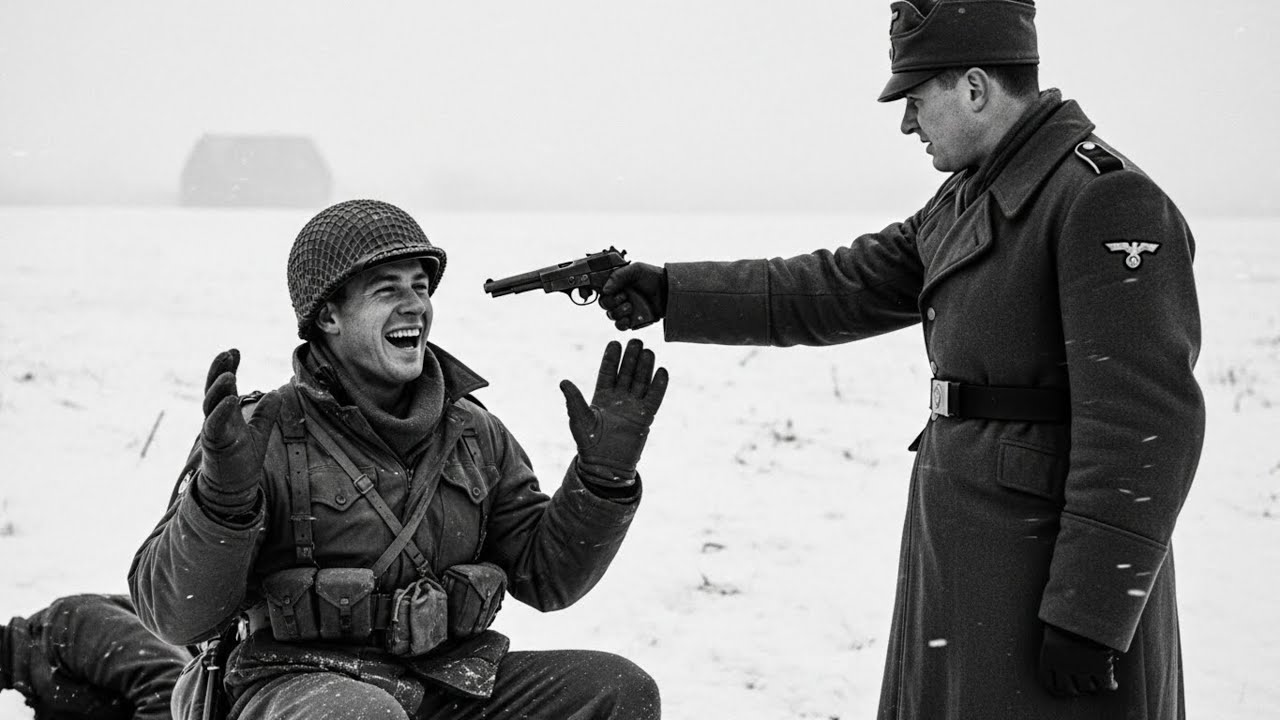
Funk froze, stepping fully into the open space of the farmyard, his breath visible in the freezing air, and a German officer who was clearly in charge was upon him in an instant, shoving the muzzle of an MP40 submachine gun hard against Funk’s stomach and screaming what could only be a command to surrender.
Funk did not speak German, the men didn’t speak German, and the officer, his face twisted with rage, screamed louder, the veins undone on his neck, pressing the weapon deeper into the American’s gut.
Funk looked at the ninety Germans, at his four disarmed men, at the pile of weapons, at the hopeless geometry of his situation, and then, in a moment that defies all military logic and reason, he began to laugh.
The laughter was not a tactic, it was something instinctive, a nervous, near exhausted release of the unbearable tension that had been coiling in him for months, a year of combat, the horrors of Normandy, the slaughter at Malmedy, the death of his friends, it all came out in that uncontrollable, cackling laugh.
 The German officer’s were confused, his face a mask of fury and bewilderment because the American was not behaving as prisoners were supposed to behave, prisoners were supposed to beg or tremble, were attempting to ask for mercy, and this tiny commander was bending over, shoulders shaking, laughing so hard he could barely stand, tearyl out of control.
Funk would later claim he tried to stop laughing but physically could not, and he called out to his men, I don’t understand what he’s saying, which only made the officer more furious but also caught some of the German soldiers laughing themselves, creating a weird moment of absurdity right at the edge of total violence and death.
With the officer completely off balance, still pressing the gun into his stomach, but now at the same level as him, Funk began to slowly unsling the Thompson submachine gun, M1A1, which was hanging over his shoulder, a move the German officer misinterpreted as a grudging compliance with his surrender order.
The officer relaxed his guard for a critical fraction of a second, the moment that Funk was gambling everything on.
In one motion, still moving with deliberate slowness, Funk swung the Thompson down, brought the muzzle up, and squeezed the trigger, unleashing a burst of 45 caliber ammunition that hit the officer in the chest trajectory and literally tore him apart, the bullets from the 30-round magazine ripping a red fog into the air as the officer’s body was slammed backwards into the snow.
The next sixty seconds was a vortex of violence that ever was never intended for clinical but for excellence either, rooms with an unthinking, unthinking.
Funk pivoted on his heels and began to spray an arc of lead across the closest cluster of German soldiers, men dropping under the barrel as they reached for their weapons, yanking another insane noise into the scene.
The magazine emptied in less than three seconds, and now this was the terrible moment, a live commander who is out of ammunition with ninety enemies that just realized they’re being attacked by one person, and in the time it took for them to begin a reaction, in that critical time, he was already slamming a fresh magazine into the grip, racking the bolt, and kept shooting, the entire reload sequence taking less than a second.
 He was screaming to his men, who were still in their knees, to grab weapons, and the guards, galvanized moments, scrambled for the rifle that was dropped by the falling Germans and began to fight back.
Some of the remaining German soldiers, who were still off the ropes, started to fire, bullets pinging around the farmyard, one round dropping the American who had been standing helplessly beside Funk, he is dead even without firing.
Funk kept moving cover, and shooting a constant stream of lead into the massed, confused, and shattered remnants of the former prisoners, using the speed of his Thompson and perfect position to cut down every German soldier doing in any form of organization.
Forty-five seconds later and the mathematics of the situation had been completely in that he stood in the middle of a farm yard drifting with smoke and red bodies, twenty-one German soldiers we’re dead in the snow, twenty-four more lay wounded and screaming, and the rest, more than forty, had thrown down their weapons and raised their hands in surrender for the second time in an hour.
The four American soldiers, their execution had been cancelled, standing but functioning.
Leonard Funk looked at the massacre, smoke curling from his Thompson, and said to one of his men, “That was the stupidest thing I’ve ever seen.”
The story of mutiny through the 82nd Airborne Division, a legend from making a short four-foot soldier who laughed at death and then killed it with a Tommy gun.
For this action, he would be awarded the Medal of Honor, presented by President Harry Truman, who, at the ceremony on September 5th, 1945, placed the blue and rose star around his neck and told him something he would soon say to many others: “I’d rather have this medal than be president of the United States of America.”
 It was the crowning moment of a war career that had already earned him the Distinguished Service Cross for single-handedly assaulting and neutralizing 3 anti-aircraft guns in Holland with only three men to guard a glider landing zone, a Silver Star for leading lost and wounded paratroopers “40 miles behind enemy lines in Normandy,” and three Purple Hearts for three separate and severity wounds.
Leonard Funk stood at five feet five inches tall and was 140 pounds. He had been a store clerk, a paper-pusher, a man who was probably screened out for combat duty when he first showed up at the induction center in 1941, but he had volunteered for airborne, and proved that kind of courage isn’t about height or strength or even combat experience.
It was about a refusal to surrender, a refusal that was fortified the knowledge of what the Germans had done at the Malmedi Massacre, a refusal that was forged in a decade of combat and which crystallized into that crazy festival laugh when all seemed lost.
He would survive the war, go home to Pennsylvania, and spend the next 27 years working as a claims officer at the Veterans Administration, helping disabled veterans process the value of their claims, which is a lot of quiet dignity.
Leonard Funk died of cancer on November 20th, 1992. He was 76 years old and is buried in Arlington National Cemetery, along with all of America’s most honored warriors.
The story of those 45 seconds in a Belgium farmyard, a moment when time just didn’t seem to apply to Sergeant Funk, lies at the heart of what military history staff truly know about the irrational madness of combat, and the absolute power of a man who just refuses to die.
The enemy didn’t see it that way, and they will likely never know what so hard was in that frozen Belgium snow, but the record of the battle field is silent, and it’s remembered, Leonard Funk saved his company from the annihilation that was planned behind them.
The VD has recognized the extraordinary event, and they have been so much it’s been 80 years since that afternoon, and it’s a wonder of the moment the persistence of a human spirit that challenged the no way you can.
Germany is quiet now, and of the 90 armed men that faced him, only 21 were all from the other highest ditches, but the legacy of the man who just couldn’t stop laughing when a gun was pressed to his stomach remains celebrated by the same size of the Armed Forces and the Airborne Museum has today, in the arena in Fort Liberty, named in his honor.
It is no memorial that a different kind of courage is not the absence of fear, its incomprehensible that the Czechs in fact are a man who is 1% full.