9 September 2026
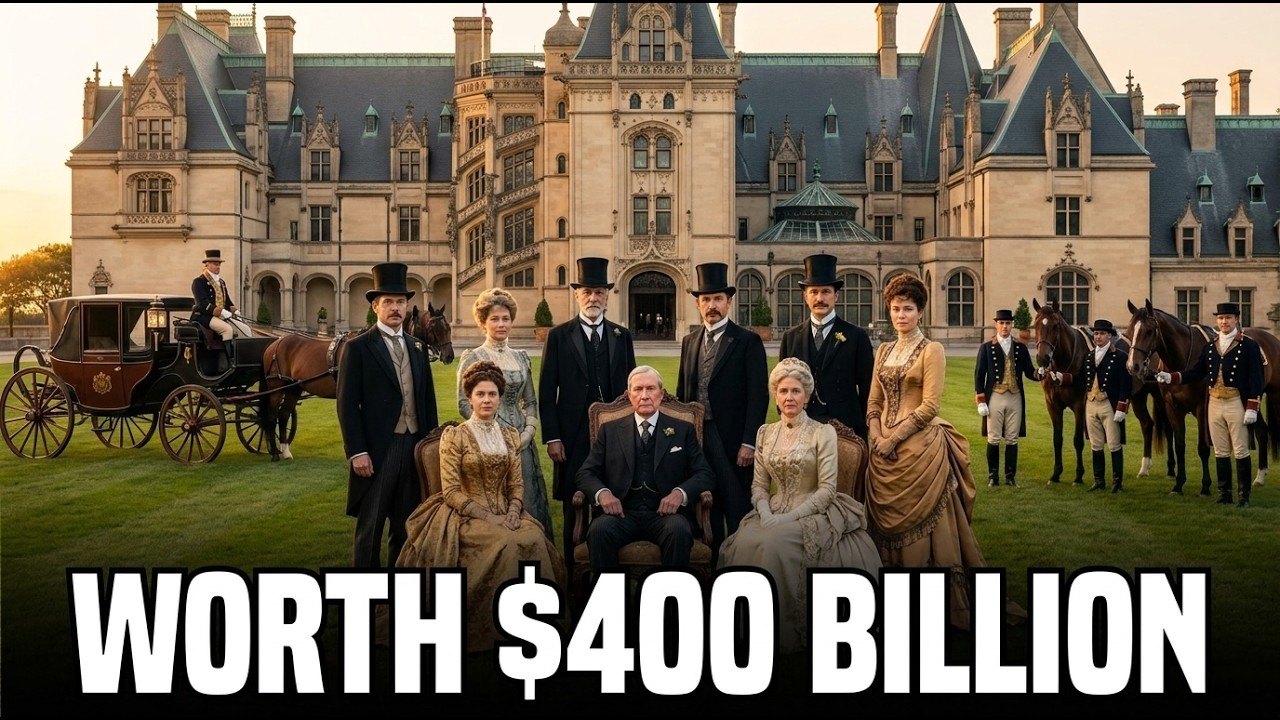
The dog wore a diamond collar valued at fifteen thousand dollars, a sum equivalent to nearly six hundred thousand dollars in today’s currency, and its guests arrived in carriages, each accompanied by a liveried footman whose sole purpose was to attend to the canine’s every whim. The menu for this dinner party, a birthday celebration for the hostess’s pet, was printed on silk, and every one of the attendees, all of them dogs, dined in style, but the most critical detail, the detail that historians still grapple with, was that this event was considered nothing out of the ordinary. This was the Gilded Age, a thirty-year period of American history when a handful of families accumulated wealth greater than that of most sovereign nations, and that wealth was not just spent; it was deployed as a weapon of social warfare and a monument to a world that constructed and was ultimately destroyed by its own insane absurdity. That world is the backdrop for the story of how the super-rich actually lived when the rules were unwritten, the money was incomprehensible, and the fall, when it came, was as brutal as the ascent had been swift, and to understand that rise, you have to understand the impossible mathematics of it all. The extraordinary numbers are the first thing to understand because they defy all modern comprehension, and at his peak, John D. Rockefeller’s personal net worth was equivalent to roughly four hundred billion dollars in today’s money, not million, billion, with a B, which is an amount of money so large it is effectively a number, a piece of theoretical wealth that has no bearing on the reality of daily life, and he was not alone. The Vanderbilts, the Astors, the Carnegies, the Morgans, and a handful of other families controlled a combined amount of wealth greater than the bottom half of the entire United States, a statistic so staggering it is often left out of the history books, not because it is untrue, but because it is too disruptive to consider, and this explosion of capital happened for a very specific and terrifying reason. Between 1870 and 1900, America experienced the most rapid industrial expansion in human history, with railroads, steel, oil, and finance all exploding in a single, unregulated burst of economic chaos, and critically, there were no income taxes, no labor laws, no regulations to speak of that could stop the flow or punish the abuses. If a man was positioned correctly in that environment, the money flowed in faster than he could physically spend it, and so the individuals at the top of this financial food chain invented new ways to destroy their own money, all in the name of a fight for social supremacy that would eventually ruin them. The physical world they built was the first and most obvious weapon in this fight, because the Gilded Age rich did not live in houses; they lived in statements, and every mansion was a calculated message designed with a specific purpose, not to promote comfort or to provide a home, but to communicate raw power to other powerful people. Consider the Vanderbilt summer cottage in Newport, Rhode Island, an estate known as The Breakers, which boasts seventy rooms, a fourteen-karat gold ceiling in the dining room, mosaic floors imported directly from Italy, and a music room modeled after a Venetian opera house, and all of this was called a cottage. To maintain this summer cottage, a permanent staff of forty servants was required, and that number climbed to over seventy during the summer season, with each servant having a defined, non-overlapping role that was a carefully calibrated system of social servitude. There was a butler, a housekeeper, a cook, a kitchen maid, a ladies' maid, a valet, several footmen, a coachman, a groom, a night watchman, and a houseboy, and the entire job of the houseboy was to polish the silver every morning, a task that took three hours. The Breakers was not even the largest Vanderbilt estate, poster children for all that was wrong with the American wealth, with that title belonging to Biltmore, a house that had two hundred and fifty rooms spread across eight thousand acres in North Carolina, and it remains the largest privately owned home ever built in the United States to this day. The mansions were not just about size but about the sequence of the experience, unique to the lives of the American robber baron elite. When guests arrived at a true Gilded Age mansion, they were moved through a deliberate series of rooms, each one slightly more impressive than the last, a carefully choreographed montage of power, a work of art built by men like Richard Morris Hunt to show the progression of one’s position in the room. The entrance hall had marble, high ceilings, and a grand staircase that was imposing enough to make a person feel small, but the reception room was where you would wait to be finally acknowledged, and the drawing room was where you were finally received, the social climax of the initial greeting. The dining room was where the real performance of the evening happened, as a formal Gilded Age dinner table could seat two hundred people and every single position had a strategic purpose, creating a hierarchy of food that changed the social spectrum of the country. There were six glasses at every place setting, one for each wine to be served across twelve courses, and the course corse followed a set sequence: oysters, soup, fish, sorbet, then meat, at least two kinds, then game, then vegetables, then salad, then dessert, then fruit, then coffee, and dinner lasted four hours to achieve a success with the socialites. The long dinner was not for eating, but because the dinner table was a stage, and the centerpiece, the seating arrangement, and whose glass got refilled first were all signals about a person’s place and their status in this rigid hierarchy of the old money families, where getting it wrong could ruin a person’s life. If the Gilded Age had a queen, her name was Caroline Astor, known to the public as Mrs. William Backhouse Astor, Junior, and she did not build the biggest mansion or throw the most expensive parties. Her power was more subtle and far more damaging, because she is the person who decided who was worth knowing, which is emphatically a massive power on the east coast. Caroline Astor maintained a list known simply as the Four Hundred, an identification of the only people in New York society who truly mattered, and the number was the exact capacity of her ballroom on Fifth Avenue, a number that solidified the power of the people living within the red line. If you were not on the list, you did not exist socially, not in New York, not in Newport, Rhode Island, and not anywhere else that mattered to the millionaires of the era, and getting on the list was a herculean effort. The process of entry started with a calling card, a piece of engraved paper that carried enormous weight, and the women of society would spend their mornings in carriages, leaving those cards at the homes of their equals. They never left a card at the home of anyone below them, nor anyone far above them in that social caste system, as the wrong call, if too ambitious, too presumptuous, could mark you as being profoundly ignorant of the rules set by these wealthy elites. Any public ignorance was fatal, and if someone above you was home when you called, they could receive you, or they could not, and if they did not receive you, the butler would collect the card and claim the Lady of the house was not at home, sometimes even if she was sitting ten feet away. Being cut in public was worse than any other death that these families endured, and to be cut meant that someone more powerful, a higher social standing, looked directly at you on street and chose to ignore you, offering no greeting, no nod, no signal of your existence, a slight that painfully burns. For a woman trying to maintain her social position, being cut by the right person could destroy years of careful work in a single moment, and this was weaponized against the extremely wealthy class of people called new money, a dangerous category. New money referred to families who had made their fortunes recently in manufacturing, in railroads, in trade, who had all the monetary resources, but had none of the lineage and the old money families made the pardons aware of these rules, ensuring they had no way in. The Vanderbilts themselves, despite being worth billions, were considered new money by the Astor set for most of the 1870s, and the only reason the transition happened was because of Alva Vanderbilt’s famous costume ball of 1883, a thirteen-hour career in social engineering. Alva Vanderbilt threw the most spectacular party New York had ever seen and then simply did not invite Caroline Astor, a deliberate, pointed insult, forcing Caroline Astor to make the social climb and visit Alva Vanderbilt at home to get her daughter an invitation. The meeting was the power move, and with that, the Vanderbilts had arrived; showing that once you were inside the social maze, the parties were where the open theater happened. And nothing illustrated this excess more clearly to millions of Americans than the Bradley Martin Ball of 1897, when the era’s most daring social climb happened in one single evening, and it was misunderstood by an entire nation. Bradley Martin and his wife Cornelia decided to throw a costume ball at the Waldorf Hotel in New York City, with the court of Versailles as the theme. Guests came dressed as Louis XIV, Marie Antoinette, Mary Queen of Scots, and various European nobles, and Mrs. Martin wore her most expensive piece, a ruby necklace that had once belonged to a real queen, Marie Antoinette. The total cost of this event was three hundred and sixty thousand dollars, which is a lot of money, but it was the reaction of the public that provides the missed history that is most important to a proper-social studies perspective. The hotel was transformed, decorated with the tower of orchids costing ten thousand dollars, and the menu included the rarest and most expensive food of the known universe, including turtle soup, canvasback duck, imported foie gras, and truffles from Perigord. Champagne, only French, only vintage, poured continuously from the moment the first of the one thousand guests arrived, and each of the guests was invited with a central piece of fresh-cut, hothouse flowers that were grown for the sole purpose of this evening, only to be discarded the next morning. But the public was not impressed; they were enraged, and those were the powerful forces that started to undo everything the Millionaires had built. There was bounding conditions right outside the gilded gates, and that is the biggest thing that is omitted from the history books because the workers who built the mansions, the Italian stonemasons, the Irish carpenters, and the immigrant laborers who laid the railroads and smelted the steel, earned one to two dollars a day. These industrialists lived in a way that was the radical, and they lived twelve to a room, in Lower East Side tenement housing, and their children worked because it was necessary for basic survival. The wealthy were not unaware of these conditions; they simply ignored them, as the poor man mattered nothing to many, but they were the bedrock on which all of this was built. Andrew Carnegie, the steel magnate, wrote an essay called The Gospel of Wealth, arguing the rich had a duty to use their surplus to do public good, and then, yes, he gave away hundreds of millions to found libraries and universities, but his philanthropy did not change the structure of the problem. The workers were still dying in pick lines and companies and mine collapse and noise of the era, and in the exact same day, the Mansions were filled with gold. When the Bradley Martin Ball hit the newspapers on the east coast, the public reaction was a violent and immediate push, and ministers preached loudly against it, newspapers wrote scathing editorials condemning the event, and the city of New York responded with a massive tax assessment that doubled the value of the Bradley Martin’s property. When he was forced to respond, he gave an interview, defending the ball by claiming that the value spending on the party had helped the local economy, but the public did not see the merit in that argument. The Bradley Martins left for England, never to return, and they took a world with them. Once the avalanche started, it was quick, and no one could stop it. The income tax was created, labor unions grew in power and in numbers, strikes forced concessions, and law started to have meaning to the bottom half of the country, and the actual end to the Gilded Age came with the start of the first great conflict of the century. First World War consumed the European aristocracy, the group the American old money had been trying to live up to, and then the Great Depression finished the job, so by 1930, the mansions were gone. Most of the great Fifth Avenue houses were demolished for the commercials, Vanderbilt Chateau was torn down for Department Stores, and the Newport summer cottages, which would cost too much to heat and staff, were sold for a fraction of their original cost. What remains today are a few museums, the institutions, the public libraries, Carnegie Hall, and The Met, and the institutions that the wealth supposedly built for the public have lasted a century and a half. The mansions of the Gilded age, built to be permanent symbols, lasted only 30 years inside of the century. The public institutions lasted 150 years and counting, which is a message all onto themselves, and it is the story of everything about the money you had and what the world you build.