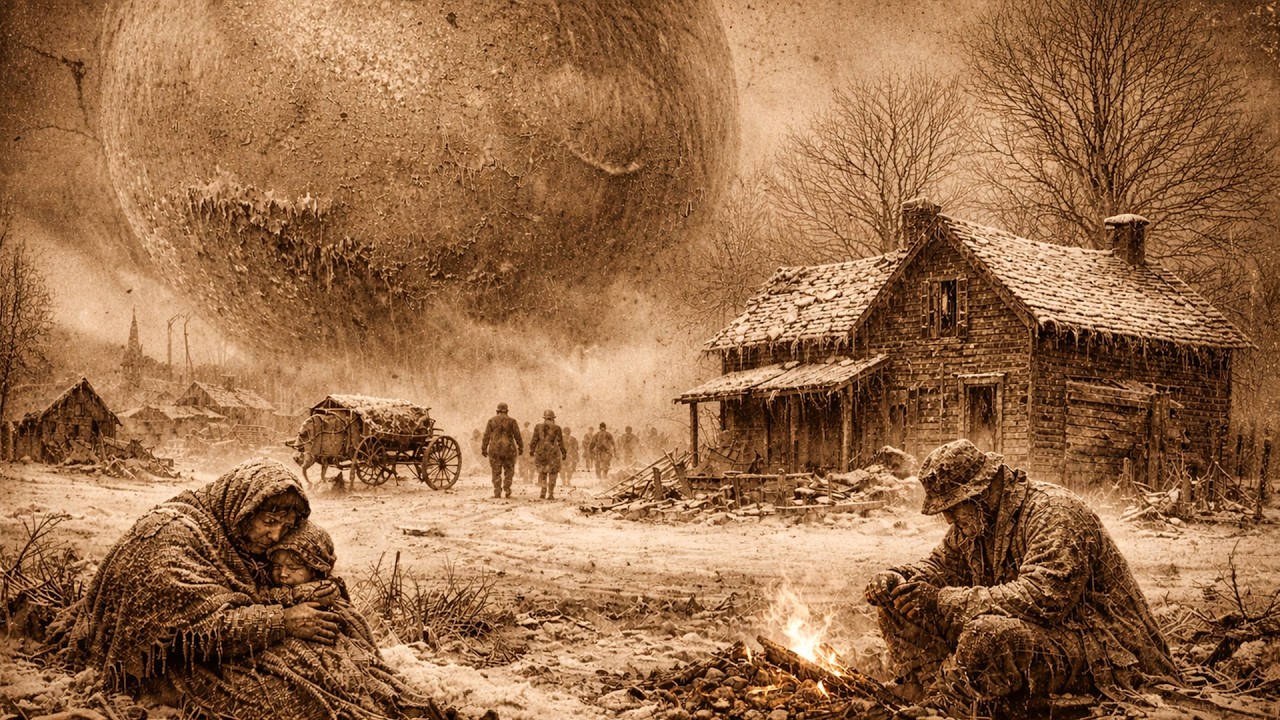
Snow was falling on fields that had already been planted twice.
It was June.
The first crop had frozen to death.
Farmers planted again.
Then the second crop froze too.
In Vermont, New Hampshire and New York, people woke to frost whitening fields that should have been green.
Livestock were pulled back from summer pasture.
In parts of Quebec, extraordinary June snow was reported.
At Monticello, Thomas Jefferson recorded killing cold during a season that should have been warming.
Then people looked up—
and saw something even more frightening.
The sun was still there.
But it seemed wrong.
Witnesses separated by an ocean described a dim, reddish disc hanging in the sky.
Light without warmth.
Across New England, farmers watched seedlings die.
Across the Rhine Valley, grain struggled.
In Switzerland, cold rain soaked the countryside.
In France, vineyards suffered.
In Ireland, harvest failure pushed already vulnerable communities closer to catastrophe.
Nobody understood why.
Nobody in Vermont knew what was happening in Burgundy.
Nobody in Switzerland knew farmers across the Atlantic were staring at the same strange sky.
There was no satellite image.
No global weather map.
No instant communication connecting the reports.
So people reached for the explanations available to them.
Punishment.
Providence.
A broken natural order.
Something had gone terribly wrong with the seasons.
And the most terrifying possibility was the one nobody could answer:
What if summer wasn’t coming back?
But summer had not simply vanished.
It had been attacked from above.
Fourteen months earlier—
on the opposite side of the planet—
a mountain had exploded with such force that its effects were already circling the Earth.
The people freezing in New England had probably never heard its name.
The peasants watching crops fail along the Rhine had no reason to look toward Indonesia.
Yet above all of them floated the aftermath of the same event.
Invisible particles high in the atmosphere were interfering with sunlight before it reached the ground.
The farmers could not see the cause.
They could only watch the consequences.
Empty fields.
Dead crops.
Rising food prices.
Migration.
Disease.
Hunger.
Riots.
And a summer that seemed to have been erased from the calendar.
The mountain was Tambora.
And what happened there in April 1815 would help make 1816 infamous as—
the Year Without a Summer.
The world entering 1816 believed the worst was over.
Europe had endured more than two decades of revolutionary and Napoleonic warfare.
Then came Waterloo.
June 1815.
Napoleon was defeated.
Soldiers began returning home.
Governments faced enormous debts, damaged economies and populations exhausted by war.
Across the Atlantic, the young United States had emerged from another war with Britain and was pushing westward.
There was hardship everywhere.
But there was also expectation.
Peace was supposed to bring recovery.
And recovery depended on something so ordinary that almost nobody thought about it until it failed.
The seasons.
Spring.
Plant.
Summer.
Grow.
Autumn.
Harvest.
Winter.
Survive on what you stored.
That cycle was more than tradition.
It was civilization’s operating system.
Cities survived because farms produced surplus food.
Governments collected taxes from agricultural economies.
Armies ate grain.
Livestock needed hay.
Families needed root cellars filled before winter.
One failed harvest could hurt.
Two could destroy.
And in 1816, the calendar said spring had arrived—
but the atmosphere seemed to disagree.
Farmers across New England planted in April and May.
Then June came.
Temperatures plunged.
Frost struck.
Seedlings died.
So farmers did what farmers had always done after an unusual frost.
They replanted.
That decision reveals something important.
At first, nobody thought the world was ending.
They thought they had been unlucky.
One cold night.
One strange week.
Start again.
Then the cold returned.
Reports described frost in June severe enough to kill new growth.
Snow fell in parts of the Northeast.
The second planting failed in places too.
Now the problem became harder to explain.
A late frost was weather.
Repeated freezing during the growing season felt like something else.
Then July failed to restore confidence.
Then August brought more damaging cold in some areas.
The growing season had become unpredictable.
And agriculture depends on predictability almost as much as rain.
A farmer can survive hardship if he knows roughly when it ends.
Plant here.
Harvest there.
Store this much.
Feed the animals that much.
But what happens when June behaves like March?
You don’t merely lose crops.
You lose the ability to calculate the future.
That psychological dimension mattered.
Because nobody knew this was temporary.
Nobody knew an atmospheric veil would eventually dissipate.
Nobody knew that ordinary seasonal patterns would return.
Standing in a dead field in 1816, a farmer could reasonably wonder whether the climate itself had permanently changed.
And above him—
the sun only deepened the mystery.
People reported unusual atmospheric appearances during this period.
Red skies.
Haze.
A weakened-looking sun.
Strange sunsets.
The descriptions varied, and historical reports have to be treated carefully.
But the underlying atmospheric disturbance was real.
What people could not know was that the explanation had begun more than a year earlier—
roughly halfway around the planet.
April 5, 1815.
Sumbawa.
In what is now Indonesia.
People hundreds of kilometers away heard explosions.
Some reportedly interpreted the sounds as cannon fire.
Authorities feared an attack.
They were not hearing artillery.
They were hearing a volcano waking up.
Mount Tambora.
For several days, activity intensified.
Then—
April 10.
The mountain entered its catastrophic phase.
The eruption column punched high into the atmosphere.
Explosions were heard at extraordinary distances.
Ash spread across vast areas.
Communities near the volcano faced something the people of Europe and North America would never experience directly.
Pyroclastic flows.
Ashfall.
Tsunamis.
Destroyed crops.
Contaminated water.
Famine.
Disease.
Entire settlements devastated.
Tambora’s summit itself was transformed.
The eruption removed an enormous portion of the mountain and left behind a vast caldera.
Tens of thousands of people in the region ultimately died from the eruption and its cascading consequences.
For them—
Tambora was an immediate apocalypse.
Noise.
Darkness.
Ash.
Water.
Death.
But the volcano had created a second disaster.
One nobody could see leaving Indonesia.
Sulfur gases had been injected high into the atmosphere.
High enough that normal rain could not quickly wash them away.
There, chemical reactions produced sulfate aerosols.
Microscopic particles.
Individually invisible.
Collectively powerful.
They scattered incoming sunlight.
The effect sounds almost laughably small when expressed as a percentage.
A slight reduction in solar energy reaching the surface.
But agriculture lives at the margins.
Move average temperatures down by a fraction of a degree across a hemisphere—
and local extremes can become devastating.
The growing season shortens.
Frost arrives where it should not.
Snow appears when seedlings should be growing.
Grain develops poorly.
Fruit struggles to ripen.
Rainfall patterns shift.
One volcano does not need to cover Europe in visible ash to damage European agriculture.
It only needs to alter the atmosphere above it.
And Tambora had done exactly that.
The particles spread.
1815 passed.
Then came 1816.
By the time a Vermont farmer pushed seed into the ground—
the cause of his future crop failure was already above him.
He simply had no way to know it.
That may be the most disturbing element of Tambora’s global aftermath.
The victims could not see the event that was hurting them.
A hurricane announces itself.
A flood rises.
An invading army appears on the road.
Tambora’s distant victims experienced something stranger.
The disaster arrived as weather.
One frost.
Then another.
A failed harvest.
A higher bread price.
A hungry child.
A neighbor leaving town.
No explosion.
No ash cloud visible overhead.
Just consequences.
And for nearly two centuries, scientists would continue reconstructing exactly how those consequences were connected to the mountain.
Because Tambora left evidence in places nobody in 1816 could possibly have read.
Inside ice.
Inside trees.
Drill into ancient ice—
and the atmosphere leaves fingerprints.
Year after year, snow falls.
Compresses.
Becomes ice.
Chemical material deposited from the atmosphere can become trapped inside those layers.
Volcanic eruptions can leave sulfate signals.
Scientists examining polar and alpine ice cores have identified major volcanic sulfate deposits corresponding to the period around Tambora.
The disaster had been archived by the planet itself.
Trees recorded another version.
A tree ring is not simply a measure of age.
Its width can reflect growing conditions.
Warmth.
Moisture.
Stress.
In unusually cold years, growth can narrow dramatically.
Tree-ring chronologies from different regions preserve evidence of severe climatic stress around this period.
So imagine the contrast.
In 1816, a farmer looks at a frozen field and asks:
Why?
No answer.
A clergyman looks at the same weather and reaches for theology.
A local official records rising grain prices.
A diarist describes the strange sky.
None can see the complete system.
But the glacier is recording sulfur.
The tree is recording cold.
The documents are recording hunger.
Different archives.
Same event.
Two centuries later, put them together—
and the map suddenly makes sense.
Indonesia.
New England.
Ireland.
France.
Switzerland.
Germany.
Places that seemed completely unrelated were connected through the atmosphere.
And there was another cruel fact the people beneath that atmosphere could not know.
The effect would fade.
The aerosols would not remain forever.
The atmosphere would gradually cleanse itself.
Seasonal conditions would move back toward normal.
But nobody standing in a failed field in late 1816 knew that.
Imagine what that uncertainty does to a family.
Your first planting dies.
You spend precious seed planting again.
That dies.
Food prices rise.
Your stored supplies shrink.
Winter approaches.
Now you have a decision.
Stay—
and gamble that next year will be normal.
Or leave—
before whatever wealth you have disappears completely.
Across New England, many families chose movement.
West.
Ohio.
Indiana.
Territories and states beyond the older settlements.
American migration toward the west was already underway long before Tambora.
Land opportunity, population growth and economic pressures had been pulling families toward the frontier for years.
So 1816 did not create westward expansion.
But the climatic crisis added pressure.
For a family already considering departure, a ruined harvest could transform possibility into necessity.
Sell what remains.
Load the wagon.
Leave.
A Vermont farmer did not say:
“Tambora has altered Northern Hemisphere climate, therefore I am migrating.”
He said:
The crop failed.
Food is expensive.
My neighbor left.
Land is available farther west.
We cannot survive another year like this.
And he moved.
That distinction matters.
History is often shaped by people responding to forces they do not understand.
The cause may be planetary.
The decision is personal.
A volcano erupts in Indonesia.
Months later, a family in New England abandons land occupied for generations.
Their children settle farther west.
Their grandchildren build lives there.
The volcano disappears from family memory—
because the family never knew it was part of the story.
That is how climate can shape demography without anyone recognizing climate as the actor.
Across the Atlantic, the consequences were even more dangerous.
Because Europe entered the crisis exhausted.
France had endured decades of war.
German territories had repeatedly become battlefields.
Governments carried debt.
Soldiers were returning.
Trade patterns were disrupted.
Communities expected peace to improve conditions.
Then harvests failed.
Grain prices rose.
Bread became more expensive.
And bread was not a side dish.
For poor Europeans, it could represent a major share of daily calories.
When grain prices doubled, people did not simply change brands.
They ate less.
Substituted inferior foods.
Sold possessions.
Borrowed.
Begged.
And eventually—
rioted.
France experienced unrest connected to food shortages and high prices.
In German-speaking regions, authorities recorded severe distress.
Historical accounts describe desperate substitutions for ordinary food.
Acorns.
Roots.
Other materials normally avoided.
Switzerland suffered through relentless cold and rain.
Lake levels rose.
Crops struggled.
Food prices surged.
The crisis became so severe in parts of Europe that 1817 would be remembered as a year of hunger.
And this is where the climate event became political.
People do not experience food prices as atmospheric chemistry.
They experience them as failure.
The baker is charging too much.
The merchant is hoarding.
The landlord wants rent.
The government is useless.
The king promised peace.
Why are our children hungry?
Nobody marches against sulfate aerosols.
They march against the institutions standing in front of them.
So a volcano thousands of miles away can create political unrest without a single protester knowing the volcano exists.
That is the hidden power of environmental shocks.
Nature creates the pressure.
Human systems determine where it breaks.
Ireland demonstrates that brutally.
Early nineteenth-century rural Ireland already contained deep structural vulnerability.
Poverty.
Unequal landholding.
Dependence on fragile agricultural income.
Large populations surviving close to subsistence.
Then the weather deteriorated.
Crop failures and high food prices damaged communities with little reserve.
Disease followed hunger.
Typhus spread through weakened populations during the broader crisis of 1816–1819.
The exact mortality figures vary among historical estimates.
But the pattern is unmistakable.
Malnutrition weakens bodies.
Displacement concentrates people.
Disease spreads.
More people die.
A climatic shock becomes a public-health catastrophe.
And the frightening part is how familiar the sequence becomes when you study history.
Weather anomaly.
Crop failure.
Price spike.
Malnutrition.
Migration.
Disease.
Political unrest.
None of those steps requires people to understand the original cause.
The chain functions whether they understand it or not.
Tambora therefore did more than lower temperatures.
It exposed structural weakness.
A resilient community with food reserves survives a poor harvest.
A society already near the edge can collapse under the same pressure.
The volcano did not create every problem.
It revealed which systems had no margin left.
And then, strangely—
the crisis helped produce cultural consequences nobody could have predicted.
Because during that miserable summer, a group of young writers gathered beside Lake Geneva.
And the weather would not leave them alone.
Switzerland.
Cold.
Rain.
Dark skies.
Mary Godwin—
soon Mary Shelley—
was staying near Lake Geneva with Percy Bysshe Shelley, Lord Byron and others.
The weather repeatedly kept them indoors.
They read ghost stories.
Then Byron proposed a challenge.
Each would write one.
Mary struggled for an idea.
Then came the nightmare.
A scientist.
A creature.
Life assembled from death.
Frankenstein.
One of the most influential novels in Western literature emerged from that extraordinary summer.
Tambora did not “write” Frankenstein.
Mary Shelley did.
Her imagination, intellectual influences and personal experiences mattered enormously.
But the abnormal weather formed part of the atmosphere—literally and culturally—surrounding the book’s creation.
Lord Byron wrote “Darkness,” imagining a world in which the sun had been extinguished.
Read that poem beside the descriptions of 1816—
and the apocalyptic imagery becomes difficult to separate from the year around him.
Again, the people experiencing the climate did not know Tambora was behind it.
The mountain entered culture anonymously.
It shaped mood without receiving credit.
But perhaps the most famous technological consequence attributed to the crisis emerged in Germany.
And here, again, the story needs care.
Because desperation rarely creates inventions as neatly as legend claims.
Food shortages meant grain became expensive.
Grain fed people.
It also fed horses.
Horses were transportation.
If feeding horses becomes expensive, transportation becomes expensive too.
In 1817, Karl Drais demonstrated his two-wheeled Laufmaschine—
a human-powered precursor to the bicycle.
The traditional story often links Drais’s invention to the horse crisis following the Year Without a Summer.
The connection is plausible and widely repeated, though the precise causal chain is more complicated than “Tambora killed horses, therefore bicycle.”
Still, the timing is remarkable.
A climatic crisis disrupts agriculture.
Agricultural disruption makes animal power more expensive.
A machine appears that allows a person to move on two wheels without a horse.
Whether Tambora directly “invented the bicycle” is the wrong question.
The better question is:
How many innovations become useful because the environment suddenly changes what society needs?
Crisis rearranges incentives.
And 1816 rearranged them across continents.
Then—
the weather began recovering.
Imagine surviving that.
Conditions improve unevenly.
Harvests begin stabilizing.
The sun feels like the sun again.
People rebuild.
Food prices eventually retreat.
And because no one understood the global mechanism—
the catastrophe fragmented into local memory.
New England remembered “Eighteen Hundred and Froze to Death.”
Europe remembered hunger.
Switzerland remembered cold rain.
Ireland remembered disease.
Writers remembered a miserable summer beside Lake Geneva.
Indonesia remembered something far more direct—
the mountain itself.
But there was no shared global story.
Not yet.
The people experiencing these events did not know they belonged inside the same disaster.
That understanding required a different kind of world.
One capable of comparing records across continents.
One capable of reading chemistry trapped in ice.
One capable of reconstructing ancient atmosphere.
One capable of looking at the entire planet at once.
And when scientists finally did—
1816 stopped looking like a collection of bizarre local weather stories.
It became evidence.
One eruption.
One atmosphere.
Millions of consequences.
That should disturb us for a reason that has nothing to do with 1816.
Because Tambora revealed something humanity still struggles to accept.
Distance does not guarantee safety.
A mountain explodes in Indonesia.
A farmer freezes in Vermont.
Bread becomes unaffordable in France.
A family leaves New England for Ohio.
Disease spreads through vulnerable communities in Ireland.
A writer beside Lake Geneva imagines a world without sunlight.
None of these people need to meet.
None need to know one another exists.
The atmosphere connects them anyway.
That was true in 1816.
It is true now.
Modern civilization is far more technologically capable than the world Tambora struck.
Satellites would detect the eruption.
Climate models would estimate aerosol movement.
Governments could track harvest risk.
Global markets could shift food.
Scientists would explain why the sun looked strange.
We would know.
But knowing does not necessarily mean escaping.
Modern agriculture is enormously productive—
and enormously interconnected.
Food moves through ports.
Fuel moves through pipelines.
Fertilizer crosses oceans.
Financial markets price grain globally.
A failure in one region can move prices somewhere else almost immediately.
Our ancestors in 1816 lacked information.
We have information—
but we have also built systems whose connections stretch much farther.
That makes Tambora less like an ancient curiosity—
and more like a warning.
The people of 1816 believed the seasons were dependable because they always had been.
Then June arrived with frost.
They believed local weather had local causes.
Then a mountain thousands of miles away changed their harvest.
They believed peace after Napoleon would bring recovery.
Then nature introduced a crisis no treaty could stop.
And perhaps the most haunting detail is still the simplest.
The farmers were not foolish.
They planted at the correct time.
They used the knowledge their fathers had taught them.
They responded rationally to the first frost.
They replanted.
Then the world changed the rules again.
That is what catastrophe actually looks like.
Not always a giant wave approaching the city.
Not always an army appearing on the horizon.
Sometimes catastrophe is invisible.
Sometimes it happened fourteen months ago.
Sometimes it happened on the other side of the planet.
Sometimes it is already above your head—
and the first sign is that the season you trusted your entire life—
simply doesn’t arrive.
In June 1816, farmers walked into their fields and found frost where summer should have been.
They looked at the sky.
The sun was there.
But the warmth was gone.
They could not know that high above them floated the chemical shadow of a mountain most had never heard of.
They could not know the veil would eventually clear.
They could not know summer would return.
The ice knew.
The trees knew.
The atmosphere knew.
Human beings were the last to understand.
And that may be the real story of the Year Without a Summer.
Not that one volcano changed the weather.
But that millions of people were already living inside a global catastrophe—
before anyone even knew the catastrophe had happened.