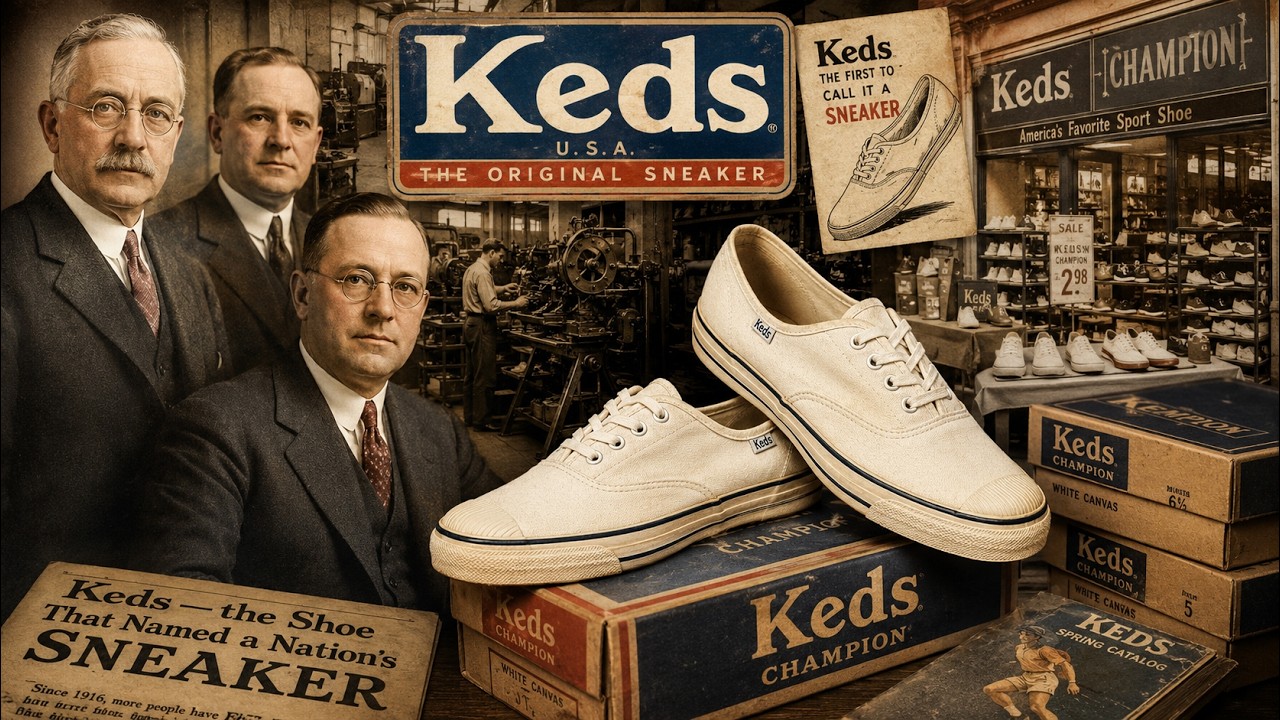
The word was coined in a Connecticut advertising office in 1917, a simple term meant to capture the silence of a rubber sole on a hardwood floor. It was a word that would outlive its creator, escape its legal boundaries, and come to define a multi-billion-dollar global industry. But the company that gave the world “sneaker” never managed to keep the word for itself, and in the century that followed, it watched nearly every competitor in the category it invented surge past it, leaving the original name to fight for relevance in an aisle it no longer controlled.
The story begins in Naugatuck, Connecticut, in 1916, a town built on rubber. The United States Rubber Company had amassed its fortune on tires, hoses, and industrial belting, the unglamorous machinery of a nation industrializing at full speed. Men in Naugatuck grew up expecting to work rubber the way a boy in a steel town expected to work steel.
 But by 1916, US Rubber had a problem unrelated to its core manufacturing. Over the preceding decades, the company had absorbed roughly 30 separate shoe and boot manufacturers scattered across New England, each retaining its own name, its own factory, and its own inconsistent quality. A retailer in Ohio might carry three different US Rubber shoe lines without ever knowing they shared a single owner.
The confusion was a liability, not a strength.
The executives made a decisive call: consolidate every one of those 30 names into a single national brand. They needed a name. Their first choice was Peds, drawn from the Latin word for foot, simple and clean.
It was rejected within weeks because another company had already trademarked it. A single consonant was swapped in, and Peds became Keds. The company that would define an entire category of American footwear was named almost by accident, a compromise forced by someone else’s paperwork.
The gap in the market was not subtle. Canvas and rubber shoes existed in 1916, but they existed the way regional soda brands existed before Coca-Cola: inconsistent, locally made, and unbranded, with no shared standard of quality.
Nothing about them was national, and nothing was trusted the way a shoe from a known maker was trusted. A father buying his son a pair of canvas shoes for the summer had no way of knowing if they would hold together through August or fall apart in July. US Rubber’s executives saw the opening not as an inventor sees a blank page, but as a manufacturer sees an inefficiency.
They already had the rubber, the factories, and 30 shoe-making operations doing the same basic work under different names. What they lacked was one national brand people could recognize on sight in any city at any general store. In 1916, they filled that void with the Keds Champion, a plain canvas upper stitched to a vulcanized rubber sole, priced to be bought without hesitation.
Nobody working the line in 1916 knew they were building the shoe that would give its name to every sneaker sold in America for the next century. The Champion did not win on novelty. Canvas shoes with rubber soles were not new.
What Keds sold was consistency, and consistency in 1916 was its own kind of innovation. The first pillar was construction. The Champion used a vulcanized rubber sole, rubber heated with sulfur until it hardened into a durable, non-sticky surface, a process that let a canvas and rubber shoe survive daily wear instead of falling apart within weeks.
US Rubber already ran vulcanization at industrial scale for tires and belting, and applying that same process to footwear produced a sole that gripped pavement, resisted water better than leather, and required no cobbler’s skill to repair.
The canvas upper was cut on standardized patterns across every factory under the new Keds name, which meant a Champion bought in Boston matched a Champion bought in Cleveland, something none of the 30 regional predecessor brands had ever guaranteed. The shoe felt the same everywhere it was sold. That sameness was the product.
The second pillar was the branding innovation, and it remains the single most consequential marketing event in the history of American footwear. Sometime around 1917, an advertising man working the Keds account arrived at a word to describe the shoe’s defining trait: silence. A leather-soled shoe announced a person’s arrival with every step on a hard floor.
A rubber-soled Keds did not.
The word chosen to capture that was “sneaker,” a shoe quiet enough to sneak in. The word appeared in Keds advertising copy, and it did something almost no piece of branding in American commercial history has done since. It stopped being a brand word and became the name of the entire product category.
Within a few years, competitors selling rubber-soled canvas shoes under other names were being called sneakers by customers who had never heard of Keds at all. The third pillar was price. A pair of leather dress shoes in the late 1910s could run $4 to $5, a significant fraction of a factory worker’s weekly wage.
A pair of Keds sold for roughly a third of that, priced not as a luxury or a specialty athletic item, but as an ordinary purchase.
 That price point put Keds within reach of nearly every American household at a moment when a national brand name still meant something new to most of the country. The fourth pillar was distribution, and here US Rubber’s scale did the heavy lifting. Keds moved into department stores, general stores, and sporting goods dealers across the country simultaneously, backed by the same national sales infrastructure that already carried US Rubber’s tires and industrial goods into every region of America.
By the early 1920s, the shoe had found its way onto Olympic soccer fields and national tennis courts, worn by athletes whose visibility gave the brand a credibility no advertisement alone could buy. College athletic programs adopted the Champion as practical, affordable equipment. A shoe built in a Connecticut rubber town was, within less than a decade, standing on an Olympic pitch.
By the mid-1920s, Keds had done something almost no company manages to do even once. It had built a product, priced it for everyone, distributed it everywhere, and handed the entire category its name, all before the shoe itself had changed very much at all. The construction would evolve over the following decades.
The word never would. It was already loose in the world, working for every competitor Keds would ever face. By the 1950s, the Keds Champion was no longer a new idea.
It was a fixture, the kind of object a person stops noticing precisely because it is everywhere. That is the quiet power a brand earns when it becomes background furniture in millions of American lives, and Keds earned it early.
Print campaigns through the 1940s and 1950s leaned on a single visual promise: durability a family could count on at a price a family could afford without deliberation. Keds advertisements rarely tried to be clever. They showed children running, playing, wearing the shoes down through a summer without wearing them out.
The Champion was positioned less as fashion and more as domestic infrastructure, as dependable as a school lunch box. Regional newspapers across the country carried Keds advertising every back-to-school season, and store managers in city after city reported the same seasonal pattern: shelves of Champions in children’s sizes restocked every August, sold through by September. The endorsements followed the same logic of quiet ubiquity rather than singular star power.
Olympic athletes and collegiate competitors had worn Keds since the 1920s, and that athletic credibility carried forward for decades without needing a single celebrity face to renew it. What Keds had instead by mid-century was something arguably more durable than any athlete’s endorsement: cultural adoption by women who defined American style on their own terms. Marilyn Monroe and Audrey Hepburn were photographed in Keds off the studio lot, wearing the shoe the way ordinary Americans did, not as a costume but as daily footwear.
Those images did more for the brand’s cultural standing than any paid campaign could have because no one had to be told they were advertisements. Wartime tested the company differently than it tested most footwear brands.
When the United States entered the Second World War, US Rubber’s factories, including the lines that produced Keds, were pulled into military production. Rubber, the material at the center of the entire Keds business, became one of the most tightly rationed commodities in the country after Japan’s advance cut off the supply chain from Southeast Asia. Civilian canvas and rubber shoe production slowed sharply as factories that had built Champions were retooled toward military footwear, tires, and rubberized equipment for the armed forces.
Women filled positions on production lines across the Naugatuck facilities as men were drafted, running machinery that had only a few years earlier been operated almost entirely by men. When the war ended and rationing lifted, returning veterans and the families they started came home to a country hungry for ordinary consumer goods again.
Keds, with its pre-war reputation for durability and its low accessible price, was positioned exactly where post-war demand wanted to spend. The post-war decades were Keds’ true plateau of ubiquity. Through the 1950s and into the 1960s, the Champion became something close to a uniform.
Physical education classes across American public schools required or strongly encouraged canvas rubber-soled shoes, and Keds, with its national manufacturing scale and its decades-long reputation, was the shoe most schools and most parents defaulted to without discussion. Suburban childhood in post-war America had a specific soundtrack, and it included the particular squeak of a Keds sole against a gymnasium floor. Summer camps outfitted children in them by the crate.
College campuses, still carrying the brand’s earlier athletic credibility, kept Champions in circulation among students who had worn nothing else since grade school.
This was the era in which Keds came closest to owning the category it had named. Converse existed, primarily known through its basketball association with the Chuck Taylor All-Star. Adidas and Puma were largely European operations with limited American footprint.
 Nike would not exist for another two decades. For a stretch of years running roughly from the late 1940s through the mid-1960s, if an American child owned a pair of canvas sneakers, there was a real chance those sneakers were Keds. Not because the shoe had been reinvented, but because nothing else had yet arrived to challenge it.
The peak metric was never a single dramatic number the way it might be for a company built on one explosive product cycle. Keds’ peak was structural.
For roughly two decades, it held something close to default status in American households. The shoe was bought not because it had been chosen over alternatives, but because for millions of families, it simply was the alternative. That kind of dominance rarely announces itself with a headline.
It shows up quietly in gym class photographs and back-to-school receipts, in a brand that had become so ordinary it was nearly invisible. Which is, for a company that had once coined a word to describe silence, a strange and fitting kind of victory. But dominance built on being the only obvious choice carries a specific vulnerability.
It depends entirely on no one else showing up with a better answer. By the late 1960s, that condition was about to end.
The first warning sign did not look like a crisis. It looked like a shift in who was buying basketball shoes. Through the late 1960s and into the 1970s, Converse’s Chuck Taylor All-Star pulled ahead in the one category Keds had never fully claimed for itself: competitive team athletics.
A new generation of runners and joggers began reaching for a different kind of shoe entirely, one built for performance rather than general durability. Keds executives read the early sales data as a temporary dip in one segment. It was not a dip.
It was a redirection of an entire generation’s attention toward companies building something Keds was not building. The decision that could not be undone was less a single choice than the absence of one.
Through the 1960s and 1970s, as Adidas expanded its American presence and a small Oregon company called Blue Ribbon Sports began selling running shoes that would soon carry the name Nike, Keds continued to compete primarily on the same terms that had built its dominance decades earlier: reliability, affordability, and the Champion’s unchanged basic construction. That formula had won the category in 1950. It was not built to win a category increasingly defined by cushioned midsoles, performance engineering, and athlete-driven technical innovation.
Keds did not fail to notice its competitors. It failed to become one of them. The ownership changes compounded the problem rather than solving it.
In 1979, US Rubber’s corporate descendant, Uniroyal, sold Keds and its companion brand Sperry Top-Sider to the Stride Rite Corporation for $18 million.
Stride Rite’s core business was children’s shoes, a natural home in some respects for a brand with deep roots in school-age footwear. But it also meant Keds now competed for investment and attention inside a company whose center of gravity was children’s sizing and orthopedic fit, not the athletic and youth culture positioning that Nike, Adidas, and eventually Vans were using to win over teenagers and young adults. Inside Stride Rite, Keds drifted toward a specific reputation it would spend decades trying to shed: the reliable, unglamorous shoe a mother bought, not the shoe a teenager chose for themselves.
The competitor disruption accelerated through the 1980s and into the 1990s. Nike’s swoosh, backed by athlete endorsement deals and a marketing budget scaled to match its ambitions, became the default aspirational sneaker for American youth.
Converse held its ground in basketball and streetwear culture. Vans, born out of Southern California skate culture in the 1960s, captured a subculture with an intensity of brand loyalty that Keds, built on general purpose reliability rather than any specific tribal identity, had never needed and now could not manufacture on demand. The Keds canvas Champion, unchanged in its essential form since 1916, began to read to younger buyers not as classic but as dated.
The word the company had coined a century earlier now described shoes made by companies actively working to make Keds look old-fashioned by comparison. The distribution collapse followed the cultural one. As department stores restructured through the 1980s and 1990s, and specialty athletic retailers captured the sneaker-buying teenager, Keds found itself positioned in exactly the wrong aisle.
 Sold alongside comfort and children’s footwear rather than athletic and streetwear lines, the brand found itself in the aisle where the categories’ growth and cultural relevance were now concentrated, but not as a participant. The shoe that had once been distributed everywhere simultaneously now found fewer and fewer shelves where the customers who define sneaker culture were actually shopping. In 2012, Stride Rite’s parent company, Collective Brands, the same conglomerate that also owned Payless Shoe Source, was broken apart and sold off in pieces.
Keds moved again, this time to Wolverine Worldwide, a Michigan footwear company built primarily around work boots and outdoor brands, for roughly $1. 2 billion as part of a larger portfolio deal that also included Saucony and Sperry. Keds was once more a line item inside a company whose core expertise lay elsewhere.
Eleven years later, in February 2023, Wolverine sold Keds again. This time to Designer Brands, the parent company of DSW. A shoe company that had invented the word for its entire industry was now owned, for the first time in its history, not by a manufacturer at all, but by a retailer.
Four owners, 107 years, not one of them a shoe company built around Keds itself. The factories changed, the names above the door changed, the sneakers kept being made, but the company that gave the world its name had not, in over a century, ever again been the one deciding its own direction. Under Designer Brands, Keds has not disappeared.
It has done something more interesting. It has leaned into being exactly what it is: the original, rather than trying to outperform companies built for a different kind of competition entirely.
The revival is not entirely cynical, and it is not entirely pure. Since 2015, Keds has run a campaign built around the line “Ladies First Since 1916,” anchored by Taylor Swift, and built explicitly around the brand’s founding era history. A marketing strategy that requires the company to actually mean something historically, not just borrow a logo.
Collaborations with Kate Spade, New York Made Well, and Opening Ceremony have positioned the Champion silhouette as a design object with real heritage credibility, rather than a discount classic. At the same time, the company doing this work is a shoe retailer, not a shoemaker. The brand’s fate now runs through inventory strategy at a company that also sells dozens of other labels.
Genuine history managed by an owner with no particular emotional stake in that history. Both things are true.
The collector’s world around Keds is smaller and quieter than the one built around Converse or Nike, but it exists. Vintage Champions from the 1950s and 1960s, particularly in original boxes or unworn condition, circulate among heritage sneaker collectors and vintage clothing dealers, typically trading in the range of $50 to a few hundred dollars, depending on condition and era. Modest compared to the four-figure resale world of rare Nike or Converse releases, but consistent and largely driven by people who remember exactly what the shoe smelled like new.
The original still matters for a specific functional reason that has nothing to do with nostalgia. The canvas and vulcanized rubber construction Keds pioneered in 1916 remains genuinely comfortable in a way engineered performance sneakers are not built to be.
A shoe designed for all-day wear without technical cushioning ages differently on the foot than a shoe designed around athletic performance metrics. For a certain kind of wearer, someone who wants a plain white canvas shoe and nothing more complicated than that, the Champion still does exactly what it was built to do in 1916. The surprise footnote is the one that started this entire story.
The word sneaker, coined for Keds, spread by Keds, and then set loose from Keds entirely, is used today by roughly the same number of people who have never once thought about where it came from as it was a century ago. It appears in the marketing copy of Nike, Adidas, Vans, and every company that ever beat Keds in the marketplace. Every time a competitor’s advertisement uses the word sneaker, it is, without anyone intending it, still citing Keds.
What the arc of Keds suggests is not a story about decline in the way most collapsed American brands tell it. There was no single bankruptcy, no factory closing broadcast on the evening news, no dramatic final chapter. What the company’s 110 years actually show is something quieter and, in its way, more universal.
Inventing a category does not guarantee ownership of it. Being first does not protect a company from being outpaced by whoever comes second with a sharper idea. Keds gave American English a word it still uses every day.
It simply never managed to keep that word working for itself the way it worked for everyone else. Somewhere in a college dorm room tonight, a pair of plain white canvas Champions sits by the door, laced loosely, worn by someone who has said the word sneakers a thousand times without ever once wondering who gave it to them. That is the story of the company that named an entire industry, and then spent a century watching the industry it named leave it behind.