The ghost of Bataan stood straight-backed on the deck of the USS Missouri, his uniform a size too large for the frame it covered.
Lt. Gen. Jonathan Wainwright watched as the Japanese delegation signed the Instrument of Surrender.
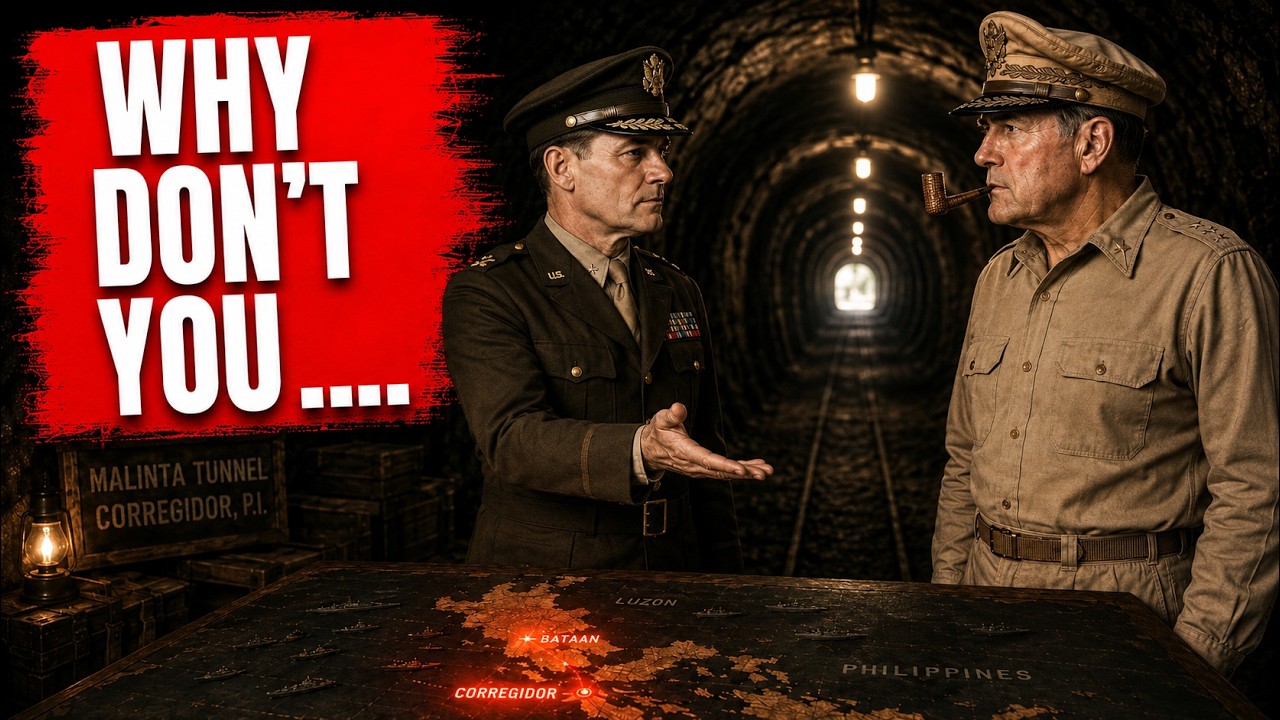 The man who had been forced to capitulate the largest force in American military history, the man newspapers had branded a failure, was now positioned directly behind Gen. Douglas MacArthur, a witness chosen deliberately by the very commander who left him to die.
It was an extraordinary reversal of fortune that ended with Wainwright holding one of MacArthur’s signing pens on Sept. 2, 1945. But the path to that deck in Tokyo Bay was forged not in the triumph of victory, but in the starving hell of the Bataan Peninsula and the frozen despair of a Manchurian prison camp.
The story began nine hours after Pearl Harbor, when Japanese bombers found the American air fleet parked wingtip-to-wingtip at Clark Field.
Despite receiving word of the attack on Hawaii, U. S. forces had failed to scramble their B-17 bombers.
The bombs walked down the runway in neat lines, and the fuel in those parked aircraft turned each machine into a funeral pyre.
In a single afternoon, MacArthur lost half his air force on the ground. Then the invasion ships came.
On Dec. 22, 1941, Japanese Lt. Gen.
Masaharu Homma put 43,000 combat troops ashore at Lingayen Gulf, backed by 80 warships. MacArthur’s patchwork force of American regulars and raw Filipino recruits fell back under the weight of the assault.
Within days, MacArthur ordered a full retreat onto the Bataan Peninsula, a narrow tongue of jungle guarding Manila Bay. The plan demanded a defensive stand until Washington delivered relief. There was one fatal flaw: logistics.
In the chaos, food and medical stockpiles were left behind. The men dug in with only a fraction of the supplies needed to survive a siege. Unknown to the 80,000 men on the line, Washington had already decided to write them off—the Atlantic was the priority.
Germany came first.
 Into this collapsing situation stepped Major Gen. Jonathan Wainwright. A cavalry officer out of West Point, Wainwright was gaunt but unbending.
He wore his rank with a promise of proximity. He walked the foxholes, sat with privates, and did not lied about the odds. His presence in the trenches became a currency more valuable than gold during the starving months that followed.
By January, they were down to half rations. Men ate monkey, snake, or iguana. They watched Japanese bombers fly overhead, dropping propaganda leaflets reminding them that “no help was coming.”
They listened to the lyrics of a jazz song, a mocking call about ships that never come in.
The starvation led to disease. By the end of March, there was no quinine left to treat malaria. Dysentery and beriberi join the fight, swelling limbs and attacking hearts.
Surgeons tended the dying by flashlight while men died faster than they could be buried.
On the evening of March 11, 1942, MacArthur was ordered out by President Roosevelt. Before boarding a PT boat, leaving the island fortress, he said simply: “Goodbye, Jonathan. If you are still on Bataan, I will make you a lieutenant general.”
Wainwright’s response betrayed no hesitation: “I will be on Bataan, sir, if I am still alive.”
MacArthur escaped to Australia. Wainwright inherited the command of a tomb. A cable to Washington was stark in its clarity: “My men will be starved into submission unless food arrives before April 15th.”
No answer came.
 On April 3, the attack came. Artillery barrages smoked the line. After three months of starvation, General Edward King, commanding on Bataan, made the call to surrender.
He did it without Wainwright’s approval, choosing to accept personal blame to stop a slaughter.
It was the largest surrender of American forces in history. The ensuing forced march to prison camps, the infamous Bataan Death March, saw thousands die along 65 miles of road, beaten, bayoneted, or shot.
But Wainwright was not done.
He was still on the fortress island of Corregidor. For a month, the Japanese artillery and planes bombed the island without pause. On May 5, they came ashore at night.
Despite vicious, savage resistance by exhausted and starving men, they landed. On May 6, 1942, after grinding months, Wainwright made the devastating decision to surrender. He knew he was trading his corps for nine more months of the Pacific War (the extra time that allowed the U.
S. to break codes and win at Midway in June 1942).
He walked out of the tunnel to the Japanese lines, certain he might be shot on sight.
He was not. Instead, he began an exile worse than death. He was a semisecret prisoner, moved across the Philippines, to Formosa, and finally to a frozen camp in war-torn Manchuria.
Attacked by the cold, he was reduced to 125 pounds. But he still put on the uniform, calling role every morning.
He Taught the Japanese guards that he was still a soldier. He traded his watch and fountain pen for scraps of information. He kept his spine and gave his men a reason to live.
For three years, he endured the depravity. He had no idea the war had turned; he didn’t know about Midway, Guadalcanal, or the invasion of the Japanese home islands.
In August 1945, Soviet and American troops liberated the camp. Doctors were stunned by the physical damage he had survived. He could barely walk.
On Aug. 31, he met MacArthur for the first time since the surrender. MacArthur saw a white-haired man using the very cane he had given him years prior.
He did not shake his hand—he embraced him.
On Sept. 2, aboard the Missouri, MacArthur placed Wainwright just behind him. When the official surrender signatures were inked, MacArthur turned and handed his sign wand to Wainwright, before Persiface the same.
The papers, the netwitness, were a vindication of the man once known as “the general who lost the Philippines.”
On Sept. 10, President Truman pinned the Medal of Honor on Wainwright’s tattered uniform. He then gave him a ticker-tape parade down Broadway in New York City, honoring the man who had been forced to give up a country but had never given up his men.
Wainwright retired a full general in 1947.
He died exactly eight years to the day of the moment he watched peace be signed. Legion, 1953.
While he could have stolen back to the line to fester in bitterness over a sacrifice ordered by a commander who flew to safety, Wainwright refused. He did not focus on the abandonment.
Instead, he honored the promise to stay. That promise, observed in starving bivouacs and death camps, became the only excuse the United States needed to turn one of its most humiliating defeats into a blueprint for the impossible resilience of its soldiers.


