Barney Kemp Riggs was born on December 18, 1856, in Arkansas, the second of seven children raised by Thomas and Hannah Felton Riggs. Shortly after his birth, the family relocated to Texas, where the Riggs name would eventually become tied to a long and complicated legacy of frontier violence and legal trouble. At age 18, Riggs was reportedly involved in an accidental shooting in Salado, Texas, that resulted in the death of his friend Hugh Armstrong. When local authorities sought to question him further in 1879, Riggs left Texas and resurfaced in Arizona Territory, specifically in Cochise County, where two of his uncles had already settled.
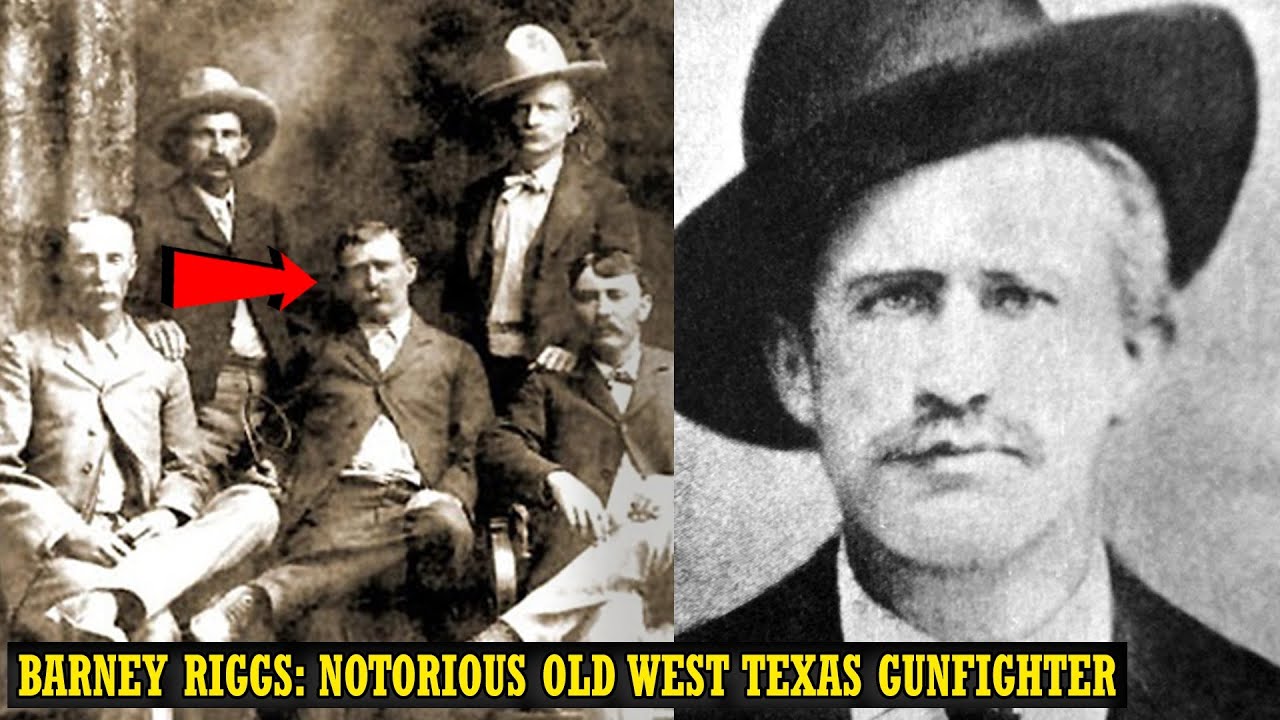
He found work on his uncle Jim Riggs’s ranch, adapting to life as a cowboy in the rugged Southwest. During his time in Arizona, Riggs met and married Venny Hicklin on February 21, 1882. Around this period, historical sources suggest Riggs may have become involved in livestock thefts, which were common crimes along the Arizona-Mexico border region. One account places Riggs at the center of a deadly dispute at a watering hole, where tensions escalated between his group and several Mexican nationals.
Historical reports claim multiple individuals lost their lives in the altercation, though exact details remain unclear. Despite his alleged involvement in criminal activity, Riggs found himself aligned with official law enforcement during a turbulent period in Arizona’s history. When Cochise County Sheriff Johnny Behan assembled a posse to pursue the Clanton brothers during their controversial vendetta ride, Riggs was among those deputized. Riggs later became entangled in a deeply personal conflict involving his own family.
The tensions centered on Richmond Hudson, the stepson of Riggs’s uncle Jim and his supervisor at the family ranch. When Riggs returned from a cattle-buying trip to Texas in the fall of 1886, he heard troubling rumors that his wife Venny may have been romantically involved with Hudson. Riggs confronted Hudson, who firmly denied the claims, and Riggs chose not to escalate the situation. However, within days, witnesses claimed Hudson had begun to boast about the alleged affair.
On September 29, 1886, Hudson was fatally shot by an unknown assailant. There were no eyewitnesses, but the ongoing dispute between Hudson and Riggs was no secret, and suspicion quickly focused on Barney. A $250 reward was offered for his apprehension, and Riggs fled into the surrounding mountains. Tombstone lawman Fred Dodge partnered with Deputy Sheriff Charlie Smith to pursue the case.
They launched a quiet surveillance operation near the Riggs ranch and eventually observed a rider using hand signals to communicate with Barney. Both Barney and his wife were arrested. Venny was released shortly thereafter, but Barney was held to stand trial for Hudson’s death. The first trial began on November 11, 1886, but the jury was divided.
Some jurors reportedly believed that retaliating against someone who had disrespected a man’s wife could be morally, if not legally, defensible. The trial ended in a mistrial. A second trial was convened in December. This time, the court placed greater emphasis on the calculated nature of the act and the use of concealment rather than confrontation.
On December 31, 1886, Barney Riggs was convicted and sentenced to life imprisonment at the Arizona Territorial Prison in Yuma. In October 1887, Riggs’s fate took a surprising turn. During an attempted prison break, seven inmates launched a coordinated effort to escape, arming themselves through smuggled weapons or a lapse in security. As prison gates were secured to prevent escape, Warden Thomas Gates was seized by one of the inmates and used as a human shield.
Amid the turmoil, Riggs reportedly took control of a weapon from one of the escapees and intervened, stopping the convict who had endangered Warden Gates. His actions helped bring the situation under control. In recognition of his bravery, Riggs was granted a pardon and released from prison on December 31, 1887, exactly one year after his original conviction. After his release, Riggs traveled to California to reunite with Venny and their son, William Earl Riggs.
But time and distance had strained the relationship beyond repair. Before long, Barney left California, taking his son with him and returning to Texas. Back in Texas, Riggs worked alongside his younger brother Tom, operating a ranch approximately 30 miles west of the Texas frontier. In the spring of 1889, the Albuquerque Citizen reported that Riggs had been detained in connection with the death of a cowboy.
Riggs denied any involvement, and no formal record of arrest or imprisonment exists for this claim. No charges appear to have been filed. Though there is no legal documentation confirming that Riggs formally divorced Venny, he remarried on September 23, 1891. His second wife was Annie Stella Fraser Johnson, the divorced spouse of former Pecos County Sheriff James Johnson and the sister of George A.
“Bud” Fraser, who served as Sheriff of Reeves County. Together, Barney and Annie had four children. Their marriage was marked by considerable difficulties. In 1891, Riggs found himself in another turbulent chapter of Old West law enforcement.
His brother-in-law, Sheriff George “Bud” Fraser, made a controversial decision by appointing James “Jim” Miller as one of his deputies. Miller had a reputation that made many uneasy, and soon after his hiring, reports of cattle rustling and horse theft noticeably increased along the Pecos Valley. Riggs raised concerns directly with Fraser, suggesting Miller might not be above suspicion. With no direct evidence, Fraser kept Miller in the position.
The turning point came when a Mexican prisoner was fatally shot while reportedly trying to flee custody. Riggs alleged that Miller had silenced the prisoner to prevent him from revealing the location of a pair of stolen mules. Acting on that lead, Fraser recovered the missing animals and dismissed Miller from his post. This marked the beginning of a long-standing and dangerous feud between Bud Fraser and Jim Miller that would simmer for years.
By 1892, Andrew Jackson “A. J. ” Royal was elected sheriff of Pecos County. Royal, known for his polarizing leadership style, soon appointed Riggs as one of his deputies.
Some locals viewed Royal as a firm hand trying to bring order to a lawless region. Others believed he frequently overstepped his authority and used intimidation against those who opposed him. During Royal’s two-year term, allegations of physical confrontations and coercion began to surface. It remains unclear whether Riggs actively participated in these incidents, but given his close association with Royal, it’s possible he was at least indirectly involved.
When the next election approached in 1894, political tensions reached a breaking point. Texas Rangers were called in to maintain peace during the campaign. In October of that year, Royal and three of his deputies, including Barney Riggs, were arrested by the Rangers. They were accused of working together to facilitate the escape of a jailed Mexican national named Victor Ochoa.
Royal was defeated in the election later that month. In November 1894, he was fatally attacked under circumstances that remain historically controversial. While serving as a deputy in Pecos County, Riggs was known to overlook certain offenses, likely influenced by personal ties and local loyalties. However, such leniency was not extended across the county line into neighboring Reeves County, where his own brother-in-law Bud Fraser served as sheriff.
Riggs was arrested on several occasions for public intoxication, carrying a firearm without proper authorization, and involvement in physical altercations. In March 1893, a more serious charge emerged when he was indicted in Reeves County for allegedly attempting to harm a man named Augustine Palano. According to Palano’s testimony, he had gone to the Riggs ranch in search of a missing burro when Riggs confronted him, discharged a weapon, and struck him. The case went to trial, but Riggs was acquitted, likely due to insufficient evidence or conflicting accounts.
Remarkably, just four days after the indictment, Riggs was arrested again, this time by Sheriff Bud Fraser himself, for unlawfully carrying a firearm. The case initially came before County Judge George M. Fraser, who was not only Bud’s father but also Riggs’s father-in-law. Recognizing the clear conflict of interest, the proceedings were moved to a different jurisdiction, and the charges were later dropped.
Tension between Bud Fraser and Jim Miller continued to escalate through 1894, with armed confrontations in April and December. Both survived those encounters, but the feud simmered on. After failing to win reelection in 1894, Fraser relocated to Carlsbad, New Mexico, where he started a livery business and stepped back from law enforcement. Yet the lingering animosity surrounding the Fraser-Miller conflict would soon affect Riggs again.
In early 1896, two associates of Jim Miller, John Denson and Bill Earhart, were overheard in Fort Stockton speaking threats against Riggs. The two soon departed for Pecos, Texas, seemingly in search of a confrontation. Fortunately, U. S.
Deputy Marshal D. Harkey sent a telegram warning Riggs, who took care to avoid the men upon their arrival. However, on March 3, 1896, while Riggs was temporarily working behind the bar at R. S.
Johnson’s saloon for a friend, the situation escalated. Denson and Earhart entered the establishment while Riggs was alone. A shot fired by Earhart grazed Riggs, who responded quickly. In the struggle that followed, Earhart was fatally wounded.
Riggs then engaged with Denson, who managed to flee. Riggs pursued him outside and, according to court records, stopped him as he attempted to escape. Riggs turned himself in and was later tried for murder. The jury found him not guilty, likely viewing the incident as an act of self-defense amid a well-known regional feud.
Later that year, tragedy struck even closer to home. On September 14, 1896, while visiting his family in Toyah, Texas, Bud Fraser was fatally attacked by Jim Miller, bringing their long-standing conflict to a deadly conclusion. In the years that followed, Barney Riggs continued to struggle with alcohol-related behavior and confrontational incidents. These ongoing issues eventually led his wife Annie to separate from him.
After leaving the marriage, Annie took over operations at the Cohen Hotel in Fort Stockton, Texas. During their time apart, Riggs frequently caused disturbances, particularly when under the influence. He reportedly directed many of his disruptive outbursts at Annie, prompting her to seek legal recourse. In March 1901, she was granted a divorce.
As part of the settlement, Riggs was required to provide regular financial support for their children. Daniel J. “Buck” Chadbourne, husband of Annie’s daughter from a previous marriage, was appointed trustee to manage these payments. This arrangement deeply irritated Riggs, who made no effort to hide his resentment.
He often spoke harshly to Chadbourne in public, displaying open hostility. By the following year, Chadbourne had become so uncomfortable with the situation that he formally requested to be released from his role as trustee. Riggs, still holding on to his frustrations, confronted him in April 1902 and struck him with a cane. The next day, the two men encountered each other again.
According to witnesses, Riggs approached Chadbourne once more with his cane in hand and behaved in a manner Chadbourne perceived as threatening. In response, Chadbourne drew a firearm and shot Riggs in the chest. Riggs was taken to the Cohen Hotel for care, but his injuries proved fatal. He passed away the next day.
He was later laid to rest in the Old Fort Cemetery in Fort Stockton, a burial ground he shares with his former associate A. J. Royal. Chadbourne was indicted on a charge of second-degree murder and brought to trial in Brewster County in October 1903.
After reviewing the circumstances of the case, the jury found him not guilty. He later moved to New Mexico, where he pursued a long and reputable career in public service as both a deputy sheriff and a U. S. customs agent.
Annie Riggs purchased the Cohen Hotel in 1904 and renamed it the Riggs Hotel. She successfully ran the business for many years until her death in May 1931. Today, the building serves as the Annie Riggs Memorial Museum, preserving her legacy in Fort Stockton. Meanwhile, R.
S. Johnson’s Saloon in Pecos, Texas, the location of Riggs’s earlier confrontation with Jim Miller’s associates, has also become a historic site. It now forms part of the West of the Pecos Museum. A plaque on the saloon floor marks the location of the deadly encounter with John Denson.
As for Jim Miller, his controversial and lawless activities continued for several more years. In 1909, Miller met his end in Ada, Oklahoma, when a group of local residents, frustrated with the legal system’s failure to convict him, took matters into their own hands and carried out a vigilante hanging.


