In the violent world of the American frontier, few figures blurred the line between lawman and outlaw quite like Dave Mather, a man history remembers only as Mysterious Dave. He wore a badge in towns like Dodge City, stood alongside legendary figures such as Bat Masterson, and survived court battles that would have ended many reputations. Yet he was also accused of crimes, entangled in shootings and scandals, and ultimately vanished without a confirmed trace. Born on August 10, 1851, in Deep River, Connecticut, Mather was the eldest son of Captain Ulysses W.
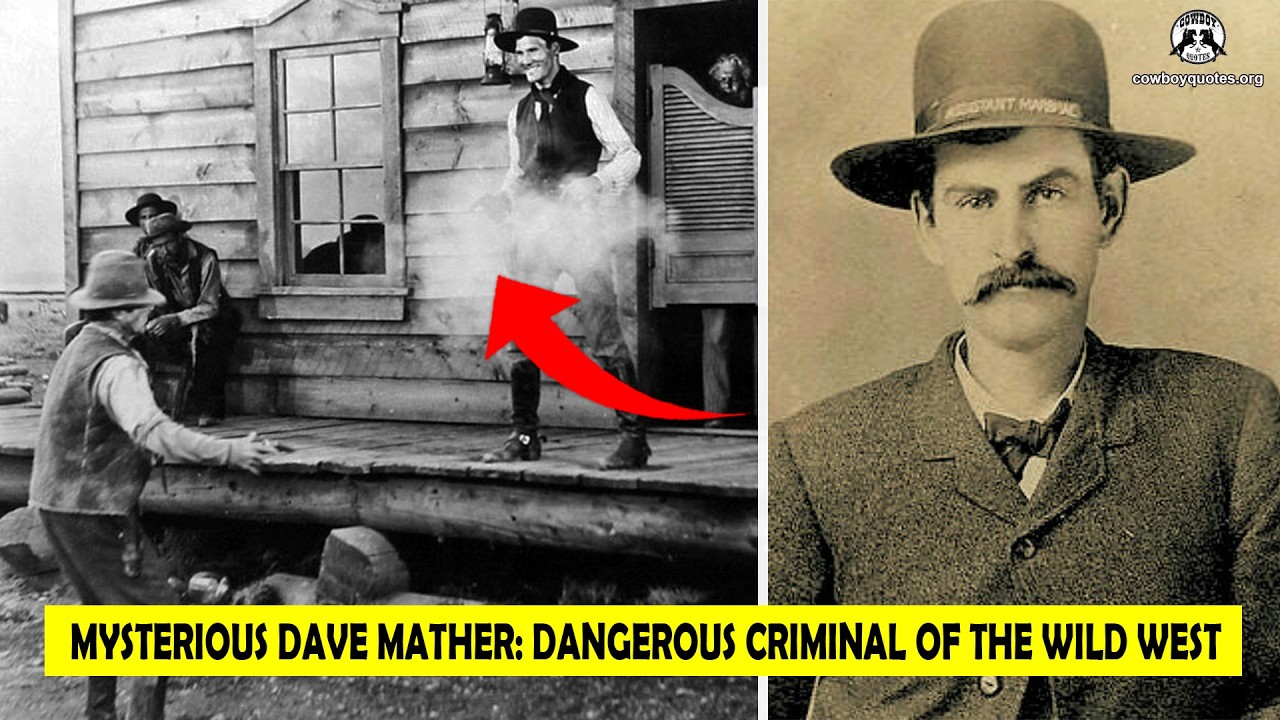
Mather and Lydia Mather. He had two younger brothers, Josiah Wright Mather and George Conway Mather. Later in life, Mather claimed descent from the well-known Puritan minister Cotton Mather, though genealogical research suggested this connection was unlikely. Mather’s childhood was marked by instability.
In 1856, his father left the family and returned to life at sea. In September 1864, Captain Mather died while serving aboard the merchant vessel Ellen in Shanghai. Confirmation of his death did not reach Connecticut until roughly two months later, when Hartford newspapers carried the report. By 1860, young Dave was living with his maternal grandfather, Josiah Wright.
A decade later, the 1870 federal census listed Mather as a boarder in a relative’s home, employed as a laborer. That same year, he and his brother Josiah signed on as crew members of a cargo vessel in nearby Clinton, Connecticut. Their voyage eventually brought them to New Orleans, a major commercial hub of the Reconstruction Era South. The precise details of Mather’s earliest years in the West remain unclear, but by 1872 he was known to be in Dodge City, a frontier town shaped by the cattle and buffalo trades.
Some accounts suggest he and his brother worked as buffalo hunters. There were also later reports claiming that in 1878, Mather had joined Wyatt Earp in an alleged scheme involving counterfeit gold bricks in Mobetie, Texas. The first solid documentation of Mather’s activities appears in 1879. That year, he was recruited by noted lawman Bat Masterson to join a posse assembled to defend the interests of the Atchison, Topeka, and Santa Fe Railway during the Royal Gorge Railroad War.
The dispute between rival railroad companies centered on control of a strategic mountain pass in Colorado and was ultimately resolved through legal negotiations. Afterward, Mather moved to East Las Vegas in the New Mexico Territory, where he secured a position as a US Deputy Marshal. In October 1879, he faced legal proceedings on accusations of being connected to a train robbery. The court ultimately cleared him of wrongdoing.
Mather’s reputation as a formidable gunman largely stems from an incident on January 22, 1880, while he was serving as assistant marshal in East Las Vegas. That evening, he and town marshal Joe Carson became involved in a confrontation at Close and Patterson’s Variety Hall with four men. The exchange resulted in Carson’s death, while Mather was credited with fatally injuring William Randall and seriously wounding James West. Two other participants sustained minor injuries and left the scene.
Three days later, on January 25, 1880, Mather was serving as acting marshal when he was called to intervene in a dispute involving Joseph Costello, who had reportedly drawn a revolver during a heated argument with his employees. According to contemporary newspaper accounts, Costello warned Mather not to come closer. Witness reports state that Mather drew his own weapon and fired a single shot before Costello could act. Costello died from the wound.
A coroner’s jury later determined that Mather’s action was justified and taken in self-defense. Mather’s tenure proved brief. In February 1880, the surviving participants from the January 22 confrontation were placed in the San Miguel County jail. During this period, a mob forcibly removed the prisoners, including James West, and executed them without trial.
Although Mather was acting marshal at the time, historical records do not clearly establish the extent of his responsibility in preventing the incident. Nevertheless, the episode damaged public confidence in local law enforcement. Within the following month, two additional killings occurred on the same day in East Las Vegas. Rumors circulated suggesting that Mather may have had connections to local criminal interests, though definitive proof has never been established.
The atmosphere of suspicion was enough to undermine his authority. On March 3, 1880, Mather resigned. Despite stepping down, he remained in East Las Vegas at least until March 19, when he signed a court document in support of John Joshua Webb, who was facing a murder charge. In the years that followed, records show that Mather traveled throughout Texas, where he encountered further legal difficulties.
These included time spent in jail on counterfeiting charges and a three-month stay in Dallas while awaiting trial for allegedly taking a silk dress belonging to Georgia Morgan, a woman with whom he had operated a brothel. Additional charges accused Mather of stealing two diamond rings and a watch from Morgan. On April 13, 1882, he was acquitted of all three counts. On June 1, 1883, Mather returned to Dodge City, where he was appointed assistant city marshal.
His tenure lasted only nine months. On April 10, 1884, he was replaced by Tom Nixon, a change that quickly led to tension between the two men. The rivalry intensified after Dodge City passed an ordinance prohibiting dance halls. Enforcement proved uneven: Mathers Opera House Saloon was prevented from operating as a dance venue, while Nixon’s Lady Gay Saloon continued without similar restriction.
In response, Mather lowered the cost of beer to five cents per glass, half the prevailing rate. Nixon and several fellow owners reportedly persuaded beer wholesalers to refuse supplies to Mather, illustrating how business disputes and personal rivalries often overlapped in frontier towns. Tensions culminated on July 18, 1884, when Nixon confronted Mather and fired at him, causing a minor injury. Nixon was arrested and released on bond while facing charges.
Three days later, another confrontation occurred between the two men, during which Nixon lost his life. Despite testimony in Mather’s favor from prominent figures such as Bat Masterson and Dodge City Sheriff Patrick Sugrue, the case proceeded to trial. The trial began on December 29, 1884, and concluded after only three days. On December 31, the jury deliberated briefly before returning a verdict of not guilty.
Contemporary newspapers reflected public approval. The Kinsley Mercury suggested the evidence indicated Nixon had initiated the altercation, while the Dodge City Times reported that applause broke out in the courtroom upon the announcement of the verdict. In early 1885, Mather’s brother Josiah rejoined him in Dodge City. On May 10, the brothers were present at the Junction Saloon, where Dave Mather was playing cards with a man named David Barnes.
A disagreement escalated into an exchange of gunfire, and Barnes was fatally wounded. Sheriff Sugrue arrested both brothers. During testimony before a coroner’s jury, Sugrue stated that Dave Mather’s revolver was fully loaded and contained no spent cartridges. Despite this detail, the jury concluded that Barnes’s death resulted from shots fired by both Dave and Josiah Mather and described the act as unlawful.
A preliminary hearing was held on May 22, 1885, and both men were ordered to stand trial without bail. They promptly filed a petition for a writ of habeas corpus. On June 2, Judge Strang permitted their release on a $3,000 bond. Their attorneys succeeded in postponing the trial until the December court term of 1885.
Before the trial could proceed, however, both brothers left the jurisdiction and forfeited their bond. They were never formally tried in connection with the Barnes case. Dave Mather’s later years remain one of the most debated chapters of his life. After the events in Dodge City during the mid-1880s, the historical record grows increasingly thin.
Because of his controversial reputation, newspapers frequently published reports claiming sightings of him in various parts of the country, though many of these accounts were never verified. The last confirmed record of Mather’s whereabouts places him in Kiowa, then known as New Kiowa, in September 1885. There he reportedly helped raise a $300 legal defense fund for his longtime associate Dave Black, who had been accused of killing bugler Julius Schmitz of the 18th Infantry Regiment. Shortly thereafter, on September 6, 1885, Mather departed Kiowa amid concerns that soldiers connected to Schmitz’s regiment might seek retribution.
Whether this fear was well-founded or exaggerated by rumor is unclear, but his abrupt departure marks the final reliably documented moment of his life. In November 1887, Mather’s bail bondsmen were summoned in Dodge City because he had failed to appear for trial in the Barnes case. The bondsmen petitioned the court to void the bond, asserting that Mather had died. However, they were unable to provide physical proof of his death.
The county attorney supported their request, and on November 9, 1887, the court released the bondsmen from liability. Significantly, no official death certificate or burial record for Mather has ever been located. In the absence of documentation, speculation flourished. In a November 1902 article in Everybody’s Magazine, writer Edward Campbell Little claimed that Mather had traveled to Canada, joined the Royal Canadian Mounted Police, later misused his authority, and disappeared with a substantial sum of money.
There is, however, no official record from the RCMP confirming such service. Another version attributed to Mather’s brother Josiah alleged that Dave met his end in the mountains of Tennessee at the hands of illicit distillers. Yet this account contradicts Josiah’s own earlier statements to his children, in which he reportedly said he never saw or heard from Dave again after their separation in Dodge City following the Barnes incident. Adding to the confusion, author William Waters wrote in 1954 that Mather remained associated with the Royal Canadian Mounted Police as late as 1922.
The RCMP formally denied this claim. From a historical perspective, the disappearance of Dave Mather illustrates how easily frontier figures could vanish from the record in the late 19th century. Record keeping in remote regions was inconsistent, interstate travel required little documentation, and name changes were not uncommon. For men seeking to escape legal trouble, reinvention was often possible.
At the same time, Mather’s notoriety likely encouraged journalists and later writers to embellish his fate. After September 1885, the historical trail grows cold. Whether Mather lived quietly under another name, left the country, or died soon after fleeing Kansas remains unknown.
His uncertain ending only reinforces the paradox that defined his life: a man who repeatedly stood in the public spotlight, yet ultimately slipped into obscurity without a trace.