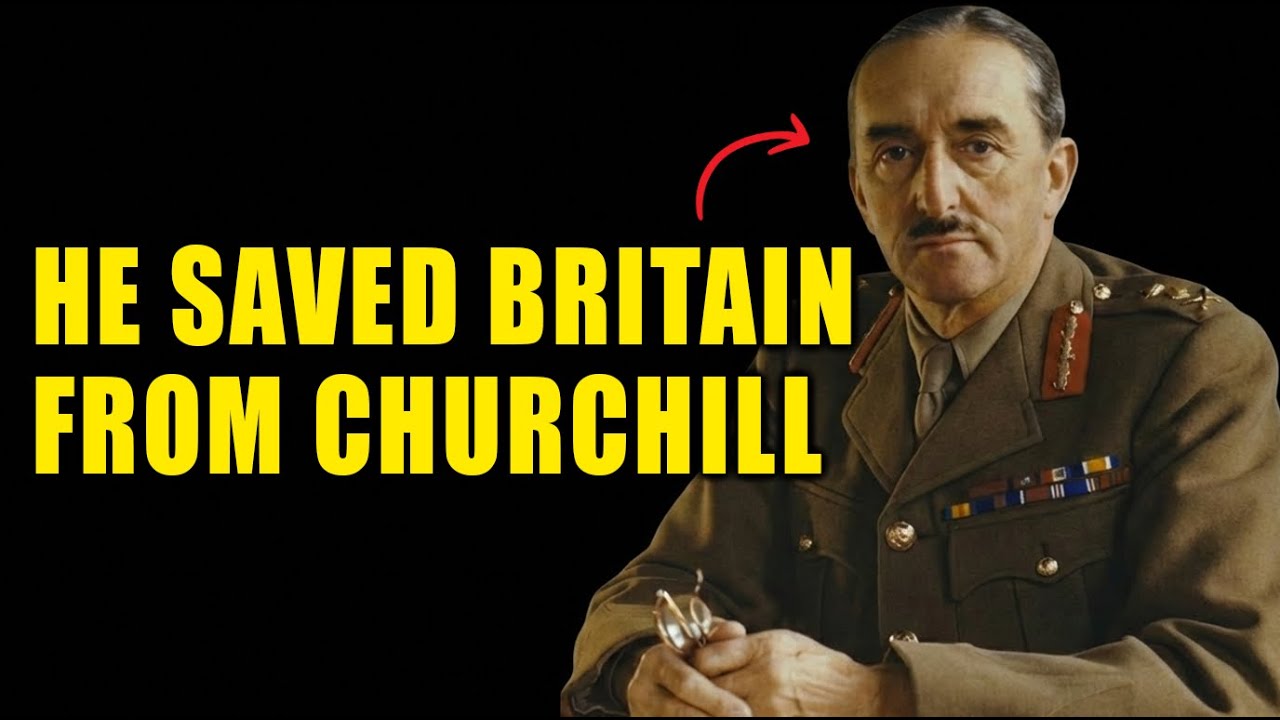
The underground Cabinet War Rooms beneath Whitehall were thick with the acrid haze of Churchill’s cigar smoke on the evening of May 23rd, 1944, the air itself seeming to crackle with the tension of a world at war. The Prime Minister was on his feet, jabbing a stubby finger at the vast map of Europe that dominated the wall, his voice rising with the fervor of a man possessed by a vision. He spoke of Vienna, of the Ljubljana Gap, the mountain corridor that led from Italy into the heart of Austria, and of a lightning dash into Central Europe to beat the Red Army to the prize.
It was a bold, romantic, and utterly terrifying idea, one that could turn a hard-won victory into a catastrophic race against the Soviet Union.
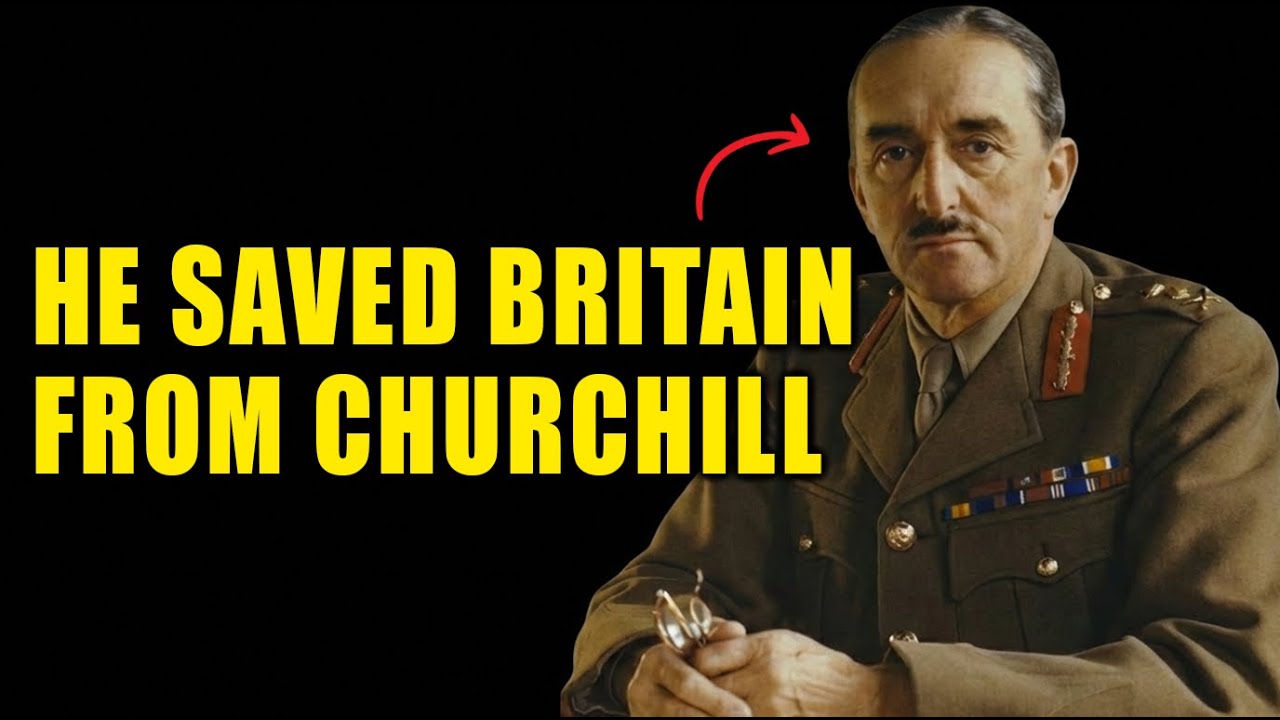 Across the table, a tall, sharp-featured officer with a notebook open before him remained silent, his expression unreadable. Field Marshal Sir Alan Brooke, Chief of the Imperial General Staff, listened as Churchill painted a picture of postwar dominance, his words flowing like a river in full flood. When the Prime Minister finally paused for breath, waiting for the expected wave of assent, Brooke did not offer it.
In a flat, steady voice that cut through the smoke and the rhetoric, he began to dismantle the Prime Minister’s grand design, one question at a time. He asked about landing craft, about the number of divisions available, about the shipping required to sustain such a thrust, and, most pointedly, about what the Soviets would think of such a provocative move. One by one, the pins on the map that had looked like opportunities began to look like insurmountable problems.
This was the essence of Alan Brooke’s wartime role, a role that would see him spend five grueling years in a battle of wills with the most formidable politician of the century. In those moments, in the claustrophobic, smoke-filled rooms of London’s wartime nerve center, he was the man who repeatedly saved Britain from the consequences of Churchill’s most dangerous impulses. His was not the glory of the battlefield, but the unglamorous, relentless, and vital work of strategic restraint, a quiet artillery officer from the First World War who understood the terrible cost of ambition unmoored from reality.
Long before he was arguing with a Prime Minister, Brooke was a young Royal Artillery officer learning the brutal arithmetic of war on the Western Front. He had joined the army in 1902, a professional soldier in an era of imperial confidence, and went to France in 1914 with the British Expeditionary Force. There, amidst the mud and slaughter, he earned a reputation as a skilled gunnery and staff officer, a man who understood the mechanics of destruction.
By the time of the Somme and the later offensives, he was deeply involved in planning artillery fire, including the intricate creeping barrages designed to shield infantry advances with a moving curtain of shellfire. He witnessed at close range what happened when attacks went forward with too few guns, too little ammunition, and only a vague idea of what waited beyond no man’s land.
He saw how entire units could be shattered for gains measured in yards, and how plans failed catastrophically when the supply system could not deliver what had been promised. From those harrowing experiences, Brooke drew a simple, ironclad rule that would guide his strategic thinking for the rest of his career. No attack should ever go in unless guns, ammunition, transport, and reserves were genuinely ready.
And it was the height of self-deception, a criminal folly, to pretend they were ready when they were not. Between the wars, he commanded artillery formations, taught on the staff, and built a reputation inside the British Army as a demanding trainer and a serious planner who understood how to make large organizations function under immense pressure. When the Second World War broke out, that background was about to matter a great deal.
In 1940, Brooke, then still Lieutenant General, took command of II Corps in France. The German offensive through the Ardennes broke the Allied front with a speed that stunned most British planners, and within weeks, the British Expeditionary Force was in a desperate retreat toward the Channel ports. By late May, the beaches around Dunkirk had become the only escape route.
Brooke and his II Corps were ordered to hold the line along the Ypres-Comines Canal, one of the last defensible positions, while the evacuation took place behind them. His task was not to win a set-piece battle, but to conduct a fighting withdrawal that bought precious time for the ships. On May 26th, 1940, German forces launched heavy attacks on his positions, and over the next days, his divisions took blows, gave ground, and withdrew only when staying would have risked encirclement.
On May 28th, the Belgian army surrendered, opening a dangerous gap on his flank. Brooke responded by shifting formations to cover the exposed side and continuing the retreat in as much order as the situation allowed. He was ordered back to Britain on May 29th and evacuated the next day, by which time the operation that became known as the Dunkirk evacuation was underway.
In the end, more than 338,000 British and Allied troops were brought out from the beaches and nearby ports. The British public later spoke of a miracle at Dunkirk, while Brooke and many other professional officers described it more soberly as hard staff work under extreme pressure, supported by the navy and helped by a measure of luck.
Even as he reached England, however, the situation in France was still deteriorating. Within days, Brooke was told to return to France to organize what was in effect a second British expeditionary force in western France. The purpose, as described in cabinet discussions, was as much political as military, to show France that Britain was still in the fight and to stiffen French resistance.
Once back in France, Brooke reported a very different picture. He found French units retreating, command systems in disarray, and German armored forces already pushing toward Paris and the lower Loire. He later described the idea that a relatively small British contingent could reverse this as unrealistic.
During a nighttime telephone discussion with London in mid-June, Churchill pressed the view that British troops had been sent to help convince the French that Britain was still at their side.
Brooke later wrote that he replied that it was impossible to make a corpse feel, and that in his judgment the French army was to all intents and purposes finished as an effective fighting force. Behind those stark words was a calculation that every division left in France was one less to defend Britain. He argued for evacuation rather than a symbolic last stand.
After argument in London, the government accepted this advice, and the remaining British forces in western France were withdrawn to ports such as Cherbourg and Saint-Malo, taken back to Britain in what became known as Operation Aerial. When France signed the armistice in late June, those troops were no longer isolated on the far side of the Channel. Some contemporaries described the decision as cold, because it meant accepting that France could not be saved.
It also set a pattern that would mark Brooke’s later role, with Churchill often thinking in terms of gesture and resolve, and a senior soldier who insisted on measuring proposals against what the forces on the ground could actually achieve.
After the collapse of France, with the threat of invasion hanging over Britain, Churchill brought Brooke back to a home role. On July 19th, 1940, he was appointed Commander-in-Chief, Home Forces, with the job of turning a shaken and underequipped army into a force that could meet a German landing if it came. For over a year, he concentrated on coastal defenses, training formations, and building a more coherent command structure.
It was not glamorous work, but he saw it as essential. On December 25th, 1941, Churchill moved him into an even larger role. Brooke replaced Sir John Dill as Chief of the Imperial General Staff, becoming both the professional head of the British Army and chairman of the Chiefs of Staff Committee just as the war was turning into a truly global conflict.
Churchill later wrote that he wanted a chief of staff who would argue back rather than simply agree, and Brooke was seen in Whitehall as someone who would challenge proposals he thought impractical. In this new post, he coordinated British strategy with the Americans and indirectly with the Soviets, helping to balance limited resources between operations in Europe, the Mediterranean, the Atlantic, and the Far East. When Brooke took up the post, the overall situation was still bleak.
In North Africa, German and Italian forces under Erwin Rommel were pressing toward Egypt. In the Atlantic, German submarines were sinking Allied merchant ships at a rate that threatened Britain’s ability to import food and war material. In 1942 alone, submarines sent more than 6 million tons of Allied merchant shipping to the bottom.
In the Far East, Japan overran Malaya, Singapore, the Dutch East Indies, and much of Burma.
The entry of the United States brought enormous potential strength to the Allied side, but it also brought new priorities and senior commanders whose ideas had to be reconciled with British plans. In London, Churchill responded to these crises with a steady stream of proposals. People who worked with him described how he saw openings in places like Norway and the northern tip of Sumatra, as well as in raids up and down occupied coasts, and how he put forward new operations at a pace that often worried his planners.
Brooke’s task as CIGS was not to shut down this imagination, but to screen it, to identify the few schemes that might plausibly be turned into workable operations and to block those that would drain scarce resources for little strategic gain.
One of the clearest examples of this came in the continuing debate over Norway. Churchill’s interest in returning there went back to 1940, and he never entirely dropped the idea that a strong move in northern Norway could hurt German access to the Atlantic, help protect the Arctic convoys to the Soviet Union, and deliver a psychological blow. Under various code names, eventually including Jupiter, versions of the concept reappeared.
 By early 1942, he was again arguing for a major operation aimed at northern Norway. On paper, the plan promised to seize important ports and interfere with iron ore routes. But when Brooke and the planners worked through the details, they found the constraints severe.
Norway lay roughly 1,000 miles from the main British ports that would have to sustain the operation, and by the middle years of the war, German forces stationed there numbered on the order of a quarter of a million men.
Any Allied force that went in would have to operate in fjords overlooked by German airfields, while the Royal Air Force would struggle to provide continuous cover from bases in Britain. Every landing ship or craft sent to Norway would not be available for operations in the Mediterranean or for the eventual return to Northwest Europe. The chiefs of staff turned the proposal down on these grounds.
Churchill, according to minutes and diaries, refused to drop it, sent it back for review, and received essentially the same answer. He then tried to build support outside that committee, inviting General Andrew McNaughton, who commanded the Canadian Corps in Britain, to Chequers to discuss using Canadian troops for such an assault. McNaughton later described that visit as an exhausting weekend in which Churchill argued almost without pause for the Norway idea, but he remained unconvinced.
With Canadian backing lacking, Churchill returned to the chiefs of staff. At various points, he was prepared to consider technical solutions such as Project Habakkuk, a proposal for a giant carrier made from ice and wood pulp as a way around the air power problem. The basic difficulty did not change.
There were not enough ships, aircraft, and troops to mount and sustain a large-scale Norway operation at the same time as the other agreed campaigns. In these discussions, Brooke’s style was not dramatic. His diary entries and colleagues’ memoirs show him repeatedly setting out the figures for shipping, landing craft, enemy strength, and likely losses, and refusing to approve a project that failed those tests, while Churchill kept looking for ways to keep the option alive.
In the end, the Norway plan in its large amphibious form was never carried out, and the troops and landing craft that would have been needed for it were committed to other theaters.
If we follow on from the Norway debates and ask why Brooke was so ready to block new schemes, we keep coming back to a few hard limits that appeared on almost every planning paper in front of him. One of the biggest was merchant shipping. In 1942 and early 1943, about 8 million tons of Allied merchant shipping were lost worldwide, most of it to submarines, which meant less fuel, less food, and fewer tanks, vehicles, and aircraft reaching Britain.
Until the Battle of the Atlantic began to turn in the Allies’ favor around the middle of 1943, any proposal for a distant operation had to be weighed against the risk that shipping losses would undercut the basic supplies needed to keep Britain in the war. Another continual constraint was landing craft. The tank landing ships and smaller assault craft needed for amphibious attacks required specialized construction and were in short supply.
Early Anglo-American discussions about a possible cross-channel invasion in 1943, often grouped under the label Roundup, imagined putting roughly 10 assault divisions across the channel in the initial waves. British and American planners concluded that this would demand many thousands of landing ships and craft, far more than actually existed at the time. Shortages of merchant shipping and landing craft together led the combined staffs to judge that a full-scale return to France in 1943 was not realistic.
Against that background, when Churchill floated new ideas for expeditions in places like Norway or Sumatra, Brooke tended to see them first in terms of what they would cost in ships, landing craft, and divisions that he wanted for the main effort. Critics who preferred dramatic operations often saw this as excessive caution. Many professional officers and later historians have instead argued that this habit of tying plans to numbers was one of the reasons Brooke came to be regarded as a serious strategist.
It is no accident that the statue of Alan Brooke outside the Ministry of Defense in Whitehall carries the inscription “Master of Strategy.”
The clash between political ambition and these practical limits was particularly visible in the Mediterranean. At the Casablanca Conference in January 1943, Churchill and President Franklin Roosevelt met with their chiefs to set Allied priorities for the coming year. The United States Army Chief of Staff, General George Marshall, pressed for an early cross-channel invasion, arguing that every extra month spent in North Africa or Italy risked drawing energy away from the main German forces in France and Germany.
Brooke accepted that Germany had to be beaten on the main European front, but he argued that in 1943, the Allies were not yet ready to land in northern France. British divisions were still rebuilding, American formations had only limited combat experience, and the landing craft stockpile was too small to support the scale of attack he believed was needed.
Instead, he backed a Mediterranean sequence that would finish clearing North Africa, move into Sicily, use that as a step toward forcing Italy out of the war, open the central Mediterranean to safer Allied shipping, and oblige Germany to keep substantial forces tied down in Italy and nearby areas before the main assault across the channel took place. Churchill also favored Mediterranean operations, but he stressed different benefits. In his public and private comments, he spoke about chances in the Balkans and about extending British influence into southeastern Europe before the Soviet Union arrived there.
Later writers often sum this up by saying that Churchill tended to think in terms of political position while Brooke focused on counting divisions, aircraft, and ships.
Events over the next two years gave material to both sides of that argument. In February 1943 at Kasserine Pass in Tunisia, relatively inexperienced American units were badly handled by German forces and suffered a serious reverse, one of the worst setbacks the United States Army experienced in the war. For Brooke and others, this underlined how hazardous a cross-channel invasion in 1943 could have been.
At the same time, the Italian campaign that followed the landings in Sicily and on the mainland soon turned into a slow and costly struggle. Through 1944 and into 1945, the front pushed northward through difficult terrain, and both Allied and German casualties were heavy. Some historians have since argued that the Mediterranean absorbed very large Allied resources for gains that were not decisive.
Brooke, judging from his wartime papers and diary, treated the Mediterranean as part of a larger balance.
By mid-1944, German forces committed in Italy, the Balkans, and surrounding regions numbered in the dozens of divisions. On D-Day itself, Allied forces in the Mediterranean were helping to hold down close to 70 German divisions, while a little more than 30 faced the initial landings in northern France. In the way he framed it, every German division tied down in Italy or the Balkans was one less that could be moved to Normandy.
That arithmetic did not remove the human cost. Infantry in Italy paid heavily, and critics then and later have questioned whether the strategic benefits were worth that price. Even those who broadly support Brooke’s approach acknowledge that his cautious and methodical style raises hard questions about how to balance operational risk, time, and casualties.
These same tensions colored his dealings with his American counterparts. In 1942 and early 1943, many United States officers thought British strategy looked hesitant. They had seen Britain suffer defeats in Norway, France, Greece, Crete, and in the Far East, and some concluded that London had become reluctant to commit to large decisive actions on the main front.
Marshall in particular worried that British leaders would always favor what he called peripheral operations over a direct blow in France. Brooke, on the other hand, respected American manpower and industrial strength, but was doubtful about the readiness of their ground forces in the early period and worried that confidence might move ahead of preparation. His private diary shows that he could be blunt in his judgment of some American proposals, but he was also very aware that the alliance with the United States was central to any hope of defeating Germany.
Over a series of wartime conferences, he and the American chiefs built a working relationship in which strong disagreement existed alongside agreement on a Germany-first strategy. Dwight Eisenhower, who dealt with Brooke repeatedly through these years, later described him in his memoirs as an able and determined officer who could argue forcefully yet remain straightforward and committed to the common goal. The campaigns in North Africa and Italy, painful as they were, gave United States divisions experience before they took part in the Normandy landings.
 By the time Allied forces went ashore in France on June 6th, 1944, years of argument and adjustment had gone into the plan, and Brooke was one of the senior officers most consistently pressing to match Allied ambitions to the shipping, landing craft, and trained formations actually available.
To explain why Brooke’s resistance to certain plans mattered, historians often set him against a very different pattern in Berlin. At Hitler’s wartime headquarters, senior military figures included Field Marshal Wilhelm Keitel and General Alfred Jodl. Keitel, as chief of the armed forces high command, was widely regarded by his peers as someone who seldom opposed Hitler’s wishes, even when professional officers believed the orders were unsound, and he acquired the derisive nickname “Lakeitel,” a play on the word lackey.
German staff officers who had served in the First World War and who understood supply, depth of defense, and the limits of German resources repeatedly found their advice overruled when it conflicted with Hitler’s instincts. The results included overextended offensives, stand-fast orders where a withdrawal would have saved troops and equipment, and a series of decisions that pushed the army beyond what its logistics could support.
Brooke’s position in London was very different. He did not personally command field armies or send orders straight to corps and divisions. His influence rested on his role as chief professional adviser and his ability to persuade and, when necessary, to resist a prime minister who combined constitutional authority with a strong personality.
Accounts from the time and later memoirs describe a system in which Churchill’s proposals were examined in detail by the chiefs of staff, with Brooke usually taking the lead on land operations, and in which part of his recognized job was to say no if plans did not match available means. That did not diminish Churchill’s importance to Britain’s survival in 1940 and after. But it did mean that many of his more hazardous ideas had to pass through committees and staff calculations before they became policy.
We cannot know what would have happened with a more compliant chief of staff in Brooke’s chair, but the contrast with the German experience is clear. In Berlin, loyalty to the leader tended to outweigh professional judgment at the top. In London, there was at least one senior officer whose duty, as he saw it, was to stand between political wishes and final operational decisions when the two did not match.
If the Norway debates showed how far Brooke was prepared to go in stopping a scheme he thought unworkable, the long-running argument over Sumatra showed how persistent such disputes could be. After the defeats in the Far East in 1941 and 1942, Churchill was deeply affected by the fall of Singapore and the collapse of British prestige in Asia. One of the ideas he kept coming back to was an amphibious assault on the northern part of Sumatra, given the code name Operation Culverin, intended to threaten Japanese shipping routes, support operations in Burma, and open a path towards Singapore.
The concept was raised at the Quebec conference in 1943 and returned in 1944. Each time Brooke and the other British chiefs of staff examined it and concluded that it did not make strategic sense. The distances were large, amphibious shipping was already heavily committed, air support over Sumatra would be hard to sustain, and the resources needed would be drawn away from the main theater where Germany still had to be defeated.
In early 1944, Churchill pressed the idea again. Brooke’s diary records that after one particularly intense meeting in February, he felt as though normal strategic logic had vanished and that he simply could not get the prime minister to accept the facts about resources and priorities. In the end, the chiefs of staff held their line and Culverin remained a paper project.
The operation was never carried out, and for Brooke, it stood as another example of his responsibility to block ventures that offered political impact but little practical return. Colleagues and later writers also note that his working relationship with Churchill did not collapse under this strain. For all the fierce arguments in Brooke’s diary, other evidence suggests that personal dealings between the two could be cordial and that sharp strategic conflict existed alongside a degree of mutual respect.
By 1943, one prospective operation had become central to Allied planning, the invasion of Northwest Europe. Brooke had been involved for some time in debates over its timing and scale. He argued consistently that the main assault on France should wait until Allied forces had gained more experience, German strength had been weakened by fighting in the Mediterranean and on the Eastern front, and there were enough landing craft, divisions, and aircraft to give the landing a reasonable chance of success.
At one stage, Churchill considered Brooke as a possible commander for the cross-channel invasion, which shows how central he had become in British thinking about the land war. In practice, wider political factors shaped the final choice. By this point, the United States was providing most of the ground forces in the European theater, and President Roosevelt and his advisers took the view that the Supreme Commander of such a force should be American.
The post went to General Dwight Eisenhower.
Brooke’s diary entries make clear that he was deeply disappointed. He believed he had given up what might have been the major field command of the war, and he doubted that any successor as Chief of the Imperial General Staff would find it easy to work with Churchill. He decided to remain in London, continuing to direct British army policy and to act as a check on proposals he regarded as too risky rather than seek a battlefield post.
By the summer of 1944, the conditions he had laid down for the invasion were largely in place. The force that crossed the channel on June 6th, 1944 included thousands of ships and landing craft, strong American and British assault divisions, and very large Allied air forces. Campaigns in the Mediterranean and on the Eastern front had drawn off German formations and reduced the Luftwaffe’s freedom of action in the West.
None of this removed the dangers on the beaches or in the fighting that followed. The soldiers who landed in Normandy still faced strong resistance and heavy casualties, but the circumstances under which they fought in 1944 were more favorable than they would have been in 1943.
Brooke watched the invasion and the later campaigns from the center of the system he had helped shape rather than from a field headquarters. Many officers who served with him came to regard him as one of Britain’s most able strategists of the war. Yet he never commanded a field army in the decisive campaign in Northwest Europe.
That gap between his influence and his public visibility is one of the striking features of his career. Throughout the war, Brooke’s calculations did not stop with British and American armies. He also had to think about the Eastern Front.
By 1942, the Red Army was carrying most of the land war against Germany, taking millions of casualties in battles from Stalingrad to Kursk. While British and American land campaigns, though costly, were still on a smaller scale, that imbalance shaped how he judged new schemes. When Churchill raised ideas for operations in the Eastern Mediterranean or the Balkans, Brooke and the other chiefs often asked whether they would really draw German divisions away from the Soviets or simply complicate relations inside the alliance without changing the main front.
The sharpest version of that debate came late in the war over advances into Central Europe. In 1944 and early 1945, Churchill showed strong interest in pushing Allied forces from northern Italy through the Balkans and the Ljubljana Gap toward Austria and possibly Vienna. In his letters, he tied this to the political shape of postwar Europe and the hope that Western forces might reach certain areas before the Red Army arrived.
Brooke looked at the same idea and saw different risks. By then, German power was clearly fading, and planners were thinking about how to end the war in Europe and then turn more strength against Japan. A drive toward Vienna from the south risked putting Western and Soviet armies face to face just when cooperation with Moscow was still needed, and it would pull shipping and divisions away from the agreed main advances that were already underway.
As in earlier disputes, he argued against the scheme. The Western Allies moved into Western Austria and southern Germany along agreed axes, while Soviet forces took Vienna in April 1945. The postwar division of Europe reflected that general pattern.
Historians disagree over how far Allied choices about where to advance shaped that outcome and how far it was set by Soviet gains on the ground. But Brooke’s advice against a dash to Vienna was one factor in avoiding a direct clash with the Red Army at the end of the war.
Looking back, it is easy to cast Brooke as always right and Churchill as always overreaching. The record is more complicated. Many specialists agree that Brooke helped to stop projects that would probably have stretched British resources too far.
 The large-scale Norway operations that Churchill wanted, and the proposed Culverin landing on Sumatra, are often cited as plans that looked attractive politically, but made little sense once shipping, air cover, and enemy strength were taken into account. Many planners and later analysts also judged that a cross-channel invasion in 1943 would have carried a very high risk of failure given the state of Allied forces and the limits on landing craft and air support. In that light, Brooke’s insistence on respecting logistical limits and building up strength before major assaults probably prevented failures and gave the allies a firmer base for the operations they did carry out.
His caution, however, had costs. The Italian campaign, which he saw as part of the necessary Mediterranean sequence, turned into a long and attritional struggle. Allied and German casualties there ran into the hundreds of thousands.
The terrain often favored the defense and the advance north was slow. Some historians argue that if resources had been shifted earlier from Italy toward northwest Europe, the war in Europe might have ended sooner or Western forces might have been able to liberate more of Central Europe before the Red Army arrived, though they accept that such choices would have involved serious risk. Brooke’s instinct, shaped by his First World War service and by the crisis of 1940, was to avoid overextension wherever he could.
That habit steered the Allies away from operations that had little chance of success. It may also have made him less ready to support ventures that were dangerous, but might have altered the political map that emerged in 1945.
What stands out is that he saw choices as trades between different kinds of risk rather than simple questions of right and wrong. Saying no to an operation might save lives in one theater while giving the Red Army more time to move forward in another. Choosing a careful, methodical campaign could make eventual victory more likely, but also prolong the fighting needed to reach it.
Any serious account of his role also has to include his own words. He kept detailed diaries throughout the war, written for himself and published only later, in which he wrote bluntly about Churchill’s strengths and weaknesses. In one well-known entry, he noted that much of the world saw Churchill as one of the great strategists of history, while he himself believed that Churchill’s strategic ideas, if not checked, had brought Britain close to disaster more than once.
In the same passage, he wrote that without Churchill, Britain would almost certainly have been lost in 1940, but that with him in charge, the country had repeatedly been on the edge of grave danger. And he described his feelings towards Churchill as a mixture of deep admiration and sharp frustration.
The phrase “public menace” comes from that entry. Taken on its own, it has often been used by critics of Churchill, but in context, it reads more like the outburst of a tired colleague who had spent another long day arguing against plans he thought unrealistic and who still accepted that Churchill’s leadership had been crucial when Britain stood alone. A later anecdote recorded by General Hastings Ismay, Churchill’s military assistant, points in the same direction.
After a particularly fierce exchange, Churchill is said to have complained that Brooke hated him. When this was passed on, Brooke replied that he did not hate Churchill, that he was attached to him, but that the moment he began to pretend to agree with the prime minister against his own judgment, he would be of no further use and should be removed. Together, these pieces of evidence give a sense of the balance at the top.
Churchill supplied the driving will, the public language, and the refusal to accept defeat that held Britain together and kept the United States focused on Europe. He pushed his advisers to look for options and not to settle too quickly into defense. Brooke supplied much of the restraint, speaking for an army with limited manpower that could not afford many disasters, and drawing on memories of what happened when poorly prepared offensives went forward in the First World War.
The two roles depended on each other. Without Churchill’s determination and political skills, there would have been very little for Brooke to direct. Without Brooke’s readiness to argue back, more of Churchill’s ambitious or improvised schemes might have moved from the map to the battlefield.
When the war ended, the public first met the story largely through Churchill’s version. His six-volume history, The Second World War, published between 1948 and 1954, naturally told events from his point of view. Brooke appears in those books as an important figure, but the nightly arguments, the blocked schemes, and the depth of the strain between them are much less visible.
So for many readers, the conflict could look like the work of one dominant strategist. A different voice appeared later when Brooke’s wartime diaries and notes were edited and published in volumes such as The Turn of the Tide and Triumph in the West. Drawn from his own records as Chief of the Imperial General Staff, they showed him as a tired but determined professional who often went home convinced that certain ideas belonged in the realm of fantasy and that part of his duty was to protect Britain from its own leaders’ more ambitious impulses.
The blunt tone surprised some and delighted others, and the material forced historians to rethink how they divided responsibility and credit at the top of the British war effort. Since then, writers have argued over that balance. One line of interpretation stresses that Brooke’s caution and insistence on preparation were vital, and that without someone in his position saying no, Churchill might have pushed Britain into operations beyond its means.
Another gives more weight to Churchill’s appetite for risk and suggests that at times the high command, Brooke included, was too slow to seize opportunities. There is disagreement over particular campaigns, but there is broad agreement on one basic point that the war in London was shaped not by a single genius or by an anonymous committee, but by a difficult partnership between a political leader who thought in broad strategic and political terms and a professional soldier whose loyalty was expressed as much in argument as in obedience.
In London today, that balance is echoed in stone and bronze. Outside the Ministry of Defense stands the statue of Alan Brooke with the plain inscription “Master of Strategy.” Near Parliament, Churchill’s statue looks out over Westminster.
The two monuments are often considered separately, but they belong to the same story of how Britain was directed in war. Alan Brooke never became a household name in the way that commanders like Montgomery, Eisenhower, or Patton did. He did not command at El Alamein, Sicily, or Normandy.
For most of the conflict, he worked in rooms lined with maps and papers rather than in forward headquarters. Yet, from the retreat in France in 1940 to the last campaigns in Germany, his influence runs through many of the major British decisions. He helped ensure that most of the British Expeditionary Force was brought home from France when some voices wanted to send more men into a collapsing front.
He argued against sacrificing Britain’s remaining divisions in gestures that might have looked brave but would have left the country weaker if invasion came. He resisted large schemes in Norway and against Sumatra that promised prestige but did not make sense once shipping, air power, and enemy numbers were examined. He supported the Mediterranean sequence that, despite heavy casualties, helped remove Italy from the war, tied down German forces, and contributed to the conditions in which Normandy could be attempted.
He pressed for the cross-channel invasion to go ahead only when the allies had enough landing craft, troops, and aircraft. And he weighed ideas for Balkan ventures, not only against maps, but also against the need to keep the Soviet alliance functioning.
He made mistakes of his own, as any senior planner in a conflict of that scale would. Some of the options he rejected still draw those who like to imagine what might have happened had the Allies moved faster in certain directions. Some of the campaigns he supported, especially in Italy, cost more in lives than their immediate gains appeared to justify, and his diaries show that in private he could be sharp, sometimes unfair, in his judgments of colleagues and allies.
Even so, many historians see his refusal to act as a compliant adviser as one of the strengths of the British system. In a war where the German high command became increasingly dominated by obedience to the leader’s wishes, Brooke’s habit of questioning proposals and matching aims to means gave Britain something different. His contribution does not rest on a single famous victory.
It lies in a series of choices that avoided some potential disasters, preserved formations for later use, and pushed scarce resources toward operations that offered real strategic effect rather than mainly rhetorical impact. By 1945, Britain was exhausted and heavily in debt, but it had not been invaded. Western Europe had been liberated by Allied forces, and Germany had surrendered.
The peace that followed was not the settlement that Churchill or Brooke would have chosen, but the combination of Churchill’s drive and Brooke’s restraint had carried the country through. Churchill’s account of that journey reached the wider public first, with Brooke’s side of the story emerging more slowly through edited diaries and later studies. Taken together, they reveal a different kind of commander at work.
One whose main achievement lay less in directing battles personally in the field than in the difficult, often unpopular task of deciding which battles should not be fought at all.