Hollywood has long portrayed the cowboy as a figure defined by his six-shooter, but the reality of survival in the American West was a different story entirely. The revolver was often the least useful tool a man could carry, and those who relied on it alone frequently perished from thirst, exposure, or infection. The men who actually endured the frontier carried a wide array of everyday items that proved far more essential to their daily survival than any firearm. The first item strapped on every morning was a fixed-blade knife, usually a Bowie knife popularized by Jim Bowie in the 1830s.
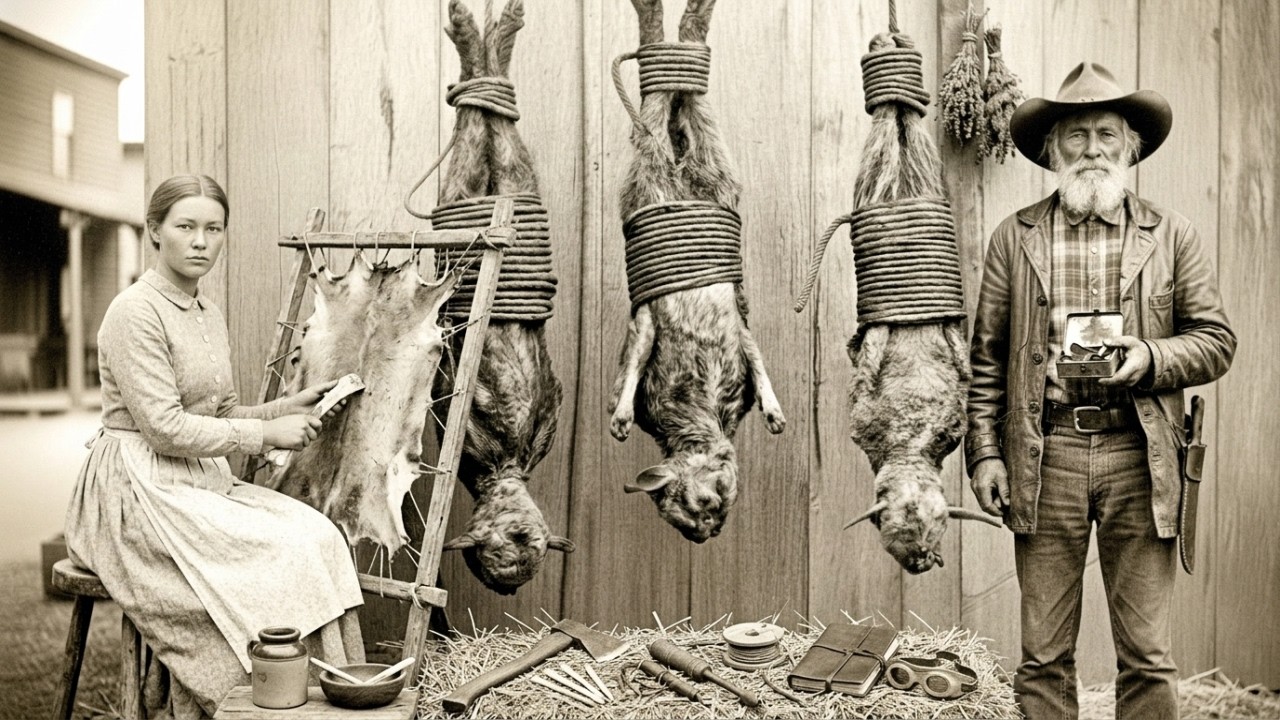
It was used for cutting rope, opening cans, removing thorns from a horse’s hoof, cleaning game, and even cauterizing wounds when no doctor was available. Unlike a revolver, which could misfire or run out of ammunition, a knife was always ready for use. A man might go weeks without firing a shot, but he would not go a single day without using his blade. Water was a matter of life and death, and thirst killed more people in the Old West than bullets did.
Cattle driving routes were chosen not for their directness, but for their proximity to rivers and wells. A leather canteen was treated as an extension of the body, and veteran cowboys rationed every sip. They followed a rule that might surprise modern readers: the horse drank first. Without the horse, a man was stranded on foot, and his chances of survival dropped to almost zero.
Starting a fire was far more difficult than it appears in movies. Matches were expensive and easily ruined by rain or river crossings. That is why experienced cowboys carried flint and steel, a kit that worked even when wet and dirty. Fire was not a comfort; it was essential for cooking meat, boiling water, keeping predators away at night, and treating wounds.
On the freezing winter plains, a single night without fire could be fatal. The rawhide lariat was one of the most underrated tools a cowboy owned. Beyond catching cattle, it was used to build makeshift shelters, serve as a tourniquet, pull wagons out of mud, and act as a rescue line during river crossings. Rawhide was chosen because it shrank when wet, tightening knots with tremendous force, making it ideal for securing cargo and restraining animals.
The desert climate was brutally unforgiving. Daytime heat could be overwhelming, but nighttime temperatures could drop by more than 30 degrees within hours. Hypothermia was a real threat, which made a bedroll as essential as water. The thick wool blanket served as a bed, insulation against freezing wind, and even an improvised stretcher.
A cowboy carried his bedroll tied to his saddle every day, and inside it, he kept his few personal belongings. Losing that blanket could mean losing his life. Navigation was another constant challenge. With no paved roads, no road signs, and no reliable maps, a cowboy crossing the plains could easily become disoriented in terrain that looked identical in every direction.
A mistake of just ten degrees could put a man fifty kilometers off course. A small brass pocket compass was a silent, dependable solution that saved more lives than many firearms ever did. A spyglass was not a military luxury but a basic survival tool. From a hilltop, a cowboy could spot dust trails from distant herds, locate hidden water sources, or detect smoke from an unfamiliar camp before approaching too closely.
The ability to see far meant making better decisions, and those few seconds of observation could mean the difference between riding into an ambush or turning away in time. Memory alone was too risky in such vast terrain, so many cowboys carried hand-drawn maps. These were sketched on tanned leather or folded thick paper and marked with personal symbols only the owner understood. They recorded the location of water wells, areas with danger of ambush, and ground that became impassable in rain.
These maps were so valuable that they were traded between drovers. Losing one was like losing years of accumulated experience overnight. The night sky served as the most reliable navigation system available. Every experienced cowboy learned to find the North Star before riding out alone for the first time.
Constellations like the Big Dipper functioned as a natural clock, showing not just direction but also the approximate time of night. Anyone who could not read the sky risked wandering in circles on land without water, a mistake that could cost them their life. Spurs were not decorative accessories. They were the primary means of silent communication between a cowboy and his horse.
A light touch could steer the animal away from a rattlesnake, while a firm press meant run during an ambush or stampede. Spurs with blunt points did not hurt the animal; they simply conveyed messages quickly. In a narrow canyon or a swift river crossing, half a second of response from the horse could determine survival. A simple sewing kit, containing a needle and thread, saved more lives than much of the medicine of the era.
Torn clothes were a genuine danger in the desert, leaving skin exposed to brutal sun or freezing wind. Cowboys stitched up worn boots, patched saddles, and repaired cracked canteens. When a man suffered a serious cut far from any doctor, that same needle and thread were used to close the wound, often without anesthesia or disinfectant. Whiskey was another survival tool carried in a small flask.
With doctors being a rare luxury, whiskey was used to disinfect cuts, ease toothaches, and clean wounds from barbed wire. It was also used to calm a man down before cauterizing an injury. Doctors of the time, when they were available, even prescribed whiskey as a legitimate remedy. Tobacco served purposes far beyond simple habit.
Smoke from burning it helped repel mosquitoes and flies around camp. Many cowboys chewed tobacco and applied it to snake or insect bites as a poultice to draw out poison, a technique learned from native peoples. It also functioned as a valuable trading item in regions where money meant little. Offering tobacco to a stranger could secure information about trails, access to water, or prevent a fight.
Animal tallow grease was an overlooked necessity. Cowboys rubbed it into boots to protect them from mud and rain, worked it into saddles to prevent cracking, and used it on chapped hands. Without this constant upkeep, leather would harden within days, boots would tear up a man’s feet, and a saddle could break apart at the worst possible moment. Salt was arguably the most valuable item a cowboy carried after water.
Without refrigeration, salting meat was the only way to preserve it, extending its life from hours to weeks. Cowboys also lost salt through sweat during long days in temperatures over one hundred degrees. Replacing it prevented cramps, dizziness, and collapse. Salt was even used to treat minor wounds and prevent infection.
Its value was so recognized that the word salary derives from it. A deck of cards was more than just a pastime. Around the campfire or in lawless towns, card games functioned as a social network. That was where deals were made, people assessed each other, and trust was established.
In an era without banks or signed contracts, the card table was where a man’s word was tested. A man who bluffed at poker often bluffed in business, and cowboys learned to spot that quickly. The harmonica was another small item with significant impact. Small enough to fit in a shirt pocket, it provided emotional relief during long, lonely nights on the trail.
A simple tune could change the mood of an entire camp, building trust between armed strangers sharing a fire. It kept loneliness at a distance and offered a moment of peace that did not cost anything the next day. In an era without identification cards, proving one’s identity was a matter of survival. Cowboys carried letters from ranch owners, pay receipts, or papers stamped by local judges.
These documents worked as informal passports. Showing such proof in an unfamiliar town could determine whether a man was welcomed in or escorted out at gunpoint by a suspicious sheriff. The saddle was a cowboy’s most valuable possession, worth the equivalent of two or three months’ wages. He spent ten to twelve hours a day in it, used it as a bed in the open, and even as a pillow.
Over time, the leather molded to its owner’s body like an old pair of boots. There was a saying on the trail that captured this bond: a cowboy would sell his horse before he sold his saddle. The horse itself was the number one tool, the foundation upon which all other nineteen items depended. Without it, a man on foot in open country was as good as dead.
That is why cowboys gave their horses water before drinking themselves, slept near them to protect them from predators, and treated them as working partners. The real West was not won at the end of a revolver. The men who survived were those who could start a fire in the rain, read the sky without a compass, stitch up their own cuts, and care for their horse before themselves.
The revolver made noise, but these everyday tools did the real work of keeping a man alive.


