Pat Garrett claimed he killed Billy the Kid in a dark bedroom at Fort Sumner in 1881, but the outlaw’s grave was later lost, no confirmed remains have ever been DNA tested, and decades later several men claimed to be the famous fugitive. Their stories involved old scars, witness statements, photographs, and personal details that seemed difficult to explain. The central question remains: did Billy the Kid really die that night, or did the Old West’s most wanted outlaw escape and live under another name? The first problem with any escape claim is that Billy’s identity was itself built around several names.
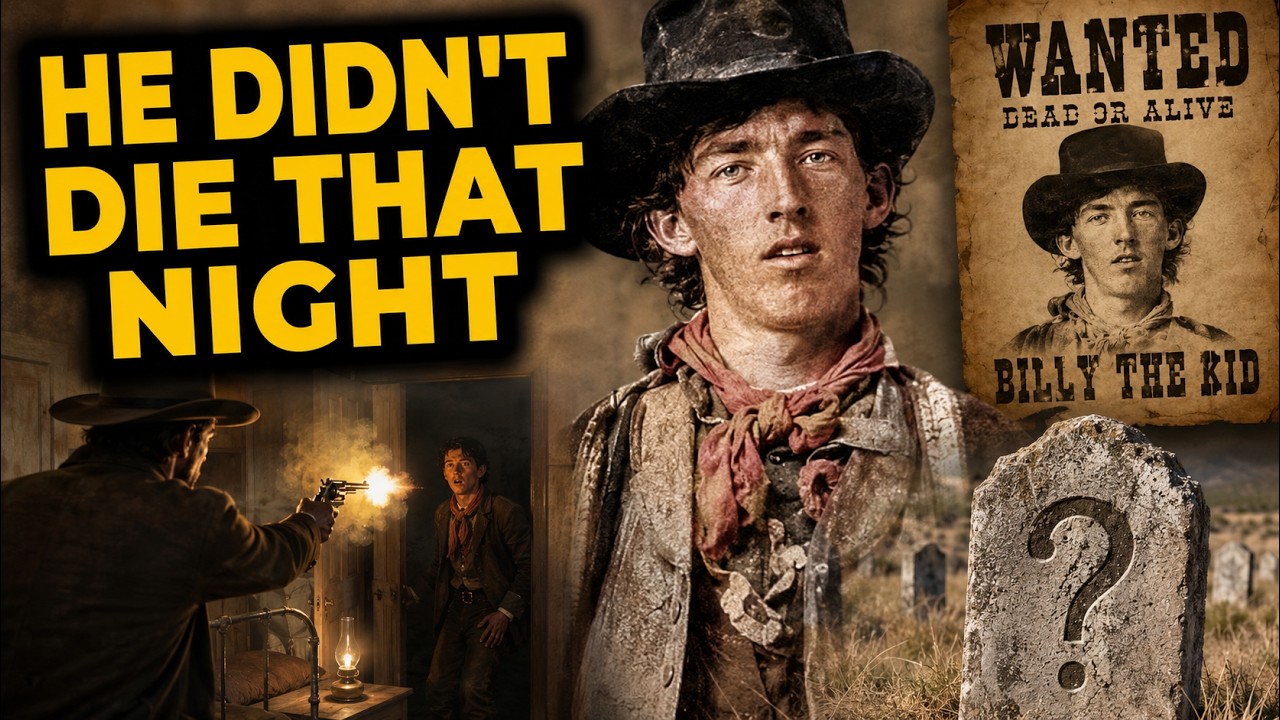
Most historians identify him as Henry McCarty, but he was also known as Henry Antrim, Kid Antrim, William H. Bonney, and finally Billy the Kid. His exact birth details are debated, with New York City in 1859 the most commonly accepted answer. His mother, Catherine, married William Antrim in Santa Fe in 1873, then died from tuberculosis in Silver City the following year.
Henry was still a teenager. He worked as a farmhand, teamster, and cowboy, and his small build helped give him the nickname Kid. His first recorded arrest came in Silver City in 1875 after stolen clothing was hidden where he was staying. He escaped from jail and moved to Arizona.
In 1877, a fight with blacksmith Frank Cahill ended with Cahill being fatally shot, and Henry fled again. In the Wild West, changing names was useful and not unusual. That background later gave impostors room to build believable stories and turned ordinary gaps in paperwork into supposed evidence of a secret life. The old claim that Billy killed 21 men, one for every year of his life, is not supported by the record.
Documented cases connected to him fall far below that legend, and historians still separate killings he personally carried out from deaths during group fighting. Billy became a major figure in the Lincoln County War, a violent business conflict that divided southeastern New Mexico in 1878. He worked for English rancher and merchant John Tunstall, who challenged the established commercial group associated with Lawrence Murphy and James Dolan. When Tunstall was killed, several of his former employees formed a group known as the Regulators.
They had legal authority for a time, but the conflict quickly moved beyond normal law enforcement. Billy took part in the killing of Lincoln County Sheriff William Brady, and that charge followed him long after the larger conflict cooled. Territorial Governor Lew Wallace later offered him protection from prosecution if he testified about another killing. Billy testified, and his testimony contributed to indictments, but the pardon he expected never arrived.
He eventually walked away from custody and returned to outlaw life, stealing livestock and traveling with a small group. Pat Garrett was elected sheriff of Lincoln County in 1880 and began hunting him. Garrett’s posse captured Billy and several companions at Stinking Springs in December. Billy was tried for Brady’s murder, convicted, and sentenced to hang.
On April 28, 1881, he escaped from the Lincoln courthouse, killing deputies James Bell and Bob Olinger in the process. For the next two and a half months, he remained close to Fort Sumner instead of leaving New Mexico completely. Billy had friends in the area, spoke Spanish fluently, and could rely on people who did not trust every lawman sent after him. Garrett did not need to invent a reason to find him, and the official search was already active.
In July 1881, Garrett traveled toward Fort Sumner with deputies John Poe and Thomas McKinney. According to Garrett’s later account, the three lawmen approached the old fort quietly and went to speak with Pete Maxwell, whose family controlled much of the property. Garrett entered Maxwell’s dark bedroom near midnight while the deputies waited outside. Billy was staying nearby and had no idea the sheriff was in the room.
He came toward the house looking for food, encountered the shadowy men outside, and stepped into Maxwell’s room while asking in Spanish who was there. Garrett said he recognized Billy’s voice. Maxwell identified the visitor, and Garrett fired twice. One shot struck Billy and killed him.
This was not the face-to-face Old West gunfight shown in many movies. It was a sudden encounter in darkness that lasted only moments. That darkness is the first major opening used by survival theories. Poe had never seen Billy before, and Garrett wrote that his deputies briefly wondered whether he had shot the wrong man.
Garrett’s version also contains an awkward detail. At first, the men thought Billy might have fired, but they could not find evidence that he had. Garrett admitted uncertainty about that point in his own book. He also admitted the encounter depended on luck and recognition by voice rather than clear visual identification before the shot.
Those weaknesses make the account open to questioning, but they do not establish that another man was secretly substituted. The strongest evidence for Billy’s death was created after the shooting. The following morning, local official Alejandro Segura held an inquest, and a coroner’s jury examined the body and reviewed the circumstances. The jury identified the dead man as William H.
Bonney and ruled that Garrett had acted in the line of duty. New Mexico’s state archives list a surviving copy of that jury verdict along with Billy’s death warrant, the sheriff’s certificate describing his courthouse escape, the attorney general’s opinion about Garrett’s reward, and later approval of payment by the territorial government. People often say there was no death certificate, but New Mexico was a territory in 1881 and did not issue modern death certificates. When a suspicious or important death occurred, a coroner’s jury could conduct an inquiry and produce the official finding.
Billy’s body was prepared for burial, viewed by people in the community, and buried in the old military cemetery at Fort Sumner beside Tom O’Folliard and Charlie Bowdre. Contemporary newspaper reporting treated the dead man as Billy the Kid, not as an unknown victim whose identity was disputed. Garrett then used the official paperwork while seeking the reward offered for Billy’s capture, creating another paper trail involving territorial officials who accepted that the wanted outlaw was dead. None of this makes every sentence in Garrett’s later book reliable, but it does mean the death story does not rest only on one lawman’s word.
It rests on a local inquiry, people who saw the body, government correspondence, a burial, and reports produced before Billy became a twentieth-century entertainment legend. The survival story gained strength because physical evidence became harder to check as decades passed. Garrett published “The Authentic Life of Billy the Kid” in 1882 with the help of journalist Ash Upson. Historians have found errors, exaggerations, and half-truths in its account of Billy’s earlier life.
Garrett also had a personal reason to defend himself: some people believed he had ambushed Billy unfairly, and a book could protect his reputation while earning money. Then there is the grave. Billy was buried with a simple marker, and a flood in 1904 washed away markers in the cemetery. Years later, three surviving pallbearers reportedly pointed to three different locations when asked where Billy had been placed.
The grave marked for tourists today represents the traditional burial area, but it does not give investigators a guaranteed set of remains. Catherine Antrim’s grave creates another problem. Her body was moved when an older Silver City cemetery was relocated, and the exact position of her remains is also uncertain. No preserved tissue, securely identified post-mortem image, or biological sample with an unbroken chain of custody is available for testing.
These are real limitations, but a missing marker is not the same thing as a missing funeral. The best-known survival claimant was an elderly Texas man called Brushy Bill Roberts. His story entered the public record in the late 1940s through William V. Morrison, a probate investigator and attorney.
Morrison had been looking into men connected with the Lincoln County War when he was told that Billy the Kid might still be alive. He eventually found Roberts in Hamilton County, Texas. Roberts first resisted the idea, then claimed he was the real Billy and that Pat Garrett had helped stage his disappearance. He said he wanted the pardon Lew Wallace had discussed with Billy in 1879, not fame alone.
Morrison arranged a meeting with New Mexico Governor Thomas Mabry. On November 29, 1950, Roberts appeared before the governor and asked to be recognized and pardoned. The request failed because the evidence did not satisfy Mabry. Roberts died less than a month later, leaving no sworn courtroom test, no completed independent forensic examination, and no DNA sample collected under modern standards.
Still, his claim had features that attracted serious attention. Morrison said Roberts carried numerous old scars, appeared to know names, locations, and events connected with Lincoln County, and several elderly people signed statements saying they believed he was Billy. The problem is that most of those details came through Morrison, who had become Roberts’s advocate. A lawyer can honestly believe a client and still present the evidence in the strongest possible way.
Forensic investigation asks whether each claim can be independently documented, dated, and connected to the historical Billy without relying on the same storyteller. The physical case for Brushy Bill is often described as stronger than it really is. Morrison reported that Roberts had many scars and argued some matched injuries associated with Billy, yet there is no complete medical record from Billy’s lifetime showing a unique map of scars that could be compared point by point. The public case also does not include an independently documented medical examination of Roberts with photographs, measurements, and a neutral report prepared before his burial.
A scar can show that a person was injured, but by itself it usually cannot show who that person was. Facial comparison creates a similar problem. Several photographic comparisons have been promoted over the years, and supporters have sometimes presented them as proof of a match. None has produced a broadly accepted identification.
Statements from elderly witnesses also need careful handling. Human memory changes over time, especially across 70 years. By 1950, books, newspaper features, and movies had already spread details of the Kid’s life across the country. A claimant could learn facts that later sounded private.
The hardest evidence for Brushy Bill to overcome is not a photograph. It is his age. Roberts claimed a birth date in 1859, which would have made him roughly the same age as Billy. Census returns, a draft card, and other family records instead placed the documented Oliver Roberts in the late 1870s.
If that identification is correct, Roberts was only a small child when Garrett shot the man at Fort Sumner. He could not have worked as a cowboy in Arizona in the 1870s, joined the Regulators, escaped the Lincoln courthouse, or stood trial for Sheriff Brady’s murder. Supporters respond that Brushy Bill used several names and that the younger Oliver Roberts may have been another person. That answer creates a new burden: they must show a continuous trail for an older William Roberts from before 1881 through the years when the documented younger Roberts lived in Texas.
No such trail has gained broad acceptance among historians. Contemporary reports also said Roberts’s answers varied from known facts and he struggled with basic names, locations, and sequences. Morrison and other supporters argued that age, illness, and the pressure of public questioning affected him. Governor Mabry rejected the pardon request because Roberts had not established that he was William H.
Bonney. The Texas State Historical Association describes the hearing as producing no conclusive proof. Brushy Bill was not the only man said to have survived as Billy the Kid. Another claimant, John Miller, lived as a farmer and horse trainer near the New Mexico and Arizona border and died in 1937.
Stories connecting Miller to Billy became more public after his death. Supporters pointed to his appearance, his knowledge of horses, and family recollections that he had privately admitted the identity. No documentary trail has gained broad acceptance connecting Miller to Henry McCarty before 1881. In May 2005, former Lincoln County Sheriff Tom Sullivan and former Capitan Mayor Steve Sederwall removed samples from Miller’s remains at the Arizona Pioneers Home cemetery in Prescott.
The samples were sent to a Dallas laboratory. Instead of comparing Miller directly with Catherine Antrim, the investigators used traces taken from a bench believed to have held Billy’s body after the Fort Sumner shooting. That approach had a major weakness. The bench itself was not a sealed piece of evidence preserved under controlled conditions since 1881.
To identify Billy, investigators would need to prove that the material on it was human, that it came from Billy, that it had not been mixed with later material, and that every transfer was documented. Public reporting did not reveal a usable genetic identification linking Miller to Billy. The samples were later returned, and Miller’s remains were reinterred. The episode produced controversy over permission for the exhumation, but prosecutors did not file charges because the investigators believed officials had authorized the work.
A reliable DNA test would need two securely identified samples. The most useful comparison would probably involve mitochondrial DNA, which passes from a mother to her children. That could connect remains believed to be Billy with remains believed to be Catherine Antrim, but only after archaeologists established which graves actually belong to them. Investigators would also need legal permission, careful excavation, independent laboratories, contamination controls, and a documented chain of custody.
The 2004 effort to exhume Catherine did not succeed, partly because the location of her remains and the location of Billy’s remains were both uncertain. Digging beneath the modern Billy the Kid marker could disturb O’Folliard, Bowdre, or another person and still produce no answer. Testing Brushy Bill or John Miller would also require a trustworthy comparison sample from Billy’s maternal line. Facial recognition cannot fill that gap.
Neither can handwriting alone. In 2015, historian Robert Stahl tried to obtain a modern death certificate for Billy, arguing that the coroner’s verdict and witness record already established the death. That effort did not create new biological evidence, but it highlighted an often missed fact. The absence of a modern certificate does not mean the territorial government left no official finding.
New Mexico’s archives identify the jury verdict, reward documents, death warrant, and related correspondence. At the same time, no approved genetic comparison has matched confirmed remains of Catherine Antrim with confirmed remains of Billy, Brushy Bill Roberts, or John Miller. No preserved sample from the Fort Sumner body has an uncontested chain of custody, and no laboratory has produced a broadly accepted DNA result identifying either later claimant as Billy the Kid.