The darkest hour of the Second World War in Europe was not a battle erupting in thunder and fire, but a silence—the cold, absolute silence of a river—and the stillness of a million men waiting for a moment that was receding further into the fog of war with every passing day. It was the late hours of March 22, 1945, when the world turned on a hinge of audacity, not artillery, and the fate of nations was decided not by the massing of forces, but by the sudden, violent movement of a few thousand souls in the dead of night. The Rhineland was a black wound under a moonless sky, and before the dawn broke, the war had been irrevocably changed, not by the titanic force that had been marshaled for months, but by the sheer, unfathomable will of a single, tempestuous American general.
The official expectations, the grand strategies, and the meticulous plans of the Allied High Command lay in tatters, and one of the most carefully guarded axioms of modern warfare had been shattered by a wooden boat and a bayonet.
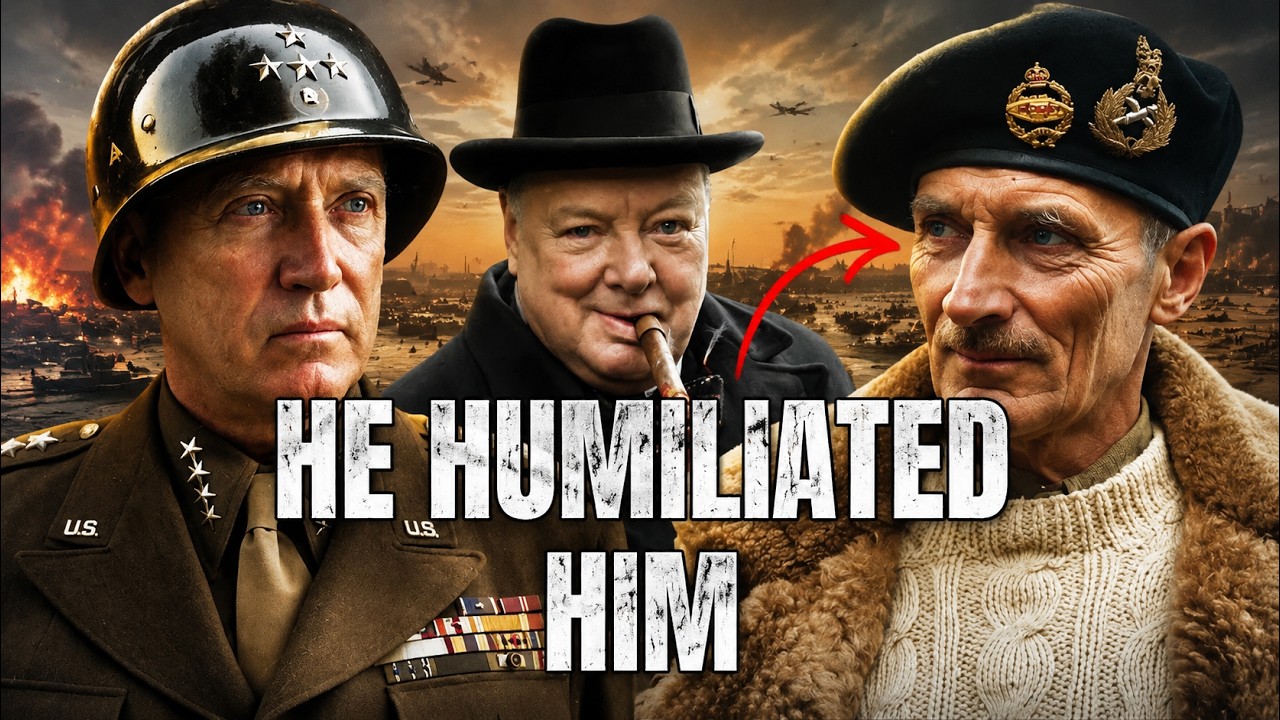 The shock that rippled through the war rooms of London and Washington DC that night was not one of surprise at the German defenses, but of disbelief at what George S. Patton had just accomplished with a handful of men against a roaring river. While the attention of the world, and the full might of the Allied armies, was pinned on the north, waiting for the colossal hammer blow of Field Marshal Bernard Montgomery’s Operation Plunder, Patton had simply unleashed a dagger in the dark.
He took 6,000 men, their rifles, and their bayonets, and refused to succor them with artillery or aerial support, thrusting theminstead into the black 300-yard wide void of the Rhine at Oppenheim. It was a maneuver that defied every tactical convention, a crossing that generals had claimed was impossible without a month of logistical build-ups. In the time it took to complete a ritual prayer, he had shattered the history of Europe.
It was a paradigm shift in the understanding of warfare that will be studied in academies for a century to come. Over 1 million Allied soldiers sat idle in the North, their supply dumps stretching for miles, their artillery pieces lined wheel to wheel, awaiting the perfect alignment of the moon and the stars for an assault that was still two days away. The Germans knew exactly where this frontal assault would come, because they saw it being prepared for months, and they rallied their forces to the north.
But in the south, where Patton launched his madness, there was no period of preparation for the German soldier. There was only the sudden emergence of a horde of screaming Americans rising out of the freezing water, with no warning, no initial positional shelling, and inhumanly, a will to cross that river. The efficacy of the response was instantaneous, precise, and absolute.
The German 159th Infantry Division, already decimated and under-supplied, were seized with a wave of shock they could not recover from, and within hours, the eastern bank was no longer a fortress, but a gateway.
The “what ifs” of history are indeed treacherous, but this night is not one of them. It was a betrayal of Montgomery’s theory of absolute firepower, of the methodical dominance that he had used as a shield against the Soviet advance and as a claim to British prestige. The military planners would be forced to ask whether the millions of tons of explosives used in the north, the thousands of emplaced artillery positions, and the deaths of his soldiers, which would happen in the Coming Battle, were necessary.
Woolfomb South, Churchill was pacing in his underground command waiting for the telegraph. The news arrived, and the world war changed in a moment. The Prime Minister, a man who had lived through the crisis of Gallipoli, and the Blitz, laughed a bitter, disbelieving laugh.
It was a laugh of pure vindication but also of sheer anger, because the report was a testament to the fact that they had all been looking in the wrong place, with the wrong map.
When the official telegraph reached him, the supreme Allied commander, General Eisenhower, understood the score instantly. Patton had done not just a military act, but a political one that would cement the end of the European war. The immediate result of that one night was not just a bridgehead.
It was a rout. Within 24 hours of Patton’s crossing, the German defense system in the south, which Hitler had vowed to hold at all costs, was now a system of scattered and demoralized units, cut off from command. The Germans who had, for six weeks, brought every single brigade to reinforce the north, were now left holding the bag in the south.
 The Third Army’s tanks rolled into Frankfurt just 7 days later, a distance that the High Command had expected to take twice as long, and the German city capitulated in a fraction of the time. His tactical audacity proved a simple thing: that the enemy you can’t see coming is worth 100 men you can. And Patton knew the turn.
It was Montgomery who carried the weight of Hitler’s constant attention. He had to carry the moral weight, too. Back in the war room, as the echoes of the laughter died in the concrete walls, he stood staring at the map, the imperial fist of greasy fate wrapped around his heart.
Montgomery had been presented with a scenario where his army was needed. He had been given the prize—the crossing of the Rhine—by the highest authority to solidify British dominance in the post-war world. He had thrown all his weight into preparation.
In his view, it was a final verdict on the efficacy of the doctrine of overwhelming set-piece force that he had developed in the desert. But what Patton proved was that this reliance on force was, in reality, a bondage. He had liberated himself with a simple algorithm: delay equals casualties; and the pace of the enemy’s reaction is the only weapon that matters.
The savage implication of the telegram shook the high command with the violence of a round being fired. Churchill did not send a telegram to Montgomery lauding his upcoming effort. Instead, he sent a message that, by all accounts of the day, was laced with an unfiltered cynicism that Phillips would have been wise to heed.
He commented on the fact that the enemy had caught him/masses unawares, and that a single American unit had crossed the river with ease. The message was a torpedo aimed at the British war effort’s prestige, and it hit the hull of the empire’s military reputation. It was a signal to every observer that the grand narrative that had taken shape since victory in North Africa—of the meticulous brilliance of the British intervention—could be nullified by a madman with a pistol and a paddle.
This was not only a military fact; it was a power play that played out in the sand.
The 48th hour after the crossing, Operation Plunder went ahead, exactly as all of the plans stated. It began with the most enormous signature display of strength the war had ever seen. 1,000 guns fired, 30,000 paratroopers dropped behind lines, and the sky above the Rhine disappeared behind the vulgar mass of 3,000 bombers.
It was a spectacle worthy of Patton’s commentary. Yet, the German defenders had seen it coming for three months. They had dug in, reinforced, and laid mines for the exact spot they knew would come.
 They exacted a terrible price for the British scheme. In this sense, because while these events were happening, George Patton was already moving his center eastwards at a speed that mocked the whole concept of logistics.
The rationale was no longer conventional war; it was a magnificent pursuit. Soldiers of the Third Army were augmented with a primal energy, their eyes glowing with the vividness of hunted men looking over their shoulder. They were not advancing in lines; they were advancing as a flood.
The tight battle-command of the German Army was fracturing. Prisoners were being captured not by the thousands, but in the tens of thousands, so quickly that the processing units could barely keep up. The war was not a stalemate, and had not been, but now it was played under the rules of a speeding express train.
In the face of a collapsing German front, the unification of the German generals became impossible. They could not defend a line that was already behind them. This alone was his advance.
But as the advance continued, the fog of war lifted and showcased a ghastly climate. On April 4, 1945, the Fourth Armored Division, on the forward line of the blitz into Thuringia, came through the town of Ohrdruf. They were expecting a military camp.
Instead, they entered a world that defied comprehension, one that took the entire war to reset the human heart. In the woods outside of town, they discovered a concentration camp—the first, but not the last, that they would find. The death stood in forms that the soldiers could not look at the right direction of and had to be forced.
It was a lone bullet, but they had entered a plane of existence that had been usually hidden, and any victory tastes turned to ashes in the mouth.
Patton, the ruthless fighting commander, was called to the scene. He arrived; Eisenhower and Bradley arrived. In a famous moment that would echo through history, Eisenhower ordered every soldier in the area to be taken to the camp, to see the evidence with their own eyes, so that the world would not be able to deny it.
Patton walked through the decomposing horror, and despite the fact that a man old soldier who had seen the war machine create so many enemies, he vomited. As he emerged, the facade broke, and he spoke the immortal truth: Now at least he will know what he is fighting against. This was the tangible result of his obsession with speed.
 The reason behind the man who had died from Shod, Georges South was the lead.
From the moment he crossed the Rhine, he knew his race had a higher purpose. His drive was not a military vanity; it was a rescue plan. The specifics of his speed, the relentless pushing of the tanks, the disregard for the living quarters of his own men, was not just for victory in battle but for victory over death itself for those who could not fight.
As the Third Army pushed toward Austria and Czechoslovakia, they found the evidence. The camps were not all extermination centers; many were work camps, but they were also not impossible if they and the results of that retardation were a final summation of the danger of delay. He discovered the Flossen Buerg, and Mautendausen, each a new level of descent into hell.
The catch, which would be studied as the meaning of the war, wasn’t the liberation of the camps—that was the consequence. The reason the survivor count was possible was specifically because he had moved fast.
By the time the German surrender came on May 8, 1945, he had a third army 11 months in the theater. They had taken 1. 5 million prisoners, which was unimaginable.
The total scope of his advance, which 𝓮𝔁𝓹𝓸𝓼𝓮𝓭 the Pentagon’s capacity to predict, could not have been achieved by any other man. The war was finished, but iends he was not able to shake himself. As was as sad, the peace was his punishment.
He had a monsters war and no monsters to fight. The stories of conflict that he had memorized in his youth had prepared him for this exact moment, not for the politics of occupation.
In the winter of 1945, he was injured in a car crash, a traffic accident on the side of a road that had not found a way to 𝓀𝒾𝓁𝓁 him until peaceful times. It was the final, tragic irony of his life. He died in a routine and undramatic way, in a hospital bed, of a blood clot.
He had engineered the ever that killed him in combat but he died in a civilian accident. Soldiers will remember him for the battle, but the historians will remember him for his philosophy. He taught the world that the lesson of the of the Rhine is never to wait.
A good, violent plan now is better than a perfect plan next week. That lesson was paid for in blood impossible, and it’s a lesson that ended the war and saved the souls of armies. That night, in the darkness of the Rhine, the narrative of twentieth century was written not by high command, but by the head of the gunmetal.

