The snow had fallen the night before, blanketing the Vosges Mountains of eastern France in a deceptive quiet. At 10:04 a. m.
on January 31, 1945, that silence was shattered by a single, deafening volley from twelve Springfield rifles. The bullets tore into the chest of 24-year-old Private Edward Donald Slovik, a former Detroit thief tied to a wooden post in the walled garden of a requisitioned chateau, his eyes covered by a black hood. Within seconds, a man who had never fired a shot in anger was gone.
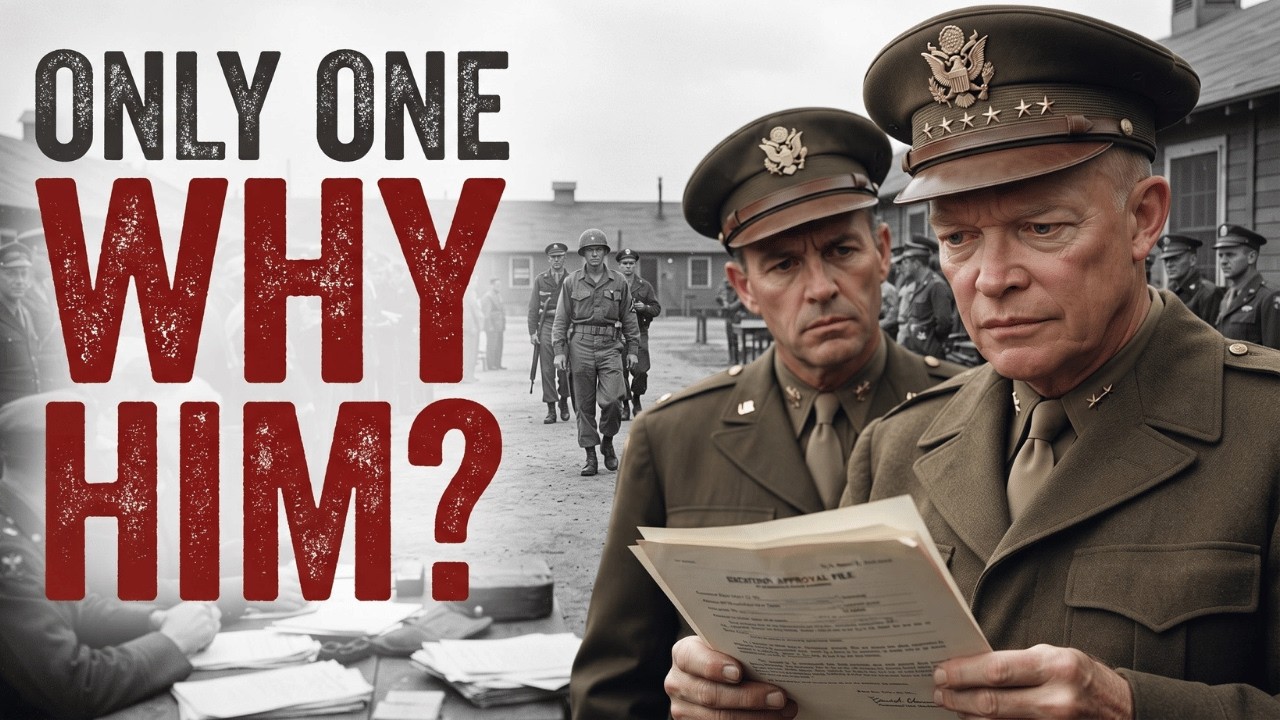 He had just become the only American soldier since the Civil War to be executed for desertion, a distinction that remains his alone today.
Slovik was not a hero; he was not a martyr. He was a scared, criminally recorded, 24-year-old former reformatory inmate who had made a fatal miscalculation. In the fall of 1944, with his 28th Infantry Division poised to enter the catastrophic fighting of the Hürtgen Forest, Slovik had gone to his commanding officer, Captain Ralph Grotte, and made a stark confession: he was too terrified to serve as a rifleman and would run away if forced to the line.
Captain Grot, a combat veteran who had already lost 42 of his original 180 men, gave Slovik every chance to reconsider.
But a terrified Slovik refused to take the rifle. He repeated his ultimatum to the regimental judge advocate the next day, and in a moment of catastrophic misjudgment, he insisted on cementing his fate in his own poor handwriting. He submitted a written confession, a single paragraph detailing his fear and his intention to desert again if returned to combat.
Two officers, desperate to save him, told him to tear up the paper and walk away, but Slovik insisted on the piece being entered into the record, convinced that a desertion conviction would land him a safe, ten-to-twenty-year prison stint.
 His plan was catastrophically flawed. The judge advocate was left with no choice but to convene a General Court-Martial, which, on the 11th of November 1944, found Slovik guilty of desertion to avoid hazardous duty. The court sentenced him to be dishonorably discharged, to forfeit all pay, and “to be shot to death with musketry.”
Slovik, who had hoped for a prison wall, smiled at the verdict, believing the army would never follow through on a punishment not carried out in 80 years. He was wrong.
The sentence moved up the chain of command for review. Major General Norman Cota, a hero of Omaha Beach who had lost over 6,000 men in just 14 days in the Hürtgen Forest, upheld the sentence, writing with a cold, logical reasoning, “I could not have looked in the face of one of my own men who had lost a friend at Vasanac and told him that Slovik was going to sit in a warm cell in England while he was going forward to die. I could not have done it.”
The file containing Slovik’s handwritten appeal, in which he begged for mercy for the sake of his wife, Antoinette, landed on General Dwight D. Eisenhower’s desk in Reims on the 22nd of December 1944. It was the darkest week of the war in Europe.
 Just six days earlier, the Germans had launched the Ardennes Offensive, killing American soldiers at a rate of 2,000 a day. Eisenhower held the files for twenty minutes, read the appeal three times, and then signed the execution order. He did so believing he was maintaining discipline in the midst of a potential catastrophic defeat.
Antoinette Slovik, the wife who had a disability and who had never believed she could find love, was told in February 1945 that her husband had died, merely. The telegram said, “died in the European area,” and did not mention the firing squad. For the next 34 years, she lived with the terrible truth after learning it from a journalist.
She had turned to the custody of seven presidents, begging for her husband’s body to be returned and for a widow’s pension, but every request was denied. She died in 1979, of breast cancer and poverty, without ever seeing her Eddie brought home.
It was only the work of Bernard Kulka, a Polish-American WWII veteran from Michigan, that brought Slovik’s bones back. For seventeen years — he fought for the repatriation, spending $8,000 of his own money, and his efforts were successful in 1987. The body was exhumed from the hidden Plot E at the Eisen American Cemetery and flown to Detroit for a re-interment ceremony.
 The cemetery had a plot reserved for that specific moment, reserved for an unknown husband, since Antoinette had been the one who purchased it 22 years earlier.
Eisenhower’s decision has remained a stain on American history. He never discussed the execution again, aside from a single sentence in his memoirs: “It was necessary.” Thousands of other soldiers deserted in WWII, and he had lenient leniency for 48 of them, but he drew the line at Eddie.
Even in the face of a written confession, he had refused mercy. The execution was a warning, a gruesome spectacle to buttress a shaky army in the face of the Bulge. He condemned a fatherless, ex-convict with a seventh-grade education who had no connections to save him.
Today, the headstones at Woodmere Cemetery in Detroit are positioned side by side, bearing the names Eddie D. Slovik and Antoinette W. Slovik.
They do not mention the desertion or the bullets. A small American flag is often found planted in the soil between them, and no one knows who puts it there. It serves as a quiet, enduring reminder of a forgotten tragedy of war—which is a soul’s ultimate sacrifice for a nation’s dishonor.