VERSAILLES, Dec. 26, 1944 — The cable arrived at Supreme Headquarters in the late afternoon, its terse operational language barely concealing the magnitude of what it reported. Third Army’s Fourth Armored Division had broken through the German ring at Bastogne.
The siege was over.
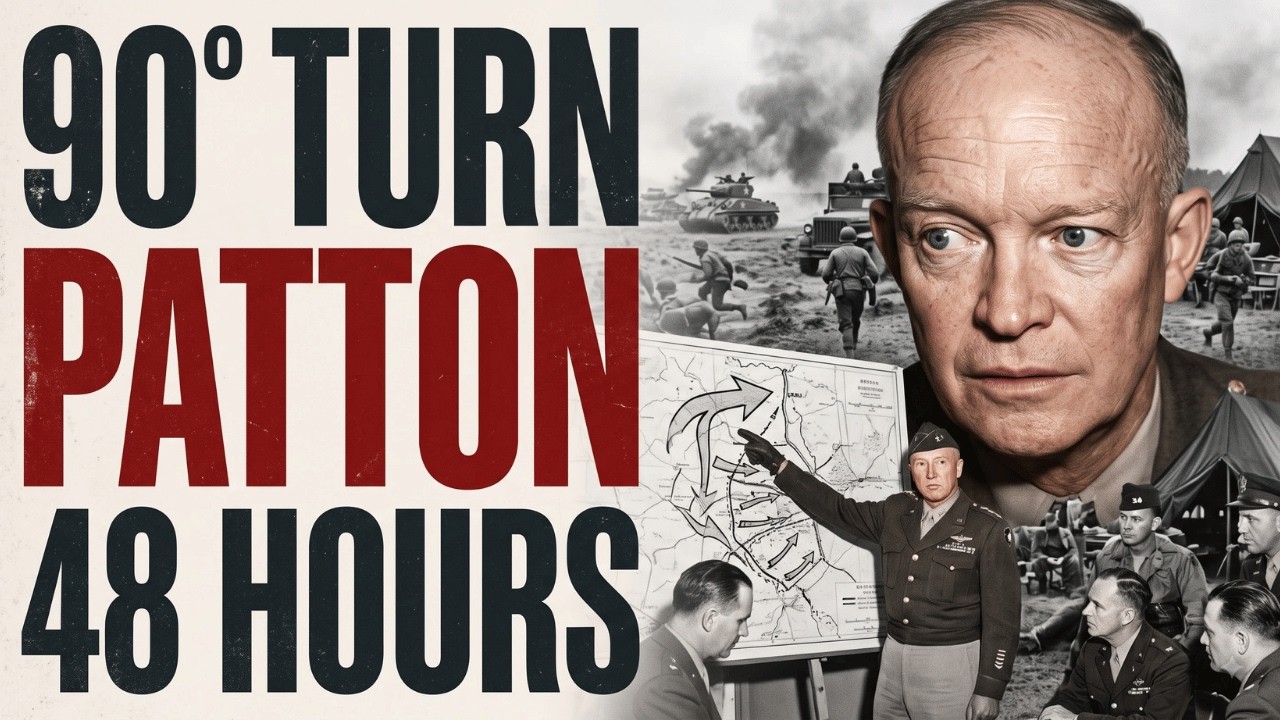 Dwight Eisenhower read the message in silence. He did not raise his fist. He did not summon his staff for a celebration.
The Supreme Commander of the Allied Expeditionary Force simply handed the paper to his naval aide, Commander Harry Butcher, and returned to the mountain of work on his desk — a desk buried under the weight of a crisis that had nearly broken the Allied war effort and a coalition dispute that threatened to tear it apart.
But as Butcher recorded in his diary that evening, Eisenhower allowed himself a single sentence of assessment. It was not a boast. It was not a victory cry.
It was a quiet, almost clinical acknowledgment of what had just occurred on the frozen roads of the Ardennes.
Patton has done what no other American general could have done.
That sentence, written in a diary and filed away in a presidential library, is the closest the historical record comes to capturing Eisenhower’s true reaction to the most audacious military maneuver of the European theater. It was not the stuff of legend. It was the stuff of a commander who had staked his campaign — and his command — on a promise made in a cold, unheated stone barracks in Verdun seven days earlier.
The promise itself had seemed impossible. The room had laughed. Eisenhower had not.
—
The conference at the Caserne de Jardin Fontaine began at 10 a. m. on Dec.
19, 1944. Sixteen officers — four British, twelve American — sat in wooden folding chairs facing a large map of the Ardennes. The only heat came from a small iron stove in the corner.
Cigar smoke hung thick in the air. Outside, the worst winter storm in 50 years continued to blanket Europe in snow and fog.
Three days earlier, roughly 30 German divisions had torn an 80-mile hole in the Allied front. The 106th Infantry Division had been effectively destroyed, with more than 7,000 men captured in the Schnee Eifel. The 28th Infantry Division had been shattered along the Skyline Drive.
The 101st Airborne was surrounded at Bastogne. Bradley’s headquarters in Luxembourg was cut off from the northern armies. If the German spearheads reached the Meuse River, they would be 60 miles from Antwerp.
If they reached Antwerp, the Allied coalition would be split in half.
Eisenhower opened the meeting with a declaration that has echoed through eight decades of military history: “The present situation is to be regarded as one of opportunity for us and not of disaster. There will be only cheerful faces at this conference table.”
Then he turned to the 59-year-old two-star general at the back of the room and asked the question that would define the next week of the war.
“George, when can you attack?”
George Smith Patton Jr. stood. He walked to the wall map.
He took a pointer and indicated a line running north from Arlon toward Bastogne.
“On December 22 with three divisions,” he said. “The Fourth Armored, the 26th, and the 80th.”
The room erupted in laughter. It was not a derisive laugh. It was the laugh of men who had just heard something so far outside the bounds of military possibility that it could only be a joke.
Patton’s Third Army was 250 kilometers south of Bastogne, oriented east, preparing to launch its own offensive across the Saar River into Germany — an attack scheduled for that very morning. To relieve Bastogne, Patton would have to pivot his entire army 90 degrees, disengage combat units currently in battle, move them 100 to 150 miles north through a blizzard, cross three rivers, and do it all in 48 hours.
No army in the history of warfare had ever done such a thing. Not in this weather. Not against this enemy.
Eisenhower did not laugh.
“Don’t be facetious, George,” he said.
Patton looked him in the eye. “I’m not being facetious, sir. I have three divisions ready to move.
My staff has prepared for this. I’m not asking your permission to try it. I’m reporting to you that I can do it.”
The room fell silent. Eisenhower looked at Bradley. Bradley nodded.
He knew what the others did not — that Patton had been preparing for this moment for ten days.
—
What the men in that room did not know was that Patton had not been surprised by the German attack. He had been surprised only by its timing. Ten days before the offensive broke, Patton’s chief intelligence officer, Colonel Oscar Koch, had walked into the morning staff briefing at Third Army headquarters in Nancy and delivered a formal assessment: the Germans were massing up to 13 divisions, including five panzer divisions, opposite the American VIII Corps in the Ardennes.
 They were preparing to attack.
Other Allied intelligence officers had seen the same signs. Colonel Benjamin Dixon at First Army had grown uneasy. Major General Kenneth Strong at Supreme Headquarters had concluded the Germans were incapable of a major offensive.
Brigadier General Edwin Sibert at 12th Army Group had done nothing. They all read the same reports. They all reached the same conclusion: the German army in the west was too depleted for a strategic attack.
Koch did not think so. And Patton believed him.
“I ought to know what I’m doing,” Patton wrote in his diary. “I have the best damned intelligence officer in any United States command.”
On the 9th of December, Patton ordered his chief of staff, Major General Hugh Gaffey, and his operations chief, Colonel Halley Maddox, to prepare three contingency plans — three different axes of counterattack, each with a code word, each ready to be executed on a single phone call. He did this while continuing to plan Operation Tink, his own eastward offensive across the Saar, scheduled to begin on the morning of December 19.
Third Army was preparing two opposite operations simultaneously. Nobody outside Third Army headquarters knew.
Patton also did something almost no other American army commander in Europe did that autumn. He sent Koch’s intelligence appreciation directly to Eisenhower’s own G2 at Supreme Headquarters, bypassing Bradley, bypassing 12th Army Group. Eisenhower saw the report.
He handed it to Bradley. Bradley’s G2 forwarded it to First Army’s G2. Everyone in the American chain of command received Koch’s warning between December 9 and December 15.
Only Patton acted on it.
—
When the German artillery opened at 5:30 a. m. on December 16, Patton was ready.
When Bradley called on December 18 to order the 10th Armored Division north and to summon Patton to Verdun, Patton had already told Bradley he was ready. When Patton hung up the phone, he turned to Gaffey and Maddox and said, roughly: “Get the plans ready. We are going to need them tomorrow.”
The drive to Verdun on the morning of December 19 was conducted in blackout conditions through blowing snow. Patton was unusually quiet, focused. He arrived at the Caserne de Jardin Fontaine at approximately 9 a.
m. Eisenhower arrived shortly after, driven 400 kilometers from Versailles through the same storm by Kay Summersby.
The conference lasted approximately two hours. After Eisenhower said “Do it,” Patton excused himself, walked into the hallway, found a telephone, and got through to Nancy. He said two words to Gaffey: “Play ball.”
Third Army began to move before the conference had even ended.
—
What followed over the next 72 hours has been studied by military historians for eight decades. The temperature dropped to 20 degrees below zero centigrade. Blizzards came in waves.
Roads were pack ice under layers of new snow. Bridges over the Moselle and the Sauer had been blown or damaged months earlier. The Fourth Armored Division moved first — roughly 150 miles from staging areas around Nancy to attack positions south of Bastogne in three days.
The 26th Infantry Division moved 100 miles from Metz to Arlon. The 80th Infantry Division moved 100 miles from Nancy to Luxembourg City.
Behind the combat divisions came the artillery, the engineers, the signal battalions, the medical companies, the supply trains, the gasoline tankers. Third Army moved as an organism. Six hundred combat vehicles per hour on some sections of highway.
Bumper-to-bumper convoys in blackout. Soldiers slept in vehicles under overcoats. When they had to relieve themselves, they did it standing on the running boards because getting down into the snow meant frostbite by morning.
On December 22, Third Army’s northern attack jumped off at dawn from Arlon. Fourth Armored on the left, 26th Infantry in the center, 80th Infantry on the right. The advance was slow.
German resistance was fierce. Snow drifts reached the tops of the tank tracks. Fourth Armored took serious casualties on the first day.
Third Army made only 10 to 15 kilometers of progress by nightfall.
At Bastogne that same morning, at approximately 11:30, a small German delegation crossed American lines under a white flag. They handed over a typewritten surrender demand from the commander of the German forces surrounding the city. It gave Brigadier General Anthony McAuliffe two hours to consider unconditional surrender.
If he refused, the demand stated, the German artillery would destroy the city.
McAuliffe, a 46-year-old field artilleryman who had inherited command of the 101st Airborne at 24 hours notice when the division commander was in Washington, read the demand. He looked up at his staff. He asked, half-joking, what he should write back.
His staff made suggestions. None satisfied.
 Then McAuliffe took a pencil and on the back of the German paper, in block capitals, wrote one word: “Nuts.”
He handed it to Colonel Joseph Harper of the 327th Glider Infantry. Harper walked it out to the German delegation at the perimeter. The German officer read the word.
He looked up. “What does this mean?”
Harper said: “It means the same as go to hell.”
The German delegation was escorted back to their lines. The perimeter held.
—
On the morning of December 23, after six days of fog so thick that no Allied aircraft could fly, the sky cleared. The sun came out. C-47 transports of the IX Troop Carrier Command lifted off from bases in England within hours and began flying parachute supply drops into Bastogne.
Over three days, they dropped approximately 850 tons of supplies — ammunition, food, medical supplies, winter clothing, batteries for radios. At the same time, P-47 Thunderbolts of the XIX Tactical Air Command began ground attack sorties against the German columns surrounding the town.
Chaplain James O’Neal’s weather prayer, printed on pocket cards and distributed to 250,000 men of the Third Army earlier in December, was suddenly the most talked-about piece of paper in the American command in Europe. Patton is said to have looked out his headquarters window at the clear sky and said: “Damn fine prayer, O’Neal.”
Whether the prayer worked is a theological question. What is inside the record is that on December 23, the fog cleared, the aircraft flew, and Bastogne received the supplies that would keep it alive.
—
On Christmas Day, the Germans launched their heaviest single attack on Bastogne. Panzer Lehr, 26th Volksgrenadier, and 15th Panzergrenadier hit the western perimeter simultaneously. The 101st Airborne held.
The 10th Armored Division held. American artillery firing unregistered points at close range broke the assault by early afternoon.
That same Christmas day, Patton spent the day at his forward headquarters in Luxembourg, watching the situation maps of the Fourth Armored Division and asking every hour when Gaffey’s tanks were going to break through. The maps showed slow, grinding uphill progress — meters per hour, not kilometers.
On December 26, late afternoon, the Fourth Armored Division broke through the outer German defenses south of Bastogne. The 37th Tank Battalion, commanded by Lieutenant Colonel Creighton Abrams, was the leading unit. Ahead of Abrams’ tanks lay the village of Assenois, defended by paratroopers of the German 5th Fallschirmjäger.
Around 16:20, Abrams made his decision. He called his artillery to lay a curtain of fire directly on Assenois. He called his lead tank — Cobra King, commanded by First Lieutenant Charles Boggess — and told him to drive straight through the village at full speed under the American artillery falling around him.
Boggess did exactly that. Cobra King and four other Sherman tanks of the 37th accelerated down the road into Assenois. American shells fell on either side.
The German paratroopers, unable to see through the smoke, did not have time to bring anti-tank weapons to bear. The tank column burst out the far side of the village at approximately 16:50.
The lead Sherman rolled up on a group of American engineers of the 326th Airborne Engineer Battalion dug in at the southern edge of the Bastogne perimeter. Boggess stood up in his commander’s hatch. He called out to the men in the foxholes: “Come on out.
This is the Fourth Armored.”
The engineers, who had been under artillery fire and small arms fire and siege for over a week, walked up out of their positions and looked up at the tank. A young officer, Lieutenant Duane Webster, walked over and shook the tank commander’s hand. The words exchanged were not dramatic.
Both men were cold. Both were tired. Both knew exactly what had just happened.
Boggess said: “I’m Lieutenant Boggess of the Fourth Armored Division. Glad to see you.”
Webster said: “I’m Lieutenant Webster of the 326th Engineers. Glad to see you.”
That was the moment. Bastogne was relieved.
—
Word went back through Fourth Armored to Third Army headquarters. From Patton to Bradley, from Bradley to Eisenhower. Cables crossed Europe within the hour.
At Versailles, Dwight Eisenhower read the message. He did not celebrate. He did not call his staff together for a photograph.
He read the message. He handed it to Butcher. He went back to work on the problem of Montgomery and the northern front — which was at that moment his other, quieter crisis, and which by December 30 would nearly make him draft a cable of resignation.
Butcher wrote in his diary that evening the sentence that has come down as the closest thing we have to Eisenhower’s real reaction on the day: “Bastogne was relieved. Ike said, ‘Patton has done what no other American general could have done.’”
 Not a speech. Not a celebration. A sentence.
That was Eisenhower’s real reaction. That was what he actually felt. The war did not stop when Boggess shook hands with Webster.
The fighting for Bastogne continued for another three weeks. The Germans launched further attacks on the corridor Fourth Armored had opened. Third Army had to widen it under continuous German artillery.
Fourth Armored took more casualties on December 27, 28, and 29 than it had taken on the day of the breakthrough.
On December 29 at Versailles, Field Marshal Montgomery sent Eisenhower a personal letter demanding that Eisenhower place all Allied ground forces under a single ground commander for the offensive after the Bulge. He recommended, tactfully, himself. Eisenhower drafted a cable the next day telling the Combined Chiefs of Staff that they had to choose between him and Montgomery.
That crisis was averted at the last possible hour on December 31 by Montgomery’s chief of staff, Freddie de Guingand, flying through winter weather to Verdun.
But it is one measure of the weight Eisenhower was carrying that on the same days Third Army was breaking through to Bastogne, the Supreme Commander was less than 24 hours from resigning.
—
First Army pressed down from the north under Hodges. Ninth Army held on the northern flank under Simpson. Third Army pushed north and east through the frozen forest.
On January 16, 1945, Third Army linked up with First Army at Houffalize, closing the base of the Bulge. On January 17, First Army was returned to Bradley’s operational command from Montgomery’s temporary control. On January 25, 1945, the last German salient was pushed back to the original line of December 16.
The Battle of the Bulge was formally over.
American casualties: 75,482, of whom 8,497 had been killed in action. British and Commonwealth casualties: 1,408, of whom about 200 had been killed. On January 18, 1945, Winston Churchill rose in the House of Commons and reminded the British public that American troops had done almost all the fighting and had suffered almost all the losses.
The German army lost roughly 100,000 men. It also lost most of the panzer reserves Hitler had been holding for the defense of the Reich. When the Allies crossed the Rhine in March 1945, they crossed against a German army that had already been broken in the Ardennes.
—
Patton kept moving. He crossed the Rhine at Oppenheim in the last week of March. He advanced into central Germany in April.
His Third Army reached Czechoslovakia in the first week of May. On May 8, 1945, the war in Europe ended. Patton had by then driven farther east than any other Allied army commander.
Eight months later, on December 9, 1945, on a road near Mannheim, Germany, Patton’s staff car collided at low speed with a 2½-ton truck. He suffered a broken neck and paralysis from the shoulders down. He died in a hospital in Heidelberg on December 21, 1945, at the age of 60.
He was buried in the Luxembourg American Cemetery at his own written request, among the enlisted men of Third Army who had been killed in the Ardennes. He is still there. Anyone can visit.
Eisenhower survived the war. He served as chief of staff of the United States Army. He served as Supreme Allied Commander of NATO.
He served two terms as the 34th president of the United States. He died at Walter Reed General Hospital on March 28, 1969, of congestive heart failure, at the age of 78. He was buried in Abilene, Kansas.
His memoir, Crusade in Europe, published in 1948, spoke of Patton’s Third Army performance during the Bulge in language that has been quoted ever since: “Patton’s counterattack was one of the most brilliant performances by any commander during the whole war.”
He never publicly said more than that. He kept faith with Patton for the rest of his life.
—
The record is still there. Every letter, every diary entry, every cable, every casualty return, every intelligence estimate — filed, cataloged, preserved, open to anyone who cares to look.
The barracks in Verdun where the promise was made is still there. So is the highway from Arlon to Bastogne where the Fourth Armored fought its way north in the blizzard. So is the crossroads at Assenois where Boggess made his run.
So is Cobra King, the specific Sherman tank, rediscovered in 2001 abandoned on a German military installation, restored by the United States Army, and put on public display at the National Armor and Cavalry Museum at Fort Benning, Georgia. Anyone can go and stand beside it and place a hand on the front glacis plate.
And in the archives, in the diary of a naval aide, filed away in a presidential library, is the sentence that captures what Dwight Eisenhower really felt on the evening of December 26, 1944, when the impossible promise made in a cold stone room at Verdun had been kept:
“Patton has done what no other American general could have done.”
That was the real reaction. Anyone can look it up.