WASHINGTON — The telephone rang in the chief of staff’s office on the afternoon of December 21, 1945. Dwight David Eisenhower picked it up and listened without speaking. On the other end of the line, 4,000 miles away in a hospital room in Heidelberg, Germany, the man who had been his closest friend in the Army for more than a quarter of a century had just died.
George S. Patton Jr. was gone, taken not by a German bullet but by a blood clot that traveled from his paralyzed legs to his lungs, twelve days after a low-speed car crash broke his neck near Mannheim.
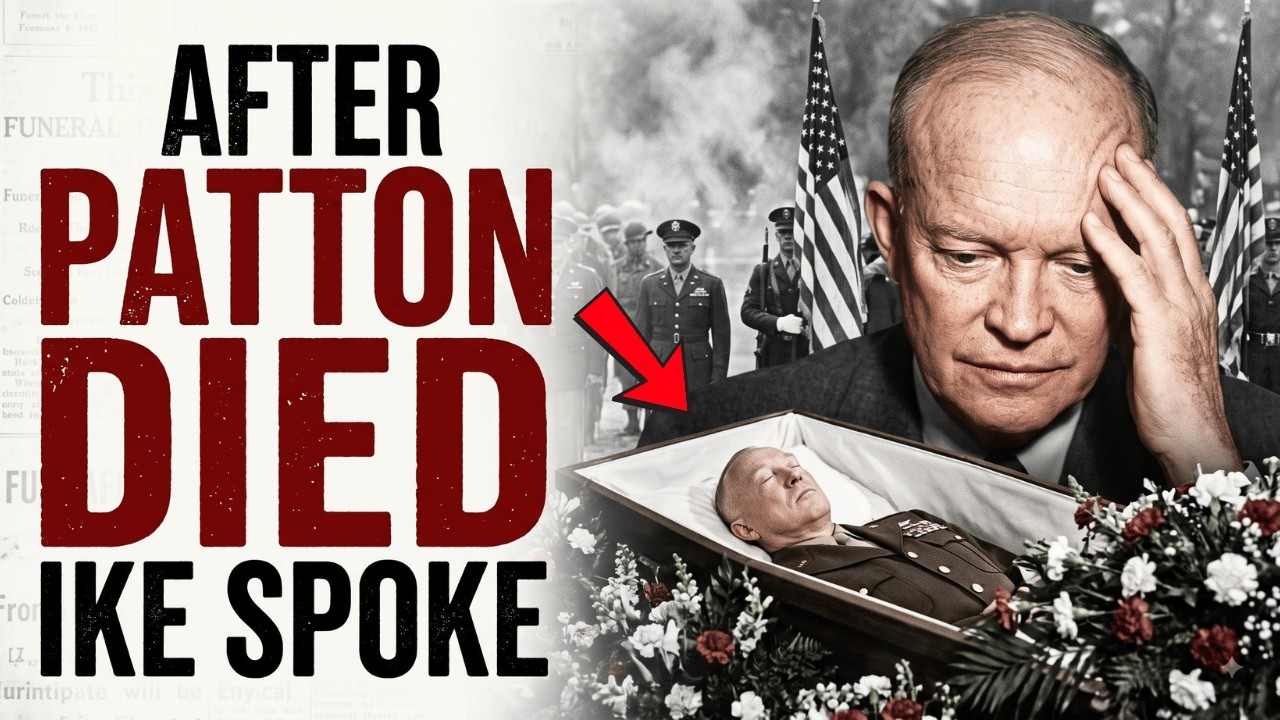 Eisenhower hung up the phone. He did not weep in public. He did not issue a statement that revealed anything beyond the formal condolences expected of the new Army chief of staff.
But something in him shifted in that moment, and over the next two decades, in memoirs, in private letters, and in carefully chosen words at public events, Eisenhower began to say what he had never been able to say while Patton was alive.
The friendship that ended in that hospital room began in the spring of 1919 at Camp Meade, Maryland, a scrappy collection of wooden barracks and muddy drill fields halfway between Washington and Baltimore. The First World War had ended six months earlier, and the Army was already shrinking, dismantling divisions, cutting budgets, and reducing officers in rank. In the middle of this dismantling sat a tiny experimental unit called the Tank Corps, staffed by a handful of officers with almost no funding and a collection of surplus French Renault tanks.
Two young captains believed this forgotten unit mattered. Patton, 33, was a wealthy Californian with a Confederate grandfather killed at Winchester, an ivory-handled Colt on his hip, and a combat record that included leading the first American tank attack in France, where he was shot through the thigh at Cheppy. Eisenhower, 28, was a poor Kansan from a Mennonite family who had graduated from West Point in 1915, missed combat entirely, and spent the war training tank crews at Gettysburg, haunted by the fact that he had never fired a shot at an enemy.
The two men lived on the same street at Camp Meade. Their wives became friends. Their children played in the same yards.
And on long evenings after training, they sat together over coffee and whiskey, imagining a new kind of warfare. They wrote articles arguing for an independent tank arm, predicting fast, concentrated armored columns that would punch through defensive lines and break armies by speed and shock. The Army’s senior generals told them to stop.
The chief of infantry warned Eisenhower that publishing radical ideas about armored breakthroughs would ruin his career. Patton, with his private income and family estate, could afford to ignore the threat. Eisenhower, with a wife and a small son and no money to fall back on, could not.
He learned to be quiet, to smile at generals whose ideas he privately thought foolish, to write carefully, to survive by not making enemies. Patton never learned this. He did not want to learn it.
That difference, small in 1919, would grow into something enormous over the next quarter century.
By 1942, the world had changed. Germany had invaded Poland and France with the exact kind of mechanized warfare Patton and Eisenhower had imagined at Camp Meade. Eisenhower had been promoted rapidly by George Marshall, rising from lieutenant colonel to commander of the entire European theater in London.
Patton, five years older and a decorated combat veteran, was now taking orders from a man who had never fired a rifle in anger. The balance of their friendship shifted overnight. Patton wrote in his private diary that Eisenhower had become too political, too careful, too concerned with coalition politics.
Eisenhower saw it differently. He was managing an alliance of nations that hated each other almost as much as they hated the Germans, answering to Roosevelt, Churchill, and Marshall, holding together British, French, and Soviet generals in a fragile balance. He did not have the luxury of being Patton.
Every reckless word from his old friend landed on his desk to be cleaned up.
The first crisis came in Sicily in August 1943. Patton, commanding the Seventh Army, had raced across the island, but in two field hospitals he exploded at soldiers suffering from combat fatigue, slapping one, threatening another with his pistol, calling them cowards. The reports went up the medical chain of command to Eisenhower’s headquarters.
Eisenhower had a choice: court-martial Patton publicly and end his career, or bury the incident and hope it never came out. He chose a third path. He wrote Patton a personal letter of reprimand, one of the harshest documents he ever wrote, ordered him to apologize to the soldiers, the doctors, the nurses, and every unit of the Seventh Army in formation.
Patton did it, weeping while he stood in front of his men. Eisenhower kept it quiet for three months. Then the radio commentator Drew Pearson revealed the whole story to the American public.
Congress demanded Patton’s head. Newspapers ran editorials calling for his removal. Eisenhower defended him to Congress, to Marshall, to the president, putting his own reputation on the line to keep his old friend in uniform.
By the spring of 1944, Patton was too controversial for a headline command. Eisenhower gave Bradley the assault on Normandy and gave Patton something that looked like a demotion: command of a phantom army. Around Dover, the Allies built a fictional army group with rubber inflatable tanks, plywood landing craft, 𝒻𝒶𝓀𝑒 radio traffic, and even 𝒻𝒶𝓀𝑒 sewage.
Patton, furious, wrote to his wife that he felt like a museum piece being put on display. What he did not know was that he was the most important weapon of the entire D-Day deception. German intelligence believed Patton was the most dangerous American commander in the war.
Hitler himself asked where Patton was when he wondered where the invasion would come. Patton was in Dover, pointing at Calais, so the Germans held the 15th Army, over 100,000 men and hundreds of tanks, at Calais for weeks after D-Day while the real invasion at Normandy ground inland. Every day those German divisions stayed at Calais, American and British soldiers on the beaches were being saved.
Eisenhower could not tell Patton this. The secret was too closely held. Patton went on believing his old friend had betrayed him.
On August 1, 1944, the phantom army became real. Patton took command of the Third Army and launched the fastest sustained advance in the history of modern warfare. In one month, his tanks covered ground that armies in the First World War had needed years to gain, liberating hundreds of French towns and villages.
In the second week of August, he pushed toward the town of Falaise, where tens of thousands of Germans were nearly surrounded. Bradley ordered him to stop, worried about coordination with Montgomery’s Canadians. The gap stayed open for two days, and between 20,000 and 50,000 German soldiers escaped.
Patton was furious, writing in his diary that the war could have been shortened by months. By September, a bigger fight had broken out. Eisenhower chose a broad-front strategy, dividing fuel and supplies among all armies, then diverted a huge share to Montgomery’s failed Market Garden operation.
Patton, sitting in eastern France with tanks running out of gasoline, wrote one of the bitterest lines of his diary: Ike is the best general the British have.
 Then came December 16, 1944, when the Germans launched their last great offensive through the Ardennes Forest. The 101st Airborne was surrounded at the crossroads town of Bastogne. Eisenhower called an emergency conference at Verdun on December 19.
The mood was grim. Bradley looked shaken. Montgomery was on the sidelines.
Eisenhower turned to Patton and asked how long it would take him to attack. Patton reached into his pocket, pulled out a small notebook, and said, December 22nd, three divisions, 72 hours. He had already wargamed the scenario on the train ride to Verdun.
Eisenhower knew when Patton was bluffing. Patton was not bluffing. On the morning of December 22, three divisions of the Third Army slammed into the German southern flank, attacking through snow and ice in some of the worst winter weather Europe had seen in a decade.
Four days later, elements of the Fourth Armored Division punched through the German cordon and relieved the 101st. The Bulge held. The last great German offensive of the war had failed.
Eisenhower wrote to Marshall on New Year’s Day that Patton had done a magnificent job. But he did not tell Patton that. One month later, in a private memo ranking his American commanders, Eisenhower placed Patton third, behind Bradley and Bedell Smith, for political reasons.
The private truth could not be put on paper. Not yet.
The war ended in May 1945, and within four months everything about Patton that had been an asset in wartime became a liability in peace. Appointed military governor of Bavaria, Patton refused to fully carry out denazification, arguing that removing every former Nazi from every position would collapse the civil administration. On September 22, 1945, at a press conference in Bad Tolz, he told reporters that most Nazi party members were ordinary people, no different from the way Americans belong to the Republican or Democratic parties.
The story exploded across the American press. Editorials called for his removal. Jewish organizations spoke out publicly.
Eisenhower once again had to act. On September 28, at the IG Farben building in Frankfurt, the two men met for one of the most difficult conversations of their 30-year friendship. On October 7, Patton was relieved of command of the Third Army and reassigned to a paper command, the 15th Army, tasked with writing the official history of the war.
He wrote in his diary that his career was finished. He wrote to his wife that he felt lost. Historians who studied his letters from that period describe his tone as depressed and disoriented.
Three weeks later, on the morning of December 9, 1945, Patton climbed into the back seat of a 1938 Cadillac staff car with his chief of staff, Major General Hobart Gay, for a hunting trip near Speyer. At a crossroads on the outskirts of Mannheim, an Army truck turned across the road in front of them. The vehicles collided at low speed.
Neither driver was going fast enough to cause serious injury under normal circumstances. Patton was thrown forward, his head striking the metal frame that separated the front and rear compartments. His neck snapped between the third and fourth cervical vertebrae.
He was paralyzed from the neck down. They took him to the 130th Station Hospital in Heidelberg. He lived for twelve more days, fully conscious, able to speak and think clearly, unable to move anything below his chin.
Beatrice Patton flew across the Atlantic and sat with him, reading to him, writing letters for him, holding his hand where he could not feel it. He knew he was dying. So did she.
So did the doctors. His old subordinates from the Third Army came to pay their respects, standing at the foot of the bed, saying very little, then going out into the corridor and weeping. Eisenhower was not among the visitors.
He was in Washington, having taken over from Marshall as chief of staff just three weeks earlier, in the middle of demobilizing the largest army in American history. He did not fly to Heidelberg. Some historians interpret this absence as a final coldness.
Others see it as the reality of a chief of staff who could not leave Washington that month. Whatever the reason, the fact stands. In the last twelve days of George Patton’s life, the friend of a quarter century did not come to sit at his bedside.
On the afternoon of December 21, 1945, quietly, without pain, George Smith Patton Jr. died in his sleep. A pulmonary embolism had traveled from his motionless legs to his lungs.
He was 60 years old. Three days later, on Christmas Eve, he was buried at the American military cemetery at Hamm in Luxembourg, at the head of his men, as he had requested. A simple white marble cross marked his grave.
Eisenhower did not come. He sent a telegram saying America had lost her most colorful and brilliant field commander. Formal words.
Diplomatic words. The same measured language he had used for the entire war. But something had changed.
And in the months and years that followed, in private conversations, in letters to friends, and eventually in his memoir, Eisenhower began to say things about George Patton that he had never allowed himself to say while Patton was alive.
In 1948, Eisenhower published Crusade in Europe. He dedicated significant sections of the book to Patton, praising his driving power, his ability to accomplish what other commanders could not. He described Patton in terms he had never quite used in wartime: brilliant, uniquely gifted.
 And in describing what Patton had done at Bastogne, he used a word that carried weight because Eisenhower did not throw it around casually. He called Patton indispensable to the war effort. That word means irreplaceable.
It means the outcome would have been different without him. Coming from a man as careful with words as Dwight Eisenhower, it was as close to a definitive statement as he was ever going to make. He was saying on the record, in a book that millions of Americans would read, that without George Patton, the Allies might not have won the war in Europe when they did.
He never said it that plainly in 1943 when he was defending Patton from Congress. He never said it in 1944 when he was using Patton as bait in Operation Fortitude and could not tell his old friend the real reason. He never said it in February 1945 when he was ranking American commanders in a private memo and had to place Patton third for political reasons.
He said it in a book, three years after Patton was in the ground.
Over the following years, in interviews, in letters to old comrades, in the second volume of his memoirs, and in his later book At Ease, published in 1967, Eisenhower kept returning to the memory of George Patton. He would talk about the days at Camp Meade. He would talk about the difficult decisions he had made during the war.
He would sometimes admit, more openly than he ever had while Patton was alive, that some of the times he had held Patton back had been for political reasons, not military ones. That some of those decisions still weighed on him. He would say, in different ways at different times, the same thing: Patton had been uniquely built for the war they had fought.
In the chaos and speed and improvisation of mechanized combat, in the moments when everything was collapsing and someone had to make an instant decision and drive an army forward through impossible conditions, George Patton had been better than any other American commander. And in peacetime, those same qualities had nowhere to go. They had turned into liabilities.
They had gotten him removed from command. They had probably shortened his life. Ike never said publicly that he regretted removing Patton from the Third Army in October 1945.
He was too disciplined an officer for that. But he did say in his later years that managing Patton had been the hardest and most important part of his own command in Europe. Patton needed to be managed.
But he also needed to exist. Without Patton, some of the things Eisenhower had accomplished would not have been accomplished, and Eisenhower knew it.
The historian Carlo D’Este, who spent years writing biographies of both men, concluded that Eisenhower had spent the war walking a tightrope with George Patton, defending him publicly, disciplining him publicly, depending on him privately, restraining him privately, managing a friend who was also a subordinate, managing a subordinate who was also an American genius of war. And only after Patton was dead could Eisenhower finally say what he had always known. Ike went on to become president of the United States in January 1953.
He served two terms, led America through the early years of the Cold War, through Korea, through the beginnings of the arms race with the Soviet Union. He was the last American president to have led an army in a great war. He never fought another war.
He never commanded another army. He died on March 28, 1969, at Walter Reed General Hospital in Washington at the age of 78. Beatrice Patton did not live to see him become president.
She died on September 30, 1953, from an aortic aneurysm rupture after being thrown from a horse near her home in Hamilton, Massachusetts. She was 67. Patton, at his own request, remains alone at Hamm, at the head of his men.
The cemetery is still there, maintained by the American Battle Monuments Commission. Visitors come. Most of them do not know the story of the man in the front row.
They see only a white cross with a name, and behind him row after row of American dead from a winter campaign in a war that ended before most of the visitors were born.
But the story is there. It is the story of two young captains who met at Camp Meade in 1919 and imagined a new kind of warfare together. It is the story of one of them becoming a strategic commander and the other becoming a battlefield commander, and how the differences between them, small in 1919, grew into something that reshaped both of their lives.
It is the story of a friend who spent an entire war having to manage his oldest friend, to protect him from himself and from politicians and sometimes from the newspapers, to put him where the enemy would fear him most even when he could not tell him why, to use him as a weapon when the war demanded it and to hold him back when the war did not, and finally to remove him from command when there was no other choice. And it is the story of a man who could only tell the truth about his friend after his friend was gone. Who spent the rest of his own life quietly saying, in book after book, in interview after interview, in his later years and into his old age, the things he had not been able to say in 1943 or 1944 or 1945.
That George Patton was irreplaceable. That the war might have gone differently without him. That managing him had been the hardest thing Eisenhower had ever done.
And that in the end, when the crisis came at Bastogne and there was no one else who could pivot an army in 72 hours through freezing weather to save a surrounded division of paratroopers, only George Patton could do what needed to be done. Ike had turned to him. Ike had asked him.
And Patton, without hesitation, had delivered. That was the truth. That was the admission Ike could only make after the ground had closed over his oldest friend on a hillside in Luxembourg on Christmas Eve, 1945.
He had spent almost 30 years knowing it. He had spent three years unable to say it. And he spent the rest of his life in careful, measured, honest words, quietly saying it at last.
There is one final thing to say about this story, and it is the piece that most tellings leave out. The war between Eisenhower and Patton was not really between two men. It was between two ways of being a soldier in the 20th century.
Patton was the last great commander of a kind of war that America would never fight again. A war of movement, of massed armor sweeping across open ground, of divisions punched forward by one man’s will and instinct. A cavalry commander in a mechanized age.
 Someone who could look at a map, see the terrain, feel the enemy, and make a decision in 20 seconds that would take other generals a week. He belonged in a strange way to the older world, the world of Napoleon and Grant and Sheridan and the great captains of history. He read their books at night.
He believed seriously that he had lived in some of their times before. He was the last American general who could talk that way without sounding ridiculous. Eisenhower was the first great commander of a new kind of war.
A war of coalitions, of logistics, of politics, of relationships between prickly national commanders who each had their own agendas and their own home governments to please. Eisenhower’s genius was not in leading troops from the front. His genius was in getting Roosevelt, Churchill, Marshall, Montgomery, de Gaulle, Bradley, and Patton himself all pulling roughly in the same direction on the same day.
That is not a small thing. That is one of the hardest things a human being can do. And Eisenhower did it for three years without breaking, without losing his temper in public, without playing favorites in a way that would fracture the alliance.
He held the whole thing together. He was in a way the first modern American general. The first one who understood that in the 20th century, war would be run out of an office in a quiet building far from the front, by a man in a plain uniform who spent his day answering telephones and reading dispatches and calming people down.
Patton could not have done that job. He would have punched somebody within the first week. Roosevelt would have removed him within the first month.
But Eisenhower could not have done Patton’s job either. Ike did not have that kind of instinct on the battlefield. He had never led troops in combat.
He had spent his war years managing men who did. The one time he came close to that kind of decision, at Bastogne on December 19, 1944, the answer he needed was a man who could pivot an army in 72 hours. And he did not have it inside himself.
He had to reach across the table and ask George Patton for it. That was the relationship. It was not equal.
It was not simple. It was not even always friendly. But it was real, and it was necessary.
And neither man could have done what he did without the other. Ike knew that. He knew it during the war.
He could not say it during the war. And he could not fully say it right after Patton died either, because the political situation was still delicate, because there were still choices being made about how to remember the war, because Bradley was still alive and would remain alive for another 36 years and would eventually publish his own memoirs in which he was in places less generous to Patton than Ike would have wanted. Ike said it slowly.
Book by book, year by year. A word here in Crusade in Europe. A paragraph there in At Ease.
An anecdote in a speech at West Point in the 1950s. A comment to a young officer in a private hallway. A letter to a friend who had served under both of them.
And by the time Eisenhower himself died in the spring of 1969, 24 years after Patton, the record was there. If you knew where to look. The record of a friendship.
The record of a partnership. The record of one man’s slow, deliberate, decades-long effort to say in a way that history could hear that George Patton had been the finest combat general the American army had ever produced. He had known it in 1919 in the porch talks at Camp Meade.
He had known it in 1943 in North Africa when he sent Patton to fix II Corps after Kasserine and Patton did it in six weeks. He had known it in 1944 when he watched from London as Patton’s Third Army raced across France faster than any army in history. He had known it in December 1944 when he needed a miracle at Bastogne and Patton delivered one.
He had known it in October 1945 when he had to sit across the desk from his oldest friend and take away his command and go home that night and write in his own diary that it had been one of the hardest things he had ever done. He had known it on December 21, 1945, when the telephone rang in Washington and the news came from Heidelberg. He had known it on Christmas Eve 1945 when he chose to stay in Washington rather than fly to Luxembourg to see George Patton put in the ground.
And he spent the last 23 years of his own life quietly, patiently, in his own careful way, making sure that history knew it too. There is a photograph taken at Camp Meade in the early 1920s that survives in the Eisenhower Presidential Library in Abilene, Kansas. It shows two young men in uniform standing next to a Renault tank.
Both of them are captains. Both of them are smiling. Neither of them knows yet what the next 25 years will bring.
The taller one on the left, with the ivory-handled revolver already on his hip, is George Patton. The shorter one on the right, with a slight smile and steady eyes, is Dwight Eisenhower. They have their hands in their pockets.
They are relaxed. They look in that photograph like exactly what they were: two friends, two officers in a tiny experimental unit that no one in Washington cared about. Two men on the ground floor of a war they would not fight for another 20 years.
That is where the story began. And where it ended, on a hillside in Luxembourg 26 years later, is where every telling of it has to end. With 5,076 white marble crosses.
With one of them at the front of the formation, marked simply George S. Patton Jr. , General, 3rd Army.
And with a man in a plain uniform 4,000 miles away in Washington, taking the call, listening, not speaking, then hanging up and beginning slowly and quietly to say what he had not been free to say while George Patton was alive. That is the story. It is the truth.
It happened between them. And the confession Ike finally made in careful pieces across the rest of his life was that from the day at Camp Meade in 1919 when they first sat down together and talked about tanks, all the way to the crossroads outside Mannheim on the 9th of December 1945, George Patton had been quietly the friend Ike would have wanted to be in another life, and the general Ike had needed him to be in this one.