The long-cherished story of a daring Allied commando raid deep into Nazi Germany to assassinate Reichsmarschall Hermann Göring at his sprawling estate, Karinhall, is a fabrication, a compelling myth built around one of the rarest and most enigmatic weapons of World War II. For decades, gun collectors and internet historians have whispered about a top-secret mission that supposedly brought back a prototype MP36 machine pistol, a weapon so rare it was believed to be a personal gift to Göring himself. The tale, however, collapses under the weight of historical fact and military logistics, leaving behind a far more plausible, yet equally fascinating, story of looting, opportunity, and the chaotic final days of the Third Reich.
The central artifact in this mystery is the MP36, a select-fire submachine gun manufactured by Erma Werke, featuring a distinctive wooden stock and a 30-degree angled magazine housing. Unlike its famous successors, the MP38 and MP40, which were mass-produced with stamped steel and synthetic furniture for cost-effectiveness, the MP36 was a finely machined prototype, built with a high-quality finish that suggests it was never intended for standard infantry issue. The weapon in question, bearing serial number 014, is one of only two known surviving examples, the other being serial number 001 in a Prague military museum.
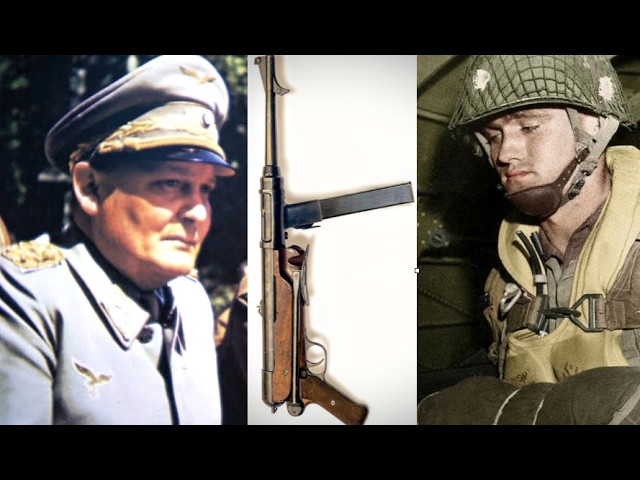 This scarcity alone elevates the MP36 to near-legendary status among firearms enthusiasts, making it a perfect centerpiece for an extraordinary origin story.
The narrative that has circulated since the late 1990s, popularized by an article in Small Arms Review, claims that in 1943, a team of US paratroopers was parachuted into the dense forests northeast of Berlin with a singular objective: 𝓀𝒾𝓁𝓁 Hermann Göring. The plan, as described, involved infiltrating the grounds of Karinhall, a vast estate guarded by a private army of elite Fallschirmjäger troops from the Hermann Göring Panzer Division. According to the story, a US major, during the ensuing firefight, slipped into the main building, spotted the MP36 hanging on a wall as a decorative trophy, and seized it before fighting his way back to safety.
The weapon was then supposedly brought back to the United States as a war souvenir, its provenance hidden for decades.
However, a professional analysis of the operational feasibility of such a mission reveals a litany of insurmountable obstacles that render the story not just improbable, but outright impossible. The first and most glaring issue is the logistics of the insertion and extraction. In 1943, the Allies did not possess air superiority over Germany.
A slow, unarmed C-47 Skytrain transport aircraft, the standard for paratrooper drops, would have been a sitting duck for Luftwaffe fighters and anti-aircraft artillery. The round trip from Eastern England to the Karinhall area, a distance of over 1,100 miles, would have exceeded the C-47’s maximum range, leaving the aircraft critically short of fuel on the return journey over occupied Europe. No other Allied aircraft available at the time was configured for a safe, covert mass parachute drop of an assault force deep into enemy territory.
The second fatal flaw in the narrative is the sheer scale of the force required to assault Karinhall. The estate was not a lightly guarded country mansion; it was a heavily fortified compound with a permanent garrison of some 200 highly trained and heavily armed soldiers. Göring himself was also protected by a detachment of the Reichssicherheitsdienst (RSD), the same elite bodyguard unit that protected Hitler.
 Any attempt to storm such a position would have required a battalion-sized force, not a small commando team. Dropping a force large enough to overwhelm the garrison would have required multiple aircraft, creating a massive radar signature and virtually guaranteeing the mission’s detection and destruction before it even began.
Furthermore, the story fails to account for the lack of any supporting infrastructure on the ground. Unlike the successful assassination of Reinhard Heydrich in Prague in 1942, which relied on a pre-existing resistance network, or Operation Foxley, the planned SOE mission to 𝓀𝒾𝓁𝓁 Hitler, which involved a two-man ambush team, the Karinhall raid as described would have required the team to operate in complete isolation with no local support, no safe houses, and no extraction plan. The British SOE and American OSS understood that such deep-penetration missions were only viable with a robust local network or a highly specific, low-risk ambush scenario.
The idea of a large American paratrooper force fighting a pitched battle in the middle of Nazi Germany is pure Hollywood fantasy, a plot point that even Alistair MacLean, the master of the wartime thriller genre, would have rejected as too far-fetched.
So, if the raid never happened, how did the MP36 end up in American hands? The answer, according to military historians, lies in the final, chaotic weeks of the war in Europe, and it is a story far more grounded in the grim reality of 1945. As the Red Army closed in on Berlin in April 1945, Göring ordered the evacuation of his vast personal collection of art, jewels, and weaponry from Karinhall.
The loot was loaded onto three trains and transported south to Berchtesgaden, his mountain retreat in the Bavarian Alps, where he maintained a smaller villa near Hitler’s Obersalzberg complex. A massive amount of material, including his extensive weapons collection, was left on goods trains at the Berchtesgaden railway station, awaiting further transport or storage.
 On May 4, 1945, US forces captured Berchtesgaden without a fight, as the SS guards had retreated. The following day, troops of the 101st Airborne Division, the famed “Screaming Eagles,” arrived to take over garrison duties. These were the same type of soldiers featured in the fictional raid, which is a crucial connection.
Major Dick Winters, of Band of Brothers fame, was among the first American officers to explore Göring’s art bunker, and it is well documented that US paratroopers extensively looted the area, taking weapons, medals, and other valuables as souvenirs. It is highly probable that the MP36 was simply one of these items, taken from a goods wagon at the Berchtesgaden station by a paratrooper who recognized its unique value.
The most likely scenario is that the officer who took the weapon, perhaps to avoid questions about looting or to enhance his own personal war story, fabricated the dramatic tale of the Karinhall raid. The story, with its “still classified” tagline, was a perfect cover for what was essentially an act of opportunistic plunder. It transformed a simple souvenir into a heroic war trophy, complete with a narrative of daring-do that would impress fellow collectors and historians for generations.
The myth persisted because it was attached to a real, tangible, and extraordinarily rare artifact, giving it an air of authenticity that it did not deserve.
The MP36 itself remains a genuine historical treasure, a testament to the engineering evolution of the German submachine gun. Its existence provides a tangible link to the pre-war development of the iconic MP40, and its presence in the United States is a direct result of the spoils of war. The weapon’s estimated value, potentially exceeding $40,000, reflects its rarity and historical significance, not the veracity of the story attached to it.
 The real history of its capture, however, is arguably more interesting than the myth, as it speaks to the human tendency to mythologize the past and the chaotic, opportunistic nature of the war’s end.
The persistence of the Karinhall raid story serves as a powerful case study in how urban legends are born and sustained. It highlights the danger of accepting a compelling narrative without rigorous scrutiny, especially when it involves famous figures, secret missions, and rare artifacts. The story checks all the boxes for a great war tale: a high-value target, a covert operation, a desperate firefight, and a unique trophy.
But the cold, hard facts of military history, aircraft ranges, and the realities of the European theater in 1943 dismantle the fiction piece by piece. The truth, that a US paratrooper likely pilfered the weapon from a train in the final days of the war, is a far more common and human story, one that reflects the widespread looting that occurred as the Third Reich crumbled.
This revelation does not diminish the importance of the MP36; rather, it grounds it in a more authentic historical context. The weapon is not a relic of a failed assassination attempt, but a spoil of war from the very heart of the Nazi regime, a piece of Göring’s personal hoard that was scattered to the winds in the final collapse. The story of its capture is a story of the American soldier as conqueror and collector, a phenomenon that played out across Germany in 1945.
The myth of the raid, while false, has inadvertently preserved the memory of this rare weapon, ensuring that its true, more mundane, and yet more believable journey from Göring’s collection to an American home is finally brought to light. The mystery is solved, not with a bang of gunfire at Karinhall, but with the quiet, opportunistic act of a soldier on a train platform in Berchtesgaden.