
The ground beneath the Great Smoky Mountains does not forget, and neither does the blood of the families who carved a life from its unforgiving slopes. In the fading light of a December afternoon in 1897, a young father fell to the floor of his own cabin, a bullet from a neighbor’s rifle tearing through him while his three children watched and his pregnant wife screamed. The man who fired that shot, a patriarch so feared and so untouchable that the courts could not hold him, would walk free for nearly two decades, his name eventually carved onto a tombstone that reads only “Long Hair.”
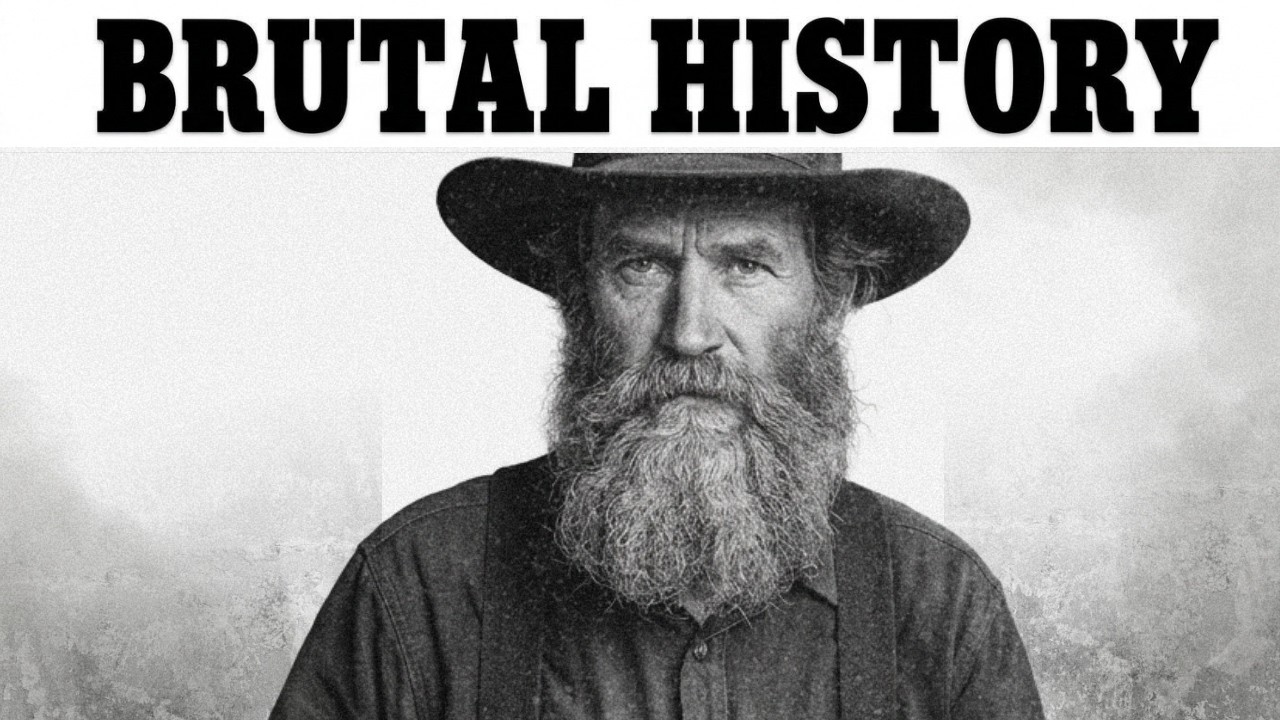
This is the story of Sam Birchfield, an outlaw so violent that the official record tried to erase him, yet the whispers of the hollow never did.
 The event that shattered the peace of Chestnut Flats was not a dispute over land or cattle, nor a drunken brawl that got out of hand in the isolated mountain community on the southwest edge of Cades Cove. The motive was far more insidious, rooted in a single act of testimony that violated the unwritten code of the mountains. George Washington Powell Jr.
, a 26-year-old neighbor, had spoken to federal agents about an illegal distilling operation tied to Hale Hughes, the son-in-law of Sam Birchfield. That testimony had sent Hughes to prison for twenty years, and in the closed world of the Smokies, talking to the government was a sin punishable by death, not in the abstract, but in the immediate, brutal reality of a rifle shot.
The ambush was planned with cold precision, a coordinated effort involving two men positioned at separate stands, waiting for the opportune moment to strike. They had intended to waylay Powell on the road home, but finding him already in his yard, they adjusted their plan without hesitation. The bullet fired from the tree line found its mark, striking Powell and sending him staggering into the sanctuary of his home, where he collapsed on the floor in front of his family and bled out within minutes.
Martha Powell, his wife and pregnant with their fourth child, did not flee into the night. She barricaded the door, spending a harrowing, sleepless vigil with the corpse of her husband and her terrified children, miles from the nearest neighbor who might offer aid or comfort.
The murder of George Powell Jr. sent a shockwave through the community, yet the immediate aftermath was met with a wall of silence so thick that no one was arrested for months. It was not until March of 1898 that Hale Hughes, the man whose imprisonment had sparked the violence, was taken into custody for the murder.
He was convicted and sentenced to another twenty years, seemingly closing the case with one man dead and one man paying for the crime. But the story was far from over, and the true architect of the violence was about to be 𝓮𝔁𝓹𝓸𝓼𝓮𝓭 from the most unexpected source: the convicted killer himself.
In June of 1899, a letter arrived from the state penitentiary that would rewrite the history of the murder, a confession from Hale Hughes that implicated the man the community had protected and the courts had failed to reach. According to Hughes, the plan to 𝓀𝒾𝓁𝓁 Powell had been concocted jointly with his father-in-law, Sam Birchfield, and both men had taken positions near the Powell cabin on that fatal day. While Hughes was prepared to shoot Powell if he passed his way, he claimed it was Birchfield who actually pulled the trigger, taking the life of the young father while Hughes could only watch.
This written confession was a bombshell, a direct accusation from a convict against a man who had been untouchable for decades.
Sheriff Rule and Deputy Edmonson acted on this new information, riding deep into the mountains to apprehend the man the newspapers would later describe as a figure of legend. The man they brought back to Maryville was a 60-year-old patriarch, over six feet tall, with long coal-black hair and a bushy mustache, a visible embodiment of the defiance that defined the region. Prosecutors prepared their case with confidence, summoning sixteen witnesses scattered across the mountains and into North Carolina, armed with a written confession and a history of violence.
Yet, in a stunning turn that defied logic, the grand jury refused to indict Sam Birchfield. Not a single charge was brought against him, and he walked out of the courthouse a free man, leaving a dead man’s family and the entire legal system to wonder what had just happened.
The reasons for the grand jury’s failure to indict remain a mystery, a gap in the record that speaks volumes about the power dynamics of the era. Did the sixteen witnesses, many of whom lived in the same hollow as Birchfield, vanish or refuse to testify out of fear for their lives? It would not have been unusual, given the mountain code of silence and Birchfield’s documented reputation for dealing with informers.
Did the grand jury members themselves, all local men, fear for their own safety or that of their families if they returned a true bill? That is entirely plausible. Or, in the most charitable reading, did they see the confession of a convicted murderer as a desperate attempt to shift blame and secure his own release, a tale woven by a man who had nothing to lose?
What is certain is that the legal system, for whatever combination of intimidation, complicity, and disbelief, proved utterly incapable of touching Sam Birchfield. The historical record notes that the two original informers who had testified against Birchfield for moonshining were “quietly put out of the way,” a chilling detail that adds weight to the theory of fear. The man who had killed George Powell Jr.
 , or at least orchestrated his death, was not just free; he was about to become a celebrity. In April of 1900, the Knoxville Journal and Tribune published a feature on Birchfield under the headline “Mountain Character,” a piece that read more like folklore than criminal biography, praising his fairness to neighbors and romanticizing his moonshining prowess.
By 1910, Birchfield’s transformation from accused murderer to public icon was complete, culminating in an event so bizarre it could only happen in America. The federal government, the very institution whose revenue agents had raided his stills for years, granted him permission to operate a working moonshine still as a demonstration at the Appalachian Exposition in Knoxville. This was no small local fair; it was a major event where Theodore Roosevelt and William Howard Taft were scheduled to speak.
An advertisement in the Knoxville Sentinel promoted him as “Uncle Sam Birchfield, the veteran moonshiner of the Appalachians,” charging ten cents admission for visitors to watch him work. The irony of the state celebrating a man it had tried to imprison for decades was lost on no one, yet the spectacle drew crowds.
The Sentinel ran a feature on Birchfield that September, based on an interview with the man himself, offering a sanitized, romanticized version of his life. He told the reporter that he had inherited a rifle from his father and used it to shoot about 75 bears, but that he had “never once used it to shoot a man.” He said this with a straight face, and the newspaper printed it without question, a perfect example of how the legend had completely overshadowed the grim reality of his past.
His wife, Nancy Evelyn, had died in 1907, and all ten of his children were living nearby, a testament to his longevity and stature as a patriarch. He had outlasted every institution that tried to contain him, from the revenue agents to the courts to the grand juries.
The fate of Hale Hughes, the man whose confession should have been the key to bringing Birchfield down, is a further testament to the strange currents of justice in the mountains. He was pardoned in December of 1908, with the Knoxville Sentinel noting only that “some people doubt his guilt.” He settled in Tellico Plains with his wife and children, worked as a carpenter, owned his own home, and lived until 1927, dying at the age of 61.
His pardon, coming years after his letter had failed to implicate Birchfield, suggests that the system had ultimately decided to let the entire sordid 𝒶𝒻𝒻𝒶𝒾𝓇 fade into memory, freeing a man who had helped plan a murder because the political and social cost of pursuing the real culprit was too high.
Martha Gregg Powell, the widow who had barricaded her door and spent a night with her husband’s body, remained in Cades Cove, trying to rebuild her life. The 1900 census lists her as a farm laborer and head of household with four children, a stark picture of the poverty and hardship that followed her husband’s murder. In 1908, she remarried, this time to John Noah Birchfield, a different member of the Birchfield clan, illustrating the complex and intertwined nature of these mountain families.
She did not blame the entire family for what happened to her first husband. She died in 1911 at the young age of 39, having survived her first husband by fourteen years but never fully escaping the trauma of that December night.
Sam Birchfield lived on, the embodiment of an ungovernable spirit that the modern world could neither tame nor punish. He died on August 8th, 1917, in the same hollow of Chestnut Flats where he had lived for half a century. There was no dramatic last stand, no ambush, no gunfight at the end of his story.
The most feared man in the Smoky Mountains died peacefully in his bed, in a place where nobody with a badge had ever been able to hold him accountable for a single one of his alleged crimes. He was 76 or 77 years old, having outlived the man he was accused of killing by two decades and the wife who witnessed the murder by six years.
The question that lingers over this story is not whether Sam Birchfield killed George Powell Jr. The record does not prove it, but it also does not try very hard. There is a son-in-law’s confession, sixteen witnesses who either scattered or stayed silent, and a grand jury that would not indict.
 The system was not broken; it was working exactly the way a system works when the most powerful man in the hollow is the one on trial. Birchfield was not a simple villain in a morality play about good law versus bad man. He was a product of a region where the law itself was seen as the invader, a foreign entity that came from outside to tax a crop that mountain families had been distilling for generations.
Federal agents were the face of an oppressive government that criminalized a way of life overnight, and state legislators passed laws that punished the poor for subsistence while ignoring the systemic poverty that forced them to break those laws. When that is the only law one has ever known, the man who defies it can look less like a criminal and more like the only honest person in the room. This does not make Birchfield innocent, but it makes his guilt far more complicated than any headline can hold.
The people of Cades Cove understood this nuance. They used his gristmill for free. They bought his whiskey.
They did not testify against him, and when the newspapers came looking for a “Mountain Character,” they offered up Sam Birchfield as the embodiment of their defiance.
George Powell Jr. paid for breaking that code with his life, a young father cut down in his own yard. His widow paid for his testimony with a night of terror, a memory that would stay with her until her early death.
The system that was supposed to answer for that failure never did, and nobody was ever held responsible for the murder of George Powell Jr. , not formally, and not ever. The injustice was absorbed into the hills, a quiet, festering wound that the community chose to ignore because to acknowledge it would be to condemn their own way of life.
They had chosen to protect the outlaw over the victim, and they would carry that collective guilt in silence.
Today, Cades Cove is the single most visited destination in the Great Smoky Mountains National Park, with more than two million people driving the loop road every year. They stop at the preserved homesteads, photograph deer in the fields, and walk past the Cades Cove Primitive Baptist Church, a small white frame building at the edge of the valley. Behind that church, in a cemetery shaded by old trees, one tombstone stands out to those who know the story.
The stone reads simply, “Sam Birchfield, Long Hair of Chestnut Flats, 1840 to 1917.” A few miles from that marker, on the southwest edge of the cove, Parson Branch Road cuts through what used to be Chestnut Flats, where the cabins and stills are long gone.
The Powells and the Birchfields are all in the ground now, some of them buried in that same cemetery, a few rows apart. Two families settled that hollow together after the Civil War, married into each other, and distilled together. One of them talked to the federal government, and the other made sure that nobody in those mountains ever forgot what happened when you did.
The grave of Sam Birchfield does not mention any of this. It just says “Long Hair.” The tourists read the name, take a photograph, and keep walking, unaware of the violence and fear that name represents.
They do not know who George Powell was, and they do not know about Martha barricading the door. The mountains remember what the markers leave out, and the ghost of an outlaw still haunts the hollow.
 The irony of Birchfield’s final years, being celebrated by the very government that had once hunted him, is a dark comedy of American history. The Appalachian Exposition was a chance to showcase the region’s culture, but it chose to highlight a man with a long history of bloodshed and lawlessness as its star attraction. The federal government’s decision to permit the demonstration was a pragmatic acknowledgment that they could not beat him, so they might as well profit from his infamy.
Birchfield, ever the showman, played his part, dressing the part of the mountain moonshiner and dispensing his lore to the curious crowds, a living relic of a bygone era. It was a cynical marriage of convenience between the state and the outlaw, and it served to further cement Birchfield’s legend while erasing the memory of his victims.
The death of George Powell Jr. was a brutal footnote in the larger narrative of Birchfield’s life, a life that was celebrated for its defiance rather than condemned for its violence. The community’s decision to shelter Birchfield was a collective judgment on the legitimacy of the federal government, a decision that said more about their own oppression than it did about the murder.
They were willing to protect a killer because they saw him as a shield against a system that had never offered them anything but taxation and punishment. This moral calculus, however grim, was a survival mechanism in a region that had been left behind by the industrializing nation, a place where the law was a foreign concept.
The story of Sam Birchfield and George Powell Jr. is a lens through which to view the entire history of the Appalachian region, a history of marginalization, resistance, and violence. The federal government’s attempts to enforce the whiskey tax in the late 19th century sparked a low-grade insurgency in the mountains, with raids and ambushes becoming a regular part of life.
The revenue agents were seen not as law enforcement officers but as occupational soldiers, and the moonshiners were not criminals but guerrilla fighters defending their homes. The killing of an informer was not just a personal revenge; it was an act of war against the external forces that threatened their community.
The legal system, far from being an impartial arbiter of justice, was complicit in this violent order. Local sheriffs and juries were often drawn from the same communities as the moonshiners, and they were deeply reluctant to prosecute their neighbors for crimes that the community did not recognize as wrong. The failure of the grand jury to indict Birchfield for the murder of Powell was not a miscarriage of justice; it was the correct decision according to the social code of the mountains.
Powell had broken the community’s cardinal rule, and his death was seen as the natural consequence of his betrayal. Birchfield was not a criminal in their eyes; he was an enforcer of a law that was more real to them than any statute book.
This complex moral landscape is what makes the story so compelling and so difficult to categorize. The modern reader wants to condemn Birchfield for his violence and sympathize with Powell, the young father gunned down in front of his family. Yet, to understand the context is to see that Powell was not just a victim; he was a man who had chosen the side of the federal government against his own community.
He had used the law to destroy a neighbor, and the community had responded with a justice that was swift, brutal, and terrifyingly effective. This does not excuse the murder, but it explains why the community protected the murderer, a nuance that is often lost in simplistic retellings of history.
The erasure of this violence from the romanticized narrative of Cades Cove is a deliberate act of forgetting. The National Park Service preserves the valley as a pastoral idyll, a snapshot of a simpler time, but it sanitizes the history by removing the conflict and bloodshed that were integral to its story. The tourists who walk the loop road see a beautiful valley, but they do not see the fear that once gripped it, the families torn apart by violence, or the graves of men like George Powell Jr.
The park has become a place of escape, not a place of reckoning, and the ghost of Sam Birchfield is allowed to rest in a way that Powell’s spirit never could. This act of historical curation is its own form of violence, a silencing of the voices of the victims that echoes the original silencing of George Powell Jr. by a bullet.


