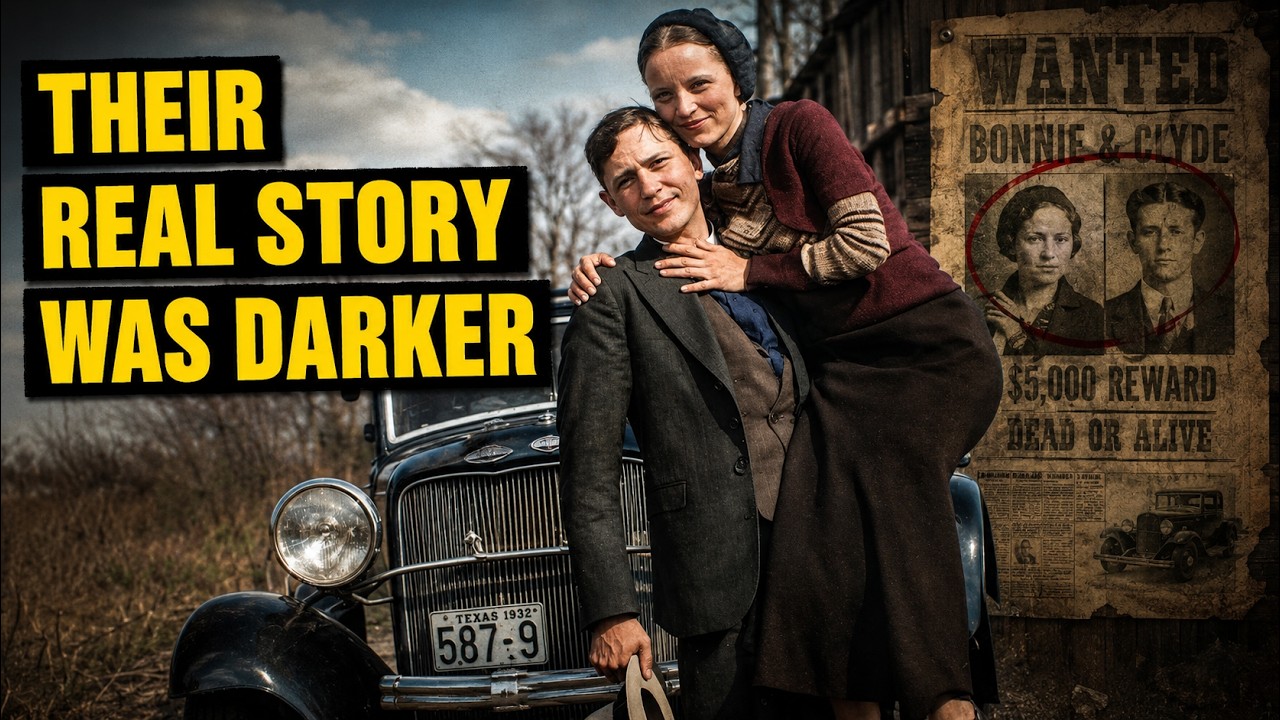
Bonnie Parker and Clyde Barrow remain two of the most famous outlaws in American history, but the story most people know is only part of the truth. Behind the famous photographs, fast cars, and nationwide manhunt are details that were exaggerated, forgotten, or misunderstood. One of the biggest misconceptions is that they were Wild West outlaws. Clyde was born in 1909 and Bonnie in 1910, and their crime spree took place mainly between 1932 and 1934, during the Great Depression.
They belonged to an era of automobiles, highways, telephones, and fingerprints, not horseback frontier bandits. Their ability to outrun lawmen came from mobility, as a fast stolen car could cross a county or state line before police agencies could communicate effectively. Bonnie was also never married to Clyde. She married Roy Thornton in 1926 when she was just 16, and although the marriage did not last as a relationship and Thornton ended up in prison, Bonnie never obtained a divorce.
When she met Clyde in January 1930, she was still legally Mrs. Thornton. According to the Handbook of Texas, Bonnie even had a tattoo commemorating her relationship with Thornton and never divorced him. The image of them as master bank robbers is also exaggerated.
They did take part in bank robberies, but much of their criminal activity involved smaller targets. Historical accounts describe robberies of grocery stores, filling stations, small businesses, and small banks, along with automobile theft. The Handbook of Texas describes them as small-time criminals compared with the glamorous image that developed around them, noting their largest haul was only about $1,500. Smithsonian’s account notes that during some periods, they sometimes struggled simply to get enough money for basic needs.
Some of the most famous photographs of the couple were never created for newspapers or the public. They were personal snapshots taken by gang members. In April 1933, the Barrow gang was staying in Joplin, Missouri, when police confronted them. The gang escaped but left behind a camera and undeveloped film.
When the photos were processed, Americans could see the fugitives posing casually. One picture showed Bonnie with a cigar and a firearm, which helped define her tough image. However, gang member W. D.
Jones later explained the cigar had been given to Bonnie for the picture, and she normally smoked cigarettes, not cigars. The real Barrow gang was also never just a two-person operation. It was a changing group of people that included Raymond Hamilton, W. D.
Jones, Clyde’s older brother Buck Barrow, Buck’s wife Blanche Barrow, and later Henry Methvin. Membership changed as people were captured, separated, or left after disagreements. Newspapers often used Bonnie and Clyde’s names as shorthand for the entire gang, but several people could be present during a robbery or confrontation. The federal investigation began with a surprisingly ordinary clue.
According to the FBI’s own history, investigators became interested in the pair in December 1932 because of stolen automobiles. Inside one recovered car was a prescription bottle that was traced to a drugstore in Nacogdoches, Texas, where the medicine had been prescribed to Clyde’s aunt. In May 1933, a federal warrant was issued charging the pair with transporting a stolen automobile across state lines. Notably, the organization did not officially become the FBI until 1935, after Bonnie and Clyde were dead.
Personal connections helped lawmen close the net. During the final months, investigators identified Bonnie and Clyde’s connection with the Methvin family in Louisiana. By May 1934, authorities had information suggesting the couple would return to the Black Lake region. Frank Hamer and other officers did not need to search every road if they could determine where the fugitives were likely to return.
Every small connection reduced the number of places Bonnie and Clyde could safely appear. Frank Hamer was not an active Texas Ranger during the hunt, despite being remembered that way. He was a former Texas Ranger whose position ended after political changes following the 1932 governor’s election. In February 1934, Texas prison system director Lee Simmons hired Hamer as a special investigator for the hunt.
According to the Handbook of Texas, Hamer was subsequently commissioned as a state highway patrolman so he would have arrest authority. The 1967 movie Bonnie and Clyde presented a highly fictionalized version of Hamer, and his widow and son later sued the producers, settling out of court in 1971. The Robin Hood reputation attached to Bonnie and Clyde is mostly a legend. Their crimes included robberies of small businesses, automobile theft, kidnappings, and violent confrontations that cost lives.
There is no credible evidence that they systematically redistributed stolen money to struggling families. Their popularity can be understood through the Great Depression, when newspapers needed stories that attracted readers, and the couple had youth, a romantic relationship, repeated escapes, and recognizable photographs. Finally, Bonnie and Clyde were not buried together. Bonnie continued writing poetry during her time with Clyde, and one of her best-known poems imagined they would be buried together.
After they were killed by lawmen in Louisiana on May 23, 1934, their remains were returned to Texas, but their families placed them in separate Dallas-area cemeteries. The Library of Congress and the Handbook of Texas both note this contradiction directly. Bonnie had helped write the story she wanted people to remember, but in real life, boundaries remained that the legend erased.