The brutal, scalping, and murderous spree of William T. “Bloody Bill” Anderson, a name that once struck terror into the hearts of Missouri and Kansas residents, has been laid bare in a new, exhaustive examination of his life, revealing a descent into savagery that redefined the nature of guerrilla warfare on the American frontier.
Anderson, who was killed at the age of 25 in 1864, was not merely a soldier in the Confederate cause; he was a self-proclaimed executioner who vowed to give no quarter and ask for none, a promise he kept with chilling fidelity until a hail of Union musket balls tore through his skull.
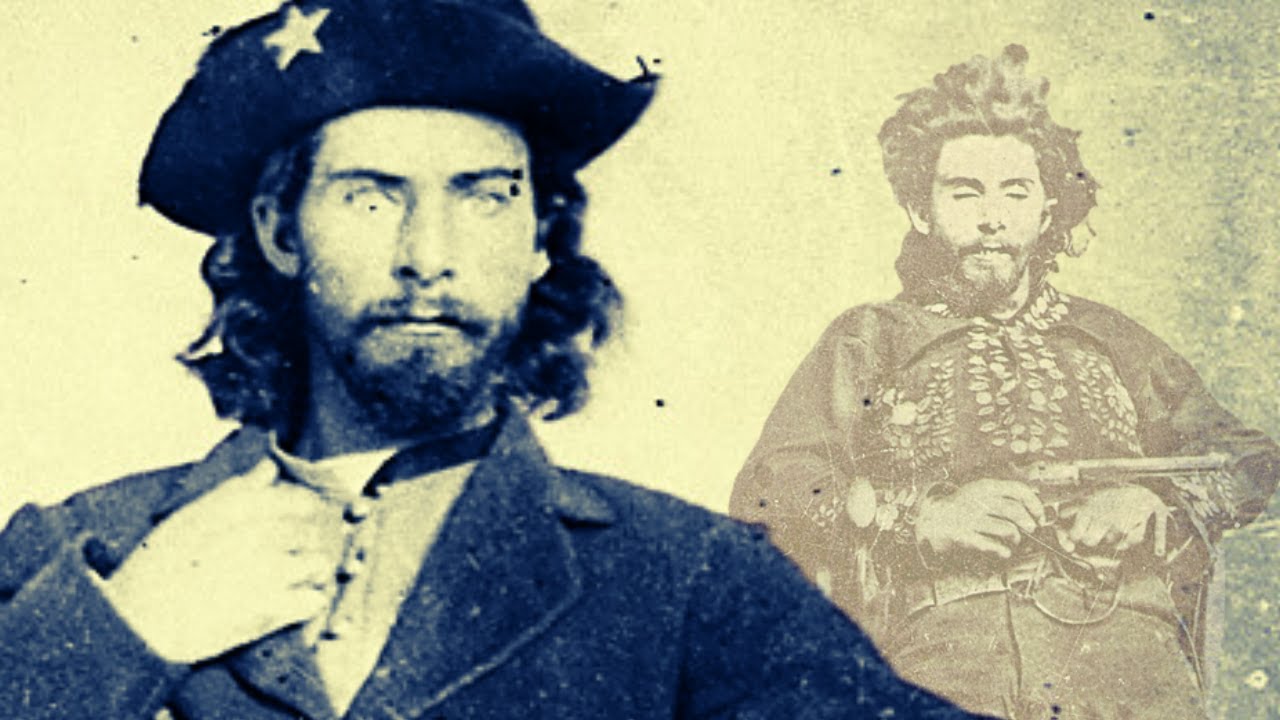 His story, which began in Hopkins County, Kentucky, around 1829, is one of a family on the move, a volatile borderland, and a personal vendetta that metastasized into an orgy of violence that shocked even the hardened veterans of the Civil War.
The narrative of Anderson’s life is a complex tapestry woven with threads of vengeance, alleged criminality, and the brutal realities of the Border War, a conflict that predated the official start of the Civil War and was characterized by a savagery that knew no bounds.
Born into a family of seven children, Anderson’s early life was marked by constant relocation, with his family moving from Kentucky to Missouri, then to Iowa, and back again before settling in Kansas in 1857.
His father, William C. Anderson, a former hat maker turned farmer, was suspected by some of supplementing his income through horse thievery, a claim that would later be used by detractors to paint the entire family as outlaws.
The younger Anderson, along with his brother Ellis, developed a reputation for a “wild streak,” engaging in deadly shooting scrapes with Native Americans in Kansas in the late 1850s, with Anderson claiming self-defense in the killing of a Kansa tribe member.
In 1860, tragedy struck the family when Anderson’s mother, Martha Jane, was killed by a lightning strike in her own front yard, a devastating blow that preceded the national conflagration that would consume her son.
The political landscape of the time was a powder keg, with the Kansas-Nebraska Act of 1854 effectively repealing the Missouri Compromise and igniting a violent struggle for control of the Kansas territory.
This period, known as “Bleeding Kansas,” saw pro-slavery and anti-slavery factions clash in a series of bloody skirmishes, with figures like the abolitionist John Brown rising to prominence through acts of retaliatory violence.
It was within this cauldron of political turmoil and divisiveness over slavery that Anderson came of age, and while his family were not slave owners, the conflict would inevitably engulf them.
Contrary to the image of a man driven by deep-seated ideological conviction, Anderson reportedly told neighbors he was taking up arms for financial reasons, not loyalty to the South, a statement that hints at a more mercenary motivation for his initial foray into the conflict.
His path to infamy was paved with a series of personal grievances, most notably the death of his father, which occurred under two very different, competing narratives that have fueled historical debate for over a century.
One version of events claims that Anderson’s father was shot and killed by a man named Judge A.I. Baker, a former territorial legislator, after a dispute over stolen horses, a confrontation that saw the elder Anderson arrive at Baker’s home with a shotgun.
In this account, Baker, a well-known and respected figure, shot William Anderson in self-defense, prompting the younger Anderson to flee the state before returning a month later to exact a horrific revenge.
Anderson, along with his brother Jim and two other men, ambushed Baker at his store, forcing him to flee to the cellar before setting the building ablaze, an act of attempted immolation that ended with Baker taking his own life.
A starkly different narrative, presented by historian Paul R. Peterson, contends that Anderson’s father was a southern sympathizer who was lynched by Kansas Jayhawkers, who then stole the family’s possessions and burned their farm to the ground.
In this version, Anderson is portrayed as a reluctant warrior, forced into guerrilla warfare to avenge his father’s murder and the destruction of his property, a narrative that aligns with the romanticized image of the “Lost Cause.”
Regardless of which account is true, the outcome was the same: Judge Baker was dead, and Bill Anderson was on the run in Missouri, where he would eventually fall in with the notorious William Clarke Quantrill.
Anderson initially formed his own gang, but was rebuked by Quantrill for robbing southern sympathizers, an early sign of the friction that would define their relationship for years to come.
It was not until early 1863 that Anderson officially joined Quantrill’s Raiders, a band of guerrilla fighters who operated outside the traditional structure of the Confederate Army.
Quantrill, a former schoolteacher from Ohio, had developed a reputation for ruthlessness and had been schooled in guerrilla warfare tactics by a Cherokee chief named Joel Bryan Mays.
The raiders, also known as bushwhackers, were not formally trained soldiers; they were irregular forces who relied on speed, surprise, and intimate knowledge of the local terrain to harass Union forces and their supporters.
They were lethally effective, employing tactics of ambush and swift, devastating raids, and they enjoyed significant support from the local Missouri population, who provided them with food, shelter, and intelligence.
This support network became a target for Union forces, who began arresting the family members of known guerrillas, a decision that would have catastrophic consequences and provide Anderson with his ultimate motivation for slaughter.
In 1863, Anderson’s sisters, along with other suspected female spies, were imprisoned in a three-story building in Kansas City, which tragically collapsed, killing his 14-year-old sister, Josephine, and severely injuring his other two sisters.
Anderson and the other raiders did not believe the collapse was an accident, viewing it as a deliberate act of murder by the hated Jayhawkers, and this event hardened their resolve for vengeance.
The attack on Lawrence, Kansas, on August 21, 1863, was a direct result of this rage, a coordinated assault by upwards of 400 guerrilla fighters who descended upon the abolitionist stronghold at dawn.
The raiders ransacked homes, burned businesses, and killed over 150 men and boys, approximately 20 percent of the town’s male population, in an orgy of violence that left 85 widows in its wake.
Anderson was credited with killing 14 people that day, some of whom were begging for their lives, a level of brutality that earned him the moniker “Bloody Bill.”
The Lawrence massacre prompted the Union to issue General Order Number 11, a draconian directive that forced the evacuation of civilians from four counties in western Missouri, a scorched-earth policy that displaced thousands.
This order, intended to deprive the guerrillas of their support base, instead created a wave of new sympathizers, as displaced citizens, their homes burned and property looted, turned against the Union.
The winter of 1863 found Anderson and the raiders in Texas, where he met and married a woman named Bush Smith, a union that further strained his already tense relationship with Quantrill.
The rift between the two leaders grew until Anderson and his men parted ways with Quantrill, becoming an independent guerrilla force that would soon eclipse its former leader in notoriety and bloodlust.
By the summer of 1864, Anderson’s campaign of terror was in full swing, with his men ambushing and killing Union troops and militia across central Missouri, often while wearing captured Union uniforms to get close to their targets.
They were known for their brutality, scalping their victims and leaving taunting notes on their bodies, and they began to decorate their horses with the scalps of the dead, a grim and terrifying spectacle.
Anderson’s men, which included the legendary James brothers, Frank and a 17-year-old Jesse, were armed with multiple revolvers, giving them a significant firepower advantage over Union soldiers armed with single-shot muskets.
On September 27, 1864, Anderson orchestrated his most infamous act of savagery in the town of Centralia, Missouri, where his men, drunk on stolen whiskey, stopped a Union passenger train.
They lined up 23 unarmed, off-duty Union soldiers and executed them all, along with an unlucky civilian who was wearing a blue shirt, before setting the train on fire and departing with over 20 scalps and $9,000 in stolen money.
Later that same day, Anderson’s men ambushed a detachment of Union cavalry that had been sent to hunt them down, killing 125 soldiers in a one-sided slaughter that became known as the Centralia Massacre.
This victory, his most decisive, solidified his reputation as a master of guerrilla warfare, but it also marked a point of no return in his descent into depravity.
In October 1864, Anderson and his men moved to Glasgow, Missouri, where he beat and trampled a wealthy citizen who had freed his slaves, and then committed the ultimate atrocity of his career: the rape of a 12-year-old Black girl.
This act, followed by the rape of other freed servants, demonstrated a complete moral collapse, moving beyond the killing of enemy combatants to the sexual violation of the most vulnerable members of society.
While some historians argue that Anderson was a product of his environment, a man dehumanized by the brutal nature of guerrilla warfare, others contend that he was a sociopath who used the war as an excuse to indulge his darkest impulses.
His actions, which included the torture of prisoners and the mutilation of the dead, went far beyond the accepted norms of even the most brutal warfare, marking him as an exceptionally deranged figure.
The end for Anderson came on October 26, 1864, near Albany, Missouri, where a specially trained force of Union troops under Lieutenant Colonel Samuel P. Cox finally tracked him down.
In a final, desperate act of reckless bravery, Anderson and another man, John Raines, charged headlong into the Union lines, a suicidal maneuver that saw Anderson struck in the head by multiple musket balls, killing him instantly.
He was just 25 years old, and his body was paraded through the streets of Richmond, Missouri, where photographs were taken, and he was propped up for public viewing before being buried in a field.
A silk cord with 53 knots was reportedly found on his body, which some claimed represented the number of men he had personally killed, a number that may have been a gross underestimate.
His death marked the end of a reign of terror that had made him one of the most feared men in the border states, but his legacy would live on through the men he trained, including the James brothers and Cole Younger.
His trusted lieutenant, Archie Clements, took over his band and continued a life of crime before being killed in a shootout in 1866, his dying words a testament to the code of no surrender that Anderson had instilled.
William Quantrill, Anderson’s former mentor, was also killed in 1865, shot in the back in Kentucky, while Anderson’s brother Jim died under mysterious circumstances in Texas in 1871.
The life of Bloody Bill Anderson serves as a stark and chilling reminder of the brutal cost of civil conflict, where the lines between soldier and murderer, patriot and psychopath, become tragically blurred.
His story, whether viewed as that of a reluctant hero or a bloodthirsty villain, is a testament to the destructive power of vengeance and the ease with which humanity can be discarded in the pursuit of a cause, no matter how noble or misguided.
The debate over his legacy continues to this day, with some in the South still viewing him as a folk hero who fought against Northern aggression, while others see him as a war criminal whose actions were an unforgivable stain on the history of the conflict.
What is undeniable is that William T. Anderson, a man who once claimed he could 𝓀𝒾𝓁𝓁 men with as much skill and rapidity as anybody, lived a short and violent life that left an indelible mark of terror on the American frontier.
His final resting place, the Old Pioneer Cemetery in Richmond, Missouri, was secured decades after his death by one of his former protégés, Cole Younger, ensuring that the memory of the man known as “Bloody Bill” would not be forgotten.
The story of his life, now fully documented in this comprehensive review, stands as a powerful and disturbing chapter in the annals of American history, a cautionary tale of how a single life can be consumed by the very hatred it seeks to sow.
The details of his final charge, his death, and the subsequent desecration of his body, serve as a grim epilogue to a life that was defined by violence from its very beginning to its bloody end.
His name remains synonymous with the savage nature of the guerrilla war that raged along the Missouri-Kansas border, a conflict that was, in many ways, a war within a war, fought with a ferocity that shocked the nation.
The examination of his life reveals a man who was a product of his time, but who also transcended the boundaries of acceptable human behavior, becoming a monster in the eyes of many and a martyr in the eyes of a few.
His story is a complex and disturbing one, a reminder that history is rarely black and white, but is instead a murky and often horrifying shade of gray.