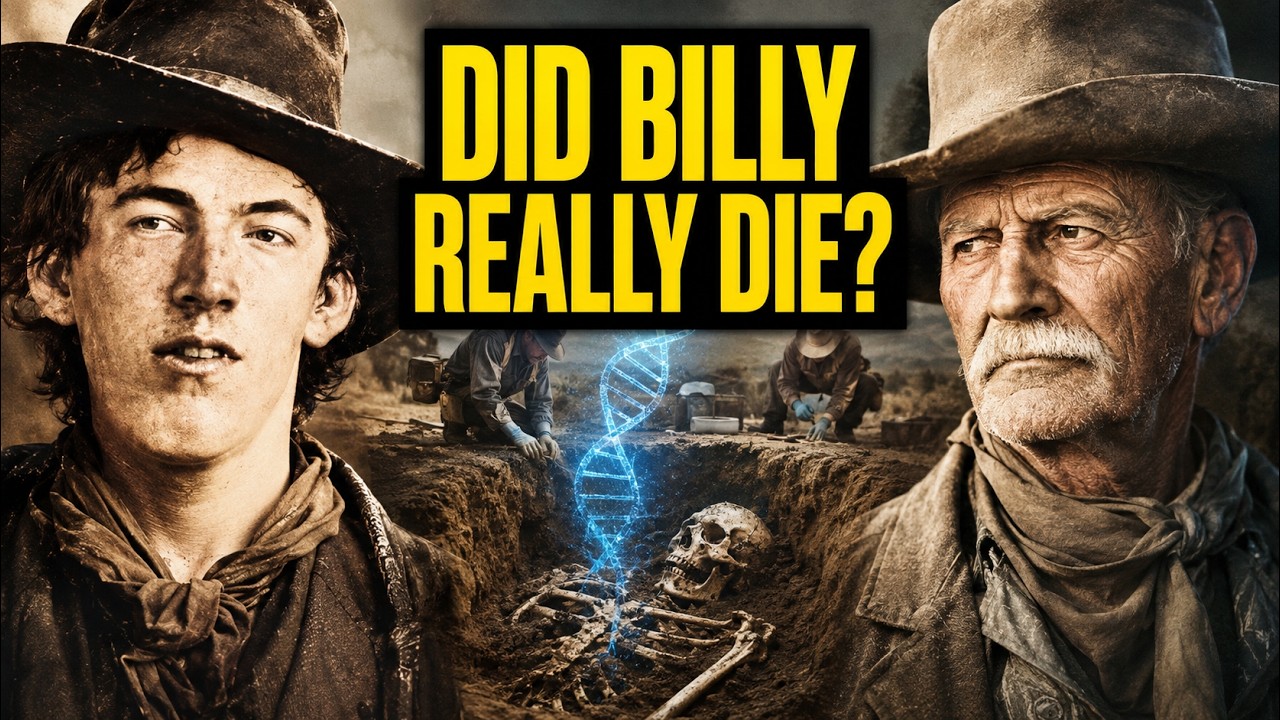
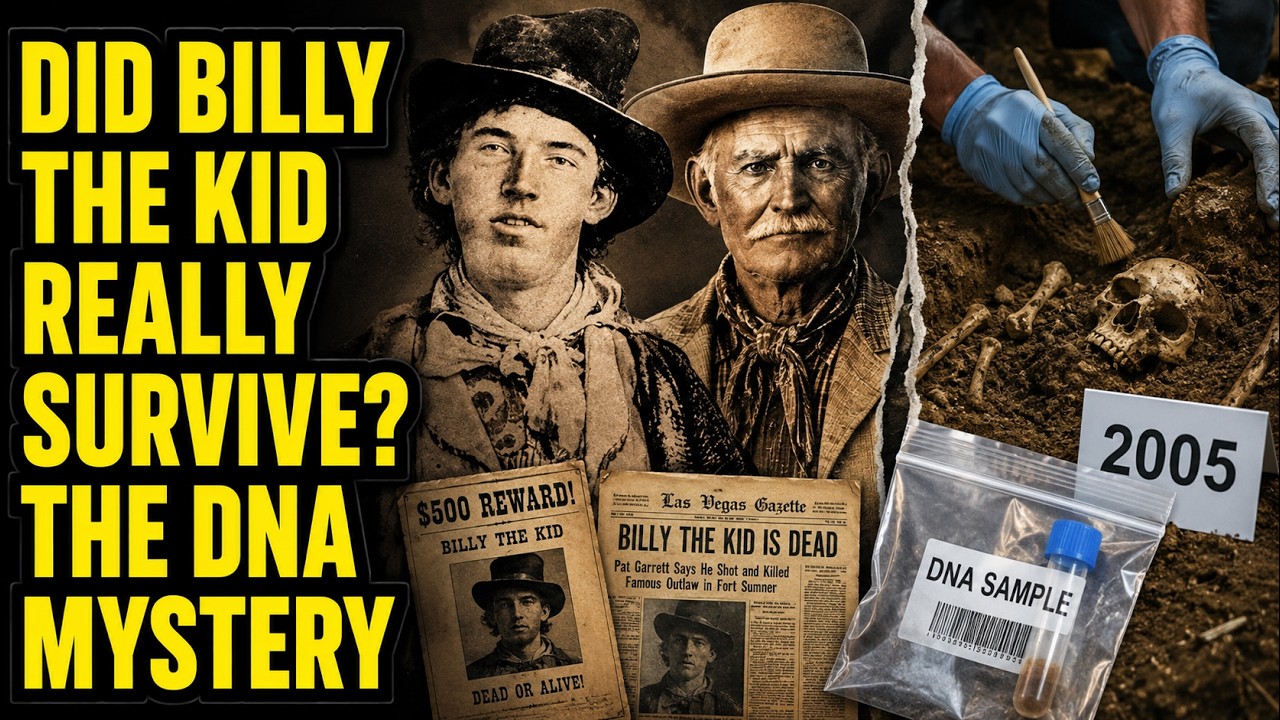
For more than a century, history has maintained that Sheriff Pat Garrett killed Billy the Kid at Fort Sumner, New Mexico, in 1881. Yet the case has never been fully closed in the public imagination because of missing forensic evidence, conflicting eyewitness accounts, and men who later claimed to be the famous outlaw. The question persists: did Billy the Kid really die that night, or did America’s most wanted fugitive escape and live out his life under another name? The survival theory begins with a genuine weakness in the official record.

There is no modern forensic file on Billy the Kid, no fingerprints, crime scene photographs, dental charts, or laboratory reports. But the absence of modern scientific evidence does not mean the case rests on nothing at all. Billy the Kid was most likely born Henry McCarty around 1859. He also used the names Henry Antrim and William H.
Bonney. Before he became one of the most mythologized outlaws of the American Old West, he worked as a cowboy and ranch hand and moved through the Spanish-speaking communities of New Mexico. His actual criminal record was serious enough without the later legends. He took part in the Lincoln County War, was convicted of murdering Sheriff William Brady, and was sentenced to hang.
On April 28, 1881, he escaped from the Lincoln Courthouse jail, killing Deputies James Bell and Robert Olinger in the process. That escape put him at the center of a major manhunt led by Lincoln County Sheriff Pat Garrett. The official account says Garrett found Billy at Fort Sumner on the night of July 14, 1881, and killed him inside the home of Pete Maxwell. This version does not rest only on Garrett’s memory.
The New Mexico State Records Center and Archives holds Billy’s death warrant, the sheriff’s certificate describing his escape, the coroner’s jury verdict verifying his death, the legal opinion concerning Garrett’s reward, and the territorial government’s later approval of payment. Those records show that officials treated the death as a completed law enforcement case, not as an unexplained disappearance. Historians evaluating the case weigh documents by asking when they were created, who created them, what motive the writer may have had, and whether independent records support the same event. The 1881 paperwork does not provide scientific certainty, but it creates a chain of evidence.
A survival theory must explain why the sheriff, local witnesses, a coroner’s jury, territorial officials, and the burial record all accepted the same identification. It must also explain why no verified document created after July 1881 places Henry McCarty alive under any name. Garrett did not arrive at Fort Sumner alone. He was accompanied by John W.
Poe and Thomas McKinney. The three lawmen entered the area quietly after receiving information that Billy might be nearby. Garrett went into Pete Maxwell’s dark bedroom to ask where the fugitive was hiding, while Poe and McKinney remained outside. According to Garrett’s account, a young man without his boots entered while carrying a knife used for cutting meat and a revolver.
He had already noticed the strangers outside and repeatedly asked who they were in Spanish. Maxwell quietly identified him to Garrett, and Garrett fired twice. One shot struck the man, and the other missed. This is the part of the story that survival believers examine most closely.
The room was dark. Poe had never seen Billy before, and Garrett himself wrote that Poe and McKinney immediately wondered whether he had shot the wrong man. That detail is important because it came from Garrett, not from a later claimant. Garrett said he recognized Billy’s voice, but recognizing a voice in darkness is not the same as making a clear visual identification.
Still, the incident did not end with the shooting. The body remained at Fort Sumner, where people who knew Billy could see it. An inquest was held the next morning, and the verdict named William H. Bonney.
A burial took place later that day. For the wrong-man theory to work, Garrett would have needed either to fool the local community or persuade people who knew Billy to support a false identification. No contemporary record identified by the New Mexico archives names the body as another known man. Garrett’s account even admits uncertainty about whether Billy fired.
Poe and McKinney believed they heard more shots than Garrett remembered, yet a search of the room reportedly found only the marks made by Garrett’s shots. That kind of confusion can happen during a fast event in poor lighting. It makes the account imperfect, but it does not by itself turn the dead man into someone else. Pat Garrett’s book is both valuable and dangerous as a source.
The Authentic Life of Billy the Kid appeared in 1882, less than a year after the shooting. Garrett’s friend Ash Upson, a journalist, did much of the writing. The book offered a detailed account of Billy’s life, capture, escape, and death. But later historians found errors in its description of Billy’s early years and questioned its effort to present Garrett in a favorable light.
Garrett had clear reasons to defend himself. Some newspapers criticized the shooting. People argued that he had ambushed Billy, and Garrett’s reputation as a lawman was tied to the claim that he had ended the hunt. The Library of Congress notes that historians have criticized the book as biased while still treating it as an important early source for the Billy the Kid story.
Bias, however, is not the same as fabrication. Garrett placed names, locations, approximate times, and witnesses into print while many people involved were still alive. He identified Poe, McKinney, Pete Maxwell, the local official who conducted the inquest, and the jury foreman. He also admitted facts that did not make the scene look perfectly controlled.
The room was dark. His deputies were unsure of the victim’s identity at first. Garrett could not fully explain the number of shots people believed they heard. Garrett also received a reward, which has sometimes been presented as a motive for fraud.
The reward was real, and New Mexico archival records include an attorney general’s opinion about paying it and later approval by the territorial government. Yet a financial motive does not prove that a substitute body was used. A successful fraud would have required much more than Garrett telling a convincing story. The inquest had to name Billy.
The community had to accept the body. Government officials had to process the case. People close to Billy would have had to remain silent for the rest of their lives. On the morning after the shooting, local official Alejandro Segura conducted an inquest.
Garrett named M. Rudolph as foreman of the coroner’s jury. The verdict stated that William H. Bonney had died from a gunshot fired by Pat Garrett while Garrett was performing his duty as sheriff, and that the killing was justified.
Billy’s body was then prepared for burial and placed in the old military cemetery at Fort Sumner on July 15, near two of his former companions. PBS records that a funeral procession followed the coffin to the cemetery that afternoon. An inquest was the closest thing the community had to an official forensic review. It was not an autopsy in the modern sense.
There was no medical examiner using present-day procedures, and the surviving material does not provide the kind of measurements a modern laboratory would expect. Even so, the jury had access to the body and the location. The New Mexico archives still identify a copy of the jury’s verdict among the Lincoln County records. That document was created in 1881, decades before the most famous survival claim became public and before Billy became a permanent movie legend.
The burial later became part of the controversy. Early wooden markers disappeared, later stone markers were stolen, and a major flood affected the Fort Sumner area in 1904. Researchers disagree about how much that flood changed the graves. Some argue there is no evidence that Billy’s remains were washed away.
Others point to the lost markers and uncertainty over the original coordinates. The safest statement is that contemporary records place Billy’s burial at Fort Sumner, while the precise position and condition of the remains are less certain today. Survival theories often focus on what the inquest lacked. There was no photograph of the dead man beside a dated newspaper.
There was no fingerprint comparison. There was no preserved DNA sample with an unquestioned chain of custody. Those are fair limitations, but a missing modern test cannot be treated as positive evidence that the official identification was false. The theory still needs a replacement victim, a reason that local residents accepted him as Billy, and a documented path showing where the real Billy went next.
Stories that famous Old West outlaws survived their reported deaths appeared around several major figures. Jesse James, Butch Cassidy, and others attracted later claimants because the historical record contained gaps and the public wanted one more chapter. Billy the Kid was especially suited to that kind of legend. He used several names, moved across a wide frontier, had escaped custody more than once, and died at only about 21 years old in a dark room with no modern forensic documentation.
The survival version usually says Garrett and Billy had once been friendly and arranged a fake death. In some versions, Garrett accidentally killed the wrong man. In others, he knowingly used another body so Billy could leave New Mexico. The details change depending on who tells the story.
That changing structure is a warning sign. A strong historical claim should become more precise as evidence appears. The Billy survival story often became less precise, adding unnamed victims, secret agreements, and conversations reported many decades after the people involved were dead. There is also a timing problem.
In the surviving contemporary record, no strong survival claim appeared immediately after the shooting. Newspapers reported Billy’s death, the legal system closed the case, and Garrett’s account appeared in 1882. The best-known claim did not become public until decades later. That delay does not make survival impossible because hiding would have been the entire purpose, but it means the later story must be supported by unusually strong evidence.
An elderly person remembering private events is not equal to a document written in 1881. A family story is not equal to a verified letter in Billy’s handwriting. A resemblance in two photographs is not equal to an identification supported by several independent records. The survival theory became popular because the official evidence was old and incomplete, not because investigators discovered a confirmed second life.
The most famous man who claimed to be Billy the Kid was known as Brushy Bill Roberts. His story reached the public in the late 1940s after investigator William V. Morrison followed a chain of elderly witnesses and became convinced that Roberts was the outlaw. Roberts said he had survived Fort Sumner, lived under other names, and remained quiet for decades.
He wanted the pardon that he believed territorial Governor Lew Wallace had promised Billy in 1879 in return for testimony connected to the Lincoln County War. Billy’s surviving letters confirm that he communicated with Wallace and expected favorable treatment, although the exact terms and legal meaning of the arrangement remained disputed. In 1950, Roberts traveled to Santa Fe and presented his case to New Mexico Governor Thomas Mabry. The meeting gave the story national attention, but it did not produce official recognition.
Mabry rejected the claim because Roberts could not provide conclusive proof. Roberts died later that year. His supporters argued that he knew unusual names and events from Billy’s world and was recognized by several elderly people who said they had known the outlaw. Morrison collected affidavits and later helped preserve the claim in a book.
The affidavits are real historical materials, but they only establish that people signed statements saying they believed Roberts was Billy. They do not establish that their memories were accurate after roughly 70 years. Information about the Lincoln County War was already available in books, newspapers, and local storytelling. Recognition after several decades is vulnerable to aging, suggestion, publicity, and honest error.
Morrison also approached the investigation already looking for a living Billy, which could influence the way questions were asked and answers were interpreted. The age problem is even more serious. Roberts said he was born in 1859, which would make him close to Billy’s age. A family Bible associated with Roberts has been reported as giving an 1879 birth year.
If that record identifies the same man and is accurate, Roberts would have been a small child when Billy was killed. Supporters challenge the identity connected to that record, but they have not produced a universally accepted paper trail connecting Roberts to Henry McCarty before 1881. Billy the Kid left more writing than many people realize. Letters sent to Governor Lew Wallace survived, and they show that Billy could read and write.
In one letter, he explained that Antrim was his stepfather’s name and referred to himself as Kid Antrim. The letters connect several of his known names to one person living in New Mexico before 1881. That creates a useful test for any survival claimant. A real claimant should match not only Billy’s face or remembered stories, but also his age, language, handwriting, family background, movements, habits, and documented relationships.
Brushy Bill never supplied that complete match. Supporters produced stories and recognitions, but not a continuous set of records showing Henry McCarty leaving Fort Sumner and becoming Roberts. There is no verified letter written after July 1881 in Billy’s known hand. There is no legal document in which a trusted person from Billy’s life privately identifies Roberts decades before the claim became public.
There is no early photograph with a secure history linking the young outlaw to the older Texas man. Photographic comparison has often been presented as scientific proof, but that description goes too far. Billy’s accepted tintype shows a young face under 19th-century camera conditions. Roberts was photographed at very different ages, angles, distances, and lighting.
Facial measurements can suggest resemblance, but resemblance is common, especially when only one widely accepted youthful image is available. A match score is meaningful only when the method is validated, the original photographs are reliable, and independent experts can reproduce the result. Even a strong resemblance would not explain conflicting ages and missing identity records. The same problem applies to private knowledge.
A detail can seem secret simply because it is unfamiliar to a modern audience. In the communities of New Mexico and Texas, stories about Old West outlaws circulated for generations. Morrison himself asked questions, offered names, and connected witnesses. That process can unintentionally shape later memories.
Brushy Bill may have believed what he said, may have built a false identity over time, or may have been repeating a story created by others. The surviving evidence does not reveal his motive, and it does not bridge the documentary gap. The Texas State Historical Association describes his proof as inconclusive. John Miller was the other major survival candidate.
He lived in the Southwest, worked with horses, and was said by later relatives to have claimed that he was Billy the Kid. He died in 1937 and was buried at the Arizona Pioneers’ Home Cemetery in Prescott. Unlike Brushy Bill, Miller did not build a major public campaign for a pardon. An official Arizona Pioneers’ Home publication notes that Miller never publicly presented the claim himself and that the story depends on second-hand information.
That makes it even harder to test. A claim reported after a person’s death cannot be questioned in real time, and the person cannot explain contradictions. Miller attracted attention because photographs appeared to show some resemblance to Billy and because little was firmly known about his earliest years. That absence created a possibility, but not proof.
When a person’s past is unclear, it can be tempting to place a famous identity into the blank space. Historical method requires the opposite approach. The claimant must be connected to Billy through positive evidence. It is not enough that researchers cannot immediately prove he was someone else.
In May 2005, investigators removed samples from Miller’s remains for DNA testing. The plan was to compare Miller’s genetic profile with blood traces taken from a bench believed to have held Billy’s body after the Fort Sumner shooting. That comparison had two major weaknesses. First, the bench needed a secure history proving it was present in 1881 and that the blood belonged to Billy rather than another person.
Second, the results were not publicly released in a form that independent scientists could evaluate. PBS later recorded that no test result had been made public. That leaves Miller in an unusual position. DNA was collected, but no transparent result settled the identity.
The lack of a published answer is sometimes treated as suspicious, yet it cannot honestly be counted as evidence for Miller. A hidden or incomplete test has no scientific value for the public. Without the laboratory data, contamination controls, reference samples, and chain of custody, no independent researcher can determine what was tested or what the result meant. A clean DNA comparison would require an unquestioned sample from Billy the Kid and an unquestioned sample from a claimant.
Neither side of that equation is simple. Billy’s grave is old. Its precise position has been debated, and the cemetery has experienced changes. Even if remains were recovered, researchers would need to establish that the bones came from the correct grave and had not been mixed with nearby burials.
A sample from Billy’s mother, Catherine Antrim, could provide a family comparison, but the effort to obtain it faced legal and ethical objections. In 2004, a judge declined to authorize the exhumation of Catherine’s remains unless investigators first located Billy’s remains and obtained usable DNA from them. That condition effectively stopped the proposed comparison at the time. Investigators also presented a much later affidavit claiming Garrett’s widow had described a substitute body plot.
According to the affidavit, she supposedly said Garrett had helped Billy escape and used another man’s body. The story was based on a childhood conversation remembered more than 60 years later. It was interesting, but it was not a biological sample or a contemporary statement. City officials opposing the exhumation argued that such a conspiracy would have required an unlikely level of cooperation and silence.
DNA can answer a narrow question. It can show whether two properly identified samples are biologically related. It cannot repair a poor chain of custody. It cannot prove that old blood on an object belonged to Billy simply because the object has a story attached to it.
It cannot identify a skeleton when the excavation location is uncertain and several burials may be close together. DNA also could not confirm every detail of Garrett’s account. Even a verified Billy burial would not tell researchers exactly what each person saw inside Maxwell’s room. The Billy the Kid case has produced plans, petitions, disputed samples, and unreleased results, but no publicly verified DNA finding that identifies Brushy Bill Roberts or John Miller as Henry McCarty.
The survival claim has three different levels of evidence, and they should not be mixed together. The first level is established documentation. Billy was a real outlaw using several names. He was convicted, escaped, became the subject of a reward, and was hunted by Pat Garrett.
Records created in 1881 state that Garrett killed William H. Bonney at Fort Sumner, that a jury examined the case, and that the body was buried the next day. Those facts are supported by more than Garrett’s book. The second level is uncertainty inside the official story.
The room was dark. Garrett’s deputies did not initially recognize the man. The surviving public record does not include a modern autopsy, fingerprint file, crime scene photograph, or preserved reference DNA. Garrett had a reward and a reputation at stake.
His book was ghostwritten and contained errors. The grave’s exact modern position has been debated. These weaknesses make careful questioning reasonable. The third level is the survival evidence.
Brushy Bill and John Miller appeared decades later without continuous records connecting either man to Henry McCarty. Their cases depend heavily on resemblance, oral history, late memories, disputed biographical details, and scientific tests that never produced a public, independently reviewed identification. Neither man supplied the one thing the theory needs most: a verified bridge from Fort Sumner in July 1881 to a later life. The official account does not have the certainty of a modern case preserved in a laboratory.
It has something the survival claimants do not have: contemporary identification supported by an inquest, government records, burial documentation, and a near-contemporary account naming the people involved. To overturn that record, a claimant would need evidence stronger than an unexplained scar, an old photograph, or a story remembered after most witnesses were gone. A verified family DNA match, a proven document in Billy’s handwriting created after 1881, or an unbroken identity record could change the case. None has been produced publicly.
The hidden truth is not that forensic science proved Billy the Kid lived. It is that the survival story grew inside the gaps of an old investigation while the strongest surviving evidence still points to Fort Sumner as the end of his life.