The woman history remembers as the “Widow of Mayerling” was once a name synonymous with absolute privilege, yet her life was a gilded cage from the very beginning. Born into the Belgian royal family, Stephanie of Belgium spent her early years under the cold, rigorous rule of her parents, a childhood marked by punishing discipline and emotional neglect. She grew up believing she was entering a fairy tale when she married Crown Prince Rudolf of Austria, heir to the Habsburg Empire, but the reality was a world of cruelty, betrayal, and deep personal tragedy that would eventually force her to renounce royalty altogether. Born on May 21, 1864, at the Royal Castle of Laeken near Brussels, Princess Stephanie Clotilde Louise Hermine Marie Charlotte was the daughter of the future King Leopold II of Belgium.
Her parents’ marriage was a purely political arrangement, and their home was described as entirely devoid of love. Leopold, a man with an iron will who would later be condemned for his brutal colonial rule in the Congo, was cold and cynical, while her mother, Archduchess Marie Henriette of Austria, preferred horses and Gypsy music to her children. When Stephanie was just four years old, her older brother, Leopold, the sole heir to the throne, died after falling into a pond and developing a severe cold. Following his death, the family atmosphere grew even colder and more distant, leaving Stephanie and her sisters to endure an upbringing so strict it was likened to a Spartan regime.
The girls were forced to wake at five in the morning, summer and winter, in unheated rooms with sparse food. For the slightest offense, they could be locked in dark rooms, denied supper, or forced to kneel on dry peas for hours. This harsh backdrop shaped Stephanie’s fragile health and quiet demeanor, making her an ideal, though unwitting, pawn for a major European alliance. In March 1880, Crown Prince Rudolf, the only son of Emperor Franz Joseph and Empress Elisabeth, known famously as Sisi, arrived in Brussels on an official visit.
The Austro-Hungarian Empire needed an ally and a Catholic bride of pure lineage to secure the future of the dynasty. Stephanie, at just fifteen years old, was the perfect choice. Rudolf, who was handsome and well-educated but already emotionally exhausted and plagued by nervous breakdowns, proposed. While the Belgian court was overjoyed at the prospect of their daughter becoming a future empress, no one asked Stephanie what she wanted.
She was enchanted by the brilliant prince and believed she was living a fairy-tale romance, unaware that he had traveled to the engagement celebrations with a mistress in tow. Their grand wedding took place in Vienna on May 10, 1881, in one of the most extravagant ceremonies in the history of the Austrian court. To the sixteen-year-old bride, however, the marriage felt more like performing a duty than a personal choice, marking the beginning of a path filled with disappointment and loneliness. Stephanie’s new life was immediately hostile.
Her mother-in-law, Empress Elisabeth, who was notoriously obsessed with her own appearance and thin waistline, despised her daughter-in-law from the start. Sisi cruelly mocked Stephanie’s figure and demeanor, reportedly calling her a “Belgian cow” and a “clumsy camel,” which turned the entire court against the young princess. The cruelty reached its peak on her very first night as a wife. Raised in strict Catholic modesty, Stephanie had no knowledge of marital intimacy, while Rudolf, accustomed to experienced mistresses and actresses, treated his young bride with harshness and selfishness.
Despite this nightmare beginning, Stephanie genuinely tried to be a good wife, recognizing that producing an heir was her only real protection in the Viennese court. The young couple settled in Prague, away from the sharp-tongued Sisi, and Stephanie later described this period as the calmest of her life. She immersed herself in learning the empire’s languages, engaged in charity work, and learned to act as a crown princess. From the autumn of 1881, she began to represent Empress Elisabeth at official functions, acting as the formal hostess for court ceremonies and accompanying Emperor Franz Joseph at major receptions.
On September 2, 1883, Stephanie gave birth to a daughter, Archduchess Elisabeth Marie, nicknamed “Erzsi,” at Laxenburg Castle. Instead of canon fire celebrating the birth of a future emperor, a disappointed silence fell over Vienna. The dynasty needed a male heir. While Franz Joseph welcomed his granddaughter warmly, Rudolf became deeply disappointed and distanced himself from his wife, falling back into a life of wild parties, heavy drinking, and a relentless string of affairs, leaving Stephanie isolated in a grand palace with her infant child.
The consequences of Rudolf’s debauched lifestyle soon had devastating effects on Stephanie. In 1886, the Crown Prince fell seriously ill. Official reports cited “acute influenza and rheumatism,” but the court physicians whispered a terrifying diagnosis: gonorrhea and syphilis. The couple was sent to the isolated island of Lacroma in the Adriatic Sea for treatment.
During the trip, Stephanie was suddenly struck with excruciating abdominal pain and a high fever. The true diagnosis was hidden by direct order of Emperor Franz Joseph: she had contracted peritonitis caused by the gonorrhea her husband had given her. In the nineteenth century, with no antibiotics available, the infection caused severe internal damage. Stephanie survived, but the doctors’ verdict was final and cruel: her fallopian tubes were blocked, and she would never be able to bear a child again.
This medical curse finished the marriage. Stephanie responded to her husband’s betrayal with coldness and a rejection of intimate relations, refusing all his attempts at reconciliation. In 1887, during a visit to Galicia, she sought consolation in an affair with Count Artur Potocki, publicly retaliating against her husband’s infidelities. Realizing he had deprived his lineage of a future, Rudolf began to lose his mind rapidly, suffering from guilt, physical pain from advancing syphilis, and severe depression.
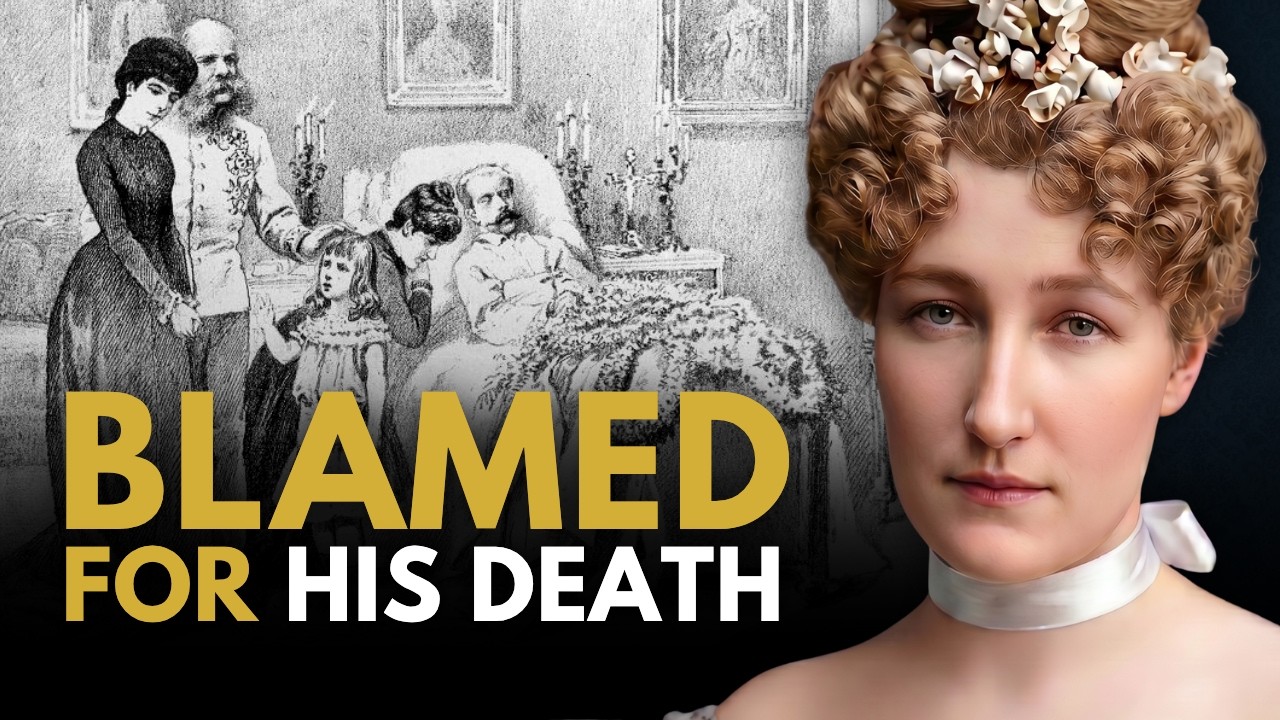
To ease his symptoms, doctors prescribed massive doses of morphine, turning the Crown Prince into a drug addict who obsessed over death. In October 1888, a desperate Stephanie tried to warn Emperor Franz Joseph about her husband’s severe depression and suicidal tendencies, but her warnings were not taken seriously. On January 30, 1889, the Mayerling tragedy occurred. Crown Prince Rudolf committed suicide at a hunting lodge, accompanied by his young mistress, Baroness Marie Vetsera.
The shock to Austria-Hungary was immense—a Catholic prince taking his own life with a minor. Emperor Franz Joseph exerted enormous effort to bribe doctors and the church to allow Rudolf a Christian burial in the imperial crypt. But the dynasty needed a scapegoat for the prince’s madness, and they chose Stephanie. The Emperor and Empress viewed her as a “failure” who had failed to prevent her husband’s fateful act, blaming her for not providing Rudolf with happiness and family stability.
Stephanie became a pariah in Vienna, an “extra person” in the court. She was isolated, her actions constantly criticized, and, most devastatingly, she began to be stripped of the right to raise her own daughter. Erszi was practically torn from her mother’s arms and handed over to courtiers who raised the girl to revere her dead father and despise her mother, portraying her as a “cold stranger. ” Stephanie found herself a prisoner whose dignity was systematically trampled, and even her own parents, especially her father Leopold II, refused to come to her aid, fearing for their own reputations.
Over the next ten years, she escaped Vienna whenever possible, traveling endlessly to find peace in the spas of England, France, and Italy, fearing she would lose her mind if she remained a shadow in the Hofburg. In 1900, at the age of thirty-five, Stephanie made a decision that shook two European royal houses. She decided to marry again—not a king or prince, but for love. She chose the Hungarian count Elemér Lónyay, a veteran diplomat who had served in St.
Petersburg, Paris, and London before retiring from government service in 1897. They met in 1899 at a resort in Abbazia, and within a year, Stephanie found in him the honesty and warmth she had never known in the Viennese palaces. For this marriage, Elemér converted to Catholicism, proving his commitment to a woman risking everything for their shared happiness. To the Habsburgs, this was not simply a marriage but an insult to the dynasty’s honor—a morganatic union warranting immediate exile.
Upon learning of it, Stephanie’s father flew into a rage, stripped her of her Belgian royal titles, forbade her from returning to Belgium, and completely removed her from his vast will. When her mother, Queen Marie Henriette, died two years later, Stephanie attended the funeral, but her father had servants expel her from the palace. The Habsburgs stripped her of her title of Archduchess, and worse, took from her the most precious thing—any real connection with her only daughter, Erszi, who remained in Vienna under her grandfather’s care. Count Lónyay was not a wealthy man by royal standards, but he possessed qualities Stephanie had never seen in the men of her family: nobility, tenderness, and genuine respect.
He loved her not as a vessel for heirs but as a woman. Their wedding took place on March 22, 1900, in Miramare. Defying all the curses from her crowned relatives, this marriage proved to be immensely happy. They lived together for forty-five years in total harmony and devotion.
Settling in the beautiful castle of Oroszvár, now known as Rusovce in Slovakia, Stephanie finally fulfilled her ambitions. She transformed the palace into a flowering paradise, designing extensive gardens herself and becoming a passionate gardener. The castle became a cultural hub for artists, musicians, and writers. Stephanie painted, danced, and supervised the creation of a multi-volume historical work on Austria-Hungary—a project Rudolf had once abandoned.
She proved to everyone that life after the Habsburgs was not only possible but could be beautiful. But the ghost of her past pursued her in the form of her daughter. The separation in 1900 caused irreparable damage to their relationship. Raised in Vienna in the cult of her dead father, Erszi was instilled with the idea that Rudolf was a romantic hero and her mother a traitor who had abandoned her for another man.
As she grew up, Elisabeth Marie inherited the rebellious Habsburg temperament and her father’s psychological instability. Her personal life was full of scandal. She married Prince Windisch-Grätz and had four children, only to divorce him amid a resounding scandal. Astonishingly, the Archduchess expressed interest in socialism, joining the Social Democratic Party and marrying the socialist Leopold Petznek in her second marriage, earning the press nickname the “Red Archduchess.
”
Stephanie, raised with strict conservative traditions, was horrified by her daughter’s behavior, and their relations completely broke down. For years, they did not meet face to face, their rare communication consisting of cold letters and fierce public attacks via lawyers. In court and through the press, Erszi publicly blamed her mother for the Mayerling tragedy, declaring in a particularly cruel outburst, “You never understood my father, you suffocated him with your compliance! ” The rift never healed.
In 1934, in the midst of a furious legal scandal over the publication of her memoirs, Stephanie made a final, difficult decision: she completely disinherited her only daughter. She bequeathed all her remaining property, personal archive, and unique memoirs not to her children but to the Benedictine monks. Her daughter reciprocated by not attending her mother’s funeral. The outbreak of World War I severely tested Stephanie.
Finding herself at the heart of a conflict between her country of birth, Belgium, and her country of marriage, Austria-Hungary, she was diplomatically isolated. Yet she did not retreat into isolation. Instead, the war years became her most prominent period of social activism. Stephanie devoted herself entirely to humanitarian work, turning the Oroszvár-Rusovce castle into a refuge for hundreds of those in need.
She and her husband converted their palace into a fully equipped hospital, with Stephanie taking charge of logistics—organizing food supplies, monitoring the hospital’s health conditions, and communicating with the wounded to ease their suffering. Her work with the Red Cross made her one of the most respected figures in the region, her authority based not on imperial insignia but on tangible actions. After the horrific end of World War I, Stephanie finally found a period of deep peace. In 1935, she took the bold step of publishing her frank memoirs.
The book became her manifesto, an attempt to pass the truth—distorted by court rumors—to future generations and to free herself from the heavy burden of the painful Mayerling memories. But the 20th century would not grant her a quiet ending. World War II crashed into her life like a relentless hurricane, destroying the fragile lifestyle she had so carefully built. On April 2, 1945, under the sound of cannon fire and the advance of the Red Army, the elderly Stephanie and her loyal husband Elemér were forced to leave Oroszvár forever.
They abandoned their flowering “paradise” to save it from ruin and looting, taking with them only their most valuable possession—their mutual love. They found their final refuge in the Benedictine monastery of Pannonhalma in Hungary. The monks sheltered the elderly couple behind their ancient, thick walls. There, in the solemn silence of the monastery cells, far from the false glitter of the imperial halls and the bloody conflicts of politics, Stephanie’s earthly journey ended on August 23, 1945.
The heart of the eighty-one-year-old princess stopped quietly. She had witnessed the final collapse of the old European order, remaining in history as a woman who found her true freedom only when she shed the suffocating weight of her imperial past. Hers is a story of broken illusions, the unbearable pain of betrayal, a medical curse that erased her future, and a final act of defiance that erased her from the official records of the Viennese court. She lost a crown but gained something far more valuable—forty-five years of genuine, honest love and inner freedom.
Her own words, written at the end of her memoirs, best summarize her life: “Crowns are made of gold and precious stones, but they are often woven from thorns. I got rid of my thorns and have never regretted it. ”