The official declaration came on September 7th, 1948, a date that would quietly seal one of the most contentious mysteries of the Second World War. In a Berlin courtroom, a judge ruled that SS-Obergruppenführer Hans Kammler, the engineer who orchestrated the construction of Auschwitz and oversaw the V-2 rocket program, was legally dead. The ruling was based not on a body, not on forensic evidence, and not on any confirmation from Allied occupation authorities, but solely on the sworn affidavits of two men: his driver, Kurt Preuk, and his orderly, Heinz Zeuner.
They claimed to have witnessed Kammler bite down on a cyanide capsule in a forest between Prague and Pilsen on May 9th, 1945, the day after the German surrender. They said they left the body behind in the chaos of the retreat, unmarked and unrecovered. The court accepted this account without question, and the man who held the keys to the Reich’s most advanced weapons programs was officially erased from the living world.
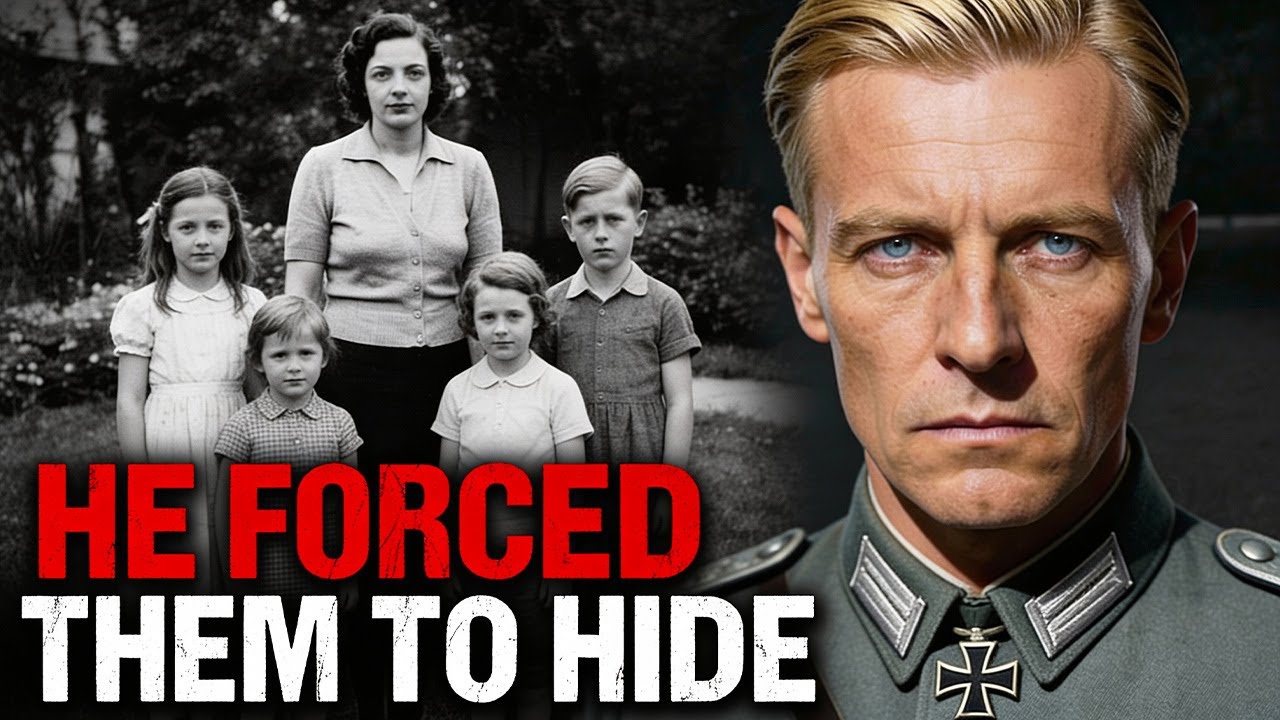 But the legal death of Hans Kammler was not an act of historical closure; it was an act of survival, orchestrated by the woman he left behind. His wife, Uta Kammler, had been waiting in Innsbruck when American troops overran the city, expecting a husband who would never arrive. She was left with four children, no income, and a legal status that was nothing short of catastrophic.
As the wife of a missing war criminal, she was frozen in a bureaucratic limbo. She could not access family assets, claim a widow’s pension, or legally move forward with her life as long as her husband existed in a state of official uncertainty. So, on July 9th, 1945, a mere two months after the guns fell silent across Europe, Uta walked into the District Court of Berlin-Charlottenburg and filed a petition to have her husband declared dead.
The timing was staggering. Allied intelligence was still scouring the continent for Kammler, the Nuremberg trials had not yet begun, and the occupation zones were still being defined. Yet here was the wife of one of the most wanted men in Europe, using the German legal machinery to close the file on him forever.
This was not grief; this was strategy. Uta Kammler understood that the chaos of postwar Germany could be navigated more effectively through paperwork than through flight. If she could secure a death certificate, she could unlock whatever assets remained frozen in bank accounts and property registries.
She could claim widow’s status and rebuild a life for her children. More importantly, she could sever the legal connection to a man whose name was becoming synonymous with the Holocaust’s industrial murder. The affidavits provided by Preuk and Zeuner were convenient to the point of suspicion.
They described a scene that was impossible to verify: a suicide in a forest, a body left behind, no grave, no identification. The witnesses were men who had served Kammler personally, men whose loyalty to their commander might have extended to protecting his escape or covering his tracks. The court did not ask why the body was never recovered.
It did not ask why no Allied patrol had reported finding a high-ranking SS officer’s corpse. It simply accepted the story and stamped the file closed.
If the conspiracy theorists are correct, if the Americans did extract Kammler for Operation Paperclip, then Uta Kammler’s legal maneuver was not just a survival tactic; it was a cover-up of staggering proportions. She would have knowingly filed false death papers to protect herself while abandoning any hope of finding her husband alive. The convenient death certificate would have slammed the door on any official investigation, allowing the Allies to claim they had no knowledge of Kammler’s whereabouts while quietly debriefing him on the V-2 program and the underground factories where slave laborers built the rockets.
The official story became a shield for both the family and the intelligence services. Or perhaps Uta genuinely believed the suicide story, perhaps Preuk and Zeuner told her the truth as they knew it, and she simply acted on the information she had. Either way, the outcome was identical.
She was now officially a widow, free to navigate the ruins of postwar Germany without the legal burden of a missing war criminal as a husband.
The network that rallied around Uta Kammler in the years following the declaration reveals the persistence of Nazi social structures long after the regime collapsed. In the 1950s, she received letters of support from Princess Ingeborg Alix of Schaumburg-Lippe, a woman who had served as an SS-Helferin during the war. The princess reinforced the suicide story, offering moral support and practical connections to other women in similar situations.
 This was not random charity; it was part of a broader underground network that had formed across Germany in the late 1940s. Organizations like Stille Hilfe, or Silent Aid, had been established to support former SS members and their families. Officially, these groups presented themselves as humanitarian organizations helping war prisoners and internees.
In practice, they became lifelines for unrepentant Nazis and their widows, providing legal assistance, financial support, and social connections that allowed them to reintegrate into German society without facing the consequences of their past actions.
The women who ran these networks understood something crucial about the Nazi social fabric. SS officers had married into certain families, attended certain social events, and built certain friendships that transcended the political collapse. When the Third Reich fell, those relationships survived.
The ideology might have been discredited, but the mutual support continued. Uta Kammler had access to this world, whether as an active participant or a silent beneficiary. The records are fragmentary, the correspondence incomplete, but the evidence suggests she was not struggling alone in the ruins.
She had people looking out for her, people who shared her interest in maintaining the fiction of her husband’s death and ensuring that the family could move forward without the stigma of being connected to one of the most notorious figures of the Nazi regime. This network provided a safety net that allowed the Kammler family to survive the immediate postwar years and eventually rebuild their lives.
While the mother was stabilizing the family through these old networks, something entirely different was happening with the children. Jürgen Kammler was born in 1940, the son of a man who would become one of the architects of the Nazi war machine. He grew up in the shadow of a father who disappeared before he was five years old, a father whose name would eventually become synonymous with concentration camp construction and the ruthless exploitation of slave labor.
What Jürgen did with that inheritance is the most dramatic twist in this entire story. He became a Marxist political scientist, a professor at the University of Kassel. He did not hide from his father’s name.
He did not flee to obscurity or change his identity. Instead, he dedicated his entire academic career to studying the German resistance and the crimes of the Nazi era. The son of the man who built the concentration camps spent his life exposing what those camps meant.
This was not quiet, private atonement conducted behind closed doors. Jürgen publicly stated that his father’s culpable 𝓮𝔁𝓹𝓸𝓼𝓮𝓭 function was the compelling motive for his life’s work. He named it.
He owned it. He made his career a direct, documented response to his father’s crimes.
 Think about what that means. Every lecture Jürgen gave, every paper he published, every student he taught, all of it was shaped by the knowledge of what his father had done. He did not try to rehabilitate Hans Kammler’s reputation.
He did not argue that his father was just following orders or that history had judged him too harshly. He took the opposite approach entirely. He made himself into a living rebuke of everything his father represented.
The Kammler name became associated with two completely opposite legacies. The father built the infrastructure of the Holocaust. The son spent decades exposing how that infrastructure functioned and what it meant for its victims.
The same surname appeared on SS construction orders and on academic studies of Nazi resistance. One man created the machinery of death. The other dedicated his career to ensuring it was never forgotten or excused.
Jürgen Kammler died in 2018, having spent more than half a century on this work, a lifetime of scholarship that directly confronted the darkness his father had helped create.
But Jürgen was not the only child. Hans and Uta Kammler had multiple children, at least four who survived to adulthood. There was another son born on December 10th, 1943, and two daughters born in 1932 and 1937.
We know almost nothing about any of them. They did not become public academics like Jürgen. They did not write memoirs defending their father or condemning him.
They did not give interviews or participate in historical research. They simply vanished, not into conspiracy theories like their father, but into deliberate, chosen silence. This was not the dramatic disappearance of a war criminal fleeing justice.
It was something quieter and in some ways more complete. These siblings erased themselves from the historical record entirely. Researchers studying the Kammler family can barely confirm basic details about their lives.
Birth dates, yes. Marriage records, possibly. But careers, locations, descendants, nothing.
 Somewhere in Germany, and perhaps beyond, the other Kammler children lived out their lives carrying a name that historians associate with some of the worst crimes of the twentieth century. Whatever choices they made, whatever paths they followed, they made sure those stories would never become public. They watched their brother Jürgen turn his inheritance into a lifetime of academic work.
And they chose the opposite. Complete withdrawal. Total silence.
The question of whether Hans Kammler survived the war remains one of the most tantalizing unresolved mysteries of the Nazi era. The official story says he died by suicide in a forest near Prague. But the lack of a body, the conflicting witness accounts, and the persistent rumors of American involvement have kept the conspiracy theories alive for decades.
Newly surfaced intelligence reports have hinted that American forces may have detained him in connection with Operation Paperclip, the secret program that brought German scientists to the United States. Kammler was not just another SS general; he was the man who knew where every secret of the Reich’s wonder weapons was buried. He oversaw the construction of Auschwitz, ran the underground factories where slave laborers built V-2 rockets, and coordinated the production of jet fighters when Hitler still believed in miracle weapons.
His signature appeared on blueprints for death camps and rocket facilities alike. When the war ended, Kammler had more secrets in his head than almost anyone alive. The Allies knew exactly who he was.
American and British intelligence had his name at the top of their capture lists. And yet, somehow, he slipped through their fingers.
Some witnesses claimed he committed suicide near Prague on May 9th, 1945. Others swore they saw him alive weeks later. Conflicting stories spread, but nothing could be verified.
No body was ever found. No grave was ever located. The official story became convenient.
Declaring Kammler dead allowed everyone, the Allies, the German courts, the postwar authorities, to close one more file in a sea of missing names. But the family story is resolved. It is documented, and it reveals something important about how people respond when they inherit the unforgivable.
Some protect the legacy because survival requires it. Some destroy it because conscience demands it. Some simply walk away and never look back, choosing a silence so complete that even their existence becomes uncertain.
Hans Kammler built the machinery of the Holocaust and then vanished into history’s shadows. His family had to live in the light he left behind, and each of them found a different way to carry that weight. The mother used the old networks to survive.
The son used his career to condemn. The other children chose erasure. Three responses to one unbearable truth, a truth that continues to haunt the historical record decades after the guns fell silent.


