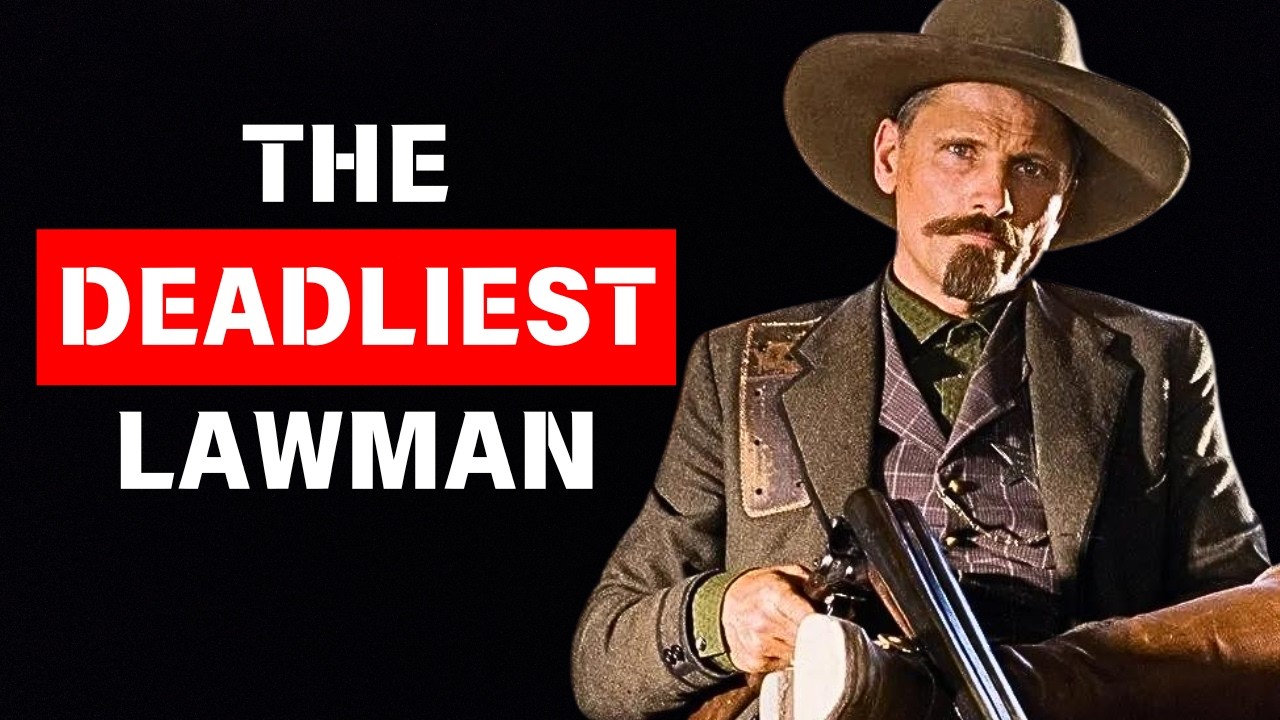
Dallas Stoutenmire arrived in El Paso as the town’s sixth marshal in eight months, yet within three days of taking office he was at the center of one of the most widely reported gunfights in Old West history—an encounter later known as the “Four Dead in Five Seconds” affair. Stoutenmire was born in Abberfoil, Alabama, one of nine children. He enlisted in the Confederate Army at just 15, was discharged when his age was discovered, and re-enlisted twice before being accepted into the 45th Alabama Infantry Regiment. He survived the war carrying two embedded bullets, a physical reminder of the conflict that stayed with him for life.

After the Civil War, he spent at least three years with the Texas Rangers before disappearing from official records between roughly 1874 and 1878. During that time he likely lived in Mexico, where he reportedly became fluent in Spanish and worked as a carpenter, sheep farmer, wheelwright, merchant, and business owner. He re-emerged as town marshal of Socorro, New Mexico, and was soon encouraged by his brother-in-law, Stanley “Doc” Cummings, to apply for the marshal’s position in El Paso. The city was swollen with railroad growth and instability, and officials wanted an outsider with a tough reputation.
Stoutenmire was appointed on Monday, April 11, 1881. One of his first tasks was retrieving the jail keys from Deputy Marshal Bill Johnson, who had a reputation for drinking. When Johnson hesitated, witnesses said Stoutenmire took the keys by force in public, humiliating the deputy and signaling a new, uncompromising tone in the department. On Thursday, April 14, 1881, roughly 75 armed Mexican cowboys crossed the Rio Grande into El Paso searching for two missing men, Sanchez and Yorgi, who had disappeared while tracking cattle reportedly stolen from a Mexican ranch.
Constable Gus Kremcow, known for his fluency in Spanish, assisted the group. The bodies of Sanchez and Yorgi were found near the property of rancher Johnny Hail, a man with a documented history of questionable cattle dealings. An inquest ruled the two cowboys had been unlawfully killed. Two American cattlemen, Peaver and Stevenson, were charged and taken into custody.
The Mexican delegation prepared to return home with the bodies. Later that day, Kremcow returned to a saloon to retrieve his firearms and became involved in a tense exchange with George Campbell, a former town marshal. Campbell had reportedly questioned Kremcow’s loyalty during the inquest. Johnny Hail, who had been drinking heavily, grew agitated and obtained one of Campbell’s pistols.
He fired at Kremcow, wounding him. Stoutenmire was eating dinner across the street. Hearing gunfire, he rushed out and opened fire on the disturbance. In the chaos, an unarmed Mexican civilian bystander was fatally struck.
Stoutenmire then turned on Hail and killed him. Campbell, stunned by Hail’s fall, reportedly tried to calm the situation, but Kremcow—still reeling from his wound and believing Campbell responsible—returned fire, damaging Campbell’s weapon and injuring his foot. When Campbell reached for his fallen gun, Stoutenmire shot him mortally. The incident brought Stoutenmire instant national fame, but it also created lasting resentment.
Hail and Campbell had deep local connections, and many in El Paso viewed the new marshal as an outsider who had killed their friends and neighbors. Three days later, on April 17, 1881, former deputy Bill Johnson—still bitter over his public humiliation—attempted to ambush Stoutenmire with a double-barreled shotgun. Johnson lost his balance and accidentally discharged both barrels into the air. Stoutenmire returned fire, and Johnson was mortally wounded.
The failed ambush marked the beginning of a long feud between Stoutenmire and the influential Manning family, friends of Hail and Campbell. Within his first week as marshal, Stoutenmire had been involved in four deadly encounters. Over the following months he was involved in additional armed confrontations during attempted arrests. Crime in El Paso declined sharply under his leadership, but his list of local enemies grew.
On February 14, 1882, the feud turned personal. James Manning became involved in a dispute with Doc Cummings. Witnesses said Cummings confronted Manning outside a saloon, briefly detained an innocent passerby by mistake, and re-entered the saloon still angry. Manning appeared in a hallway armed, and both men opened fire.
Cummings was struck and died shortly after. Manning claimed self-defense and was acquitted in a trial that drew a large crowd of his family’s supporters. Stoutenmire was devastated by his brother-in-law’s death and openly expressed his dissatisfaction with the verdict. His anger made El Paso’s saloons and public spaces tense, and many residents avoided town altogether.
As an outsider with few personal connections beyond his wife and the deceased Cummings, Stoutenmire grew politically vulnerable. On May 27, 1882, the town council voted to remove him from office. Stoutenmire entered the chamber visibly intoxicated and challenged the council’s authority. Council members suggested he could keep his job, but once sober he submitted his resignation on May 29, 1882.
He briefly took over the Globe Restaurant, previously run by Cummings, before being appointed deputy U. S. Marshal for Western Texas and the New Mexico Territory by U. S.
Marshal Harrington Lee “Hal” Gosling. The feud with the Manning family continued. On one occasion, an intoxicated Stoutenmire stood outside a saloon where the Mannings had gathered, shouting provocations and challenging them to face him. The Mannings stayed inside, and local townspeople persuaded Stoutenmire to leave.
On September 18, 1882, the Mannings and Stoutenmire met in a saloon to attempt a peace agreement. James Manning, believing the meeting had gone well, excused himself and left early. The remaining conversation quickly turned tense. Stoutenmire accused one of the Mannings of spreading falsehoods; Doc Manning accused Stoutenmire of breaking a promise.
Both men reached for their weapons. In the struggle, a friend of Stoutenmire attempted to intervene, causing Stoutenmire to stumble. Doc Manning fired, striking Stoutenmire in the left arm. A second shot made limited contact, cushioned by folded documents in his shirt pocket.
As Stoutenmire fell near the doorway, he drew his pistol with his right hand and wounded Doc Manning in the arm. James Manning then returned to the scene and fired two rounds from behind. One struck a barber’s pole; the other fatally wounded Stoutenmire. Stoutenmire’s funeral was held with honors by El Paso Lodge Number 130 of the Ancient Free and Accepted Masons.
His wife Isabella arranged for his remains to be transported to Columbus, Texas, where he was laid to rest in Allin Cemetery in Colorado County. The Masonic Lodge paid all funeral expenses. The Mannings were arrested and stood trial for the killing. The jury included many of their friends and supporters, and they were ultimately acquitted.
Life in El Paso returned to normal, and Stoutenmire’s dramatic final days faded from public discussion. In a curious turn, Frank Manning was later appointed assistant city marshal after Thomas Mode was killed on July 11, 1883. His time in the position was brief; he stepped away after facing criticism for his reluctance to act against friends and acquaintances. Dallas Stoutenmire made his name in five seconds but carried its consequences for the rest of his short life.
He was fast, fearless, and ultimately a tragic figure in a town that never fully accepted him.