The final broadcast never aired. The voice that had commanded the German people to embrace total war, to sacrifice everything for a doomed Reich, was silenced not by a hangman’s noose, but by his own hand in the smoldering ruins of Berlin. Joseph Goebbels, the master manipulator of Nazi ideology, cheated the gallows by a single day.
Yet, a meticulous examination of the Nuremberg precedent, his own extensive diaries, and the nature of his crimes leaves little room for doubt: had he survived the bunker, he would have been condemned to death.
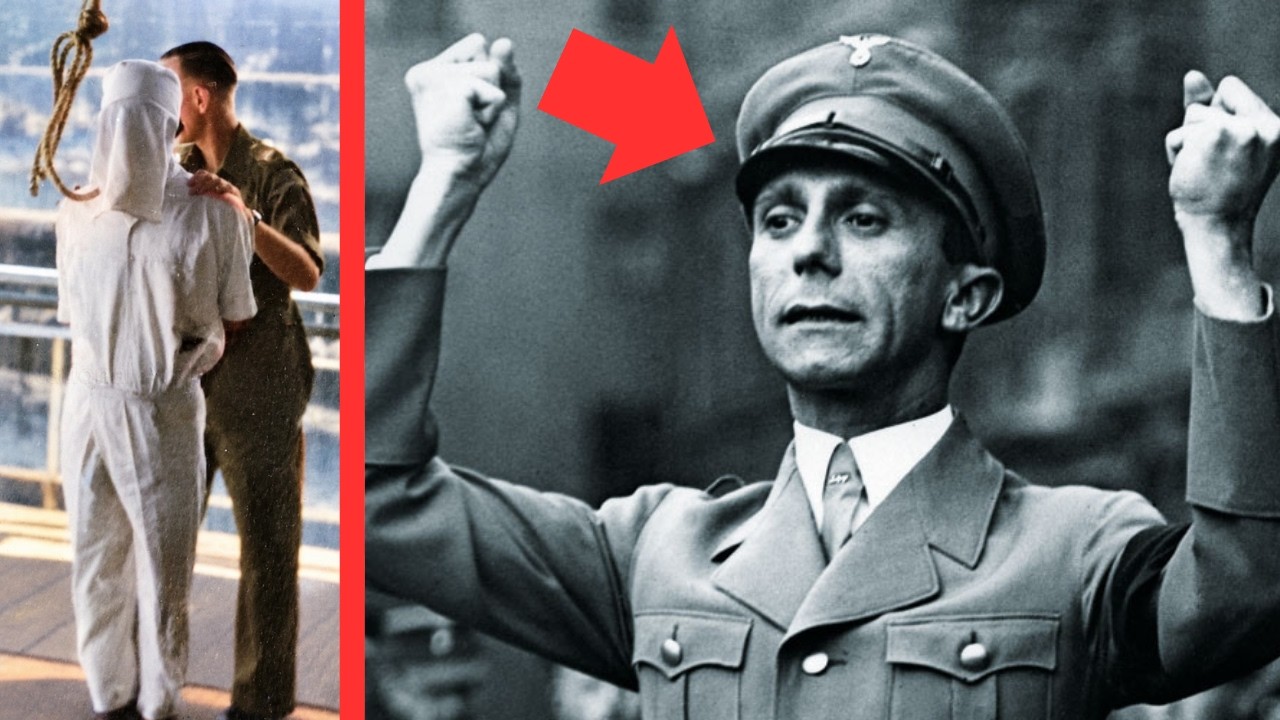 The question of Goebbels’ fate is not a matter of idle speculation but a grim exercise in legal and historical probability. The International Military Tribunal at Nuremberg was not merely a victor’s court; it was an attempt to establish a legal framework for the unprecedented horrors of the Nazi regime. The prosecutors sought to prove that aggressive war, war crimes, and crimes against humanity were not just acts of state but individual criminal offenses.
In this context, Goebbels was not a peripheral figure. He was the architect of the psychological warfare that enabled the entire Nazi project, making him a prime target for prosecution.
To understand why execution was the near-certain outcome, one must first look at the fate of Julius Streicher. Streicher was a publisher, a man whose influence waned significantly during the war, yet he was hanged on October 16, 1946. His crime was not commanding troops or managing logistics of death camps; it was the relentless incitement of hatred through his newspaper, Der Stürmer.
The tribunal found him guilty of crimes against humanity for his poisonous propaganda, which they determined directly contributed to the persecution of Jewish people. The legal principle established was clear: words that incite genocide are a capital offense.
If Streicher’s newspaper was enough to warrant the death penalty, the case against Goebbels would have been exponentially more devastating. Goebbels did not merely publish a hateful rag; he controlled the entire information ecosystem of a nation of eighty million people. As Reich Minister of Public Enlightenment and Propaganda, he dictated what was printed in every newspaper, broadcast on every radio station, and shown on every cinema screen.
He did not just express anti-Semitic views; he orchestrated a state-sponsored campaign of dehumanization that made the Holocaust possible. His reach was absolute, and his responsibility was therefore far greater than Streicher’s.
The prosecution’s case would have been built on an unassailable foundation: Goebbels’ own words. Unlike many Nazi leaders who claimed ignorance of the “Final Solution” after the war, Goebbels left behind a detailed diary spanning over a decade. These documents are not ambiguous.
They contain explicit references to the mass murder of Jews. In March 1942, he wrote about the fate of Jews being deported to the East, making it clear he understood they were being killed. He did not record these events with horror or dissent, but as a necessary part of the radical program he supported.
In a courtroom, these diaries would have been a smoking gun, proving his knowledge and approval of genocide beyond any reasonable doubt.
Furthermore, Goebbels was not a passive observer of violence; he was an instigator. The events of Kristallnacht in November 1938 serve as a stark example. Following the assassination of a German diplomat in Paris, Goebbels delivered a speech that served as a signal for a nationwide pogrom.
Synagogues were torched, Jewish-owned businesses were looted and destroyed, and thousands of men were sent to concentration camps. Goebbels was not merely reporting on this violence; he was the catalyst. This event alone demonstrated his willingness to translate his propaganda into direct physical action against a defenseless population.
His role in the war effort also placed him squarely in the category of major war criminals. The speech he delivered at the Berlin Sportpalast in February 1943, demanding “Total War,” was a desperate attempt to rally a nation facing defeat. He called for the closure of businesses, the conscription of women into factories, and the complete subordination of civilian life to the military machine.
 This was not the act of a man trying to end a conflict; it was the act of a fanatic determined to prolong it, regardless of the cost in German lives. His appointment as Reich Plenipotentiary for Total War in 1944 gave him dictatorial powers over the home front, further cementing his status as a key architect of the regime’s final, desperate phase.
The defense that might have been offered—that he was merely a propagandist, not a killer—would have been legally fragile. The Nuremberg Charter explicitly defined crimes against humanity to include “persecution on political, racial, or religious grounds.” The tribunal established that those who orchestrated persecution were just as culpable as those who physically carried it out.
Goebbels’ ministry was the engine of that persecution. He created the climate of hatred in which the SS could operate. He demonized the enemy to justify the war of annihilation in the East.
He was, in the eyes of the law, a principal in the crime of genocide.
The comparison to other defendants at Nuremberg further clarifies the likely outcome. Hermann Göring, the head of the Luftwaffe, was sentenced to death. Hans Frank, the Governor-General of occupied Poland, was sentenced to death.
Alfred Rosenberg, the chief racial theorist, was sentenced to death. These men were all senior leaders who, like Goebbels, were not directly operating the gas chambers but were responsible for the policies that led to them. Goebbels’ proximity to Hitler, his control over the national narrative, and his documented knowledge of the Holocaust placed him in the same category of criminality as the most senior figures of the regime.
Even the technicality of his final appointment could have been used against him. In his political testament, Hitler named Goebbels as his successor as Reich Chancellor. For a single day, Goebbels was the head of the German government.
While this was a symbolic appointment, it demonstrated the absolute trust and authority he held. It also meant that he was the final political leader of the Nazi state, responsible for its last actions. This fact would have been highlighted by prosecutors to show that he was not a marginal figure but the ultimate heir to Hitler’s power.
The argument that he might have received a life sentence, like Rudolf Hess, is weak. Hess was sentenced to life in prison, but his case was unique. He had flown to Scotland in 1941 on a bizarre peace mission and had been imprisoned for the remainder of the war.
He was largely disconnected from the later, most horrific phases of the Holocaust. Goebbels, by contrast, was active until the very end. He was in the bunker with Hitler, encouraging resistance until the Red Army was at the gates.
He had no mitigating circumstances. He did not break with the regime; he died for it.
 The evidence from his diaries is particularly damning when considering the issue of intent. To convict someone of crimes against humanity, prosecutors must prove that the accused acted with knowledge and intent. Goebbels’ diaries prove that he had specific, detailed knowledge of the extermination process.
He wrote about the “liquidation” of the Jews with chilling detachment. He did not just suspect what was happening; he knew. This level of knowledge, combined with his active role in creating the ideological justification for genocide, would have made it nearly impossible for any defense lawyer to argue for his innocence or even for a reduced sentence.
Moreover, the Allies were determined to make an example of the Nazi elite. The trials were not just about punishing individuals; they were about establishing a historical record and deterring future tyrants. Executing the man who had controlled the media and manipulated the masses would have sent a powerful message that propaganda for genocide is a crime against humanity.
The symbolic value of hanging Goebbels would have been immense. It would have demonstrated that the architects of the “Big Lie” were just as responsible as the soldiers who pulled the triggers.
In the annals of legal history, the Nuremberg trials established the principle of individual accountability for state-sponsored atrocity. The judges rejected the defense of “just following orders.” They held that individuals who shape policy, incite hatred, and knowingly participate in a criminal enterprise are personally liable.
Goebbels was the ultimate participant in that criminal enterprise. He was not a bureaucrat in a distant office; he was the voice of the regime, the creator of its myths, and the inciter of its worst crimes.
The final days of his life offer a chilling glimpse into his mindset. On May 1, 1945, after poisoning his six children, he and his wife Magda took their own lives. This act was not one of remorse but of absolute commitment to the ideology he had spent his life promoting.
He chose to die rather than face the consequences of his actions. This refusal to accept responsibility, this final act of defiance, underscores the fact that he was a fanatic to the end, a man who would have offered no repentance in a courtroom, only justification.
If he had been captured alive by Soviet troops, he would likely have been taken to Moscow for interrogation before being handed over to the International Tribunal. The Soviets, who had suffered the most at the hands of the Nazi war machine, would have had no sympathy for him. His trial would have been a global media event, with the world watching as the man who had lied to millions was finally confronted with the truth.
The prosecution would have presented his own speeches, his own diary entries, and the testimony of survivors to paint a picture of a man who was not just a follower but a leader in the campaign of hatred.
The legal path to the gallows was clear. The charge of “crimes against humanity” was tailor-made for someone like Goebbels. His systematic persecution of Jews, his incitement to violence, and his role in the psychological preparation for war all fell under this charge.
 The tribunal had already established with the Streicher verdict that propaganda for genocide was a capital crime. Goebbels’ propaganda was far more extensive, far more powerful, and far more effective than Streicher’s. To sentence Streicher to death and spare Goebbels would have been a legal and moral absurdity.
Furthermore, the charge of “waging aggressive war” would also have applied. Goebbels was a member of the inner circle that planned and executed the invasions of Poland, France, and the Soviet Union. He used his ministry to soften up the German public for these wars, to demonize the enemy, and to justify the brutal occupation policies that followed.
He was a key member of the criminal conspiracy to take over Europe. The tribunal was explicit in its finding that the Nazi leadership was a criminal organization, and Goebbels was one of its most senior members.
The only scenario in which Goebbels might have escaped execution is if he had cooperated fully with the Allies and provided testimony against other leaders. However, this was inconceivable. Goebbels was a true believer.
He had no intention of betraying Hitler, even after Hitler’s death. He chose to die with his Führer. If captured, he would have remained defiant, using the trial as a platform to spew his propaganda.
This defiance would have only hardened the resolve of the judges to impose the ultimate penalty.
The physical evidence of his crimes was also overwhelming. The Allies had captured the records of the Propaganda Ministry. They had copies of his speeches, his directives, and his correspondence.
They had the testimony of his subordinates. The case against him would have been a prosecutor’s dream. It would not have relied on circumstantial evidence or unreliable witnesses; it would have been built on the defendant’s own written and spoken words, meticulously documented over a period of twelve years.
In conclusion, the historical record, the legal precedent, and the nature of his crimes all point to one inescapable conclusion. Joseph Goebbels, had he been captured alive, would have been tried at Nuremberg, found guilty of crimes against humanity, and sentenced to death by hanging. The execution of Julius Streicher established the precedent for punishing propagandists.
The diaries of Goebbels provided the proof of his knowledge and intent. His position as the second-most powerful man in the Reich made him a primary target. He was not a minor functionary; he was a principal architect of the Holocaust and the Second World War.
The only reason he was not executed is that he took his own life, a final act of cowardice that robbed the world of the justice it deserved. The gallows at Nuremberg, which claimed the lives of Göring, Ribbentrop, and Streicher, were built for men like him. He escaped them, but history has rendered its verdict: he was guilty, and his sentence would have been death.