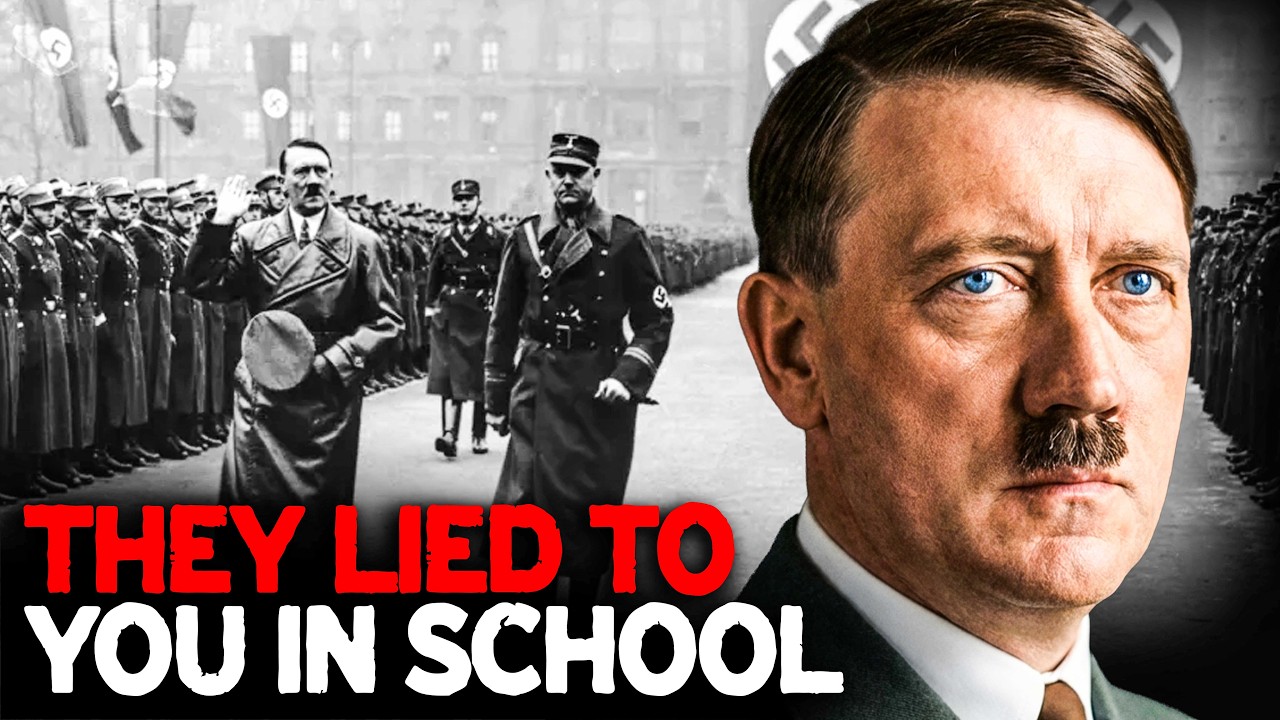
The long shadow of the Treaty of Versailles, the global economic collapse, and the catastrophic miscalculations of Western leaders created the perfect storm that allowed Adolf Hitler to plunge the world into its deadliest conflict, a comprehensive new analysis reveals. The war that began with German guns firing on the Polish garrison at Westerplatte at dawn on September 1st, 1939, was not the sudden act of a single madman, but the culmination of two decades of interlocking failures, humiliations, and missed opportunities. From the railway carriage at Compiègne in 1918 to the signing of the Molotov-Ribbentrop Pact in 1939, a chain of decisions rendered the Second World War not just possible, but for many historians, all but inevitable.
The seeds of the catastrophe were sown in the hall of mirrors at the Palace of Versailles in June 1919. The treaty, designed to permanently cripple Germany, instead created a nation seething with resentment and a political culture poisoned by the “stab-in-the-back” myth. The war guilt clause, Article 231, which forced Germany to accept sole responsibility for the war, was a factual lie that unified the German public in outrage.
 The crushing reparations bill of 132 billion gold marks, a figure so vast it defied comprehension, crippled the German economy and created a generation of citizens who felt betrayed by their own government. The French Marshal Ferdinand Foch, who had seen the terms, reportedly predicted with chilling accuracy, “This is not a peace. It is an armistice for twenty years.”
This economic devastation was compounded by the hyperinflation of 1923, which wiped out the savings of the German middle class overnight. A wheelbarrow full of banknotes could not buy a loaf of bread, and people burned money in their stoves for warmth. This psychological trauma, the second time in a decade that prudent citizens had been ruined, created a desperate search for someone to blame.
It was in this toxic atmosphere of defeat, humiliation, and economic chaos that Adolf Hitler, a failed artist and decorated but embittered veteran, found his voice. His raw, visceral oratory in Munich’s beer halls, tapping into the deep well of grievance and national pride, offered simple answers to complex problems, and his message of revenge against the “November criminals” and the Jews resonated with a population in despair.
The brief period of stability in the mid-1920s, marked by the Dawes Plan and the Locarno Treaties, masked the underlying fragility of the Weimar Republic. The prosperity was largely dependent on American loans, and when the Wall Street crash of October 1929 triggered the Great Depression, the house of cards collapsed. Unemployment in Germany soared from 1.
3 million to over 6 million by 1932, and the Nazi party’s electoral fortunes rose in near-perfect correlation with the economic misery. From a fringe party winning 2. 6% of the vote in 1928, the Nazis surged to 37.
4% by July 1932, becoming the largest party in the Reichstag. The German people, in their desperation, voted for the most extreme solution on offer.
The final transfer of power, however, was not a popular revolution but a backroom deal. Conservative politicians and military leaders, including former Chancellor Franz von Papen, convinced the aging President Paul von Hindenburg that they could harness Hitler’s popularity and control him. They believed they could “push him into a corner so far that he would squeak.”
 On January 30th, 1933, they were catastrophically wrong. Within weeks of becoming Chancellor, Hitler used the Reichstag fire as a pretext to suspend civil liberties and arrest his political opponents. The Enabling Act of March 1933 effectively ended German democracy, and Hitler moved with blinding speed to dismantle every institution that could check his power.
The international community’s response to Hitler’s rise and his subsequent violations of the Treaty of Versailles was a study in paralysis and wishful thinking. The initial reaction in Britain was often sympathy, rooted in a genuine belief that Germany had been treated unjustly. This sentiment was fed by John Maynard Keynes’s influential book, “The Economic Consequences of the Peace,” which argued that the reparations demands were economically unrealistic and morally indefensible.
This guilt about the peace settlement led many to see Hitler as a strong nationalist leader addressing legitimate grievances, rather than a conqueror with a program for continental domination. The Times of London was broadly sympathetic to Germany for most of the 1930s, and Lord Halifax described Hitler as a man who had achieved a great deal for his country.
This misreading of Hitler’s ambitions was fatal. When Hitler remilitarized the Rhineland in March 1936, a direct and open violation of the Treaty of Versailles, the German generals were terrified, and Hitler had given secret orders to retreat if the French moved. But the French, paralyzed by political crisis and overestimating German strength, did not march.
Britain made clear it would not support military action, with Anthony Eden describing it as Hitler “marching into his own backyard.” The gamble paid off, and Hitler’s contempt for the Western democracies hardened into certainty. The lesson was not lost on him: they would talk, investigate, and condemn, but they would not fight.
The policy of appeasement reached its tragic zenith at the Munich Conference in September 1938. Neville Chamberlain, the British Prime Minister, flew to Germany three times in a desperate attempt to prevent war. He genuinely believed Hitler was a rational actor with finite demands and that the Sudetenland, with its German-speaking population, was the last territorial claim.
 He was willing to sacrifice Czechoslovakia, a genuine democracy with a formidable army and defensive fortifications, to achieve “peace for our time.” The Czechoslovak government was not even invited to the conference that decided its fate. When Chamberlain returned to London, waving the Anglo-German declaration, he was hailed as a hero.
But Winston Churchill, in a prophetic speech, declared it “a total and unmitigated defeat,” warning that it was “only the beginning of the reckoning.”
Munich did not satisfy Hitler; it taught him that the democracies would retreat further under pressure. Within six months, in March 1939, German forces occupied the rest of Czechoslovakia, shattering the central premise of appeasement. This was not a revision of Versailles; it was the raw conquest of a non-German people.
The occupation of Prague finally forced a reversal in British policy. Chamberlain, publicly humiliated, issued a unilateral guarantee to Poland on March 31st, 1939, a country Britain had no practical ability to defend. The guarantee was a moral statement, but it was strategically hollow without the Soviet Union, the only power that could place troops on Germany’s eastern flank.
The Anglo-French negotiations with the Soviet Union throughout the summer of 1939 were a dismal failure. Stalin demanded the right to move Soviet forces through Poland and the Baltic states to counter a German attack, a demand that Poland categorically refused. The memory of Russian domination was too fresh.
The negotiations stalled, and Stalin, watching the West’s hesitation, concluded he must secure his own interests. On August 23rd, 1939, the world was stunned by the announcement of the Molotov-Ribbentrop Pact, a non-aggression treaty between the two ideological arch-enemies, Nazi Germany and the Soviet Union. A secret protocol divided Eastern Europe between them, with Poland to be partitioned.
 Hitler now had a free hand to attack Poland without fear of Soviet intervention.
The final pretext for war was manufactured on the night of August 31st, when SS troops in Polish uniforms staged a faked attack on a German radio station. At 4:45 a. m.
on September 1st, 1939, German forces crossed the Polish border on multiple fronts, unleashing the devastating combined-arms warfare that would become known as Blitzkrieg. The Luftwaffe bombed Polish cities, and the old battleship Schleswig-Holstein opened fire on the Westerplatte. Britain and France, having issued ultimatums that expired without a German reply, declared war on September 3rd.
The Second World War had begun.
The war was not caused by a single factor, but by a confluence of them. The Treaty of Versailles created the conditions for radical nationalism. The Great Depression provided the crisis that made it electorally viable.
The failures of the Weimar Republic created the institutional vacuum. The miscalculations of conservative German elites allowed Hitler into power. And the catastrophic failures of the international community, driven by fear, guilt, and wishful thinking, allowed him to use that power without effective challenge.
Ultimately, however, the war happened because one man willed it. Adolf Hitler had been planning for it since the 1920s, laying out his goals of racial empire and continental conquest in Mein Kampf. The responsibility rests above all on him.
But he was enabled by a generation of choices that added up to one of the greatest failures of political judgment in modern history, a failure that cost the world tens of millions of lives and serves as a stark and enduring warning about the fragility of democratic institutions and the price of discovering too late that there are things worth fighting for.