The Rhine ran black under a moonless sky on the night of March 22, 1945, a 900-foot-wide seam of darkness separating the American Third Army from the heart of Nazi Germany. There was no artillery preparation, no airborne drop, and no swarm of war correspondents to witness the launch of 24 wooden assault boats from the vineyards near Nierstein. Instead, there was only a 59-year-old general with a point to prove, a plan that defied the Supreme Allied Command, and a gambit that would ignite a firestorm of rivalry between the most decorated—and most difficult—commanders of the European theater.
George S. Patton Jr. had ordered his men across the last great natural barrier of the Reich, an operation that was not authorized, not scheduled, and designed explicitly to embarrass his British counterpart, Field Marshal Bernard Law Montgomery.
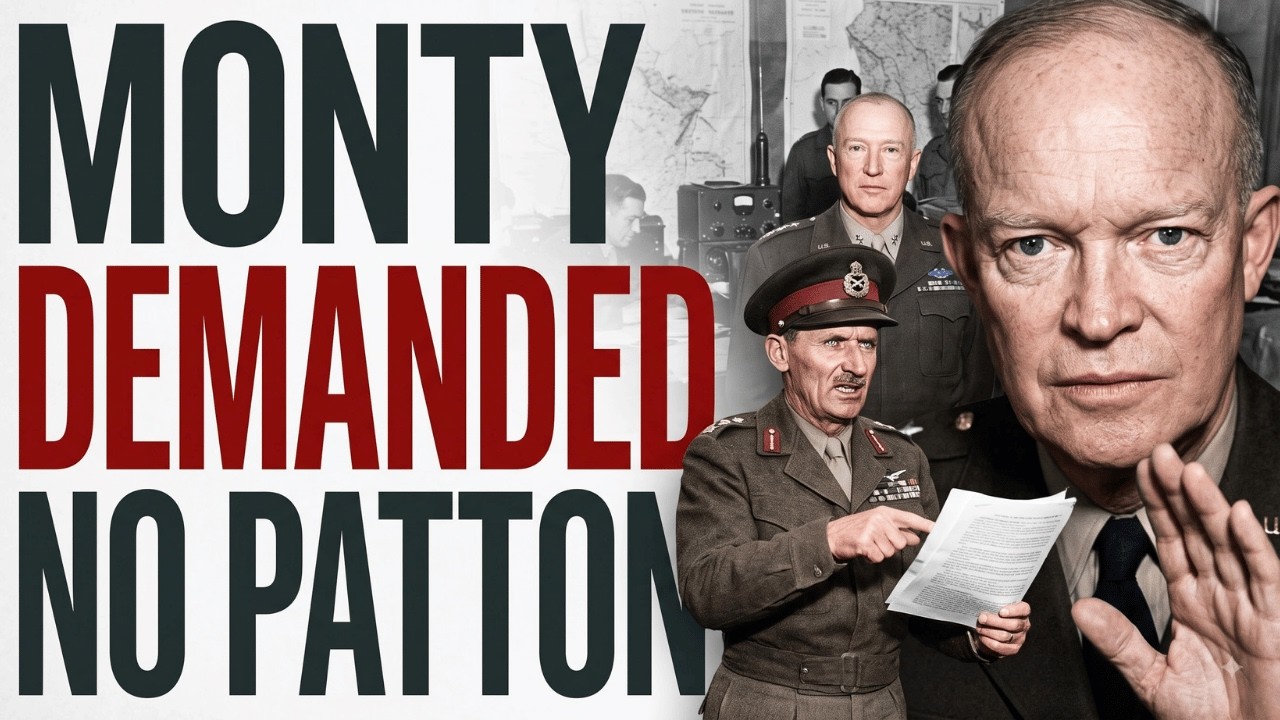 Within 36 hours, Patton would achieve what the entire Allied war machine had been planning for months: a full-scale crossing of the Rhine. But the success on the eastern bank was immediately overshadowed by a political and strategic crisis that threatened to tear the coalition apart. Reports reached Supreme Headquarters Allied Expeditionary Force (SHAEF) in Reims that Montgomery, furious at being upstaged, was demanding Patton’s immediate removal from command.
The tension between the two men, which had simmered since the deserts of North Africa, had finally boiled over at the most critical juncture of the war. General Dwight D. Eisenhower, the Supreme Allied Commander, was forced to choose between his most aggressive field general and his most powerful ally—a decision that would define the final weeks of the war in Europe.
The origins of this explosive confrontation lie in the opposing philosophies of the two commanders. Patton, a cavalryman turned armor pioneer, believed that speed saves lives. His swift, improvisational campaigns across France in the summer of 1944 had shattered German defenses and driven the Third Army to the very gates of the Reich.
He viewed preparation as a form of cowardice, a luxury that cost lives while allowing the enemy to regroup. Montgomery, by contrast, was the master of the set-piece battle. Having crushed Rommel at El Alamein, he adhered to a doctrine of overwhelming material superiority and meticulous logistical planning.
He refused to commit troops until every ton of ammunition and every reserve unit was in place. For Montgomery, the Rhine was the ultimate objective—a prize that demanded the largest operation the British Army had ever mounted.
By March 1945, these rivalries had reached a fever pitch. Montgomery was preparing “Operation Plunder” and “Operation Varsity” at Wesel, a massive crossing involving 3,500 artillery pieces, two full airborne divisions, and thousands of tons of supplies. It was to be the crowning achievement of the 21st Army Group, a demonstration of British military power that would seal the fate of the Ruhr.
Meanwhile, Patton had been relegated to the southern flank, a role he saw as a demotion designed to feed Montgomery’s ego. Watching the buildup to the north, Patton realized that if he allowed the timetable to hold, history would record Montgomery as the conqueror of the Rhine. He decided, in his words, to “beat him across.”
The operation at Nierstein was a masterpiece of tactical audacity. Patton ordered the 5th Infantry Division, under Major General Stafford LeRoy Irwin, to cross at a point defended only by a battalion of Volkssturm—old men and boys with minimal training. The assault boats slipped into the river just before 11 p.
m. on March 22. With no preliminary bombardment, the infantry achieved complete surprise.
 Within four hours, the entire assault echelon was across, having established a bridgehead a kilometer wide and 500 meters deep. American casualties were fewer than ten. It was, by any measure, a flawless execution of military engineering and infantry courage.
As Patton later drove his jeep onto the pontoon bridge being laid across the river, he paused in the middle, unbuttoned his trousers, and urinated into the water for the assembled photographers—a deliberate, theatrical insult aimed directly at the British command.
The news hit the wire services by the afternoon of March 23, just hours before Montgomery’s 90-minute bombardment was scheduled to begin at Wesel. Patton’s crossing had made the operation Plunder look excessive and slow. For Montgomery, the humiliation was compounded by the psychological damage to his campaign.
He had been beaten across the river by a man he considered an undisciplined cowboy, and he had done so without the massive air support and paratroopers that Montgomery considered essential. The British field marshal, a man famously thin-skinned regarding his own prestige, flew into a controlled rage. He immediately drafted a message to Eisenhower demanding that Patton be relieved of command for insubordination, arguing that the unsanctioned crossing had compromised the strategic integrity of the northern advance and 𝓮𝔁𝓹𝓸𝓼𝓮𝓭 Allied forces to needless risk.
Eisenhower, however, did not see an insubordinate general. He saw a war-winning asset. The Supreme Commander’s greatest gift was not operational genius but coalition management.
He understood that Patton’s aggression, while infuriating to the British, was precisely what was needed to break the Wehrmacht’s back. For Eisenhower, removing Patton in the final weeks of the war would have been a catastrophic error, a gift to German propaganda. He recognized that the Third Army’s spectacular success had opened a new front in the south, forcing the Germans to divert precious reserves away from Montgomery’s axis.
The crossing, though unauthorized, was strategically brilliant, and Eisenhower was wise enough to know that you do not punish success in the middle of a war.
The records of the time show that Eisenhower refused Montgomery’s demand outright. He sent a formal cable of congratulations to the Third Army, praising the “skill and dash” of the crossing. He then spent the next 48 hours engaged in a delicate diplomatic dance, ensuring Montgomery understood that the British operation remained the priority in the north while making clear that Patton would retain his command.
 Eisenhower’s decision was rooted in a clear-eyed assessment of the political landscape. The American public, hungry for heroes, had embraced Patton as a symbol of American martial prowess. Budging to British pressure would have caused a political storm in Washington that no one could afford.
Furthermore, Eisenhower knew that removing Patton would alienate General Omar Bradley, the 12th Army Group commander, creating a schism within the American command structure at the very moment operational tempo was at its peak.
Yet the tension did not dissipate quickly. Montgomery, sulking in his headquarters, refused to speak to Patton directly. The British press, fed a carefully curated narrative of an American usurper, fanned the flames of public resentment.
Meanwhile, the German high command watched the Allied infighting with alarm, realizing that the coalition’s strength lay in its ability to absorb such friction and keep moving. By the end of March, the Rhine was crossed at multiple points. The Ruhr Pocket was sealed, trapping 320,000 German soldiers.
The war was effectively over, though the fighting continued for another five weeks until the final surrender on May 7, 1945.
The aftermath of the Rhine crossing cemented the legacies of all three men. Patton, who had proven his naysayers wrong, would live to see the German surrender but would die in a car accident just seven months later. He was buried in Luxembourg among the men he had led.
Montgomery, stripped of the historic glory he felt he deserved, continued to serve as a senior British officer but spent the rest of his career nursing grievances against Eisenhower. He died in 1976, on the anniversary of his own Rhine crossing. Eisenhower, having navigated the personality clashes that could have broken the alliance, went on to become President of the United States, his stature as a coalition-builder confirmed by history.
The story of March 22, 1945, is not merely a tale of military rivalry; it is a lesson in leadership. Eisenhower understood that the victory of the Western Alliance depended not on a single strategy but on the ability to hold together a volatile mix of national egos, tactical doctrines, and political pressures. He did not resolve the tension between Patton and Montgomery; he channeled it, directing their competitive energy toward the common enemy.
 He refused to punish boldness, even when it broke the rules, because he knew that the rules were secondary to the objective. The greatest risk in war is not insubordination; it is paralysis. By backing Patton, Eisenhower kept the American army moving at a speed that the Germans could not match, while keeping Montgomery focused on the crushing blow in the north.
This decision came with a cost. Montgomery’s demands, though rejected, poisoned the atmosphere of the High Command for years. British memoirs painted Patton as a reckless gambler, while American accounts dismissed Montgomery as a timid bureaucrat.
The historical record, however, shows a more complex truth. The Rhine was crossed not by one man but by the collective—albeit grudging—effort of all who fought. Patton’s speed saved lives by denying the Germans time to fortify.
Montgomery’s precision saved lives by ensuring that the main crossing had overwhelming force. Eisenhower’s diplomacy saved the alliance by preventing victory from being consumed by ego. Each was necessary, none was sufficient.
In the end, the refusal to remove Patton stands as Eisenhower’s finest hour as a Supreme Commander. He faced a moment when the easy choice—appeasing a powerful ally—would have been disastrous. Instead, he made the hard choice: trusting a difficult, arrogant, but brilliant general to do exactly what he was born to do.
The result was a bridgehead that broke the German line in the south, a complementary offensive in the north, and the collapse of the last great defensive line of the Third Reich. As the infantrymen waded ashore near Nierstein, they carried with them the will of a leader who understood that audacity, managed correctly, is the most powerful weapon in a democracy’s arsenal. The river was crossed.
The war was won. And George Smith Patton Jr. was never removed from his command.