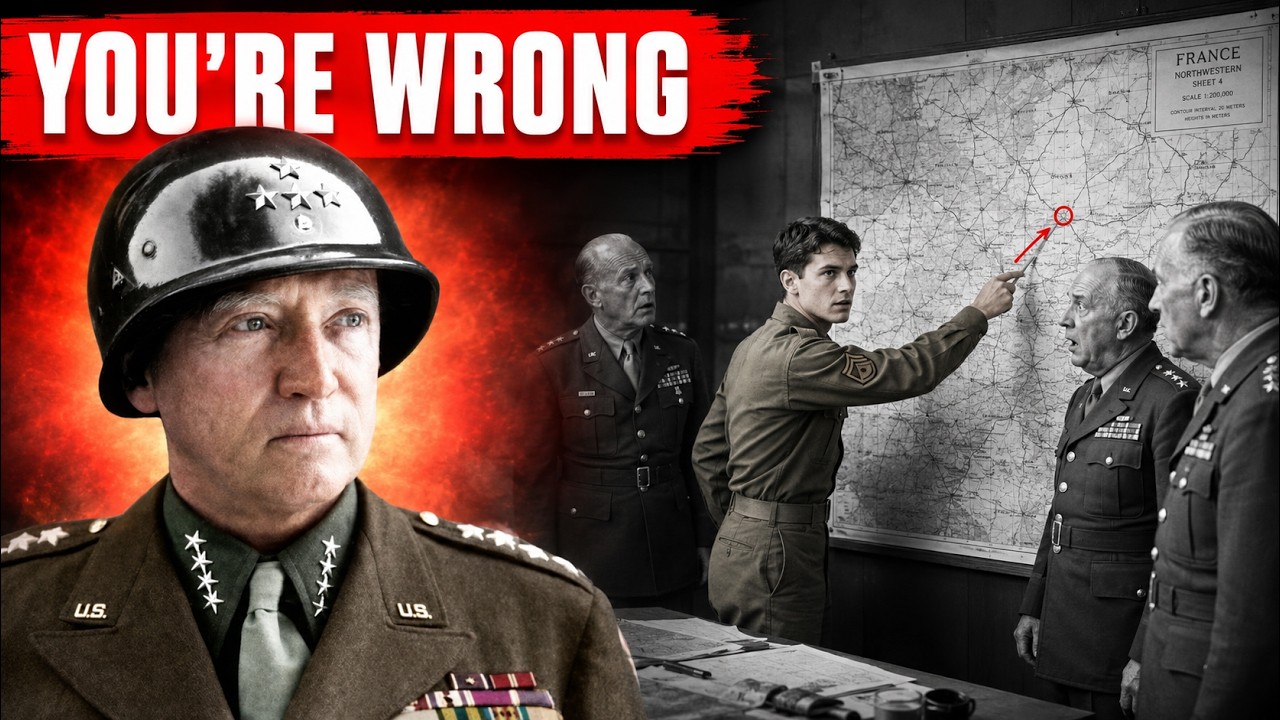
LONDON — Hidden beneath the streets of Whitehall, in the cramped, map-lined Cabinet War Rooms where Winston Churchill directed Britain’s survival, a secret ambition took shape in the winter of 1941 that threatened to redefine the entire Anglo-American alliance.
It was a plan never committed to a single piece of paper, never formally proposed to Washington, and yet pursued with relentless, sophisticated determination for three years. The objective was audacious: place a British general in operational command of all American troops fighting in Europe.
 The plan nearly worked.
Churchill, a lifelong student of power, understood the moment Pearl Harbor was attacked on December 7, 1941, that the war had fundamentally changed. Britain was no longer fighting for survival; it was fighting for position. With American industrial might, manpower, and money now fully committed, the defeat of the Axis was, in his assessment, mathematically inevitable.
The real question was who would shape the strategy that produced that victory, and who would emerge from the war holding the levers of global influence.
The answer, Churchill believed, lay in command structure. The nation whose generals led the alliance would be the nation whose interests were served by the outcome. Britain possessed one crucial advantage in this coming competition: experience.
British commanders had been fighting since 1939, learning the brutal complexities of coalition warfare and the German military in the hardest possible school. American commanders, in December 1941, had no such battlefield credentials.
Churchill intended to press this advantage as hard as the traffic would bear. Through the newly established Combined Chiefs of Staff machinery in Washington, he and his chief military advisor, General Sir Alan Brooke, advanced a series of incremental positions. Each looked reasonable in isolation.
The cumulative effect, had it been realized, would have placed British officers in command of every American soldier committed to the European theater.
The test case was North Africa. Operation Torch in November 1942 was the first major combined operation, and the command arrangement set the precedent. Churchill and Brooke pushed for a British theater commander.
General George Marshall, the U. S. Army Chief of Staff, pushed back.
The compromise was Dwight Eisenhower as supreme commander, with a British deputy and British officers filling the majority of senior subordinate positions. It looked like a compromise; in practice, it was a mechanism for British operational control. British officers commanded the ground, air, and naval components beneath an American supreme commander new to theater command.
The effective operational authority in the Mediterranean resided with the British.
The plan reached its most dangerous moment in the summer of 1942, when Churchill himself became the source of peril. The question of who would command the eventual invasion of Northwest Europe was understood to be the most consequential military appointment of the war. Churchill wanted that officer to be British, and his preferred candidate was Brooke.
He told Brooke so directly, and Brooke, a man of controlled discipline, received the news with careful restraint while privately wanting the command more than anything.
 The British argument was serious: the initial invasion forces would be predominantly British and Commonwealth, built on British logistics and experience. Placing an American in command of that force was an unnecessary risk. Marshall, however, was performing his own calculation.
He understood that the supreme command was not just a military appointment but a political one, reflecting which nation provided the preponderance of resources. By autumn 1942, American forces were set to outnumber British forces in every theater. American industrial production was dwarfing British output.
The nation providing the foundation was not going to accept a command structure giving strategic authority to the nation it was supplying.
Marshall took his assessment to President Roosevelt, who understood immediately. The decision was made in principle by the end of 1942: the supreme command would go to an American. Eisenhower was formally appointed in December 1943.
Brooke learned he would not receive the command in the summer of 1943. His diary entry that day is one of the most restrained and devastating passages in the document. He recorded that he understood the reasons and accepted the decision.
He recorded almost nothing about what it cost him.
But Churchill did not abandon the campaign. He pivoted. If the Americans held the title, the British would hold the substance.
In the Mediterranean, the model was already in place: Eisenhower as supreme commander, with General Sir Harold Alexander as ground forces commander, Admiral Sir Andrew Cunningham as naval commander, and Air Chief Marshal Sir Arthur Tedder as air commander. Three of the four principal operational commands were in British hands. Alexander, as ground forces commander, translated Eisenhower’s strategic direction into operational orders for both British and American armies.
In practice, he commanded American soldiers.
The Americans noticed. Omar Bradley, commanding the II Corps under Alexander’s 18th Army Group in Tunisia, spent the spring of 1943 forming a clear assessment: Alexander managed American forces as a component to be directed rather than a partner to be consulted. He assigned missions and reallocated resources without the coordination American commanders believed the relationship required.
When American formations underperformed due to inexperience, Alexander interpreted it as evidence they needed tighter British control. When they performed well, he adjusted plans to reduce American roles and expand British ones, as happened in Sicily when Patton’s Seventh Army was assigned the flank mission while Montgomery’s Eighth Army drove on Messina.
The pattern was consistent because the intent was consistent. The British command structure was managing American forces in ways designed to confirm the proposition that American forces needed British management. Marshall saw the pattern clearly.
 He concluded the Mediterranean arrangement had reached its limit. Operation Overlord, the invasion of Normandy on June 6, 1944, was built on a different structure. Eisenhower was supreme commander.
Montgomery was ground forces commander for the initial phase, a concession to British experience. But the command was explicitly temporary. As American forces built up and outnumbered British ones, operational command would pass to an American army group commander.
The structural arrangement that gave British officers authority over American soldiers was designed with its own expiration date.
Montgomery held the ground forces command through the summer of 1944, exercising it with the conviction that he was the right officer and with his characteristic method of meticulous preparation and set-piece battles. American commanders beneath him formed the same assessment Bradley had formed in Tunisia. Montgomery managed American forces as though their primary function was to serve his operational design.
In September 1944, Eisenhower assumed direct command of Allied ground forces, ending Montgomery’s authority over American formations. The transition had been built into the command structure from the beginning. Montgomery protested, arguing for an extension on operational grounds and appealing to Churchill.
Eisenhower absorbed the political pressure with diplomatic skill and proceeded with the transition.
The British campaign to command American forces had been reduced from a structural arrangement to an argument. And arguments in an alliance where one partner provides the preponderance of forces are governed by different rules. Marshall had understood this from February 1942.
By September 1944, the operational record had made it visible to everyone else.
What prevented full success was not American awareness of British intent, though Marshall’s awareness was clear and early. What prevented it was the arithmetic of the alliance itself. Churchill’s plan was built on British experience and American inexperience, and inexperience has a natural expiration date.
American formations accumulated combat experience in Tunisia, Sicily, and Normandy. American commanders developed operational judgment. American forces grew in number until they represented the dominant element of the Allied order of battle.
Each development eroded the foundation of the British argument. By the time the Rhine crossing was planned in early 1945, the proposition that British experience justified British command of American forces was operationally indefensible and politically unsustainable.
Brooke understood the trajectory before most of his colleagues. His diaries from the later years record increasing frustration with American commanders, a frustration that reads less like contempt and more like the frustration of a man watching an argument he had been making from a position of strength gradually become an argument from weakness. The experience advantage that gave the British leverage in 1942 was gone by 1944.
 Churchill never fully acknowledged the failure of the plan. He continued to press for British operational influence through the final year of the war, raising strategic objections to Eisenhower’s broad front approach and arguing for the northern thrust that would have kept the decisive campaign in Montgomery’s hands. He was persistent and occasionally effective at the margins.
But the fundamental question of who commanded American forces had been answered by autumn 1944. The answer was Americans.
Marshall had built his resistance on the same foundation Churchill had built the campaign: a clear understanding of where power resided and what it would eventually require. He had understood that American industrial capacity and manpower meant American commanders would eventually command American forces, regardless of initial arrangements. He had been patient, prepared, and right.
The deeper lesson of Churchill’s plan is not that it failed. It is how close it came to succeeding, and what that proximity revealed about the nature of alliance warfare. Command structures in combined operations are not neutral technical arrangements.
They are political decisions with operational consequences. The nation that allows another to determine those structures at the beginning of a campaign may find that changing them once the campaign is underway is considerably more difficult than the initial arrangement suggested. The Americans learned this lesson in Tunisia and applied it to every command negotiation that followed.
Marshall carried it with him through the Combined Chiefs meetings in London, Washington, Quebec, and Cairo, and made sure each successive arrangement moved structural authority over American forces closer to American hands.
It was not aggressive or confrontational. It was methodical and sustained, grounded in the same clear understanding of power that Churchill brought to the alliance from the other direction. Two men who both understood power earlier and more completely than almost anyone around them.
One trying to hold an advantage the arithmetic of war was eliminating. The other waiting with professional patience for the arithmetic to finish its work.
History records Churchill as the great strategist and Marshall as the great organizer. What neither description fully captures is that both men were engaged in the same fundamental activity throughout the alliance: calculating exactly where the power was, where it was going, and how much of it they could hold. Churchill held more of it for longer than the arithmetic strictly justified.
That was the measure of his achievement. Marshall made sure the arithmetic eventually prevailed. That was the measure of his.
The British general who commanded all American forces was never appointed. The plan that would have appointed him was real, sophisticated, and pursued with the full weight of Churchill’s political genius. It was defeated not by American cleverness but by American mass.
In the end, the argument was settled the way most coalition warfare arguments are settled: not at the negotiating table, but on the ground, in the numbers, in the weight of the forces that had to be fed, fueled, and commanded, and in the political reality that the nation bearing that weight was not going to bear it indefinitely under someone else’s direction. By 1945, that weight was American.