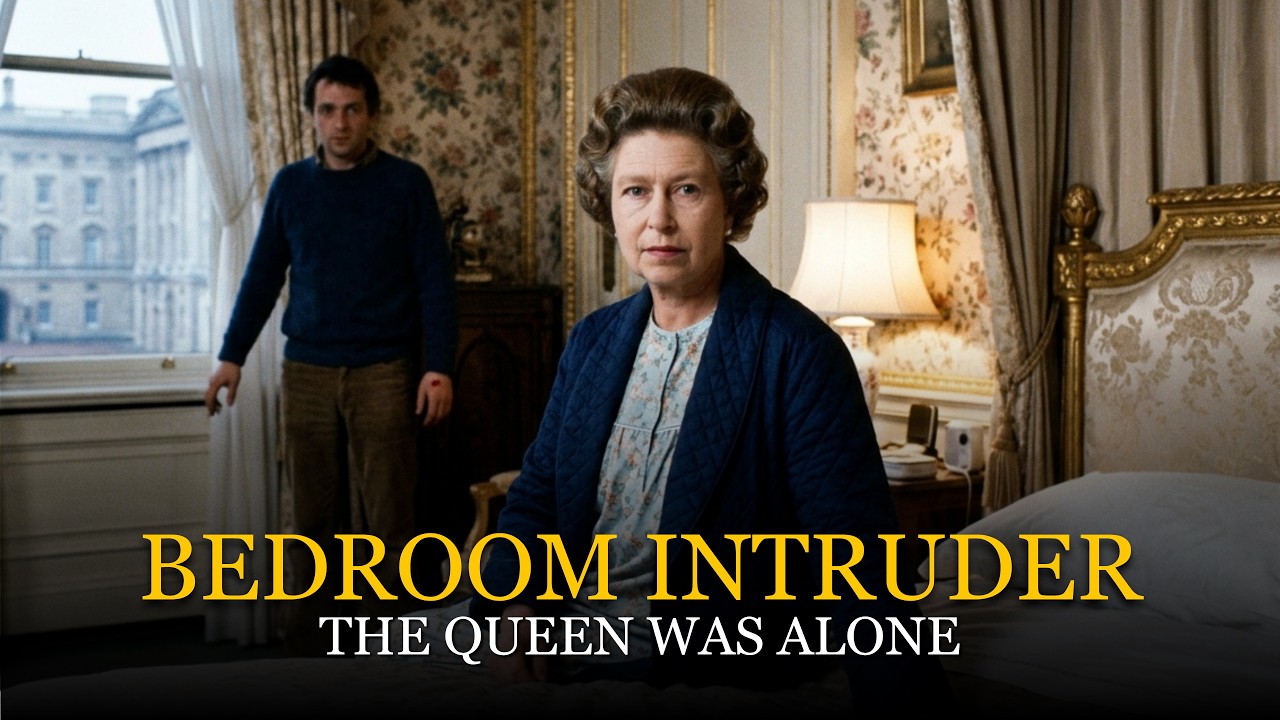
On July 9, 1982, Queen Elizabeth II woke to find a stranger standing beside her bed, his hand bleeding from a cut caused by broken glass. Michael Fagan, a 33-year-old unemployed painter and decorator from North London, had climbed the 14-foot wall of Buckingham Palace, scaled a drainpipe, and passed through an upper window before making his way to the monarch’s bedroom. For roughly ten minutes, the most protected woman in the world was alone with an unstable intruder, and the telephone calls she made for help went unanswered. The breach exposed a security system that had been quietly failing on every level.
The palace’s alarms had sounded during Fagan’s climb, but an officer judged the signal a false alarm and reset it. The armed officer who was supposed to stand guard outside the queen’s bedroom had come off duty earlier that morning, and his replacement had not yet arrived. The night patrols had not detected him, and the wall’s revolving spikes and barbed wire had not turned him back. Fagan had previously broken into the palace about a month earlier, in early June, when he wandered the halls for half an hour, sat on a throne, and drank wine that reportedly belonged to the Prince of Wales.
That first intrusion had triggered alarms and was even witnessed by a housemaid, but palace officials dismissed the warnings as faults and took no action. Fagan was drawn to the queen by a fixation he could never fully explain. He was a father of four whose marriage was failing and whose mental health was deteriorating. He had no weapon, no plan, and no political motive.
When he entered the queen’s bedroom and drew back the curtain, she woke, remained calm, and reached for the alarm by her bed. It did not bring help. She then telephoned the palace switchboard and asked for police, but no one arrived. She called a second time with the same result.
The crisis ended not through the security apparatus, but through the household. A chambermaid entered the room and blurted out her shock at seeing the stranger. Shortly afterward, Paul Wybrew, the queen’s footman, returned from walking her corgis and found the situation. He kept Fagan calm and talking until police arrived and took him into custody.
The queen was unharmed. The aftermath produced a second scandal. Commander Michael Trestrail, the queen’s personal bodyguard for nearly 20 years, resigned on July 17, 1982, after the palace learned from a newspaper that he had been in a relationship with a male prostitute. The paper had declined to print the story, but passed the information to the palace.
Two days later, the home secretary publicly named the reason for his resignation. An inquiry later cleared Trestrail of any security failure, finding that his private life had never compromised the queen’s safety. The case against Fagan collapsed for a remarkable reason. Under English law at the time, trespassing was a civil matter, not a criminal offense, and merely entering Buckingham Palace was not a crime.
The only charge prosecutors could bring was the theft of half a bottle of wine that Fagan had drunk during his first break-in. In September 1982, a jury acquitted him, accepting that he had no dishonest intent. He was instead committed to a psychiatric hospital for about three months and released in January 1983. Home Secretary William Whitelaw offered his resignation to Prime Minister Margaret Thatcher on July 21, 1982, accepting responsibility for the security failure.
She refused it. In the years that followed, royal protection was reorganized, with clearer lines of command and stronger manning. The law was not changed until 2005, when trespassing on royal residences was finally made a criminal offense. Fagan’s later life was marked by continued instability.
In 1984, he received a suspended sentence for assaulting a police officer. In 1997, he was convicted of involvement in heroin supply and sent to prison. He gave occasional interviews over the years and expressed no regret for the break-in, saying he had wanted to talk to the queen. After her death in September 2022, he said he had lit a candle in her memory.
He died in 2024 at the age of 74. Paul Wybrew remained in royal service for decades and was honored for his loyalty. In 2012, he appeared beside the queen in the short film made for the London Olympics, the same man who had once talked a bleeding intruder down until help arrived. The story itself returned to public attention in 2020 when it was dramatized in a television series about the royal family.
The morning of July 9, 1982, revealed a hard truth. The wall, the wire, the alarms, and the armed guards had all failed. What protected the queen in the end was her own composure and the steadiness of the people who happened to be near her.


