Few literary marriages were ever as intertwined as that of Zelda Sayre and F. Scott Fitzgerald. They became icons of the Jazz Age, celebrated for their glamour and their excess, but their story ultimately became one of confinement, borrowed words, and mutual destruction. By the spring of 1930, their celebrated life had unraveled.
Zelda’s behavior had grown increasingly erratic, and a Swiss doctor, Dr. Oscar Forel, delivered a devastating diagnosis: schizophrenia. She was admitted to a clinic outside Geneva, where she was confined and her condition closely monitored. As Zelda’s health declined, she faced a double abandonment.
Her husband, Scott, while begging for her recovery in letters to doctors, also sought to establish himself as the singular authority over their shared story. He sent one of her short stories to his American publisher, but his letters about her condition were filled with his own vanity and self-justification, describing her passion for ballet as a symptom of her illness rather than an expression of ambition. Zelda’s own letters from the facility were a mix of heartbreaking lucidity and fragmented despair. She begged to be allowed to dance, the one pursuit that gave her life meaning, and pleaded with Scott to visit.
But as her mental state frayed, a severe skin ailment spread across her face, leaving her bedridden and physically altered. While she suffered, Scott envisioned how her ordeal might be shaped into his next acclaimed novel. For fifteen months, she remained at the Swiss clinic. In that time, he refused to take her complaints about his drinking seriously, treating his own consumption as a right.
She even attempted to escape, which led to her being moved to a locked ward. A turning point came when Forel instructed her to write the truth about herself. Zelda produced a seven-page confession in fractured French, detailing the pressures of her marriage, a long-rumored affair with a French aviator, and the relentless psychological strain she felt. She claimed Scott had even confined her to her room at one point to keep her from seeing the aviator.
She also conveyed that Scott’s own infidelities, including one in California, had been less painful to her because she felt she had equaled his betrayals. Scott finally allowed her stories to be sent to his editor, Maxwell Perkins, who found them powerful but too strange for publication. Still, Scott began to imagine collecting them into a book of her own. During this period of intense confinement, Scott wrote an excruciatingly honest private manuscript, admitting, “We ruined ourselves.
You were going crazy and calling it genius. I was going to ruin and calling it anything that came to hand. ” He never finished that draft. Zelda rallied enough by the spring of 1931 that she and Scott were able to meet often, shopping in Lausanne and enjoying warm afternoons in Geneva.
Their time together felt like a fragile return to normalcy. In September of that year, after fifteen months, Zelda was discharged. The couple boarded the Aquitania for America. The return to Montgomery, Alabama, was filled with hope for a second chance.
They rented a house, bought a car, and even adopted a Persian cat. But the quiet life was a strain. Scott called their days dull, and Zelda’s behavior was noticeably strange to friends who were unaware of her hospitalization. She moved in a way that was peculiar, smiled too broadly, and spoke openly of a death pact the couple had allegedly made years earlier to end their lives at age 35.
Scott began planning a trip to Hollywood to write a film script for Irving Thalberg. He left for California in early November, promising to return by Christmas. That same week, Zelda’s father, Judge Sayre, died. Grief-stricken and isolated, she began secretly writing stories.
She wrote seven pieces during the eight weeks he was away. Among them was a story called “A Couple of Nuts” about a married couple who achieve success in Paris. It was unmistakably based on the Fitzgeralds’ own lives. The husband dies and the woman survives alone.
She didn’t send Scott any of the stories, writing to him instead, “I’ll never be able to write like that. ”
When Scott returned, they fled south to Florida, staying at the Don CeSar Hotel. For five consecutive months, Scott worked on his novel, while Zelda rested and painted. It was the most stable their life had felt in years.
Then, without warning, the stability broke. On the drive back to Montgomery, a red patch of eczema appeared on her neck. Zelda grew silent and agitated. At dawn, she drank an entire flask of Scott’s whiskey.
She shook him awake, accusing him of knowing that someone was hurting her. The next morning, she asked him to take her to a clinic. On February 12, 1932, Zelda was admitted to the Phipps Psychiatric Clinic at Johns Hopkins Hospital. The diagnosis was the same: schizophrenia.
Scott explained her to the doctors, describing her as wild, spoiled, and hungry for praise, while saying nothing about his own drinking. Within weeks, the doctors reported that Zelda’s tension had eased and that she had finished two chapters of a book. Secretly, without telling Scott, she had sent the manuscript to his editor at Scribner’s. When Scott learned of it, he was furious.
He accused her of stealing his material, his rhythm, and even his characters. The novel, titled “Save Me the Waltz,” told the story of Alabama Beggs, a Southern girl who marries a rising artist and is dragged through the glamour and ruin of Europe. Scott insisted the book would cause her “inconceivable harm. ”
The manuscript was deeply personal.
It included Zelda’s search for self through ballet, the loss of her father, and her frustration with a distant husband. Over the following months, Scott demanded revisions. Zelda submitted, writing to him, “Of course, I gladly submit to anything you want about the book. ”
The publication of “Save Me the Waltz” created a deep rift.
In it, Zelda had finally claimed ownership of her own narrative, a direct challenge to Scott’s dominance. The contract was signed in June 1932, and part of her royalties went to pay Scott’s debts. The book was commercially unsuccessful, selling fewer than 1,400 copies. In the same year, Scott was working on a darker novel, which he called “The Drunkard’s Holiday.
” It was a story about a young psychiatrist named Dick Diver and his beautiful, unstable wife, Nicole. He filled the margins with notes and character analysis that pulled directly from Zelda’s illness and their shared life. He was methodically turning their pain into fiction. Out of a desperate need to connect, Zelda turned to playwriting.
She wrote a three-act comedy called “Scandalabra,” which premiered in Baltimore in June 1933. Critics called it chaotic and disjointed. The play was a commercial and critical failure. The same year, as their marriage continued to fracture, they agreed to a session of joint therapy with both of their doctors.
A stenographer recorded the entire 114-page transcript. The meeting was an ambush. Scott immediately stated that he was being destroyed by the marriage, claiming that Zelda had “nothing essentially to say. ” Zelda cut him off, telling the doctors he drank constantly.
He responded that she was a “third-rate writer, a third-rate ballet dancer. ” She replied, “Then it seems to me you’re making a rather violent attack on third-rate talent. ” Scott then declared that the material of their lives was his alone. “If I catch you writing,” he said, “I will destroy it.
” Zelda whispered, “You know it would break my heart. ”
Their marriage didn’t recover from that confrontation. They lived separately for extended periods, with Zelda moving back to her mother’s home in Montgomery, and Scott moving to Los Angeles. They continued to exchange letters until his death on December 21, 1940.
Zelda was devastated by the news. She told a friend that Scott was the best friend anyone could have been to her, that his long months beside her in Switzerland, the hospital bills, the loyalty, were all more poignant now than appreciated then. After his death, Zelda began work on another novel, “Caesar’s Things. ” It was another exploration of her life, with a protagonist named Jano who was clearly modeled on herself.
The writing was fragmented and increasingly difficult to follow, blending scripture with hallucination. She worked on the manuscript for years but never completed it. Zelda’s final years were a slow retreat. She lived with her mother in Montgomery, painted diligently, and wrote letters filled with religious devotion.
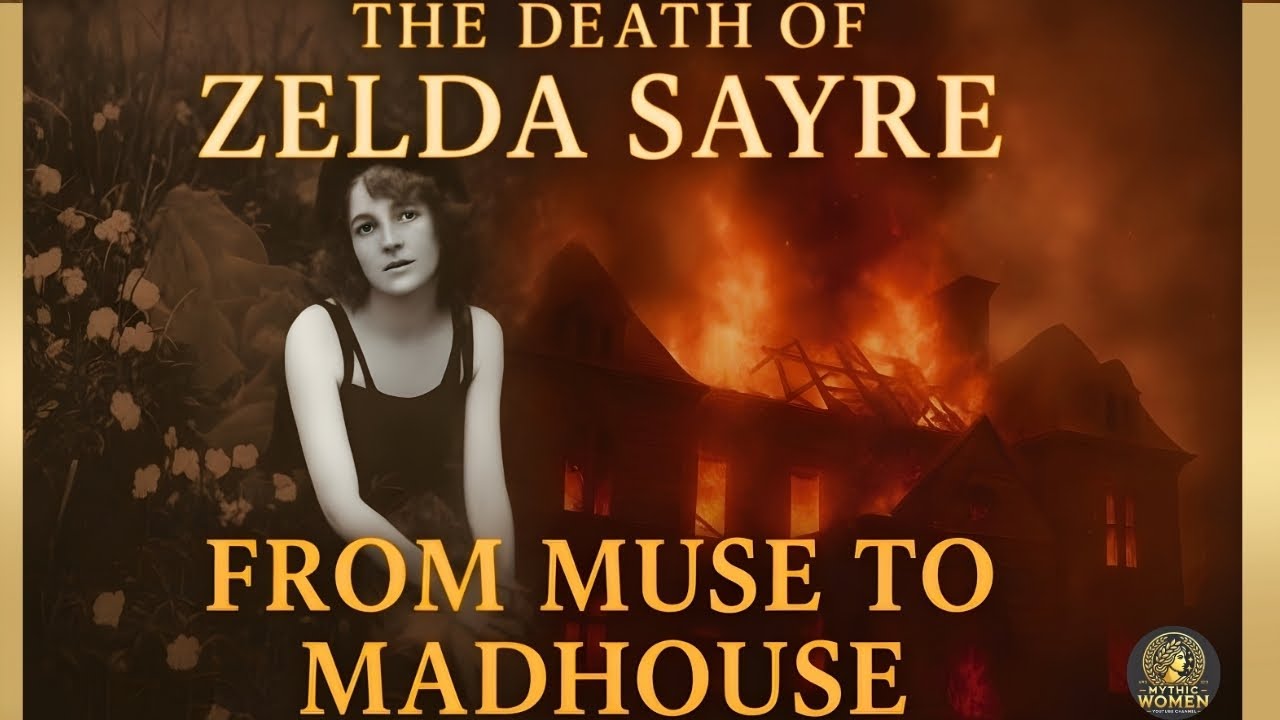
She experienced short periods of stability where she would travel to see her daughter, Scottie, but these were followed by relapses that returned her to the Highland Hospital in Asheville, North Carolina. In early March 1948, she experienced a period of relative calm. Shortly after midnight on March 10, a fire broke out in the hospital’s kitchen. Flames traveled up the dumbwaiter shaft, filling the stone corridors with smoke.
The doors to the top floors were locked and the windows chained. Nine women trapped on the upper floors died. The body of Zelda Sayre Fitzgerald was found, identified only by a single charred slipper. She was buried beside Scott in Rockville, Maryland, on St.
Patrick’s Day 1948. In the end, the question of who owned the story was answered with finality: the authority over the Fitzgerald legacy was placed in the hands of the survivor left standing in the ashes.


