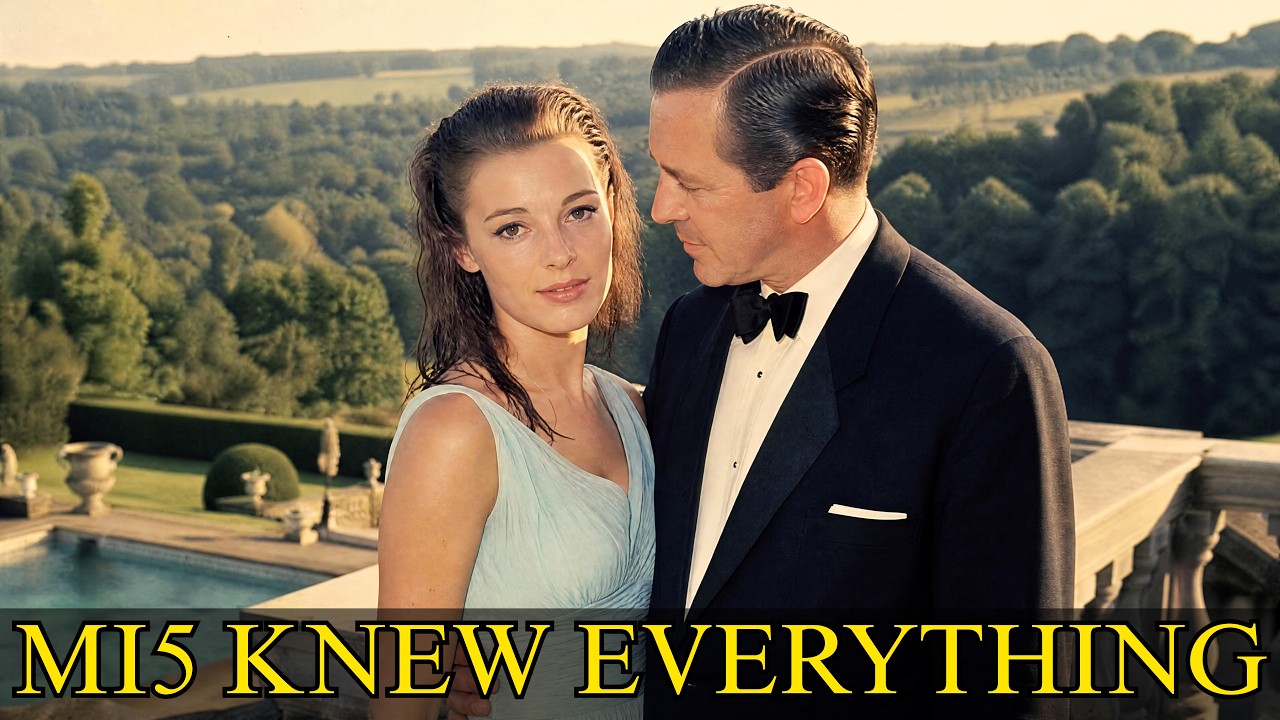
It was a warm July evening at Cliveden in 1961, and the 19-year-old girl at the pool had just lost her borrowed swimming costume in the dark water. When the dinner guests came down through the trees, one of them stopped at the water’s edge. He was John Profumo, the Secretary of State for War, 46 years old, married to the actress Valerie Hobson, and sitting in Harold Macmillan’s cabinet. Within two years, Profumo would lie to the House of Commons about her.
A brilliant London osteopath would be dead of an overdose. A prime minister would be gone. And Christine Keeler, the girl in the borrowed towel, would spend the rest of her life trying to be believed. Keeler was born on the 22nd of February 1942 in Uxbridge, Middlesex.
Her biological father left before she was two. Her stepfather, a former railwayman, moved the family into two converted railway carriages placed side by side on a scrap of ground between the reservoirs and gravel pits west of London. There was no plumbing. Water was heated on a stove for a tin bath, and the lavatory was a bucket in a shed.
By her own account, her stepfather was a violent drunk, and her earliest memories were of her mother being hit. She said she was sexually molested from about the age of eight by a man in a neighboring carriage, and raped in her early teens by an American serviceman. She left school at 15 barely able to read a newspaper. By 17, she was pregnant; the baby lived six days.
The local children called her “the goddess of the gravel pits,” a phrase Time magazine would rediscover more than 20 years later. What she had was her face, and the knowledge that London was 90 minutes away by train. She reached London at 17 and by the following spring was working at Murray’s Cabaret Club in Soho, wearing ostrich plumes and little else. There she met a small blonde Welsh girl named Marilyn Rice-Davies, known to everyone as Mandy.
It was in her first months at Murray’s that Christine was introduced to Stephen Ward, a middle-aged osteopath with a soft Cambridge voice and a small notebook full of famous names. Ward had built one of the most fashionable practices in the country. His patients included Winston Churchill, the American diplomat Averell Harriman, film stars Ava Gardner and Mel Ferrer, and, most consequentially, William Waldorf Astor, the third of that name, who had inherited the tenancy of Cliveden. Ward was not a rich man, earning about 5,000 pounds a year, roughly 100,000 pounds in today’s money.
What he had was a diary full of names. The historical record is unusually clear on what Ward wanted from the girls he collected: it was the pleasure of the introduction. He liked to walk into a great house holding the arm of a girl from poverty and watch a peer or a cabinet minister find her interesting. He gave Christine a room in his flat at 17 Wimpole Mews, pocket money, and lessons in which fork to use.
She was 19 and did not understand what she was being trained for. She thought she was being taught the world. On the 8th of July 1961, Lord Astor was giving a country weekend at Cliveden for the President of Pakistan, Ayub Khan. Ward had driven Christine down from London.
She had brought no swimming costume, so Ward produced a borrowed suit that did not quite fit. On the Saturday evening, while the main house was at dinner, Ward walked her up through the woods to the outdoor pool. The night was warm. At some point the swimming costume came loose and she could not find it in the dark water.
She reached for a towel. The dinner ended and the guests came down through the trees. Lord Astor was leading in white tie. Behind him came the President, and after him a man in his 40s with a soldier’s carriage.
Profumo stayed at the pool’s edge and watched. He engaged the girl in conversation, then in a small chase around the pool in the sodium light. The following morning, according to Ward, Profumo returned to the pool alone hoping to find her. She was there.
So was Lord Astor. So, on Ward’s account, was Yevgeny Ivanov, the assistant naval attaché at the Soviet Embassy, a serving officer of Soviet military intelligence. Within a single seven-day period in July 1961, Christine had sexual encounters with a cabinet minister who ran the British Army and an intelligence officer of a hostile foreign power. She later said Ward asked her whether she could find out from Profumo when American nuclear warheads were to be transferred to the West German Army.
She said she never asked Profumo any such thing. Lord Denning, in his official inquiry two years later, agreed there was no evidence that any classified information had passed between the two men through her. The affair with Profumo lasted between one and three months and took place in London. He sent his ministerial car to collect her.
On another occasion, he took her back to his own house when it was empty. One physical object from the affair survives: a short handwritten note on House of Commons stationery beginning “Darling” and signed with the single initial J. Christine kept it under her mattress. By the end of the summer of 1961, MI5 noticed.
Sir Roger Hollis arranged a quiet word with the cabinet secretary, who arranged a quiet word with Profumo. The message was that the flat was known. Profumo ended the affair at once. For the whole of 1962, nothing surfaced.
Then, on the 14th of December 1962, a jazz singer named Johnny Edgecombe pointed a pistol at the front door of 17 Wimpole Mews and fired. Inside, terrified on the stairs, was Christine. She had ended their relationship; he had slashed another man’s face with a knife over her in a Soho nightclub weeks earlier. Nobody was hurt.
Edgecombe left and was later convicted of firearms offenses and sentenced to seven years. But from the moment police wrote down Christine’s name in a notebook, she was in the record and in the reach of Fleet Street. The tabloids did not print what they were hearing because Profumo was still Secretary of State for War. But they began to circle.
Ward, frightened, began talking to journalists on background. In February 1963, Christine sold her story to the Sunday Pictorial for a thousand pounds, about 20,000 pounds today. The paper, on legal advice, refused to run it. The story of the payment leaked immediately.
On the 22nd of March 1963, John Profumo went to the dispatch box of the House of Commons and made a personal statement. He said his acquaintance with Miss Keeler was slight. He said there had been no impropriety whatsoever. The statement was a lie, and it was one of the most consequential sentences ever spoken in the modern British Parliament.
In the last week of May, Profumo took his wife to Venice. On the plane back to London, he told Valerie Hobson he had lied to the House of Commons and was going to resign. She was unshaken and stayed with him for the rest of her life. His resignation letter was released to the press on the morning of the 5th of June 1963.
On the first free morning of the rest of his life, he walked across London to Toynbee Hall, a settlement house in the East End, and asked whether there was any work he could do. He began by cleaning the lavatories. He continued there for 43 years and never again gave a public interview about the affair. He died in 2006, aged 91.
Three days after Profumo’s resignation, the Metropolitan Police arrested Stephen Ward. The charge was living wholly or partly on the earnings of prostitution. He was refused bail and held for six weeks. He wrote from his cell that he was being assassinated.
No member of the British political class raised a public voice for him. His trial opened at the Old Bailey on the 22nd of July 1963. The prosecution made Christine its principal witness. On the second day of evidence, Mandy Rice-Davies was in the box, aged 20.
Asked whether she was aware that Lord Astor had denied ever having had an affair with her, she said, “Well, he would, wouldn’t he? ” The phrase entered the Oxford Dictionary of Quotations. By the seventh day, Ward knew the verdict was going against him. On the evening of the 30th of July, he wrote a note for the press: “I am sorry to disappoint the vultures.
” He then swallowed a bottle of Nembutal and lay down on a sofa. He was found unconscious the following morning and never woke up. On the 3rd of August 1963, Stephen Ward died. He was 50.
In June of that year, Lucky Gordon, another jazz singer, had been convicted of assaulting Christine and sentenced to three years. In December, the Court of Appeal quashed his conviction because Christine had failed to mention two men present at the time of the alleged assault. She had lied in the witness box, on her own account later, because people connected with the Ward circle had told her it would be simpler for everyone. On the 6th of December 1963, Christine was arraigned at the Old Bailey as the defendant, charged with perjury and conspiracy to obstruct the course of justice.
She pleaded guilty on the advice of her counsel. She was sentenced to nine months in prison and served it at Holloway. She was 22, the most famous woman in England when she walked through the gate, and ordinary when she walked out in June 1964. Harold Macmillan had resigned as Prime Minister on the 18th of October 1963.
In October 1964, the Conservatives lost the general election to Harold Wilson’s Labour Party. The rest of Christine’s life was long and hard and mostly out of the papers. She married twice and had two sons. She worked in a school canteen, behind the counter of a dry cleaner’s, in cheap clerical jobs and small hotels.
She lived in council housing. She developed chronic obstructive pulmonary disease and smoked a great deal. She wrote four books of memoir. The last, The Truth at Last, published in 2001 and revised as Secrets and Lies in 2019, was closer to what she had wanted to say.
All of them tried to do the one thing she had been unable to do in 1963: to be believed. On the 4th of December 2017, on her son Seymour’s 46th birthday, Christine Keeler died at the Princess Royal University Hospital in Farnborough, Kent. She was 75. She left her estate of 77,000 pounds to Seymour, with a written instruction: that he do what he could to make sure the truth was told about her.
The BBC drama The Trial of Christine Keeler, broadcast in 2019, took a version of her story much closer to the one she had wanted told. The revised memoir carried the actress Sophie Cookson’s voice on the audiobook. Cliveden is now a hotel, and the pool where Christine met John Profumo appears on its promotional literature as a fixture of the estate’s heritage. The plywood chair on which she sat for the Lewis Morley photograph in May 1963 is in the collection of the Victoria and Albert Museum.
The remaining sealed papers about the Ward trial are held at the National Archives and are due to be released in 2046, the year Christine would have turned 104.


