Her name, in Ottoman Turkish, meant “a pearl worthy of kings. ” But her life proved that the true value of this pearl lay neither in the gleam of gold nor in the honor of the royal court. Born at the height of the Ottoman Empire’s glory, she was the granddaughter of its last sultan, the daughter of the final caliph of Islam, and the daughter-in-law of the richest man in India. It seemed her fate was sealed for a comfortable life in the magnificent palaces of the East.
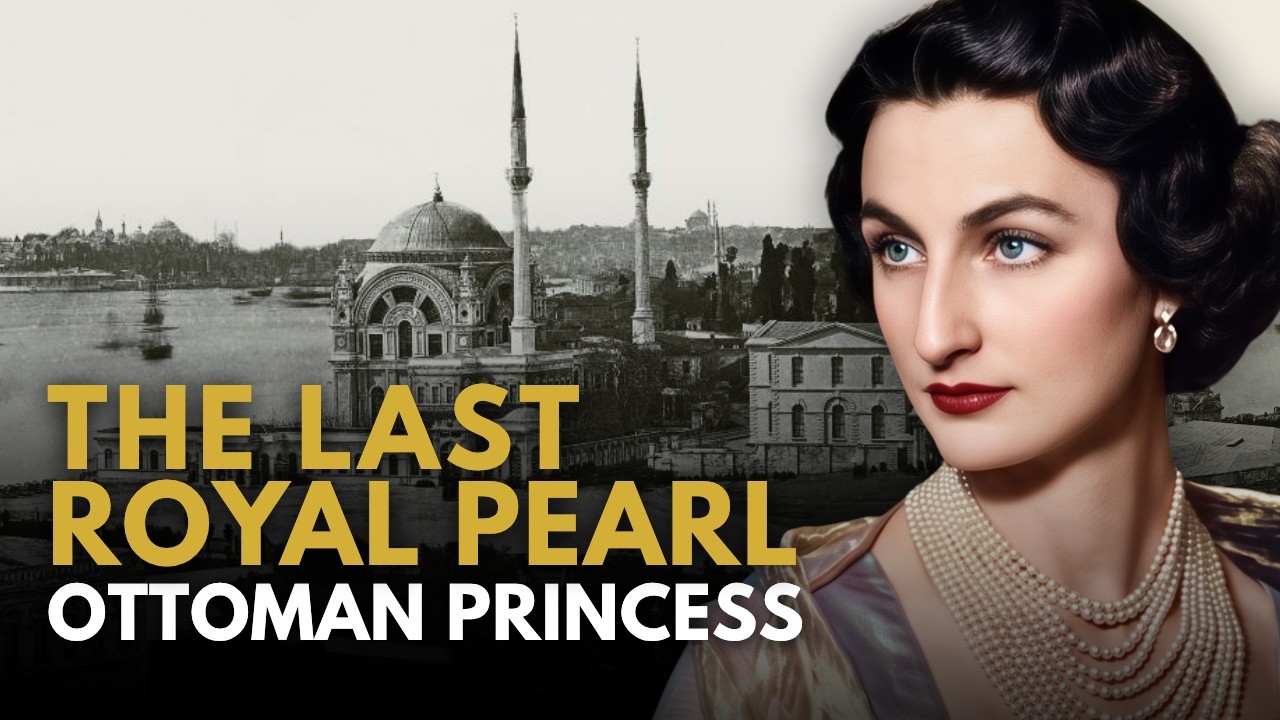
History, however, had other plans. Dürrüşehvar Sultan was born on January 26, 1914, at Çamlıca Palace in Istanbul. The air was heavy with the smell of gunpowder from World War I, and a grim twilight was descending on the great Ottoman Empire. She was the only daughter of Prince Abdülmecid Efendi and his wife, Atiye Mehisti Kadın Efendi.
Her father was an unusual figure in the dynasty. While other princes concerned themselves with military affairs, Abdülmecid II devoted himself to art, creating paintings celebrated across Europe, composing music, and reading philosophical texts fluently in French, German and English. Dürrüşehvar spent her childhood in the splendor of Dolmabahçe Palace, overlooking the Bosphorus, surrounded by books, classical music, and the scent of oil paints from her father’s studio. Raised as a modern princess, she studied European languages, world history, and literature alongside the Quran and Islamic tradition.
When Mustafa Kemal abolished the sultanate in 1922, Abdülmecid II was declared the last caliph of the Islamic world. He sought to present an example of harmony between tradition and modernity, and ten-year-old Dürrüşehvar became his key ally. She accompanied her father on public outings, sitting beside him with her face uncovered. This shocked religious conservatives in Istanbul, but for the educated elite, the young unveiled princess became a genuine symbol of hope.
That fairy tale ended abruptly on March 3, 1924, when the new Turkish Republic abolished the caliphate. All members of the Osman family were ordered to leave the country immediately under threat of arrest. The caliph’s family was expelled from Dolmabahçe Palace in the middle of the night, allowed to take only a few clothes and a small sum of money. Switzerland’s hotels quickly exhausted the family’s modest savings, and they moved to Nice, France.
There, at Villa Carabacel, Dürrüşehvar spent her youth in strained financial circumstances, often uncertain how they would pay their bills. Even so, the former caliph insisted his daughter complete her education. Growing into a tall, graceful young woman of rare aristocratic charm, Dürrüşehvar soon attracted suitors, including the future Shah of Iran, Mohammad Reza Pahlavi, and King Farouk of Egypt. A marriage proposal from India proved the turning point.
The seventh Nizam of Hyderabad, Mir Osman Ali Khan, was seeking a noble bride for his eldest son, Azam Jah. Aware that his immense wealth could not buy the ancient legitimacy of the Ottoman dynasty, the Nizam offered to cover the exiled caliph’s expenses and pay a monthly stipend in exchange for the princess’s hand. Dürrüşehvar, then seventeen, accepted to ensure her parents could live with dignity in France. The wedding took place on November 12, 1931, in Nice.
The bride appeared in a magnificent silver sari embroidered with pearls. It was a union of two entirely different worlds: the refined, vanishing European Ottoman culture and the dazzling, deeply conservative feudalism of India. Upon arrival in Hyderabad, Dürrüşehvar, now Princess of Berar, faced a reality her European upbringing had not prepared her for. Women of noble Muslim families lived in seclusion, bound by purdah, forced to wear a heavy veil hiding even their eyes.
Dürrüşehvar, accustomed to strolling freely along the promenade in Nice and riding in an open carriage in Istanbul, refused to follow these rules. She declared to her husband and father-in-law that she would keep her face unveiled. The Nizam, known for his frugality and stern demeanor, unexpectedly sided with his daughter-in-law, charmed by her intelligence, education, and aristocratic grandeur. He often said she possessed a keener political mind than his two sons combined, and frequently presented her to foreign delegations as his court’s most precious treasure.
The refusal of purdah was only the first step. Recognizing her position allowed her to change the lives of millions of Indian women deprived of basic rights and education, Dürrüşehvar launched, with her cousin Niloufer, extensive modernization efforts across the state. In 1933, Hyderabad was astonished when the Princess of Berar personally attended a tennis tournament and, without any shame, presented the trophy to the male winner. Many noblewomen followed her lead, gradually discarding the heavy veil.
She learned Urdu to communicate with ordinary people, founded girls’ schools, and built hospitals. The largest children’s hospital in the city, funded by her, still bears her name. In November 1936, she laid the foundation stone of a new building at Begumpet Airport, opening the state’s gateway to aviation. Her life was not confined to India.
As a member of the global elite, she regularly visited London, where her status as an Ottoman princess drew admiration. In 1935, she and her husband attended the Silver Jubilee of King George V, and in May 1937, they shone at the coronation of King George VI and Queen Elizabeth, where legendary British photographer Cecil Beaton photographed her. Behind this external brilliance, her life at Bella Vista Palace was filled with loneliness. Her husband, Prince Azam Jah, proved coarse and limited, losing vast sums at casinos, keeping a harem, and resenting his wife’s growing popularity.
Although they had two sons, Makhram Jah in 1933 and Muffakham Jah in 1939, the marriage quickly became a hollow formality. Dürrüşehvar devoted herself entirely to raising her children, personally designing a European educational program for them and sending them to prestigious schools in the United Kingdom. During World War II, despite her personal difficulties, she proved herself a genuine leader. She completed nursing courses with the Red Cross, worked in hospitals, and headed Hyderabad’s Women’s Civil Defence Committee.
She regularly visited military hospitals, personally speaking with the wounded and addressing their needs—a remarkably bold act for a woman of her station in that conservative era. She also organized fundraising campaigns and food supply drives, becoming someone her subjects could rely on in times of hardship. In August 1944, her father, Abdülmecid II, died in Paris. Before his death, the last caliph asked his daughter for one thing: to bury him in Istanbul.
For Dürrüşehvar, this became a sacred vow. She traveled urgently to France and petitioned the Turkish government to repatriate her father’s remains. The authorities refused, fearing his funeral in Istanbul would become a political demonstration by opponents of the republic. Over ten years, Dürrüşehvar showed extraordinary persistence.
She held continuous negotiations with Turkish diplomats, met personally with President İsmet İnönü, wrote petitions, and appealed to the conscience of officials. Throughout this time, the coffin of the last caliph remained in the basement of a grand mosque in Paris. Only in 1954, after exhausting every legal and diplomatic avenue, did the princess accept defeat. She moved her father’s ashes to Saudi Arabia, where he was laid to rest in the sacred Al-Baqi cemetery in Medina.
The late 1940s brought radical changes to the geopolitical map of Asia. India gained independence in 1947, and in 1948, the Indian army annexed Hyderabad, stripping the Nizam of real power. The palaces and treasures were no longer the family’s own. By then, Dürrüşehvar’s marriage to Azam Jah was a fiction.
After their formal divorce in 1954, she decided to leave India forever, settling in London. She lived a quiet, withdrawn life as a London noble, devoting herself to painting, reading, and writing memoirs, and above all, spending time with her sons and grandchildren. She occasionally visited Turkey as an ordinary citizen. Turkish journalists who met her noted her impeccable fluency in Istanbul and her astonishing calm.
She never publicly criticized the Turkish authorities, nor showed any bitterness, choosing absolute discretion as a great wall behind which to hide her feelings. Dürrüşehvar Sultan died on February 7, 2006, in London, at the age of 92, surrounded by her children and grandchildren. In her final years, Turkish officials had repeatedly hinted they would permit her burial in Istanbul, with the tombs of the sultans on the Bosphorus open to her. They wanted the gesture to symbolize national reconciliation.
The princess categorically refused. She requested to be buried in a modest Muslim section of Brookwood Cemetery in Surrey, England, beside her mother. Her choice was not the whim of an elderly woman; it was her final, silent, and majestic political statement. As if telling her historic homeland: “You stripped our family of our name, cast a ten-year-old girl into the open, took everything from us, and above all, you denied my father two meters of your earth and forced his coffin to wait ten years in Paris.
Now, you will not have me either. ”
She left behind no palaces or gold, but schools, hospitals, and the memory of a woman who preserved her dignity through the collapse of two great empires in the twentieth century. Her grave beneath the grey sky of Surrey stands as an eternal monument to quiet, unconquerable pride. Born a princess of an empire that seemed immortal, she became something far greater, proving that a person is always more than their title or passport.
The schools and hospitals she left behind continue to serve people decades later, underscoring that true greatness is defined not by thrones, but by what one chooses to do.