In 1989, Goldman Sachs was making $1. 2 million a day in profit and stood at the top of Wall Street. Yet a single block in Washington, D. C.
, surrounded by boarded-up houses and broken street lights, was pulling in roughly $2 million a day selling crack cocaine—more than twice Goldman’s daily profit. That block was Hanover Place, and it was not an isolated case. For much of the 20th century, certain Black neighborhoods generated more cash than Wall Street firms, more than banks, and more than every legitimate Black business in America combined. The men who ran these operations often received federal life sentences, while the bankers handling similar sums earned summer homes in the Hamptons.
In 1923, Casper Holstein, a Virgin Islands immigrant who worked as a janitor on Wall Street, invented a modern version of the numbers game using the daily stock exchange clearinghouse total. By 1925, Holstein was making roughly $12,000 a day on Lenox Avenue in Harlem—about $220,000 per day in today’s money. His operation grossed around $5 million that year, or more than $90 million today. Holstein paid winners daily in cash, funded Harlem Renaissance artists, provided Black college scholarships, and ran soup kitchens during the Depression.
His success drew the attention of the Italian mob, and Dutch Schultz tried to take over the operation by force in the 1930s. Stephanie St. Clair fought back, and Bumpy Johnson later took control. Into the 1950s, Lenox Avenue was still moving over $1 million per week through its underground lottery.
By 1985, the Pulaski Houses in Brownsville, Brooklyn—six red brick public housing buildings where Mike Tyson grew up—had become the center of the largest open-air heroin market in Brooklyn. The crew controlling the territory, the Avenue D Boys, had over 80 soldiers and moved between $500,000 and $1 million per week, generating $25 to $50 million a year from a single housing project. Customers came from across Brooklyn, Manhattan, Long Island, and even New Jersey. Nighttime lines were so long that the NYPD set up checkpoints in 1986 to slow the traffic, but it did not work.
By 1988, the operation had expanded into crack cocaine and revenue doubled. Federal RICO indictments in the early 1990s finally shut the operation down. Brownsville remains one of the poorest neighborhoods in New York City today. In South Jamaica, Queens, a small deli called Big Max sat on 159th Street in the mid-1980s.
In the back room, Lorenzo “Fat Cat” Nichols ran a crack operation that brought in around $30 million a year between 1985 and 1988. He controlled every corner in South Jamaica, moving 50 to 75 kilos of crack per week—four times the annual revenue of a typical mid-sized Queens retail chain. The block also produced two of the most violent men in New York history: Howard “Pappy” Mason, Fat Cat’s enforcer, and Kenneth “Supreme” McGriff, who later launched the Supreme Team. After Fat Cat went to federal prison in 1988, his lieutenants kept 159th Street generating over a million dollars per week.
The deli is gone and the block has gentrified, but in the late 1980s it was the highest-grossing single retail location in Queens. Frank Lucas ran the Country Boys organization in Harlem during the early 1970s, with his flagship operation on 116th Street. His innovation was flying to Bangkok and buying heroin directly from Asian suppliers, cutting the Italian Mafia out of the supply chain. At its peak, his organization generated approximately $1 million per day—$365 million a year from one stretch of Harlem.
In March 1971, Lucas wore a $250,000 chinchilla coat to the Ali-Frazier fight. The FBI noticed, launching a five-year investigation. He was convicted, cooperated with authorities, and died broke in 2019. But from 1969 to 1974, 116th Street was the most profitable heroin retail location on the East Coast.
In Cleveland’s Hough neighborhood during the 1960s, a numbers operator named Don King emerged as the most powerful figure in the post-riot area. Federal court records put King’s weekly revenue at over $500,000 at peak—roughly $25 million in 1968 dollars, or about $230 million today, from one Cleveland neighborhood. In 1966, King beat a man to death over a $600 gambling debt. He served four years for manslaughter, then transitioned from running numbers to managing fighters, eventually becoming one of the most powerful figures in American boxing.
But before he managed Muhammad Ali and Mike Tyson, he ran a Black neighborhood that out-earned every legitimate business in Cleveland. In Detroit, 17-year-old Milton “Butch” Jones founded Young Boys Incorporated, or YBI, in 1983. The innovation was simple and brutal: they used children. Boys between 11 and 16 sold heroin and crack on Detroit corners because kids could not be charged as adults, worked cheaper, and were faster.
By 1983, YBI had over 300 child runners across the city. The flagship corner, 79th and Essex, moved $250,000 in heroin per day at peak—about $91 million a year off one street corner sold by children. Federal prosecutors estimated YBI’s annual revenue at over $100 million during peak years, roughly a quarter of Detroit’s entire annual property tax revenue in 1983. Jones received a federal sentence of over 100 years, and most of the children who worked for him are dead, locked up, or destroyed by addiction.
About two miles south of Fat Cat’s operation in Queens, the Supreme Team, run by Kenneth “Supreme” McGriff and his nephew Gerald “Prince” Miller, controlled the Baisley Park Houses—11 buildings on 12 acres of public housing. Federal indictments documented daily revenue of $200,000 to $500,000, with annual revenue of $50 million to $100 million. The Supreme Team organized the projects like a corporation, with rooftop lookouts, soldiers at every entrance, rotating stash apartments, and timed money pickups. A federal informant told the DEA the team operated with the discipline of a Fortune 500 company and the violence of a Mexican cartel.
Prince Miller was personally linked to over 20 murders during this period. The organization’s cultural footprint lasted far longer: 50 Cent grew up in its shadow, and Irv Gotti named his record label Murder Inc. , which allegedly received money laundered through the Supreme organization. In Miami, the Overtown neighborhood had been a thriving Black community in the 1950s and 1960s, with Black hotels and nightclubs where Sam Cooke and James Brown played.
By 1979, highway construction had destroyed half the neighborhood and white flight had collapsed the legitimate economy. Then the 1980 Mariel boatlift brought 125,000 Cuban refugees to Miami, some of them experienced criminal operators connected to Colombian cartels. These operators needed a Black neighborhood for distribution, and Overtown was the closest, poorest, and most isolated option. At peak in 1985, Overtown processed roughly $2 million in cocaine sales per day—$730 million per year from one Miami neighborhood.
Black operators ran street-level distribution, Cubans handled mid-tier supply, and Colombians provided the source product. Most of the Black operators lasted less than three years before being killed or arrested. In Los Angeles, Ricky “Freeway Rick” Ross grew up illiterate in South Central, unable to read or write at age 18. By 21, he was running the largest crack cocaine operation in American history at street level from the corner of 66th Street and South Hoover.
From that single intersection, he supplied Crips and Bloods territory across South Central, plus crews in St. Louis, New Orleans, Cincinnati, and Memphis. Federal court records put his peak daily revenue at $3 million per day for five straight years between 1982 and 1987—over $1 billion in cumulative revenue from a single Los Angeles intersection. His supplier was a Nicaraguan named Oscar Danilo Blandon, whom federal investigations later confirmed was tied to the CIA-backed Contras.
A 1996 San Jose Mercury News investigation revealed the connection, and Ross’s life sentence was reduced. He walked out of prison in 2009. No plaque marks the intersection today. Rayful Edmond was 23 years old when his block at Hanover Place in Northeast Washington, D.
C. , became the largest open-air drug market in the United States. The DEA called it the cocaine supermarket. Buyers drove in from Maryland, Virginia, North Carolina, West Virginia, and Pennsylvania, waited in lines of hundreds of cars, completed a purchase in about 30 seconds, and drove away.
At peak, Hanover Place processed up to $2 million in cocaine sales per day—$730 million per year. That was more than the annual revenue of the entire US Postal Service for the District of Columbia, more than three times the combined annual revenue of every Black-owned business in Washington, D. C. Edmond employed over 150 people directly, paid them weekly in cash, and made $75 million personally between 1985 and 1989.
He spent it on Mercedes, Rolex watches, and front-row seats at Georgetown basketball games, partying with NBA stars, rappers, and politicians. In April 1989, federal agents arrested him. His 1990 trial became the largest federal drug trial in American history at the time, with witnesses testifying behind bulletproof glass. Convicted on multiple federal counts, he was sentenced to life in federal prison at age 26.
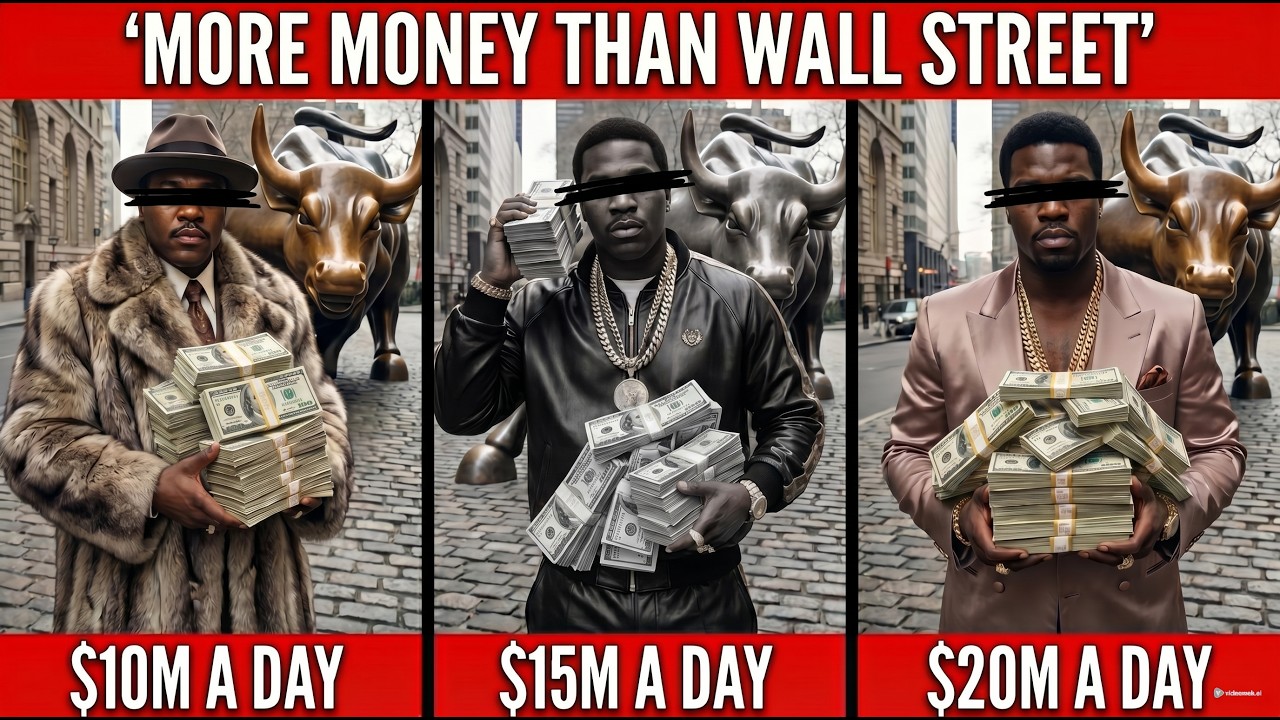
Hanover Place was later raided, demolished, and rebuilt. Today it is a quiet residential street. Combined, these ten blocks generated roughly $12 million per day at their peak—more than the daily profit of the largest American banks in the 1980s. The men who ran them built sophisticated commercial operations with supply chains, distribution networks, logistics, hierarchy, and quality control, all while police, federal agents, and rival crews actively tried to shut them down or kill them.
Most of the cash these operations generated did not stay in the neighborhoods. It flowed into white-owned banks, real estate, car dealerships, and jewelry stores. Casper Holstein died broke in 1944. Frank Lucas died broke in 2019.
Freeway Rick is rebuilding from a one-bedroom apartment. Rayful Edmond remains in federal prison. Don King is the only one of these figures who walked away with generational wealth, and he did it by leaving the streets. The blocks made the money.
The blocks did not keep it.