The phone call came through to Dwight Eisenhower’s office in Washington on the afternoon of December 21, 1945, and the weight of the message settled over him like a physical blow. George S. Patton, the most feared and controversial battlefield commander of the Second World War, was dead, the result of a car accident in Germany twelve days earlier.
For Eisenhower, the Supreme Allied Commander who had spent three years walking a razor’s edge, the news did not just mark the loss of a friend. It signaled the end of a relationship so tangled in political necessity and battlefield reliance that only death could finally untangle it, revealing the unvarnished truth he had long buried beneath layers of diplomatic obligation.
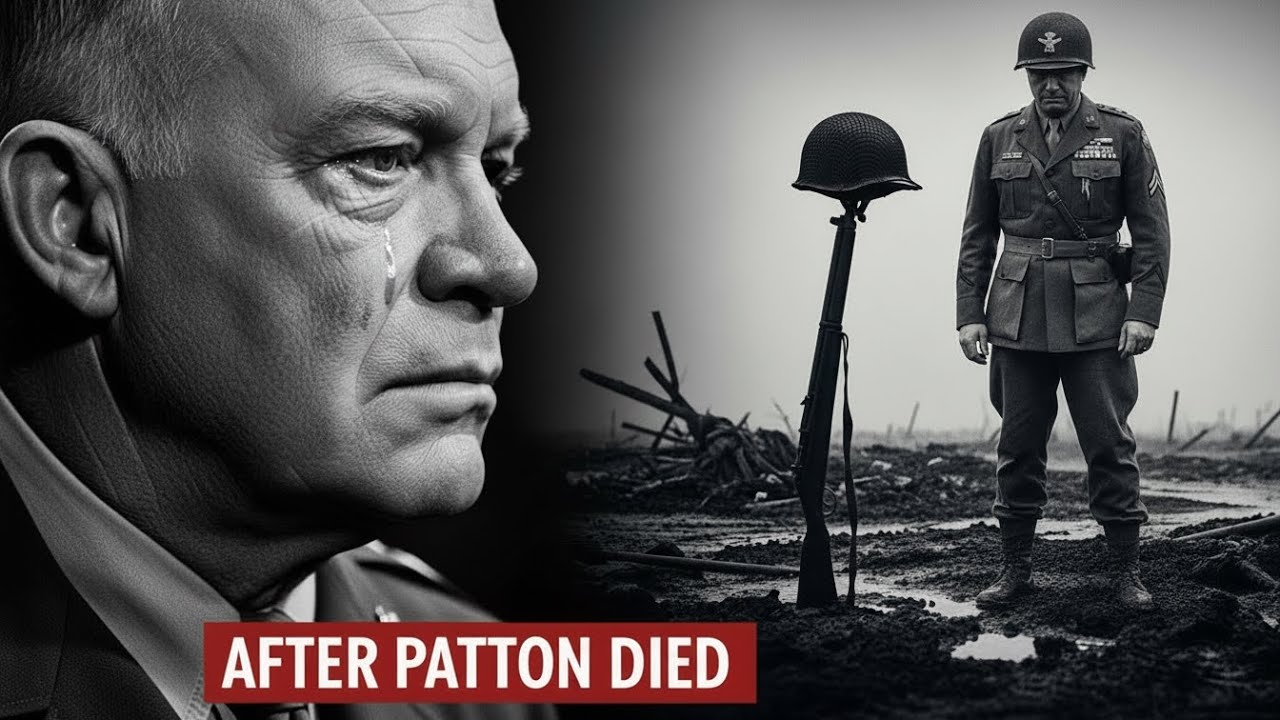 In the immediate aftermath, Eisenhower did not issue a grand public statement filled with battlefield hyperbole. Instead, he retreated into the private sphere of letters, diaries, and hushed conversations with close staff members, and it was there that the mask finally slipped. He admitted, in terms that shocked those who heard him, that George Patton was not merely an effective commander, but an irreplaceable force of nature, a weapon forged for total war who could not be replicated by planning, logistics, or organizational genius.
The admission was raw, unfiltered, and a stark departure from the carefully measured public praise he had always been forced to offer.
The seeds of this complicated bond were planted in the muddy fields of Camp Meade in 1919, where both men served as captains in the nascent tank corps, convinced that the future of warfare lay in mobile, armored columns. They were an odd pair, the wealthy, aristocratic Patton, already a combat veteran from Mexico and France, and the Kansas farm boy Eisenhower, who had missed combat in World War I and was still clawing for recognition. But they shared a singular vision, one that the old guard of the Army rejected, and that shared defiance forged a friendship built on mutual respect and a common understanding of what war would become.
By the time World War II erupted in Europe, the two captains had evolved into the Supreme Allied Commander and the most dynamic general in the American arsenal, but the dynamic of their relationship had shifted irrevocably. Eisenhower was no longer a peer debating tactics over engine parts; he was the manager of an unwieldy coalition, the political steward of a fragile alliance between the United States, Britain, and the Soviet Union. Patton, meanwhile, remained the pure warrior, resentful of the diplomatic constraints that, in his view, tied his hands and allowed the enemy to slip away, and he made no secret of his disdain for the political calculus that governed Eisenhower’s decisions.
The first major test of this fragile alliance came in August 1943, in the scorched landscape of Sicily, where Patton’s brilliance on the battlefield was nearly eclipsed by a moment of explosive rage. Visiting a field hospital, he encountered two soldiers suffering from what is now known as post-traumatic stress disorder, and in two separate incidents, he slapped them, called them cowards, and threatened their lives, triggering a media firestorm that demanded his immediate removal. For Eisenhower, it was an impossible dilemma: fire his most aggressive combat commander and risk the entire Italian campaign, or protect him and face the wrath of politicians and the public.
 He chose the middle path, issuing a public reprimand while privately ensuring Patton’s career survived.
What the world did not know, and what Eisenhower could never say publicly, was that he secretly believed Patton had a point about the soldiers he had slapped. In private conversations with his staff, Eisenhower expressed frustration with the breakdown of discipline and the prevalence of combat fatigue, believing that an army needed mental toughness to endure the horrors of war. Patton’s methods were wrong, Eisenhower admitted, but his underlying instinct that a commander could not coddle his troops was not entirely without merit.
It was a truth that Eisenhower could only whisper behind closed doors, forced instead to publicly condemn his friend to save him.
The delicate dance of punishment and protection would define their partnership for the remainder of the war, especially in the spring of 1944, when Eisenhower prepared for the greatest amphibious invasion in history. Facing the need to deceive the Germans about the location of the D-Day landings, Eisenhower turned to Patton, not as a combat soldier, but as a mythical decoy. He placed Patton in command of a fictitious army group threatening the Pas de Calais, using his fearsome reputation as the ultimate weapon of deception, a role that kept German divisions pinned in the wrong place even as Allied troops stormed the beaches of Normandy.
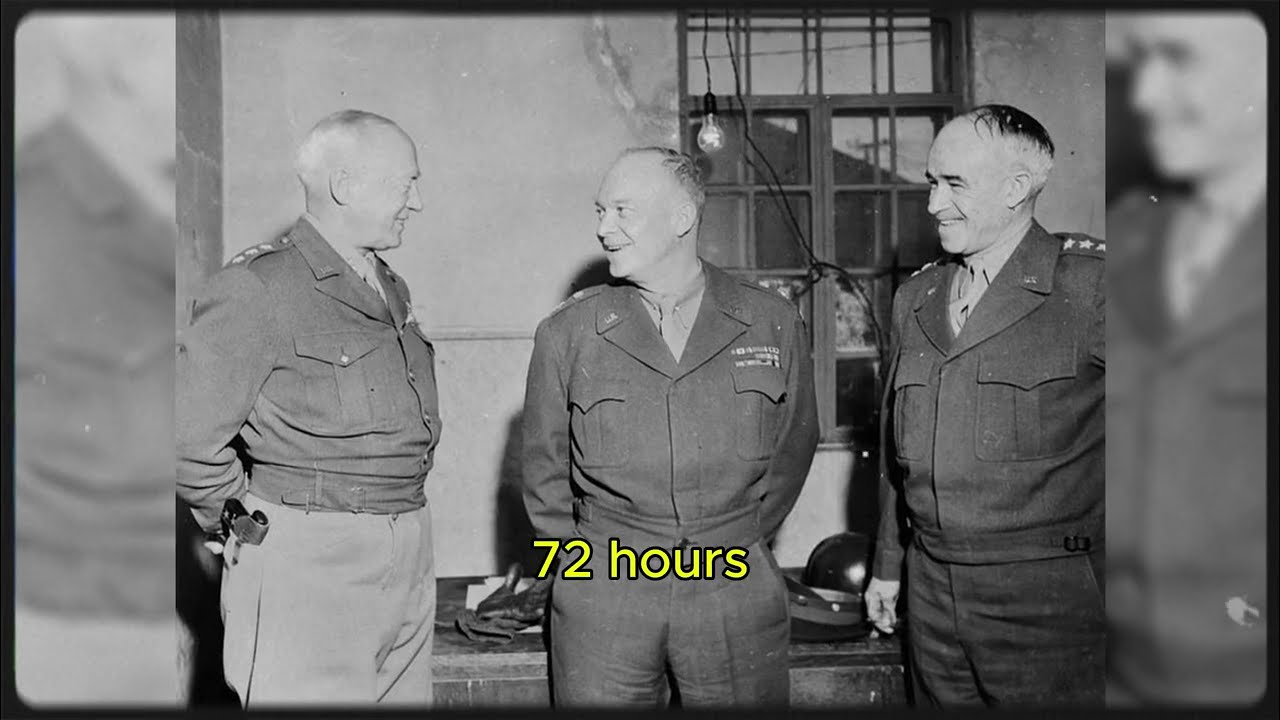 Patton was humiliated by the assignment, desperate to be in the first wave of the assault, playing actor instead of warrior while other generals earned glory on the sand. Eisenhower, burdened with the knowledge that Patton’s reputation was saving lives by deceiving the enemy, could not tell him the full scope of the plan, and Patton only learned the truth after the war, when it was too late to matter. It was a masterstroke of strategic deception, but it deepened the resentment that simmered between the two men, adding another layer of frustration to a relationship already strained by the burdens of command.
When Patton was finally unleashed in August 1944, his Third Army’s advance through France was nothing short of breathtaking, a blitzkrieg of American power that outran supply lines and left other commanders scrambling to catch up. Patton moved at a speed that defied conventional military logic, liberating towns, destroying German divisions, and driving toward the Rhine with a ferocity that terrified his enemies and worried his allies. Eisenhower watched with a mixture of pride and anxiety, celebrating the results while constantly reining Patton in, diverting supplies to other armies and forcing him to pause for political reasons that Patton found incomprehensible.
The climax of their turbulent relationship came in December 1944, during the chaos of the Battle of the Bulge, when the German army launched a desperate surprise attack that shattered the Allied front lines. As the situation looked catastrophic, Eisenhower gathered his top commanders and asked Patton how long it would take to turn his army around and attack the German flank, a logistical nightmare that most generals believed would require weeks of preparation. Patton, having anticipated the crisis during his train ride to the meeting, uttered the two most famous words of his career: “Three days,” and he delivered exactly that, slamming into the German flank and turning a potential disaster into a decisive victory.
It was in that moment, in the frozen Ardennes forest, that Eisenhower’s true reliance on Patton was undeniable, as he turned to the one man who could do the impossible when everything else was collapsing. Yet even after that triumph, Eisenhower was forced to keep his praise measured, treating Patton as just one of many commanders to avoid alienating British Field Marshal Montgomery or stirring up political jealousy. The public narrative was carefully managed, but the private truth, whispered in staff meetings and diary entries, was that Eisenhower constantly asked “What would Patton do?”
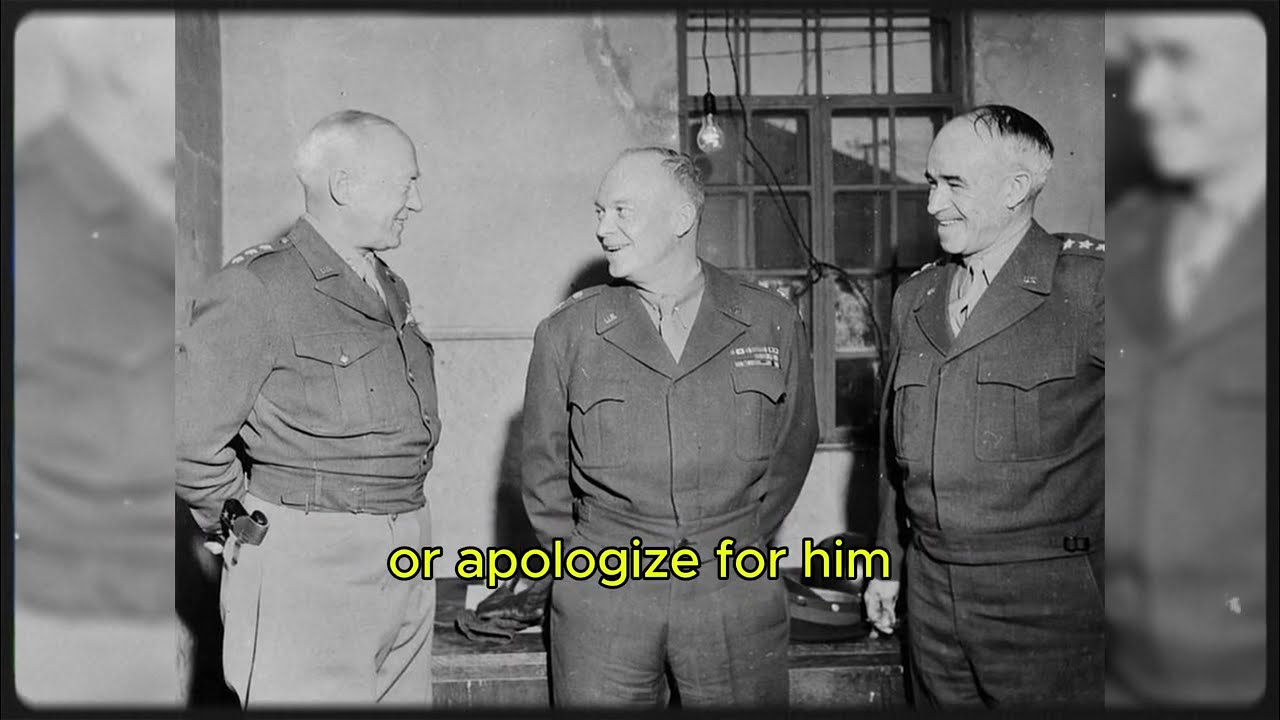 when facing a difficult decision, acknowledging that his old friend thought differently than anyone else.
Following the German surrender, Patton became an instant liability, his comments about Nazi party members and his calls to turn against the Soviets making him politically radioactive. Eisenhower had to demote him, a decision that was painfully difficult, effectively sidelining the general who had saved his campaign in its darkest hour. Their final conversations were bitter and strained, with Patton feeling betrayed by the very system he had fought to preserve, and Eisenhower feeling trapped by the demands of postwar geopolitics, a painful end to a friendship that had survived two decades.
After Patton’s death, Eisenhower’s carefully maintained diplomatic facade crumbled, and he began to speak with a startling, unguarded honesty about the man he had lost. He admitted that Patton’s aggressive nature, while impossible to manage in peacetime, had been essential for war, that his sheer force of will could achieve results that no other commander could replicate. Eisenhower also expressed a haunting regret, confessing that some of his decisions to hold Patton back had been driven by politics rather than military logic, and he wondered if the war might have ended sooner had he allowed his friend more freedom to pursue his instincts.
In his memoirs, written years later, Eisenhower used a word he had never dared utter publicly, calling Patton “indispensable” to the Allied victory, a recognition that the outcome of the war would have been fundamentally different without him. He described Patton as uniquely suited for the chaos of combat, a man who thrived when everything was falling apart, but who became a liability the moment peace returned, leaving him with no place to channel his aggressive energy. This was not a criticism, but a profound acknowledgment that some individuals are shaped for a specific purpose, and that Patton’s purpose had been to break the enemy, not to build a postwar world.
Eisenhower would go on to become President, leading the nation through the fraught early years of the Cold War, but he never forgot the man he had both defended and restrained. Late in his life, in interviews granted to historians, he would still speak of Patton with a sense of lingering sorrow, reflecting on the loneliness of command and the burden of having to manage a genius while protecting him from himself. The admission he made after Patton died was not merely about a single general; it was a confession about the impossible nature of leadership, about the gap between what is militarily effective and what is politically acceptable.
The nation lost more than a soldier on December 21, 1945; it lost a man who could make impossible things happen through sheer force of will, a figure who was uniquely suited for the chaos of war. Eisenhower had always known this, had always understood the value of Patton’s unorthodox brilliance, but only when the man was gone could he finally say it without fear of consequence. The bond between them, forged in the tank yards of Camp Meade and tested on the battlefields of Europe, remained unbroken, a testament to the complicated truth that the greatest victories are often won by the most difficult men, and that the burden of command is the loneliness of restraining those you need the most.