The polished image of Doc Holliday as Wyatt Earp’s loyal, quick-witted sidekick has long overshadowed a far messier reality. Behind the legend was a professional gambler whose daily life revolved around saloons, cash, and violence—and whose fearsome reputation was not just personality, but a practical tool for survival. Historians note that Holliday and Earp were not elevated to major folk heroes during their own lifetimes the way later figures were. It was books, and especially films, that built the clean version of the story long after the real record was already set.
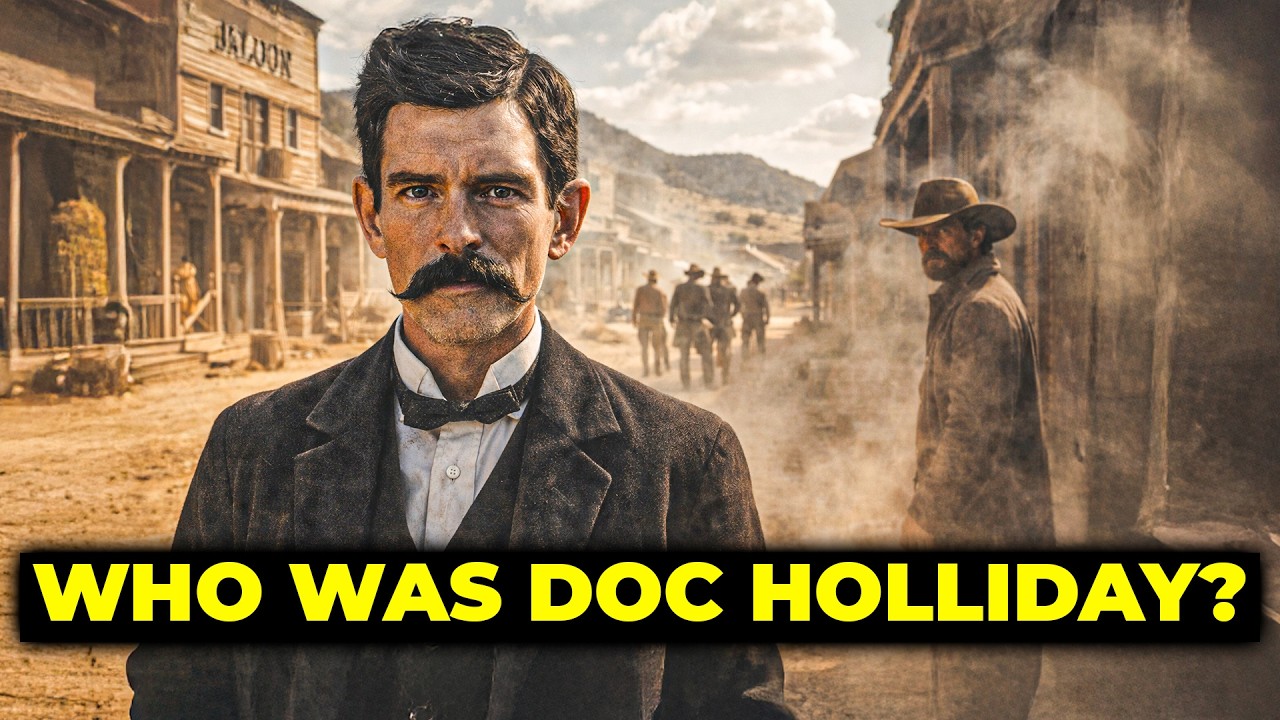
The man and the myth grew at very different speeds. Holliday’s real trade in the West was cards. After tuberculosis pushed him out of dentistry, he became a full-time faro dealer. In the 19th-century frontier, that meant more than shuffling cards.
A dealer had to keep order, spot cheats, and convince every hard case in the room that crossing him would cost more than it was worth. Historians have argued that he cultivated his dangerous image deliberately, because a feared gambler had a better chance of avoiding thieves and testers. Menace was part of the job. In Dallas, he quickly became known as a quarrelsome card player and picked up gaming charges.
In 1875, he was arrested after trading gunfire with a saloon owner. He drifted through Texas, Colorado, Wyoming, New Mexico, and Kansas, gambling for a living while the respectable title of dentist stayed in the background. Some historians have even suggested that in Tombstone, he may have served as a kind of informal enforcer in local gambling competition—useful not just as Earp’s friend, but as muscle for business interests. Tuberculosis was not merely tragic decoration.
His mother died of it, and he developed chronic pulmonary tuberculosis himself shortly after starting his dental career. He went west hoping a drier climate would slow the disease. Sickness narrowed his options and gave him a shortened sense of time. Some historians link his behavior to an older southern dueling culture, where personal honor could push men toward confrontation rather than retreat.
Add alcohol, pride, and the need for a dangerous reputation, and the result was a man who could escalate ordinary conflict very quickly. He did not look like a classic dominant gunman. He was often described as frail and thin, which may be exactly why reputation mattered so much. He could not overpower a room with size, so he learned to control it through fear.
Nobody needed proof that he had killed many men; they only needed to think he might kill the next one. The record shows violence before the legend. Many of the biggest stories attached to his name do not hold up under scrutiny. Researchers point out that the long list of supposed kills is mostly built from late stories, not solid records.
Even the famous Mike Gordon killing is disputed. One modern historian points to a coroner’s inquest that did not name Holliday at all, and notes that newspapers at the time discussed Gordon’s death without mentioning him. But cutting away the weak stories still leaves plenty that is dark. In Las Vegas, New Mexico, an altercation reportedly involved him killing a man and wounding a bartender.
In Tombstone, after a dispute in the Oriental Saloon, owner Milt Joyce had him thrown out. Holliday came back with a gun. Shots were exchanged, Joyce was wounded in the hand, and his partner was hit in the toe. Holliday later pleaded guilty to assault and battery.
In Leadville, when Billy Allen approached him over a small gambling dispute, Holliday opened fire and wounded him, then was acquitted. The amount of money involved was tiny; the response was not. That pattern matters. Violence around Holliday often looked petty, impulsive, and woven into daily life.
A quarrel here, a saloon dispute there, a court appearance, a fine, a move to another town. He did not need 35 killings to be dangerous. Repeatedly drawing weapons and repeatedly shooting over conflicts was enough. Holliday stood exactly where the Old West gets hardest to simplify.
He was close to famous lawmen, but he lived in the underworld those lawmen dealt with. His friendship with Wyatt Earp did not magically turn him into a clean force for order. Even public television histories stress that Wyatt’s own life was tied to gambling and opportunistic movement between boomtowns. Their alliance came out of a frontier gray zone, not a pure stand for justice.
In Tombstone, local “cowboys” were not just ranch hands; the term could point to a rough faction tied to rustling and robbery. Ike Clanton was associated with that world. When Holliday took part in the OK Corral fight, he was not marching in as a long-serving town officer. He was a gambler with a violent record who was temporarily pulled onto the official side.
The law borrowed from the underworld when it needed muscle. The stagecoach robbery cloud over Holliday is one of the best windows into his darker side. In 1881, he became a suspect in an attempted stagecoach robbery in which two men died. Georgia’s state encyclopedia identifies Ike Clanton as tied to the gang that robbed the stage, while noting it is unclear whether Clanton himself took part in the attack.
According to the encyclopedia, Clanton later fell out with the robbers and made a secret deal with Wyatt Earp: if he gave up the men responsible, Earp would ensure he received Wells Fargo reward money. Earp agreed because clearing Holliday’s name would also improve his own standing as a lawman. Holliday’s personal life made the situation worse. After a nasty break with Big Nose Kate, she signed an affidavit implicating him in the hold-up and killings.
Later sources say she had been drinking and was pushed in that direction by Holliday’s enemies, including Milt Joyce and Sheriff Johnny Behan. Once sober, she backed away from the claim. Witnesses supported Holliday’s whereabouts elsewhere, and the case collapsed. Legally, it was a huge break.
But his name fit the accusation too easily. That is what mattered—he was already close enough to violent circles that a stage robbery charge did not seem impossible to the people around him. The OK Corral is the moment that froze Holliday in public memory, but it also hides one of the most uncomfortable facts. He was not acting as a long-time peace officer when the shooting came.
He was a dangerous gambler who had been deputized for that crisis. Virgil Earp had deputized his brothers Wyatt and Morgan and his friend Doc Holliday as tensions with the Cowboys rose over the town’s weapon ordinance. Four days after the gunfight, murder charges were filed against the Earps and Holliday. Wyatt and Holliday were arrested and held for more than two weeks before Judge Wells Spicer cleared them.
Tombstone was divided. Many residents openly wondered why a hot-headed man with his own grievances had been turned into a deputy in the first place. Public television histories of Wyatt Earp now openly describe the gunfight as something that blurred the boundaries of law and criminality. What came after the OK Corral made that blur much darker.
In December 1881, Virgil Earp was badly wounded in an ambush. In March 1882, Morgan Earp was killed. After that, Wyatt Earp turned from defendant into the leader of a retaliatory campaign, and Holliday went with him. The Georgia Encyclopedia describes it as a vendetta campaign that ended in the death of Frank Stillwell, a suspect in Morgan’s murder.
The Encyclopedia of the Great Plains notes that Holliday was alleged to have helped Wyatt kill Stillwell and Florentino Cruz, though he never stood trial for either death. Stillwell ended up dead in Tucson, and a warrant followed. Holliday fled Arizona with Earp, was later arrested in Denver, and Arizona wanted him back. Colorado authorities refused to extradite him and eventually released him.
That result is sometimes treated as proof the whole matter was clean. It was not. It only proves that frontier justice could break along state lines and political influence. Later storytelling kept sanding off the sharpest edges while inflating everything else.
Historians note that film, television, magazines, and later books did huge amounts of work in shaping the Holliday people think they know. On one hand, writers exaggerated his kill count and turned rumor into biography. On the other hand, they polished his image into something stylish, almost noble. The Encyclopedia of the Great Plains says stories crediting him with 35 killings have little basis in fact and argues that much of his deadly aura came from later embellishment.
It also suggests that Holliday himself may have helped nourish that fearsome image because it protected him in gambling circles. The famous movie duel with Johnny Ringo belongs to cinema, not the historical record. The dramatic first kill tale involving Mike Gordon is disputed. The classic image of him rescuing Wyatt Earp in a Dodge City standoff has likely been enlarged by later retellings.
A rumor appears, a memoir adds detail, a biography states it more confidently, and a film turns it into a perfect scene. The dark side of Doc Holliday is not one shocking reveal. It is the fact that almost every part of the famous image has been cleaned up. He was educated, yes, but much of his adult life in the West was spent in gambling rooms.
He was loyal to Wyatt Earp, yes, but that loyalty repeatedly pulled him into conflicts where private grievance and public law were tangled together. He may not have killed as many men as folklore claims, but the actual record still shows repeated readiness to threaten, shoot, and escalate over slights and arguments. He was sick, yes, but his illness should not be romanticized into automatic depth or wisdom. A dying man can still be reckless, cruel, and dangerous.
In his case, the disease seems to have sharpened the need to live through nerve, pride, and reputation. He did not move through the West like a simple hero or outlaw because the West he lived in did not really work that way. It ran on overlap—gamblers with political friends, lawmen with business interests, cowboys tied to rustling, and posse riders driven by revenge. Even the famous friendship can be read another way.
Holliday was valuable to Wyatt because he was not cautious, because he was already compromised, and because he could be counted on to stand in ugly places where a cleaner man might hesitate. That is not the same thing as moral greatness. It is frontier usefulness. And once film got hold of him, usefulness became glamour.
Strip away the polish and there was still a powerful character there—just not the one most people were handed. What remains is a frontier gambler who understood that a frightening name could be nearly as valuable as cash, and sometimes more useful than the law itself.