James “Whitey” Bulger ran Boston’s criminal underworld for two decades while serving as an FBI informant. When federal agents finally came for him in December 1994, he vanished for 16 years. His death in 2018, at age 89, came not in a dramatic shootout but in a West Virginia federal prison, where fellow inmates beat him to death because they despised informants. Martin Scorsese’s 2006 film The Departed gave audiences a far cleaner ending for its fictional Bulger counterpart, Frank Costello, played by Jack Nicholson.
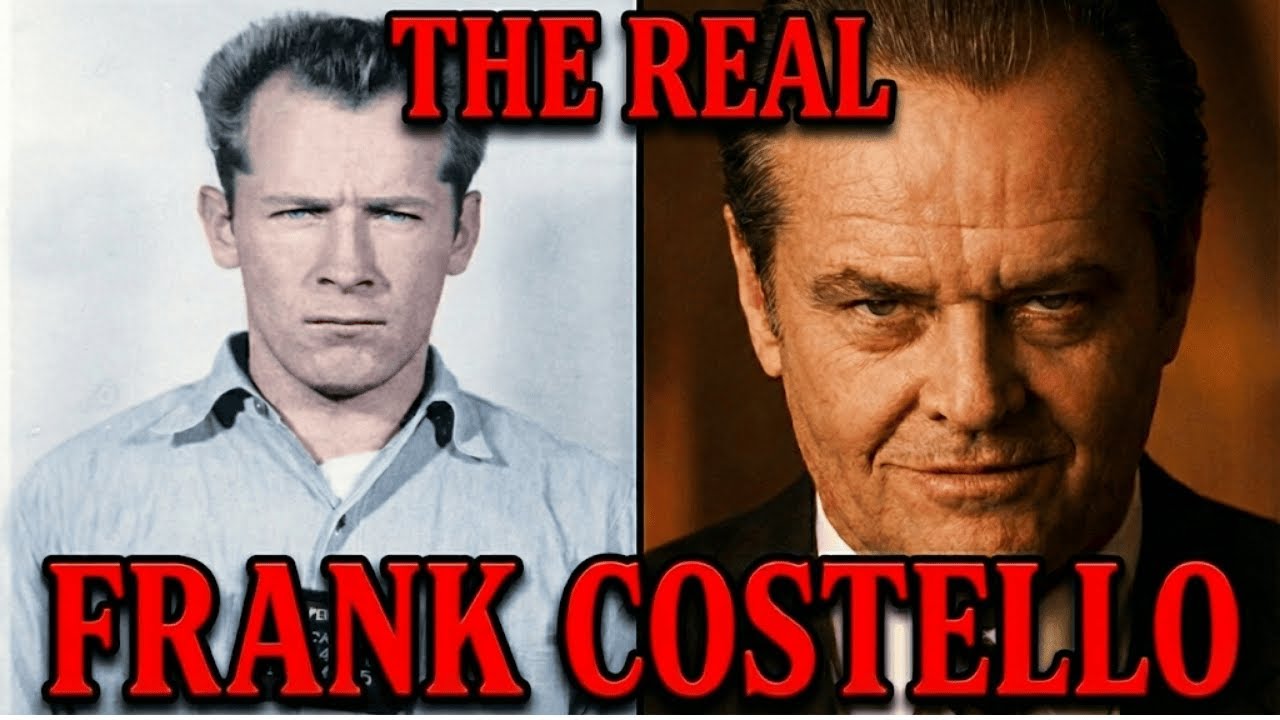
In the movie, Costello is gunned down by his own protégé the moment his FBI ties surface. Hollywood delivered resolution. Reality delivered something stranger. Nicholson’s Costello is theatrical and volatile.
He lectures young Colin Sullivan about taking what you want from the world, murders people in bars, waves severed hands around during drug deals, and delivers crude monologues about power. Bulger operated differently. People who knew Bulger in South Boston described him as quiet, rarely raising his voice. He dressed conservatively and kept routines, jogging along Carson Beach in the early mornings and eating at the same restaurants week after week.
Former associates told investigators he preferred listening to talking, asked questions, and remembered the answers months later. In the housing projects where he grew up, Bulger cultivated a Robin Hood image, keeping hard drugs out of the neighborhood and helping elderly women carry groceries. That image was a strategic lie. Bulger understood that power came from appearing legitimate while operating in the shadows.
He let others do the violence while he collected the profits and maintained deniability. Before becoming Boston’s most wanted fugitive, Bulger survived something stranger than anything in the film. In the 1950s, while serving federal sentences at Atlanta Penitentiary and later Alcatraz, he volunteered for CIA-sponsored experiments under the MK Ultra program. Government doctors injected him with LSD as part of research into mind control techniques on prisoners.
Bulger later said the experiments gave him nightmares for years. In 1975, Bulger and his associate Stephen Flemmi made a decision that would define Boston organized crime for two decades. They agreed to become FBI informants, not reluctantly but willingly, understanding the arrangement offered protection from prosecution. The agent who recruited them was John Connolly, a South Boston kid who had grown up in the same housing project as the Bulger brothers.
Fellow agents said Connolly talked about Bulger the way other men talked about sports heroes. The arrangement was supposed to work simply: Bulger would provide intelligence on Italian mafia families in New England, and the FBI would use it to prosecute them. What actually happened was corruption that took decades to fully expose. Connolly did not just receive information from Bulger.
He gave it back. FBI supervisor John Morris later testified under oath in federal court that he accepted money and gifts from Bulger’s organization, including dinners, wine, and cash payments. Morris admitted he leaked the names of informants cooperating against the Winter Hill gang. One of those informants was John McIntyre.
In the early 1980s, McIntyre began cooperating with federal authorities. He had information about Bulger’s gun-running operation to the Irish Republican Army and was prepared to testify. According to federal court documents, Connolly leaked McIntyre’s identity to Bulger and Flemmi. They tortured McIntyre for hours, then killed him.
His body was not found for years. The Departed treats Costello’s FBI relationship as a secret, a betrayal that justifies his death when Sullivan shoots him in a warehouse. Bulger’s informant status was never secret within law enforcement. He was officially designated a top-echelon informant in FBI files starting in 1975.
His handler bragged about him at bureau functions. The arrangement lasted 20 years and was known to supervisors at multiple levels. The only secret was how completely it had corrupted the Boston field office. Scorsese and screenwriter William Monahan knew about Bulger when they made the film.
The project began with a bidding war, with Brad Pitt’s Plan B Entertainment outbidding Harvey Weinstein for the rights to remake the Hong Kong thriller Infernal Affairs. Monahan, a Boston native, said he wanted to capture the class structure and accent of South Boston. When Nicholson signed on, he requested something more than a standard gangster role. Monahan suggested basing the character on Bulger.
Technical adviser Tom Duffy, the Massachusetts State Police detective who spent years investigating Bulger, worked on set to ensure authenticity. Leonardo DiCaprio met people who lived through what locals called the Whitey era. Matt Damon confirmed that Duffy introduced the cast to police officers and South Boston residents who remembered Bulger’s reign. Scorsese said that once the production team read books about Bulger, nothing they put in the film was exaggerated.
That claim does not survive scrutiny. The Departed shows Costello personally murdering people, shooting victims in bars and joking about sleeping with a severed hand. Bulger was present at some murders, and witnesses testified he strangled a woman named Deborah Davis who threatened to expose his informant status. But his power came from delegating violence, not performing it.
He had killers on his payroll, including Flemmi and John Martorano. The microprocessor deal in the film is fiction borrowed from Infernal Affairs and grafted onto the Boston setting. Bulger’s actual criminal enterprises were gambling, loan sharking, extortion, and drug trafficking, the same rackets that had sustained organized crime in Boston for generations. He was running a protection operation that generated $30 million over two decades.
Nicholson’s Costello wears a Yankees cap throughout the film, refusing to wear the Red Sox cap that was Bulger’s signature look in surveillance photographs. Nicholson wanted the character to feel unpredictable and disconnected from the real man. The costume choice signals the distance between performance and documented reality. The filmmakers made these changes for reasons tied to risk.
Bulger was still alive in 2006. He had fled Boston in December 1994 after Connolly warned him about a forthcoming RICO indictment. For the next 16 years, he lived as a fugitive with a $2 million reward on his head, eventually landing on the FBI’s Ten Most Wanted list, just below Osama bin Laden. Depicting him directly, using his real crimes, and naming his actual victims carried legal exposure that Warner Brothers and Plan B refused to accept.
So they built Costello as a composite, borrowing the outline of Bulger’s life and filling it with fictional excess. They gave him Nicholson’s manic energy and turned a calculating strategist into a raving lunatic. The film also needed an ending that Bulger’s life could not provide. His story in 2006 had no conclusion.
He was somewhere in America using false identities and evading capture. A two-hour thriller cannot accommodate that ambiguity. So Costello dies, closing the narrative loop. The real resolution came years later.
FBI agents arrested Bulger on June 22, 2011, outside a rent-controlled apartment in Santa Monica, California. He was 81, living under an alias with his longtime girlfriend Catherine Greig. Neighbors knew him as a quiet older man who avoided attention. Agents found 30 weapons and over $800,000 in cash hidden in the apartment walls.
In 2013, a federal jury convicted Bulger of racketeering and involvement in 11 murders. He received two consecutive life sentences plus five years. The trial lasted eight weeks. Former associates testified against him.
Families of victims confronted him in court. On October 30, 2018, inmates at the United States Penitentiary Hazelton in West Virginia beat Bulger to death within 12 hours of his arrival. He was 89 and confined to a wheelchair. Investigators later determined that word of his transfer had spread through the prison population before he arrived.
Fotios Geas, a hitman for the Genovese crime family who despised informants, was later charged with the murder. The Departed won four Academy Awards in 2007, including Best Picture and Best Director for Scorsese. The film grossed $291 million worldwide against a $90 million budget. Critics praised it as Scorsese’s return to form.
The myth endures because the film endures. Most viewers believe they are seeing some version of Bulger’s story, that Costello represents how Bulger operated, theatrical, volatile, personally violent. They believe the ending represents justice, that the rat gets killed and order is restored. Bulger operated for decades because the system never corrected itself.
FBI agents took his money and protected his crimes. Supervisors looked away. Informants who cooperated against him were murdered with information the bureau provided. The corruption was not one rogue agent.
It was institutional failure requiring congressional hearings and multiple federal prosecutions to partially address. Connolly was eventually convicted of racketeering and second-degree murder for his role in the death of businessman John Callahan. A judge sentenced him to 40 years. He was released on medical grounds in February 2021, suffering from terminal cancer, after serving 19 years.
The Departed tells a story about rats and loyalty and the price of betrayal, suggesting that everyone who informs eventually pays. The real story of James Bulger is about what happens when informing becomes the system, when the line between law enforcement and organized crime dissolves so completely that the FBI functions as a protection racket for the criminals it was supposed to prosecute. Hollywood needed Frank Costello to be a monster who gets what he deserves.
Bulger was something more disturbing, a businessman who understood that the most valuable product he could sell was information and who found buyers at the highest levels of federal law enforcement willing to let him kill to protect that arrangement.