John Wesley Hardin was one of the most feared gunmen of the American Old West, a figure whose life blurred the line between documented fact and self-made legend. Over the course of his violent career, Hardin claimed responsibility for dozens of killings, though historians have long debated the true number. Contemporary news reports credited him with 27 deaths, while Hardin himself later claimed 42. Modern researchers believe the actual figure was significantly lower, likely between 12 and 20, with many of his claims lacking credible evidence.
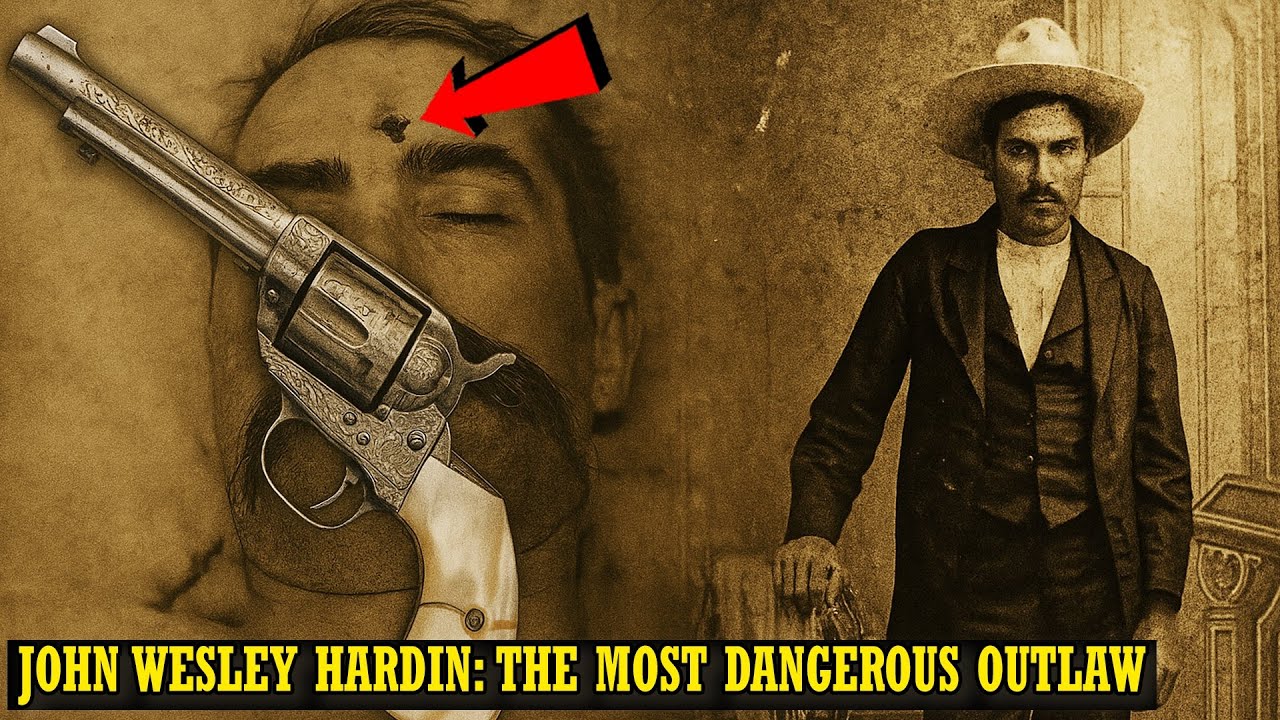
Hardin was born in 1853 near Bonham, Texas, into a family of considerable social standing. His father, James Gibson Hardin, was a Methodist minister and circuit rider, while his mother, Mary Elizabeth Dixon, came from a respected background. He was named after John Wesley, the founder of Methodism. The family moved to Sumpter, Texas in 1859, where his father continued his ministry and opened a school for local children.
Hardin’s lineage included congressmen, a senator, and Confederate generals, and his father served as a captain in the Confederate Army during the Civil War. Influenced by the times, a nine-year-old Hardin once tried to run away from home to join the Confederate forces. His first serious trouble came in 1867 while attending his father’s school. Hardin was accused of writing a crude poem on the schoolhouse wall insulting a female classmate.
He denied it and blamed another student, Charles Slater. The dispute escalated when Slater allegedly approached Hardin with a knife. In the struggle, Hardin used his own knife, seriously injuring the other boy. Though Slater survived, the incident nearly got Hardin expelled.
A year later, a more tragic episode occurred. According to Hardin’s autobiography, he wrestled and defeated a man named Mage, who had been formerly enslaved by a relative. The next day, Mage allegedly confronted him on horseback, and Hardin shot him. Mage died three days later.
Hardin’s father, fearing the charged political climate of post-Civil War Texas would prevent a fair trial, advised his son to go into hiding. Hardin claimed he was later located by Union authorities who sent three soldiers to arrest him. He resisted, and the encounter turned deadly. By his own account, this marked a turning point in his life.
Much of what is known about these early episodes comes from Hardin’s autobiography, written years later. Historians treat these accounts with caution, noting they mix fact with embellishment. As a fugitive, Hardin remained on the move. In January 1870, he was playing cards in Hill County, Texas, with a man named Benjamin Bradley.
Hardin claimed his consistent winning upset Bradley, who became threatening. That night, Hardin said Bradley fired a shot at him and missed. Hardin retrieved his pistols and returned fire, killing Bradley. Witnesses confirmed details of the encounter, including that Hardin wore his guns sewn into his vest with the handles angled inward, allowing him to cross his arms for a fast draw.
Later that month, he reported another fatal dispute after an argument at a circus. Within a week, he described yet another episode involving a confrontation with a man he identified as a pimp. In January 1871, Hardin was arrested in connection with the death of Laben Hoffman, the city marshal of Waco, Texas. Hardin denied involvement.
While being transported by two Texas State Police officers, he claimed he was tied to a horse without a saddle. During a rest stop, he alleged an officer struck him repeatedly. He pretended to cry and slump against his pony, then retrieved a hidden firearm and escaped. He also claimed he was briefly detained again and escaped after his captors grew careless while drinking.
Following these events, Hardin took refuge with cousins in South Texas, who encouraged him to join a cattle drive to Kansas. In early 1871, he began working with cattlemen in the region. During this period, he recounted a dispute with a freedman and another altercation with three Mexican men over a card game. During the summer of 1871, Hardin was part of a cattle drive along the Chisum Trail to Abilene, Kansas.
He described a confrontation with Mexican vaqueros that allegedly resulted in several deaths. Historians generally accept that three Mexican cowboys were killed, a number lower than Hardin later claimed. He also described separate encounters with Native Americans, including one where he said he shot a man near the South Canadian River. Upon reaching Abilene, Hardin claimed he was involved in an argument at a restaurant that turned physical.
He quickly left town along the Cottonwood Trail. On July 4, 1871, a trail boss named William Corin was killed south of Abilene by an unidentified Mexican national. The suspected killer was later located and killed by two cowboys. Hardin admitted to being involved in the shooting and claimed he had been deputized for the act.
Hardin’s path crossed with Wild Bill Hickok in Abilene. Town marshal Hickok was asked to remove a mural of a bull with exaggerated anatomy from the side of the Bulls Head Tavern. The tavern owners, including Ben Thompson, were upset and tried to provoke Hardin, who was traveling under an alias, into confronting Hickok. Thompson told Hardin, “He’s a damn Yankee.
Picks on rebels, especially Texans, to kill. ” Hardin reportedly responded, “If Bill needs killing, why don’t you kill him yourself? ” Hickok later approached Hardin and instructed him to surrender his weapons. Hardin complied, though he briefly startled Hickok by offering the revolvers with the barrels turned forward.
The situation de-escalated, and Hickok advised him to keep a low profile, unaware of his true identity. On the night of August 6, 1871, Hardin, his cousin Gip Clemens, and a rancher named Charles Cougar stayed at a hotel in Abilene after an evening of gambling and drinking. Hardin was awakened by loud snoring from Cougar’s room. Irritated and reportedly intoxicated, he shouted for Cougar to quiet down.
When there was no response, Hardin fired multiple shots through the wall. One bullet struck Cougar in the chest, killing him instantly. Hardin and Clemens fled through a second-story window onto the roof. A local newspaper reported the next day that a man had been killed in his bed by a desperado called Arkansas.
Hardin claimed he escaped by hiding in a haystack overnight, then took a horse and rode to a cow camp outside town. There, he said he surprised lawmen sent after him, forced them to remove their clothing, and made them walk back to Abilene. He then left Kansas for Texas and never returned. The incident became part of his legend, branding him as the man who shot someone for snoring.
Years later, Hardin expressed frustration with the story. “They tell lots of lies about me,” he reportedly said. “They say I killed six or seven men for snoring. Well, it ain’t true.
I only killed one man for snoring. ” In his 1896 autobiography, he gave a different account, claiming the man had tried to stab him with a dagger during a burglary attempt and dating the incident differently. In January 1875, the Texas legislature authorized a $4,000 reward for Hardin’s capture. An undercover Texas Ranger intercepted a letter revealing that Hardin was living near the Alabama-Florida border, working at a lumberyard under the assumed name John Swain.
In mid-1877, two men who had once been enslaved by Hardin’s father attempted to apprehend him in Gainesville, Florida. The confrontation left one man dead and the other permanently injured, though the account is based largely on Hardin’s own writings. The effort to arrest Hardin finally succeeded on August 24, 1877, when Texas Rangers and local law enforcement confronted him aboard a train in Pensacola, Florida. Reports say Hardin attempted to draw a firearm but struggled to free it from beneath his suspenders.
Officers subdued him before he could act. One of his associates was shot and killed during the operation. Hardin later claimed he was calmly smoking his pipe and was not armed at the time of his arrest. Hardin was tried for the death of Brown County Deputy Sheriff Charles Webb.
On June 5, 1878, he was convicted and sentenced to 25 years at Huntsville Prison. In 1879, he and 50 other inmates were discovered just hours before completing a tunnel that would have given them access to the prison armory. In 1892, he was convicted of manslaughter for an earlier shooting and given a two-year sentence to run concurrently. While in prison, Hardin read religious literature and became superintendent of the prison’s Sunday school.
He also studied law. His health declined due to an old injury that became infected in 1883, leaving him bedridden for nearly two years. By 1892, prison records described him as about 5’9″, weighing 160 pounds, with numerous scars from old wounds. His first wife, Jane, died on November 6, 1892, while he was still incarcerated, a loss that reportedly affected him deeply.
During his confinement, Hardin wrote an autobiography that historians have long noted contains numerous exaggerations and unverified claims. In one reflective passage, he recalled witnessing a fatal stabbing as a child in 1861 and included a moral lesson for readers: “Readers, you see what drink and passion will do. If you wish to be successful in life, be temperate and control your passions. If you don’t, ruin and death is the result.
”
On February 17, 1894, Hardin was released after serving 17 years of his sentence. He was 40 years old. On March 16, he received an official pardon. On July 21, he passed the Texas Bar Examination and earned a license to practice law.
However, troubling stories continued to follow him. A newspaper article published in 1900 alleged that not long after his release, he accepted a bet that he could knock a man off a soap box with a single shot. The man reportedly died from the fall, though the incident is difficult to verify. In January 1895, Hardin married 15-year-old Callie Lewis.
The relationship was short-lived. Later that year, he moved to El Paso, Texas, where he became involved in a series of confrontations. One incident began when John Selman Jr. , a local lawman, arrested a woman associated with Hardin.
The arrest led to a confrontation between Hardin and Selman Jr. , with some reports claiming Hardin may have physically assaulted the young officer. Constable John Selman Sr. , Selman Jr.
‘s father and a former outlaw himself, confronted Harden in public on August 19, 1895. The two exchanged harsh words. Later that evening, Hardin went to the Acme Saloon and began playing a game of dice. His final recorded words, according to witnesses, were reportedly “four sixes to beat.
” Just before midnight, Selman Sr. entered the saloon and approached Hardin from behind. He shot Hardin, who died instantly. Several more shots were fired after Hardin fell.
At the time, Hardin’s hand was resting on the grip of a holstered revolver. Hardin was buried the next day in El Paso’s Concordia Cemetery. Selman Sr. was arrested and charged with murder.
He claimed self-defense, stating that Hardin reached for his weapon. The jury could not reach a unanimous verdict, resulting in a mistrial. Before the case could be retried, Selman himself was fatally shot on April 6, 1896, following a dispute with a US Marshal. On August 27, 1995, exactly 100 years after Hardin’s death, a dispute took place at his grave.
Several of Hardin’s great-grandchildren wanted to relocate his remains to be buried beside his first wife. El Paso residents and preservationists opposed the move, arguing his burial was historically significant. When the two sides met at the cemetery, Hardin’s descendants presented a legal permit for disinterment, while the opposing group produced a court injunction prohibiting removal. Both sides accused the other of financial motives.
An initial court ruling favored keeping the remains in El Paso, but this was later reversed on appeal. Despite the legal back and forth, Hardin’s remains were never moved and continue to rest in Concordia Cemetery.