The war in Europe was supposed to be racing toward its conclusion in the late summer of 1944, yet the Allied war machine ground to a halt not because of German resistance, but because of a single, controversial American general named John C. H. Lee.
While George Patton and Omar Bradley chased the fleeing Wehrmacht across France, their tanks were running dry on fuel that was being diverted and delayed by a logistical behemoth commanded by a man they openly despised. The story of how this administrative titan nearly crippled the greatest military advance in modern history, and why Dwight D. Eisenhower refused to fire him, remains one of the most fiercely debated and overlooked chapters of the Second World War.
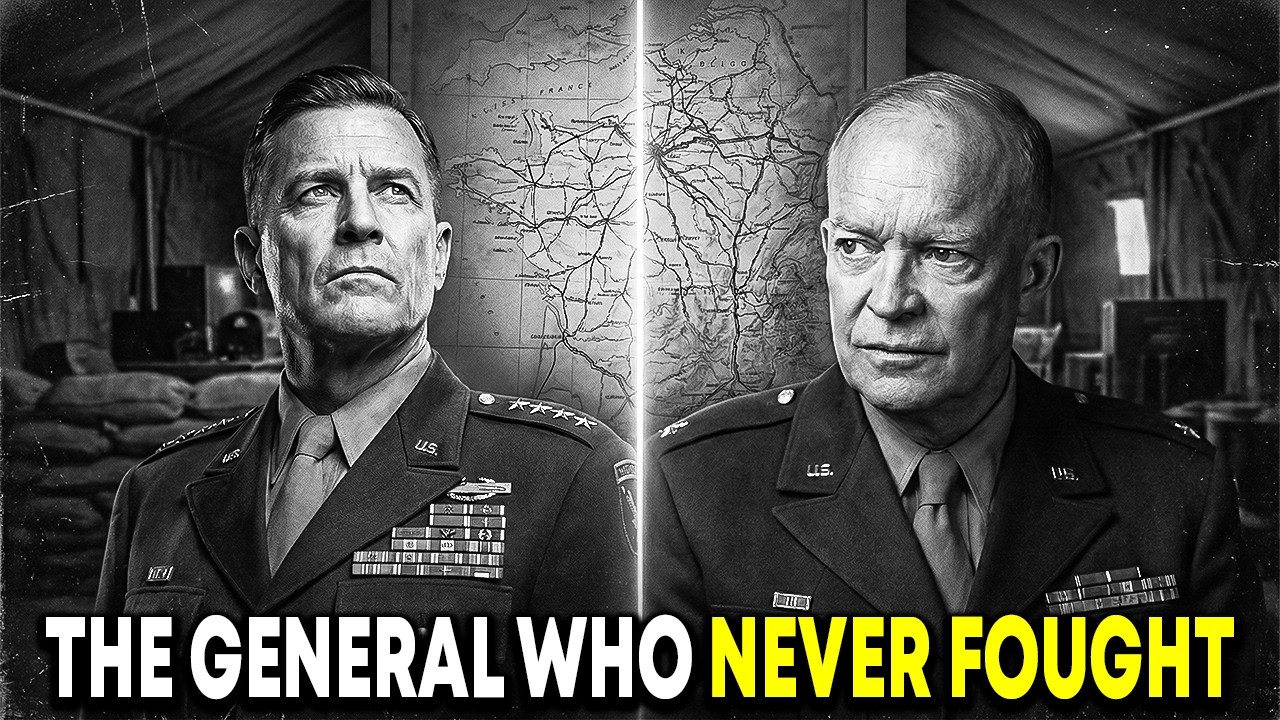 To understand the fury directed at Lee, one must first grasp the sheer scale of his domain. As commander of the Communications Zone, known as COMZ, Lee controlled over 1. 5 million personnel—a force larger than the entire standing armies of most sovereign nations.
He commanded more troops than Patton, managed more resources than Bradley, and wielded authority surpassed only by Eisenhower himself in the European Theater of Operations. Yet, he never led a single frontline unit, never heard a shot fired in anger, and never experienced the visceral reality of combat that defined his peers’ careers.
Lee was a logistician by trade and by temperament, a master of the invisible machinery of war—railroads, ports, convoys, and warehouses. By every objective metric, he was exceptional at his job, having spent decades perfecting the architecture of supply that keeps armies alive. However, his world was one of spreadsheets and tonnage, not tactics and terrain, and this fundamental disconnect would sow the seeds of conflict.
His nickname, given behind his back, was “Jesus Christ Himself Lee,” a moniker born from his initials that captured his unshakable belief in his own divine mandate and intellectual superiority.
The friction between Lee and the combat commanders was not merely a personality clash; it was an institutional schism. Frontline generals live and die by the breakthrough, the bold advance, and the decisive moment of action, while Lee’s glory came from ensuring those breakthroughs never ran out of fuel. This tension exploded into open warfare in late July 1944, following the Operation Cobra breakout near Saint-Lô.
Patton’s Third Army poured through the gap at a speed that stunned the world, turning a planned breakout into a full-scale pursuit across open country, with the Germans in full retreat.
The problem was distance, and distance in warfare translates directly to tonnage. Every mile Patton advanced stretched the supply lines another mile from the Normandy depots, and his armor consumed fuel at a voracious rate. The infrastructure built for a methodical advance was never designed for a sprint across an entire country.
 Lee’s answer was the Red Ball Express, a bold, almost unreasonable gambit that designated two parallel highways—one for loaded trucks heading forward, one for empties returning—running convoys around the clock. At its peak, nearly 6,000 vehicles rolled on those roads every 24 hours, and it defied all odds to keep the advance alive for six weeks.
It was a staggering logistical achievement that saved the campaign, yet it was immediately overshadowed by a decision that would define Lee’s legacy forever. On August 25, 1944, Paris was liberated, a moment of profound historical and emotional weight. Eisenhower, acutely aware of the city’s logistical burden, had considered bypassing it entirely to maintain momentum.
But Lee saw an opportunity and relocated his headquarters to the French capital, moving significant portions of COMZ into the city within days. Thousands of support personnel occupied prominent hotels, living in a standard of comfort that stood in stark, obscene contrast to the muddy, bloody conditions at the front.
The reaction was swift and venomous. Patton was furious, Bradley was coldly precise in his anger, and the officers throughout the combat formations saw the move as a betrayal of priorities. Every truck used to transport COMZ’s staff and furniture into Paris was a truck that could not carry ammunition or fuel to the men who desperately needed it.
The symbolism was devastating: the rear echelon was living in luxury while the vanguard was dying in the mud. Lee’s defenders argued the move had operational logic, as Paris sat at the center of the French road and rail network, but his critics saw it as arrogance bordering on insubordination.
This single decision crystallized all the resentment that had been building for years. Lee’s leadership style was intensely top-down; he demanded complete deference and did not naturally seek input or share decision-making. In an alliance requiring constant coordination between American, British, and French elements, this style created ongoing difficulties at every level.
 He strained relationships with British logistics counterparts, alienated his own senior staff, and exasperated Eisenhower’s headquarters personnel, who found him almost impossible to work with through standard channels.
By the autumn of 1944, the case for removing Lee had been made repeatedly by the most senior commanders in the theater. Bradley wanted him gone. Patton demanded his removal.
Several senior members of Eisenhower’s own staff agreed, citing concerns about the bloated size of his organization, which seemed to grow in proportion to its distance from the fighting. The question of efficiency haunted COMZ; the ratio of support personnel to front-line combat strength appeared to have drifted badly out of balance, costing the campaign real momentum and resources.
Yet Eisenhower, who knew everything, kept Lee in place. This is where the story becomes compelling, because Eisenhower’s decision was not passive or accidental—it was a deliberate choice made in full knowledge of the arguments against him. Part of his reasoning was operational: replacing the commander of an organization the size of COMZ mid-campaign risked catastrophic disruption.
Lee knew the systems, the personnel, the networks, and how they functioned; removing him created the potential for an organizational vacuum that the enemy could exploit.
Eisenhower’s thinking went deeper. He possessed an underappreciated quality—a clear-eyed understanding of what the mission required, not what was politically satisfying. The operational reality was that Lee’s organizational capacity was genuinely valuable, despite his flaws.
 Eisenhower made a calculated judgment that continuity in logistics command was worth the significant political cost of absorbing the anger of his most trusted combat generals. It was not a popular decision, but it was a considered one, and whether it was right remains a matter of fierce historical debate.
The winter of 1944-45 put that decision to the ultimate test. In December, the German offensive through the Ardennes—the Battle of the Bulge—struck with devastating force, placing the entire Allied position under immense pressure. Suddenly, every question about logistics efficiency and supply priorities became a matter of immediate operational consequence.
COMZ performed under this strain in ways that were both impressive and critiqued. The infrastructure Lee built did ultimately deliver, and the system held together when it needed to hold, even as the arguments over its efficiency were never fully resolved.
Post-war analysis suggested that the rear-area support structure consumed a larger share of available resources than the situation required, tilting the balance between support and strength in a costly direction. Yet, whether a different commander would have done significantly better, given the unprecedented scale of the challenge and the complexity of a multinational supply operation, remains genuinely open to debate. The war in Europe ended in the spring of 1945, and Lee’s career moved toward an obscure close, his name fading from the mythology of the victory.
History remembers the bold advance, the decisive engagement, the leader at the front of the column, but it forgets the fuel, the round, and the road that made it all possible. Lee never received the recognition of Patton or Bradley; there is no parade in his name, no monument along the highways his convoys traveled. He was arrogant, difficult, and made decisions that created real problems, yet he built something that worked at a scale never attempted before, under pressure that never relented.
Eisenhower, who saw the whole picture more clearly than almost anyone, chose to keep him, understanding that large-scale operations require the leader the situation demands, not the one easiest to admire.
In the end, the story of John C. H. Lee is a profound meditation on the nature of organizational leadership and the unglamorous foundations of victory.
He was the man who controlled the spigot that fed the beast of war, and when he turned it, he did so with a personal conviction that bordered on the divine. The combat commanders despised him for his arrogance and his distance from their suffering, but they relied on his systems for every ounce of their survival. Eisenhower’s choice to retain him speaks volumes about the difference between the popular narrative and the harsh reality of command, where the supply officer in the rear often holds the fate of the soldier at the front in his hands.