The flashbulbs had barely stopped popping before the political shockwave began its devastating march across the Atlantic. In a crowded press room in Belgium on January 7th, 1945, Field Marshal Bernard Montgomery delivered a nine-minute performance that did more damage to the Allied war effort than a German Panzer division, fundamentally altering the balance of power between the British Empire and the United States of America.
The Battle of the Bulge, Hitler’s final desperate gamble, had been a crucible of fire and ice for the American soldier. For weeks, young, often inexperienced American units had held the frozen Ardennes forest against 250,000 German troops and 1,400 tanks, suffering nearly 90,000 casualties in the largest and bloodiest battle in American military history. They fought with their backs against the wall, their communications severed, and entire divisions cut off behind enemy lines, holding the Western Front together by sheer grit and sacrifice while the skies remained too foggy for Allied air power to intervene.
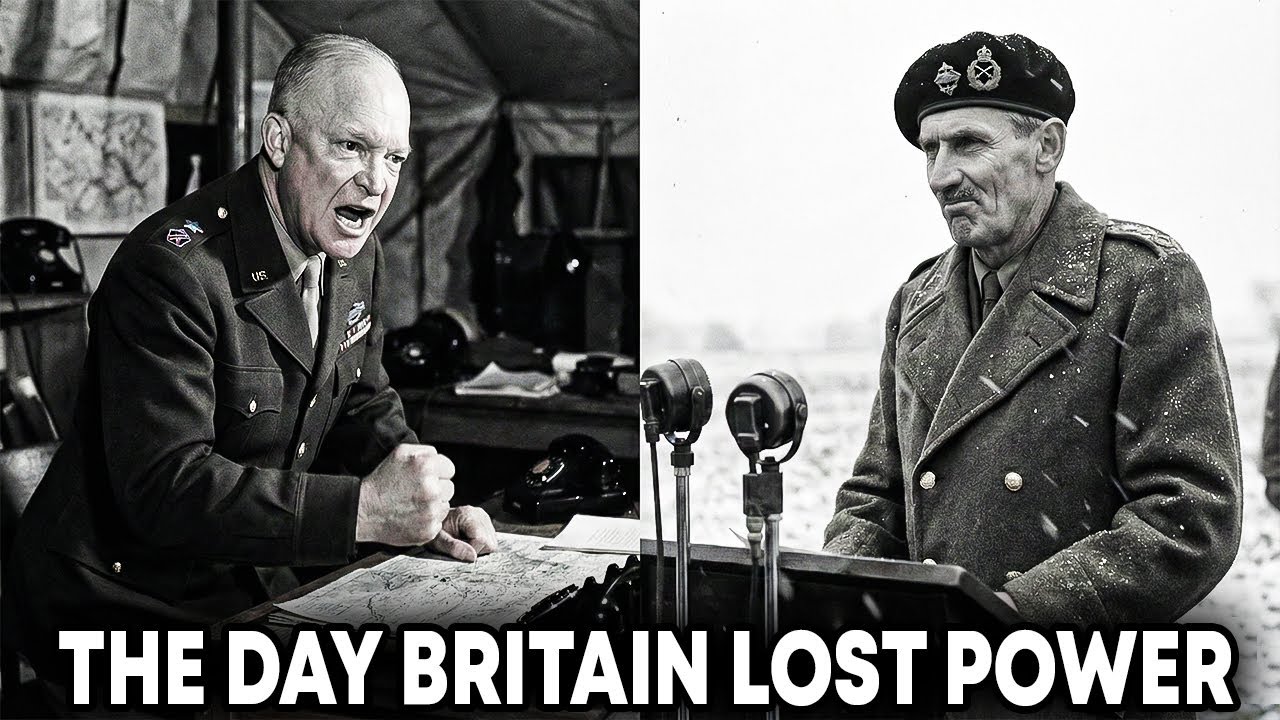 In the midst of that chaos, a purely tactical decision was made. General Dwight D. Eisenhower, the Supreme Allied Commander, had split the front, giving Montgomery temporary command of all forces north of the German penetration.
It was a logistical calculation, a matter of proximity and intact communication lines, meant to coordinate a pincer movement to pinch off the German advance. It was supposed to be temporary.
But Montgomery, the meticulous British hero who had broken Rommel at El Alamein, saw something else entirely. He saw vindication. To the man who considered himself a chess master among amateurs, the crisis in the Ardennes was not a near-disaster caused by a massive surprise offensive; it was proof of his own strategic genius and the supposed inadequacy of American command.
When he finally faced the world’s press, he did not speak as a coalition partner. He spoke as a headmaster scolding a failing student body.
He praised the American soldier as a “brave” and “good” fighter, but the tone was patronizing, dripping with the condescension of a colonial overlord. He described the American command structure’s handling of the German onslaught as “ragged.” He explained, with the clinical detachment of a surgeon, how he had “sorted out the battlefield” and deployed British troops to “plug the gaps.”
He positioned himself as the savior of the American army, the professional firefighter who had arrived to rescue amateur homeowners from a fire of their own making.
The implication was unmistakable and lethal. The Americans had failed, and Montgomery had saved them. He even had the audacity to praise Eisenhower’s “great courage” in asking for British help, framing a tactical necessity as a desperate confession of incompetence.
 To the American press, this was not just an insult; it was a wholesale theft of valor, a public humiliation of a nation that had just bled itself white on the snowy battlefields. The headlines in the United States screamed with fury, and the political fallout was immediate and explosive. Congressmen who had long harbored isolationist sentiments felt vindicated, and public outrage threatened to poison the very fabric of the Anglo-American alliance.
But the real detonation occurred behind closed doors. Eisenhower, a master diplomat in uniform, had spent months enduring Montgomery’s insufferable arrogance. He had tolerated the lectures, the end-runs around the chain of command, and the lobbying directly to Churchill.
He had accepted the constant implications that his broad-front strategy was mediocre. But this was the final straw. Eisenhower understood that this was not just a military campaign; it was a political balancing act of immense fragility.
He realized that the alliance itself was now at stake.
Eisenhower sat down and drafted a cable to the Combined Chiefs of Staff in Washington and London. The language was stark, professional, and final. He delivered the kind of ultimatum that no political leader wants to receive.
He stated, in essence, that he could no longer serve as Supreme Commander if Montgomery remained in his position. The division and disrespect had corroded trust to the breaking point. A choice had to be made.
 It was him or me.
The gravity of that message sent a shockwave through the highest echelons of power. Prime Minister Winston Churchill was horrified, not by Montgomery’s personality, but by the geopolitical reality the ultimatum revealed. Britain was financially shattered, exhausted by six years of total war, and militarily dependent on American industrial might and manpower.
The empire was on its knees, and it could not afford to alienate its most powerful ally over the ego of one general.
Montgomery’s friend and patron, Chief of the Imperial General Staff Alan Brooke, was forced to pull the Field Marshal aside for what must have been the most excruciating conversation of his career. He had to explain, in terms even Montgomery’s towering ego could understand, that he was about to be fired, disgraced, and that he was dragging the credibility of the entire British Empire down with him.
The subsequent apology was nothing short of a humiliation. Montgomery, the hero of El Alamein, a man who never admitted a mistake, penned a letter to Eisenhower that was effectively a grovel. He praised Eisenhower’s leadership in effusive terms, pledged absolute loyalty, and essentially begged to keep his command.
Eisenhower, ever the pragmatist, accepted. He needed unity, not vengeance. The ultimatum was quietly withdrawn, and the alliance held.
 But the architecture of that alliance had fundamentally shifted forever.
In that forced apology, the mantle of strategic dominance passed from the British Empire to the American Republic. It was not signed at a treaty table or declared in a grand ceremony. It happened in the backrooms of a military headquarters, because a field marshal could not control his own arrogance.
The end of British global supremacy was not marked by a battlefield surrender but by a press conference gone catastrophically wrong.
Montgomery would go on to take the German surrender on May 4th, 1945, and would be elevated to Vic Count Montgomery of Alamein. History would remember him as one of Britain’s greatest generals. But he never again wielded strategic influence on the world stage.
He was never again able to challenge American dominance. From that January day forward, when conflicts arose, American preferences prevailed. When resources were allocated, American priorities determined the distribution.
Britain was forever reduced to the junior partner, the architect of its own demotion, written in the stark, unforgiving language of a Supreme Commander’s ultimatum.