
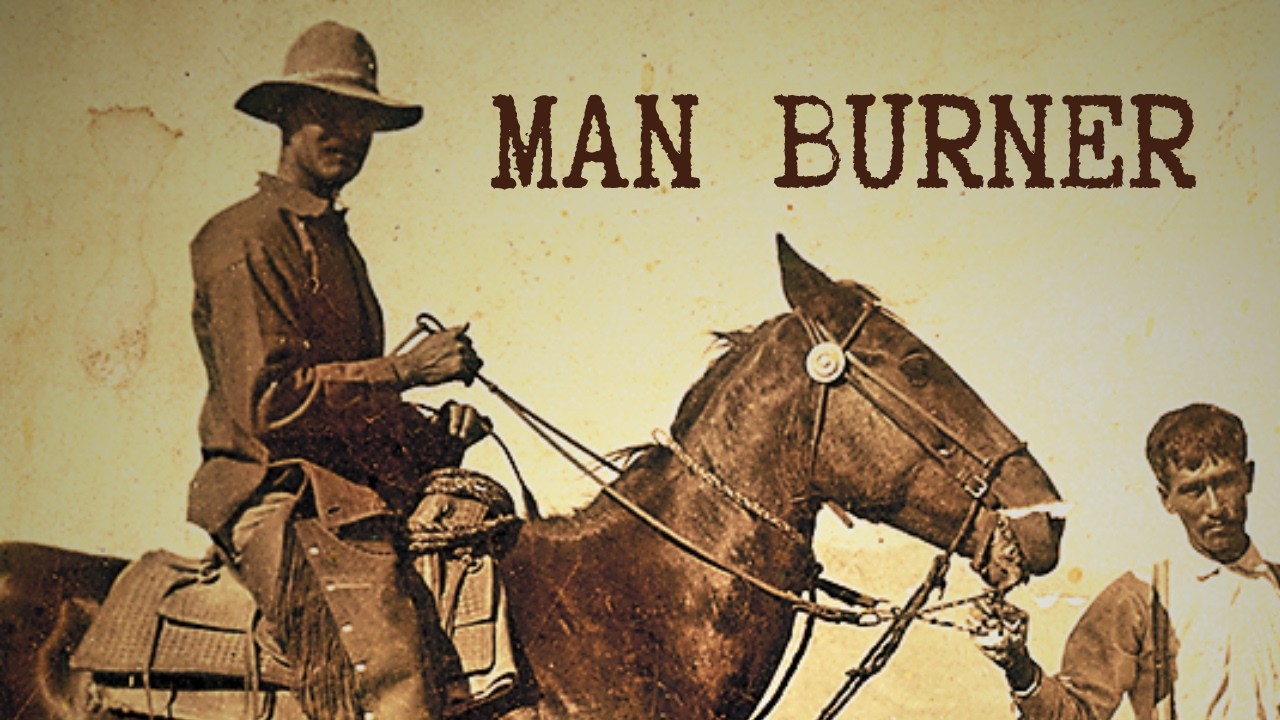
LONE TREE, NEBRASKA – The raw, unvarnished history of the American frontier is a tapestry woven with threads of brutality, enterprise, and unyielding survival. Few figures embody this volatile mix more completely than Isom Prentice “Print” Olive, a Texas cattleman whose life of violence, vigilante justice, and eventual downfall has cemented his legacy as one of the Old West’s most controversial and feared figures. Newly surfaced historical accounts and contemporary records paint a portrait of a man who was at once a pioneering rancher, a cold-blooded killer, and the probable inspiration for one of literature’s most iconic characters.
For decades, the story of Print Olive has been a whispered legend, a tall tale told around campfires alongside stories of Billy the Kid and Wyatt Earp. But unlike many of his contemporaries whose exploits were exaggerated by dime novels, Olive’s history is a matter of public record—a litany of murder charges, acquittals, and brazen acts of frontier justice that blur the line between lawful order and outright terrorism. From the sun-scorched plains of Texas to the frozen rangelands of Nebraska, Olive left a trail of blood that defined an era of unchecked expansion.
 The grim saga begins in the immediate aftermath of the Civil War. Returning to his family’s ranch in Williamson County, Texas, a young Print Olive found a landscape transformed by conflict. With the men gone to war, the cattle herds had run wild, multiplying into a vast population of unclaimed “mavericks.”
For a man with ambition and a willingness to use force, this was an opportunity carved from chaos. Olive, alongside his brothers, began a campaign of aggressive roundups, claiming as many unbranded cattle as they could rope. But this nascent empire was immediately threatened by a constant plague: rustlers.
To understand Print Olive, one must first understand his absolute, unwavering fixation on cattle rustling. In his worldview, the theft of a cow was a capital offense, punishable by a bullet, a rope, or something far worse. By 1876, the Olive brothers’ war on rustlers had escalated to a fever pitch.
Local newspapers of the era credited them with killing as many as twelve men in just a few months. It was during this period that the most horrifying legend of Olive’s career was born: the “death of skins.”
The story, recounted in various historical texts and folklore, describes a punishment of almost unimaginable cruelty. It is said that after catching two thieves in the act of butchering Olive cattle, Print and his brother captured the men and enacted a brutal ritual. They wrapped the living men in the freshly butchered cowhides, green and pliable, and then tied them to a tree.
As the Texas sun beat down, the hides began to dry and shrink. The process is a slow, merciless constriction, squeezing the life from the victims as the leather tightens, eventually leading to suffocation and a crushing death over several agonizing hours. It is a tale that has achieved near-mythic status, though contemporary newspaper reports from the time merely note the men were shot and one was found “covered” in a cowhide bearing the Olive brand.
Whether the “death of skins” was a reality or a terror tactic invented to spread fear, its association with Olive’s name has ensured his infamy.
But that horrific act, if it happened, was merely a prelude to the violence that secured his “Man Burner” moniker. The catalyst was the death of his younger brother, Bob Olive. Deputized despite an outstanding murder warrant in Texas, Bob Olive was attempting to arrest suspected rustlers Luther Mitchell and Ami Ketchum in November 1878.
The confrontation turned into a shootout, resulting in Bob Olive being shot through the lungs. He died days later.
 Print Olive was consumed by a rage so profound it drove him to extremes even he had not previously reached. Offering a $700 bounty—a small fortune at the time—Olive and his men tracked down Mitchell and Ketchum. The two men were captured and placed in the custody of a sheriff, but they never reached trial.
Under murky circumstances, the prisoners were turned over to Olive and his associates. They were taken to a desolate location known as Devil’s Gap, roughly fifty miles west of Kearney, Nebraska. There, in the shadow of an elm tree with low-hanging branches, the two prisoners were hanged.
The lynching itself was brutal, but it was the aftermath that shocked even the hardened residents of the Nebraska frontier. After the bodies of Mitchell and Ketchum were hoisted into the air, they were doused with oil and set ablaze. The image of the two burning bodies swinging from the tree became a morbid landmark, and the act earned Print Olive the nickname that would follow him to his grave: “Man Burner.”
While Olive later denied lighting the match, claiming his cowboys acted on their own, the public perception was clear. He was a man who did not just 𝓀𝒾𝓁𝓁 his enemies; he desecrated them.
The burning was a step too far for the citizens of Custer County. While lynching was not uncommon on the frontier, the act of burning the dead struck many as barbaric. Public sentiment turned against Olive, and for the first time, the machinery of the law refused to look the other way.
He was arrested and charged with murder. In a stunning turn of events, despite his wealth and powerful lawyers, Olive was convicted and sentenced to life in the Nebraska State Penitentiary.
Yet, his incarceration did not last. After serving only two years, the Nebraska Supreme Court overturned his conviction on a technicality—the trial had been held in the wrong county. A retrial was ordered, but it became a farce.
Witnesses had disappeared, died, or simply refused to testify. The charges were eventually dropped, and Print Olive was a free man, though his empire was in ruins.
 The harsh winters of the plains had decimated his cattle herds, and his legal fees had bled his finances dry. Returning to Custer County to a cold reception from neighbors who had been horrified by his actions, Olive decided to start over yet again. He relocated his family and remaining operations to Dodge City, Kansas, a town already infamous for its lawlessness.
There, he attempted to reinvent himself as a legitimate businessman, opening a butcher shop and becoming a director of the Western Kansas Stockmen’s Association.
His attempts at legitimacy were short-lived. His business partner absconded with funds, leaving Olive heavily in debt. Another brutal winter destroyed a significant portion of his livestock.
The Old West was a cruel place, and it seemed the fates were now aligned against the man who had once controlled one of the largest cattle empires in Nebraska. Broke and desperate, Olive drifted westward to the ephemeral boomtown of Trail City, Colorado.
Trail City was a five-year anomaly, a lawless settlement born of the Kansas cattle quarantine laws. It was a haven for cowboys driving Texas longhorn herds, and their presence attracted a swarm of saloons, gamblers, and prostitutes. It was a fitting, chaotic backdrop for the final act of Print Olive’s life.
In 1886, he was 46 years old, part-owner of a livery stable, and trying to scratch out a living in the squalid town.
The end came not from a feared rival gunfighter or a posse of rustlers, but from a petty debt. Olive had co-signed a loan for a man named Joe Sparrow, who owed a mere $10. When Sparrow failed to pay, Olive pressured him relentlessly.
On August 16, 1886, Print Olive walked into a Trail City saloon. Sparrow was waiting for him. Without a word, Sparrow opened fire.
 Olive, caught off guard, fell to the ground, wounded and defenseless. He threw up his hands, begging for mercy, but none was forthcoming. Sparrow calmly walked up to the bleeding man and delivered a final, execution-style shot to Olive’s forehead.
The man who had survived gunfights, lynching trials, and the brutal winters of the plains died in a pool of his own blood on a dusty saloon floor, killed over a debt not worth the cost of the bullet. Joe Sparrow was tried for murder three times and acquitted each time, claiming self-defense. He later fled to Mexico, where he died as an old man.
The death of Print Olive was as violent and undignified as many of the lives he had taken. But his legacy did not die with him. It was reborn in the pages of American literature.
Historians and literary scholars have long pointed to Olive as a key inspiration for the character of Woodrow Call in Larry McMurtry’s Pulitzer Prize-winning novel “Lonesome Dove.”
The parallels are striking. In the novel, the character of Dan Sug and his brothers, who meet a grim fate at the hands of Captain Call, are based on the Ketchum and Mitchell lynching. McMurtry’s prose explicitly uses the phrase “man burner” to describe the aftermath of the lynching, directly echoing Olive’s historical nickname.
Furthermore, the character of Deets, the loyal Black cowboy who rides with the Hat Creek Cattle Company, bears a striking resemblance to Print Olive’s real-life companion, James Kelly. Kelly, a former slave whose parents lived near the Olive family, was a devoted and deadly gunhand. Known as “Inward Jim” or “Prince Bad Inward,” Kelly was described by contemporaries as being as handy with a pistol as any white gunfighter of the era.
McMurtry, a voracious student of Texas history, almost certainly drew from the historical record of Olive’s life, including these specific details.
The story of Print Olive is not a simple one. He was a builder, a man who carved a fortune from the wilderness and supplied beef to a growing nation. He was also a murderer, a vigilante who believed his brand of justice was the only law that mattered.
He could be charitable, as evidenced by his relationship with James Kelly, and utterly merciless, as demonstrated by the fate of his enemies. In the annals of the American West, there are saints and there are sinners, but men like Print Olive occupy a darker, more complex space. They are the grim engines of expansion, men whose ambition and brutality were inseparable, shaping the frontier with blood and iron.
His life serves as a stark reminder that the romanticized Old West was often a brutal, unforgiving place, where the line between civilization and savagery was as thin as a knife’s edge, and where the end of a rope, or the flash of a gun, was the only currency that truly mattered.