Hunsdon House, Hertfordshire, June 1536. The room was silent except for the scratch of a pen across parchment. Princess Mary Tudor, twenty years old, her face drawn from weeks of illness and sleeplessness, signed the document placed before her by the King’s Privy Council.
With that single stroke, she acknowledged her parents’ marriage was unlawful, declared herself illegitimate, and renounced the Pope’s authority in England, all at the command of her father. Her mother, Catherine of Aragon, had died five months earlier, having refused to the very end. In that quiet room, the resistance that had defined Mary’s life for three brutal years crumbled, and whatever sound she made as she helped destroy her own honor was never recorded in any archive.
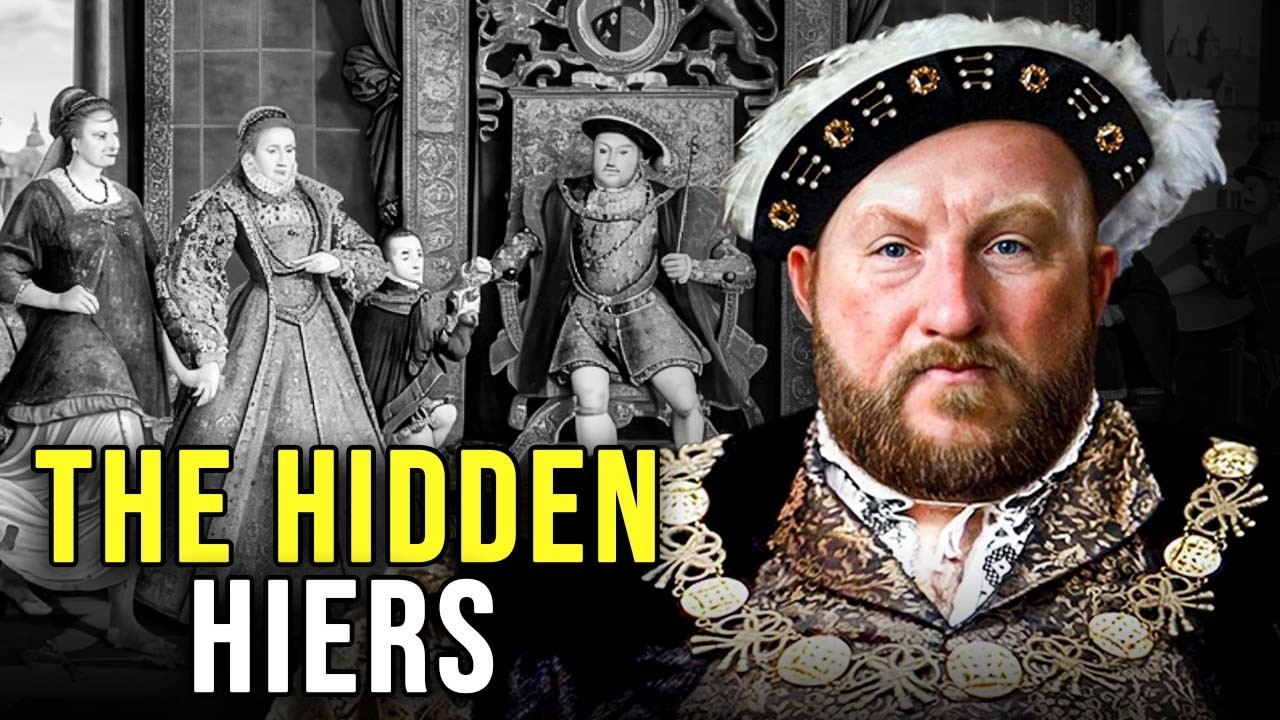
 The public story of the Tudors has always been told through Henry VIII’s appetites, his six wives, and his violent break with Rome. But inside the palaces, a private war was waged against his own children. This is the story of Mary and Elizabeth Tudor, two daughters born to the highest position in England and then systematically erased by their father using the full machinery of Parliament, the church, and the law.
It is a story spanning four decades, two reigns, and a pattern of paternal destruction that shaped not just two women, but the very future of the English crown. To understand how a princess could be brought to that room and that sheet of state language, one must first understand the dynasty’s founding terror.
The House of Tudor did not win the throne through undisputed inheritance; it won it through war. When Henry VII defeated Richard III at Bosworth Field in 1485, he claimed a crown his claim to which was, at best, arguable. His bloodline was weak, and the memory of the Wars of the Roses was living, breathing fear for every nobleman who served him.
The lesson was pitiless: a Tudor king without a clear, undisputed male heir was inviting chaos back to England. This foundational insecurity drove every decision of the early dynasty. Henry VII married Elizabeth of York to fuse warring factions, and his son, Henry VIII, inherited not only the throne but this obsession with securing the line at all costs.
Born in 1491, the young Henry VIII was charismatic, athletic, and intellectually formidable, the golden prince of Europe. He married his brother’s widow, Catherine of Aragon, in 1509, a union that began as a genuine partnership. Catherine, the daughter of Spain’s Ferdinand and Isabella, was poised, devout, and politically astute, deeply beloved by the English people.
But the nursery cast a long shadow over their marriage. Catherine’s pregnancies were a devastating sequence of stillbirths and infant deaths. By 1516, when Mary was born, the queen had endured at least five failed pregnancies.
The one surviving child was a girl, and the kingdom understood what that meant: the succession was open again, and a king’s love was conditional on a son.
Mary was not initially received as a disaster. She was christened with full royal ceremony, given her own grand household, and educated at the highest level in Latin, Spanish, music, and theology under the tutelage of figures like Juan Luis Vives. By the age of nine, she was sent to Ludlow Castle as nominal head of the Council of Wales, a rehearsal for queenship.
In diplomatic circles, she was a coveted bride, betrothed first to the Dauphin of France, then discussed as a wife for Emperor Charles V. Mary absorbed her mother’s lesson: legitimacy was a spiritual fact, not a legal convenience. But by the mid-1520s, Henry had decided that his marriage was cursed, citing Leviticus as proof that marrying a brother’s widow would leave a man childless, conveniently ignoring the living, breathing daughter in front of him.
Enter Anne Boleyn. She was not a simple seductress but a destabilizing force of extraordinary consequence. Polished in the French court, sharp-witted and ambitious, Anne refused to become a mere royal mistress, holding out for the ultimate prize of marriage.
Once Henry decided he wanted her, his desire became a constitutional crisis. Cardinal Wolsey failed to secure a papal annulment, and Thomas Cromwell rose from the ashes to engineer a legislative revolution. Through the Reformation Parliament, Henry declared himself Supreme Head of the Church of England, transferring religious authority from Rome to the Crown.
 This was not merely a divorce; it was a redefinition of the English state, and it created the legal framework to destroy his own children.
The legal machinery moved with methodical precision. In 1533, Cranmer declared Catherine’s marriage void. Anne was crowned queen, and Elizabeth was born in September of that year.
The First Act of Succession followed in 1534, declaring Elizabeth heir and Mary a bastard. It required an oath of allegiance from every subject, and refusal was treason. Men like Thomas More and Bishop John Fisher were executed for refusing.
Mary, at seventeen, was stripped of her title, her household dissolved, and her beloved governess, Margaret Pole, dismissed. She was transferred to Hatfield House to serve as a lady-in-waiting to the infant Elizabeth, a daily humiliation designed to break her spirit.
The cruelty was procedural, intimate, and relentless. Mary was instructed to walk behind Elizabeth’s litter. Her meals were taken at the common table, seated below the household officers of the baby who had replaced her.
When Anne Boleyn visited Hatfield and demanded Mary pay her respects, Mary replied that she knew no queen in England other than her mother, a calculated insult that enraged Anne so deeply she reportedly instructed the household to slap the girl. Mary’s defiance was articulate and dangerous, watched closely by the Imperial Ambassador, Eustace Chapuys, who relayed her struggles to the Emperor. Through him, we see Mary weeping in private, falling ill with headaches and stomach pains, her health deteriorating under a regime that denied her adequate medical care.
Her mother, Catherine, was a parallel story of endurance. Banished to increasingly remote and damp castles like Buckden and Kimbolton, she was stripped of her title and forbidden to see her daughter. The regime understood that a meeting between the defiant mother and daughter would be a political event, so they were kept apart, communicating only through smuggled letters and Chapuys’ intermediaries.
Catherine’s health failed in the cold, isolation, and grief. She refused to the end to accept any title other than Queen. She died on January 7, 1536, dictating a final letter to Henry asking him to be a good father to Mary, signing it, “Catherine the Queen.”
Catherine’s death removed Mary’s anchor. The hope that Anne Boleyn’s fall would restore her position was brutally extinguished. Anne was arrested, tried for fabricated charges of adultery and treason, and executed by a skilled swordsman on Tower Green on May 19, 1536.
Eleven days later, Henry married Jane Seymour. The Second Act of Succession, passed in July 1536, declared Anne’s marriage void and Elizabeth illegitimate, confirming Mary’s illegitimacy for a second time. The result was a grotesque irony: after a decade of destruction, England had no legitimate heir at all.
 Henry had created the very crisis he spent his life trying to prevent.
For Elizabeth, the terror was atmospheric and silent. She was two years old when her mother was executed, too young to understand, but old enough to absorb the lesson that safety was fleeting. Lady Bryan, her governess, wrote a harrowing letter to Cromwell asking what rank the child held.
Did she need new gowns? Was she a princess or merely the Lady Elizabeth? No one had told them.
The child was suspended between identities, dressed in outgrown clothes, a political non-entity. These early lessons forged Elizabeth’s character: the watchfulness, the ambiguity, the instinct to say nothing until the winds changed.
For Mary, the endgame was imminent. Cromwell, having dispatched Anne, turned his attention to the problem of Mary’s conscience. He sent the Privy Council to Hatfield in June 1536 with a set of articles demanding she acknowledge her father’s supremacy over the Church, accept the nullity of her parents’ marriage, and declare herself illegitimate.
She refused. Henry’s response was ferocious, reportedly threatening to have her tried and executed for treason. Chapuys, who had for years urged resistance, now reversed course, counseling submission.
A dead princess, he argued, was useless. She could preserve her conscience internally while conforming outwardly.
The pressure was immense. It was the intensification of an already brutal existence. Mary was alone, ill, motherless, threatened with prosecution, and the regime had already sent better men to the scaffold for lesser defiance.
On June 15, 1536, at Hunsdon House, she signed. The document stated that her father was Supreme Head of the Church of England, that her parents’ marriage was unlawful, and that she was illegitimate. Each clause was a separate annihilation.
Chapuys reported she did not read it fully, a detail that may shield her conscience, but the signature was enough. It bought her survival, improved her household, and a tentative reconciliation with her father, but it was a psychological wound that would never heal.
 The aftermath was a strange interlude of conditional comfort. Mary was restored to court, treated with grudging respect, and served as godmother to her half-brother Edward at his christening in October 1537. Jane Seymour, who had been kind to her, died shortly after giving birth to the long-awaited son.
Jane’s death left the household cold, and the dynasty barren of heirs except for the sickly boy prince. Henry married three more times: Anne of Cleves (annulled), Catherine Howard (executed), and Catherine Parr, who finally brought a semblance of domestic peace to the fractured family. The Third Succession Act of 1543 restored both Mary and Elizabeth to the line, behind Edward, but Henry never re-legitimized them.
He gave them a future, but not back their past.
Henry VIII died in January 1547, believing he had solved the succession. Edward was king, but the boy was sickly and Protestant. When he died in 1553 at fifteen, he attempted, in his final months, to bypass both sisters in favor of the Protestant Lady Jane Grey.
The plot lasted nine days. Mary, now 37, gathering support in East Anglia, rode to London in August 1553 to the most rapturous reception ever recorded. Her first act as queen was to nullify the submission she had been forced to sign.
She declared her parents’ marriage valid and herself legitimate. The daughter who had been erased had erased the erasure.
But Mary’s reign was a tragedy. She married Philip of Spain, a cold diplomatic arrangement that he treated as a duty. Her desire for a Catholic heir produced phantom pregnancies and immense personal anguish.
She returned to her mother’s faith, but the zeal that had sustained her through persecution became a rigidity that could not see the world had changed. She burned nearly 300 Protestants, earning the moniker “Bloody Mary”, a legacy that has obscured the broken woman who ordered them to the stake. She died in November 1558, alone, friendless, her restoration undone, her half-sister poised to inherit.
Elizabeth, at Hatfield when she heard the news, fell to her knees. Her 45-year reign would define the era, yet she was the product of the same paternal violence. Her caution, her refusal to marry, her ability to delay and evade, were weapons honed in a childhood where identity was a legal fiction.
She was the second daughter Henry tried to erase, and she drew the line of succession through herself. The Tudor dynasty ended not with the male heir Henry destroyed half a realm to obtain, but with the daughters he sought to write out of existence. The hand that signed the submission in 1536 belonged to the queen who would undo it.
History had decided which of his daughters counted, and it was not the son.