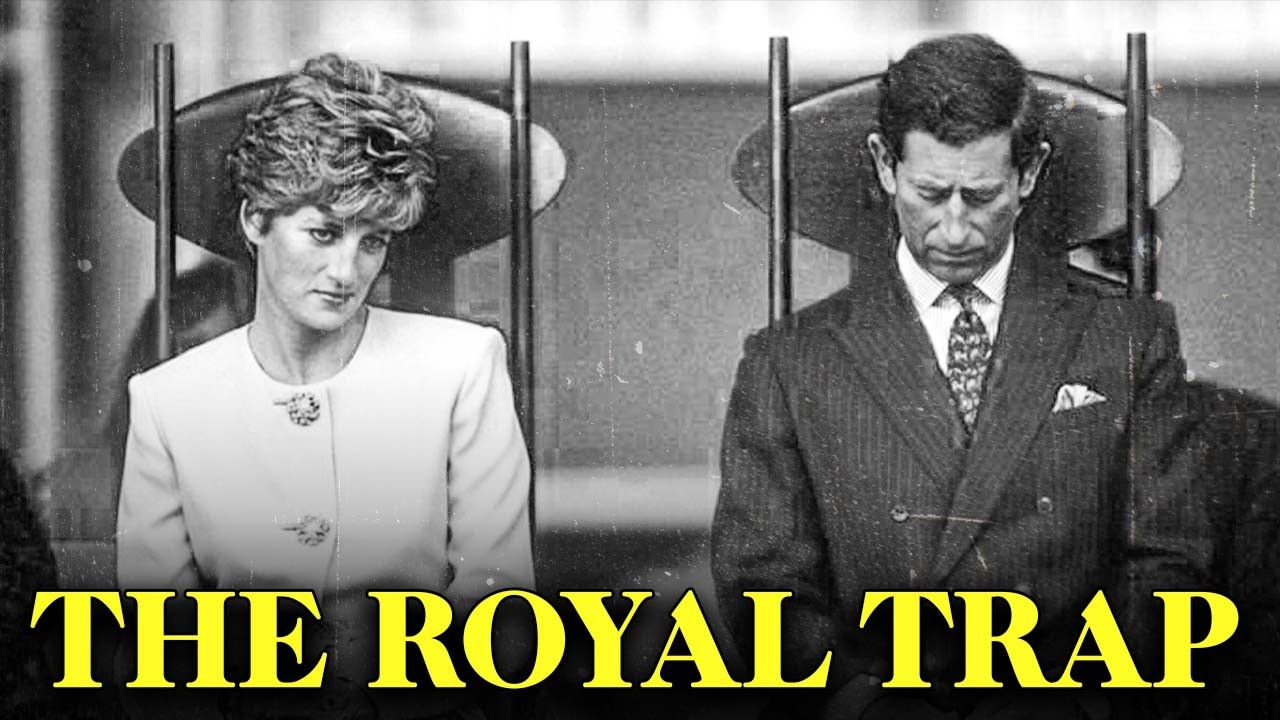
LONDON — The fairy tale that captivated an estimated 750 million people was, almost from its first breath, a carefully constructed fiction, and the institution at its center knew it.
For sixteen years, the marriage of Charles, Prince of Wales, and Lady Diana Spencer was sold to the world as the romance of the century. The reality, as revealed in a sweeping new examination of the union, was a quiet arrangement dressed as a love match—a union of two incompatible souls bound by duty, haunted by a prior attachment, and protected by a palace machinery whose only true priority was the preservation of the Crown’s image.
 The story begins not with a courtship, but with a collision of two ancient British systems. The House of Windsor, built on containment and the doctrine of “duty above desire,” had spent a century perfecting the art of public performance. The Spencer family, older than the throne it served, was a world of hereditary grandeur and private emotional fracture.
Into this machinery stepped a 32-year-old heir who had never surrendered the attachment of his heart, and a 19-year-old aristocrat described by the palace as “without a past.” She was suitable, photogenic, and, crucially, uncomplicated on paper.
What the public saw on July 29, 1981, was a pageant of ivory silk and national euphoria outside St. Paul’s Cathedral. What the participants experienced, by their own later accounts, was the beginning of a personal catastrophe.
Diana, who reportedly developed bulimia within a week of the engagement, later described the days before the wedding as among the worst of her life.
The first fissure was visible even in the vows, as Diana stumbled over the order of Charles’s names. But the true omen came earlier, at the engagement interview, when asked if they were in love. Charles famously hedged, “Whatever ‘in love’ means.”
The palace, according to the account, operated on an unspoken but absolute code: that the way a thing looked mattered more than the way it felt. When the marriage began to fail, the institution’s response was not to mend the wound, but to manage the visibility of the blood. Distress was contained, medicated where necessary, and kept rigorously out of view.
 By the mid-1980s, the marriage had become two emotional countries at war. Charles found understanding and continuity in Camilla Parker Bowles, the woman whose family had a long history of royal favor. Diana found herself isolated, her gift for public warmth—which made her the most beloved figure on the planet—seen as destabilizing inside the palace walls.
The collapse was detonated into public knowledge in 1992 with the publication of Andrew Morton’s book, Diana: Her True Story. The palace denied the content, unaware that Diana herself was the secret source, having recorded tapes detailing her bulimia, her despair, and her sense of being erased.
That year, described by the Queen as an “annus horribilis,” saw the separation announced in the cold, administrative language of a government statement—”amicable,” “constitutional positions unaffected”—a dialect designed for continuity, not compassion.
The ensuing “War of the Waleses” was fought not with lawyers in courtrooms, but with leaks in newsrooms. Charles’s circle briefed against Diana’s instability; Diana’s camp countered with images of radiant defiance. The escalation saw the release of an intercepted intimate telephone call between Charles and Camilla—named “Camillagate”—which ended any pretense that the marriage was salvageable.
In 1994, Charles admitted to adultery in a televised documentary, confirming in his own voice the betrayal the public had long suspected. That very night, Diana stepped out in a black off-the-shoulder dress, a wordless, devastating rebuttal that dominated the front pages.
 The final break came on November 20, 1995. In an interview with BBC’s Panorama, Diana sat before a single camera in Kensington Palace and told the nation her truth. She spoke of the bulimia, the despair, and delivered the line that would define the era: “There were three of us in this marriage.”
The interview, watched by 23 million in Britain, was a seismic event. Weeks later, the Queen instructed both parties that a divorce was now in the best interest of the country. It was finalized on August 28, 1996, stripping Diana of the style “Her Royal Highness”—a precise bureaucratic act of distancing.
Years later, it would emerge that the interview itself was procured through deceit. An inquiry in 2021 found that journalist Martin Bashir had used forged bank statements to win Diana’s trust, preying on her fears of surveillance. The BBC was found to have covered up the breach.
Freed from the institution, Diana redefined her power. She walked through a minefield in Angola, using her global reach to shine a light on suffering. She was beginning to build a new life, one defined by her own purpose.
It ended in a Paris underpass in the early hours of August 31, 1997. Pursued by photographers, the car carrying Diana and Dodi Fayed crashed into a pillar. The driver was found to be over the legal alcohol limit.
 Diana, not wearing a seatbelt, died from her injuries. She was 36.
The wave of public grief that followed was unprecedented. It curdled into anger at the silent Balmoral family, forcing the monarchy to break its own ancient rules—the flag was lowered to half-mast, and the Queen addressed the nation.
Two boys, William and Harry, walked behind their mother’s coffin, forced to perform a composure no child should have to summon. The image remains one of the most harrowing of the age.
The institution that had failed Diana in life proved ruthless in its survival after her death. Charles and Camilla were married in 2005, their reputations rebuilt through decades of patient public management. In 2022, Charles became King, with Camilla at his side.
The sons, however, have carried the inheritance in divergent directions. William, the heir, absorbed himself into the duty. Harry, the spare, walked away, publicly accusing the institution of repeating its failures.
Nearly three decades on, the story is no longer just history; it is a myth, endlessly retold. But the deeper truth remains: a wedding sold as destiny became a marriage remembered as damage. The fairy tale was a fiction, the palace was complicit, and the cost of that performance was paid, in full, by the children who were left to carry it.