
DEAUVILLE, France — The empty space beside Michael Douglas on the red carpet here was not the story. It was only the visible edge of one.
On August 28, 2013, the 68-year-old actor walked the film festival line alone, promoting Behind the Candelabra, the role that had carried him back from a stretch of life he was not sure he would survive. The flashes fired. He stopped, turned, held the pose.
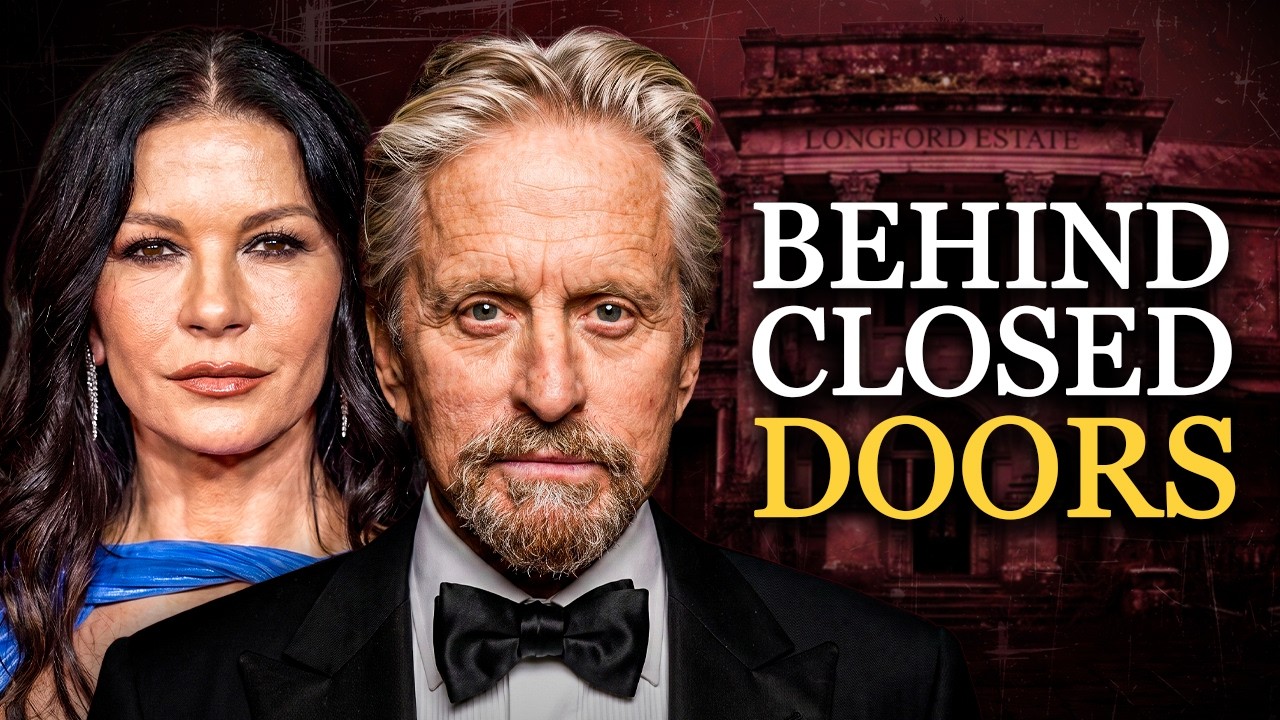 And beside him, where for 15 years there had almost always stood one particular woman—the same woman he had met at this very festival, in this very town—there was now only open air.
Days earlier, their representatives had confirmed the couple was taking time apart. So he worked the line by himself in the place where it had all begun, keeping his expression exactly where it needed to be.
The world had its version of this family: the glamour, the trophies, two famous names joined into a kind of modern royalty. What the world did not have was the rest of it. Behind the composed public image was a private reality the cameras had circled for years without ever fully reaching.
This is the story of what those three years had actually held. A son in federal prison. A father fighting a cancer that nearly killed him.
A wife who twice stepped away for treatment. And two children growing up in the middle of it. Four people bending under one accumulated weight, and a marriage that came far closer to ending than the public ever understood.
What explains it began long before that afternoon in Deauville. To understand how a marriage that appeared to hold every possible advantage—two Academy Awards, a dynasty name, homes on three continents, the money to purchase privacy, and the fame that made privacy impossible—ended up where it did, you have to go back. Not to an event, but to a word.
A name: Douglas.
Because before there was a marriage to protect, there was a name to live up to, and the man who carried it had spent his entire life trying to prove he was more than the son of the man who made it famous. Everything that happened later—the wedding at the Plaza, the estates, the crises that arrived one after another until the family could barely absorb one before the next one came—begins there, with a boy born into a shadow and determined to step out of it.
Michael Kirk Douglas was born on September 25, 1944, in New Brunswick, New Jersey, the eldest son of Kirk Douglas and the actress Diana Dill. His father was not yet the international star he would become, but he was on his way. Kirk Douglas was the chin, the intensity, the self-made myth—a ragman’s son from Amsterdam, New York, who had clawed his way out of poverty and into the center of American cinema.
To be his child was to inherit access to a world most people only watched from the dark of a theater. It was also to inherit a permanent comparison that could never be won, only survived.
There is a story from the beginning of his career that tells you almost everything about who Michael Douglas was. Kirk had spent years holding the rights to Ken Kesey’s novel One Flew Over the Cuckoo’s Nest. He had played the lead role on Broadway.
He wanted badly to play it on screen. But by the time the film finally came together, Kirk was considered too old for the part—and it was Michael, the son, the producer, who shepherded the picture to the screen without his father in the cast. The film won the Academy Award for Best Picture in 1976.
It was a triumph. It was also unavoidably a wound.
That history matters because it shaped the kind of father Michael would become. He would later admit plainly that his work had once been a place to hide from an unhappy first marriage, from the ordinary difficult labor of raising a child. Decades later, when his own eldest son described his childhood, he would describe a father whose career kept pulling him out of the house.
The pattern that had started with Kirk did not end with Kirk. It moved down a generation, the way these things do.
When Michael Douglas met Catherine Zeta-Jones, he was not simply a movie star meeting a younger movie star. He was a man carrying an unfinished relationship with his first son, looking at the possibility of a second family, and believing he could build something this time that he had failed to build before.
Catherine Zeta-Jones came from a different world entirely. She was born on September 25, 1969, in Swansea, Wales—the same birthday as Michael, exactly 25 years apart. Her mother was a seamstress.
 Her father worked in a sweet factory. This was not a household with connections to fame or money. When a chance came to fund young Catherine’s dance training, it reportedly came from a family bingo win.
She left school at 15 and went to London to pursue the theater. What she built, she built through repetition and discipline and an ability to hold her composure under scrutiny.
Two ambitious people, both accustomed to performing composure, found each other. That skill would keep their private reality hidden for years. It would also eventually become a kind of prison.
But there was a third person in the family from the very beginning, and he occupied the most difficult position of all. Cameron Douglas was born in December 1978, the only child of Michael and his first wife, Diandra Luker. He was the child of the first marriage.
He would become, in time, the family member whose private struggle turned into a public legal crisis that no amount of money or fame could contain.
Cameron would later describe learning, at 7 years old, that his father had been unfaithful to his mother. He began using drugs at 13. By 20, he was using heroin.
The family sent him to numerous rehabilitation programs, but he was not yet ready to change. Michael would later say that his career had come before his family and that he should have concentrated more on his home life. He did not, however, accept that his absence had caused his son’s addiction.
And neither, importantly, did Cameron.
The wedding was held on November 18, 2000, at the Plaza Hotel in New York. Cameron, 21 years old, stood beside his father as best man. The cost has been commonly estimated at between 1 and 2 million dollars.
Picture Cameron in that room, 21 years old, standing next to his father in the most photographed celebration of the family’s life, holding the ring, playing the role of the trusted son. He had already been using drugs for 8 years.
The clearest image of the marriage at its peak came in a single night. On March 23, 2003, Catherine attended the Academy Awards visibly heavily pregnant with Carys. She stood on that stage late in her pregnancy and performed the song “I Move On” from Chicago.
Later in the ceremony, she won the Academy Award for Best Supporting Actress, joked that her hormones were far too unpredictable for her to be trusted with a speech, and thanked her husband and her young son. Less than a month later, on Easter Sunday, April 20, 2003, Carys was born.
The first real crack was not where anyone was looking. It was in the relationship between Michael and his oldest son, which had never healed. In the summer of 2009, Cameron Douglas was arrested in Manhattan in connection with the distribution of methamphetamine and cocaine.
On April 20, 2010—the same date, 7 years later, that his half-sister Carys had been born—Cameron stood in federal court to be sentenced. The sentence was 5 years in prison.
What matters most is what Michael Douglas did before it. Michael wrote a handwritten letter to the judge asking for mercy. He acknowledged his son’s responsibility, but he also described the repeated attempts at rehabilitation, his own failings as a father, and the particular pressure of a child growing up inside a famous family.
The private history of this family had entered an official public document.
 In those same months, Michael had been noticing something: a soreness in his mouth that would not go away. On a visit to Montreal, a physician found a tumor roughly the size of a walnut sitting at the base of Michael’s tongue. The answer came a few days later, by telephone: cancer.
He was 65 years old. His eldest son was in federal custody. And now his own body had produced the next emergency before the family had finished absorbing the last one.
For roughly 7 to 8 weeks, he underwent radiation and chemotherapy. He lost close to 40 pounds. In the middle of all of it, he went out and did publicity for Wall Street: Money Never Sleeps.
Catherine held it together. She became a caregiver, parent, and public spokesperson all at once. In January of 2011, the answer came: the tumor was gone.
But as Michael’s body was clearing, something in Catherine was breaking down.
In April of 2011, Catherine Zeta-Jones voluntarily checked herself into Silver Hill Hospital, a mental health facility in New Canaan, Connecticut, and stayed for approximately 5 days. She had bipolar 2 disorder, and she chose to say so publicly. It was in its own quiet way among the bravest things she ever did in public.
And while both parents were fighting their own battles on the outside, the hope that prison would save Cameron was quietly falling apart. Cameron continued to obtain and use substances while incarcerated. In December of 2011, Judge Berman added 54 months to his sentence for possession in prison.
A group of addiction specialists later filed an amicus brief laying out the medical picture: he had entered custody with a severe untreated opioid dependence, and the Bureau of Prisons had confined him to his cell for 23 hours a day for roughly 11 months without providing professional treatment.
Three members of one family, each shut away, each alone. Michael inside a hospital. Catherine inside a psychiatric facility.
Cameron inside a prison cell.
In late April of 2013, Catherine again checked into a mental health facility. This time, her representative characterized it not as a crisis, but as proactive periodic care. And then came June of 2013, and a single interview that took the most private subject of all and put it in front of the entire world.
Speaking to the Guardian, Michael offered an explanation for his cancer that was his own: that it had been caused not by decades of smoking and drinking, but by HPV, a virus transmitted through oral 𝒔𝒆𝒙. He then made a joke, medically unsupported, that became a global headline within hours. Michael later expressed regret, specifically for the embarrassment it caused Catherine and her family.
By the middle of 2013, there was very little left in reserve. The marriage was the thing that finally gave. In late August, their representatives confirmed that Michael and Catherine were taking time apart to evaluate and to work on the marriage.
Reports noted that they had not been photographed together in roughly four months. No divorce petition was filed. This was not an ending announced.
It was a fracture acknowledged.
At the end of August, Michael returned alone to the French festival where 15 years earlier he and Catherine had met. He went back to the beginning without her.
 In September of 2013, Michael Douglas won the Emmy for Behind the Candelabra. He arrived without Catherine. From the stage, he thanked his absent wife.
And then he turned his attention to his son, saying he hoped he would be allowed to see Cameron. Everything converged in that moment: a man at the peak of professional validation, holding a trophy, thanking a wife who was not there, and pleading publicly because private channels had failed to be allowed to see the son locked away in a cell.
The marriage did not break because someone did something unforgivable. Sometimes a marriage does not break because someone did something unforgivable. Sometimes it bends and bends and bends under one emergency after another arriving before the family has recovered from the last, until it can no longer hold the shape it was.
It went slowly back toward each other. By the end of 2013, the signs began to appear. By 2015, Michael was willing to talk about it.
He described them as stronger than they had been before, but he made a point of saying that a marriage cannot be repaired by one person. The separation became not the end of the relationship, but a chapter inside it.
Cameron Douglas was released in August of 2016 after serving roughly 7 years. He came out sober, and this time the sobriety held. He stayed clean.
He became a father. In 2019, he published a memoir, Long Way Home, that told the whole of it in his own voice. That same year, in the ABC special The Douglas Dynasty: Fame, Addiction, Finding Home, Michael and Cameron talked about the childhood, about the addiction.
Love and damage could exist in the same room at the same time in the same two people.
Kirk Douglas died in February of 2020 at the age of 103. The dynasty’s oldest chapter closed, and the responsibility of being its center passed to the son who had spent his whole life trying to earn the right to it.
Today, Michael Douglas is 81 years old. He has said that he stepped back from acting on purpose after filming the series Franklin in 2022. He has a memoir announced for publication in October of 2026.
Catherine Zeta-Jones is 56. She never stopped working. Cameron Douglas is 47.
He is an actor, an author, and the father of two. Dylan Douglas graduated from Brown University in 2022 and works in political organizing. Carys Douglas graduated from Brown in 2025 and made her professional stage debut in 2026 as Nina in a Brooklyn production of Chekhov’s The Seagull.
On November 18, 2025, Michael and Catherine marked their 25th wedding anniversary. Catherine looked back on the day it began—the flowers, the candlelight, the Welsh choir—not as evidence that the hard years had never happened, but as evidence of something more durable: that after the imprisonment and the cancer and the diagnoses and the separation, it was still, 25 years on, the same marriage.
The photographs the public saw were not lies. The affection in them may have been entirely real. They were only incomplete—a single frame from a story that was always larger and harder than the frame could hold.
Between two pictures—a 21-year-old best man at the Plaza, and a father and son standing together again a quarter century later—is everything no camera ever captured. A family learning the hard way that staying together was not a promise made once and kept forever, but a decision that sometimes had to be made all over again after everything had gone wrong.