Doc Holliday is remembered as a thin, sickly gunfighter standing beside Wyatt Earp, but his reputation as one of the Old West’s most feared men was built on far more than his skill with a weapon. The real source of his danger was a rare combination of intelligence, nerve, reputation, and a life that forced him to stay sharp in the roughest towns on the frontier. Holliday was born in Georgia in 1851 and trained as a dentist, graduating in 1872. He tried to build a respectable career, but tuberculosis derailed those plans.
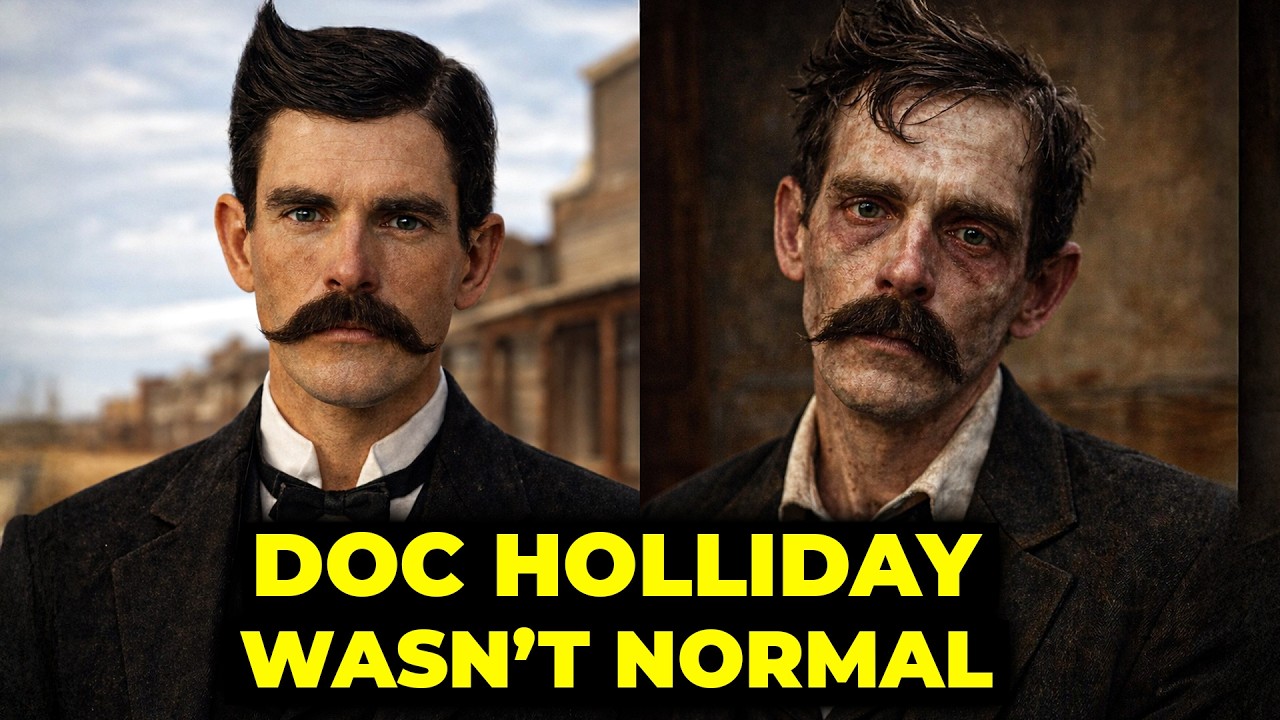
The disease had already killed his mother, and after his own diagnosis, he moved west in 1873 seeking a drier climate, following the medical advice of the era. That background mattered because Holliday was not a born outlaw. He was an educated man whose profession no longer matched his body or his circumstances. Once he moved through Texas and the wider frontier, he entered towns where status, nerve, and quick judgment mattered daily, and a diploma offered no protection.
Holliday could speak like a gentleman, think like a trained professional, and still live among gamblers, lawmen, and hard men who settled disputes with weapons. He was smart enough to read people, proud enough not to be pushed around, and sick enough to understand he could not assume he had plenty of time. That made him hard to size up, a contrast that followed him everywhere. Tuberculosis was not a background detail in his life.
In the 19th century, before antibiotics, doctors recommended rest, fresh air, and moves to drier climates. Holliday was following that advice, trying to stay alive, but the disease shaped how others saw him. A man who was coughing and losing strength yet still walking into gambling halls and frontier disputes gave off a very different impression from a healthy drifter looking for trouble. The disease also kept pushing him from one place to another, from Georgia to Texas and through cattle and mining towns where gambling paid better than dentistry ever could for a man with failing lungs.
That made TB one of the main forces that put him exactly where danger lived, and exactly where dangerous men were noticed fast. Once his health undermined his dental career, gambling became his real profession. A frontier gambler was not just a man sitting at cards. He worked in loud rooms full of drunk strangers, armed cowboys, and men who hated losing money.
One historian notes that in the frontier West, a gambler usually stood alone and had to be able to protect himself. Holliday learned that world quickly. His dental business declined as his coughing worsened, but he discovered a natural talent for games like poker and faro. His survival depended less on professional reputation and more on whether people thought twice before crossing him.
He practiced with weapons and let stories about his readiness for violence spread because those stories protected him. By the time he moved through Texas, Kansas, New Mexico, Colorado, and Arizona, he understood that a dangerous image worked like armor. A sheriff had a badge, a rancher had his people, but a gambler often had only himself and whatever reputation he could carry into a room. Holliday was not physically imposing, and as his illness worsened, he became even less so.
That forced him into a different survival logic. If you are slim, sick, and unlikely to win a fistfight against a healthy cowboy, speed, nerve, and weapons become your equalizers. There is evidence this was not empty talk. In Dallas in 1875, he was arrested after trading gunfire with a saloon owner.
In Tombstone, after a quarrel at the Oriental Saloon, he returned armed and opened fire, wounding the owner and another man. These incidents show a pattern of shifting from argument to weapon fast, especially in the alcohol-heavy environment of saloons and gambling rooms. Britannica notes that during his Western years, he built a reputation as a drinker, fighter, and killer. That reputation did not come from nowhere, even if later storytellers exaggerated it.
His weakness actually made him more dangerous, because everyone knew he was less likely to play fair once things turned serious. At the same time, the biggest mistake people make is assuming danger always equals a massive body count. Modern researchers have pushed back hard against old stories giving Holliday 16 killings or 30 duels. HistoryNet’s review of the evidence calls those numbers fanciful and says many famous Holliday stories fall apart under investigation.
Even the Mike Gordon shooting in Las Vegas remains disputed. Popular retellings treat that killing as clear, but a coroner’s inquest at the time did not name Holliday as the shooter. The honest answer is that the hard record does not support the image of an unstoppable one-man death machine. But that does not make him less dangerous.
His threat came from a mix of verified violence, repeated confrontations, visible nerve, and stories that spread faster than legal certainty ever could. In frontier towns, reputation shaped how men approached each other and how much room someone got before a fight started. Holliday appears to have understood that and, at times, encouraged the stories that made him sound deadlier than the paperwork could prove. Holliday also became more dangerous because important men took him seriously, especially Wyatt Earp.
According to Earp’s own account, Holliday intervened in Dodge City during a showdown with rowdy cowboys and saved his life. The friendship that followed is solidly part of the historical record, and it changed how people viewed him. In the Old West, a dangerous reputation grew faster when it was confirmed by men whose judgment carried weight. If Wyatt Earp believed Holliday had nerve and loyalty in a crisis, other people noticed.
Later descriptions from Wyatt were clearly colored by friendship, but they still show how Holliday was perceived by the men closest to him. The best proof of that trust comes from the OK Corral case itself. After the gunfight, Judge Wells Spicer criticized Virgil Earp for calling on Holliday, but he also said Virgil needed the support of friends whose courage and coolness he could trust in an emergency. Even in a ruling that called the choice unwise, Holliday appears as the kind of man selected when the situation looked likely to turn violent.
By the time Holliday reached Tombstone, the town was a pressure cooker. There were cattle rustling rumors, stage robbery suspicions, and constant friction between the Earp side and the cowboys around Ike Clanton and the McLaurys. Holliday was already tangled in that world. He was suspected in an attempted stage robbery, though the charges were dropped for lack of evidence, and he had publicly quarreled with Ike Clanton the night before the famous fight.
Then came the legal trigger. Tombstone had an ordinance forbidding people from carrying deadly weapons in town without a permit. On October 26, 1881, Virgil Earp moved to enforce it against armed cowboys. The gunfight grew out of a law, a feud, and threats, not just a random showdown between loud men in the street.
The fight did not actually happen inside the OK Corral. It took place in a vacant lot near C. S. Fly’s studio and lasted roughly half a minute.
Judge Spicer later called Virgil’s choice to use Holliday injudicious and censurable, showing exactly how controversial Doc’s involvement looked even then. What Holliday actually did during the gunfight is more revealing than the legend around it. According to Gary Roberts’ reconstruction of the testimony, Virgil Earp gave Holliday a sawed-off shotgun to hide under his long coat and took his cane to make him look less threatening. Once the shooting began, Holliday did not act like a man firing blindly in panic.
Roberts argues the testimony shows him as surprisingly controlled. He stayed in the street rather than rushing into the lot, took up a position that blocked movement, did not fire until the fight was already underway, and used the shotgun at close range before shifting to his pistol. He was also grazed by a bullet, under real return fire in a cramped space where one mistake was enough to get you killed. Roberts also argues that the evidence does not support the old claim that Holliday mindlessly started the fight with a pistol shot.
The testimony points to a man more restrained on that day than his public image would suggest. That makes him more dangerous, not less. A man who stays methodical when a fight has already become deadly is a much more serious threat. The period after the OK Corral shows Holliday fully inside an escalating cycle of frontier violence.
In December 1881, Virgil Earp was ambushed and badly wounded. In March 1882, Morgan Earp was killed. Holliday stayed with Wyatt instead of stepping away and joined the federal posse that went after the men they believed were responsible. Frank Stillwell was killed in Tucson.
Warrants were issued, and Holliday was later arrested in Denver on the Arizona charge. Colorado refused to extradite him, and he was released. This sequence matters because it shows Holliday’s danger was not limited to quick saloon disputes or one famous gunfight. He was willing to stay inside a feud after the legal and moral ground had become muddy.
Holliday was not a regular lawman, but he rode with lawmen. He was not a standard outlaw either, but he became a wanted man tied to retaliatory killings. That in-between status is part of what made him so unsettling. He moved between gambling tables, temporary authority, personal loyalty, and open violence, making him harder to predict and harder to control.
By the mid-1880s, Holliday’s body was giving out. In Leadville, his tuberculosis flared again. Pneumonia hit him more than once, and his health was further damaged by alcohol and opium. Even then, his reputation still had force, and people in Colorado still saw him as a man not to be trifled with.
By that point, the most important thing about Doc Holliday was no longer raw physical ability. It was the total package he had built, partly on purpose and partly by circumstance. He was educated enough to read men. He was sick enough that ordinary long-term caution may not have governed his life.
He worked in gambling houses where self-protection was part of the job. He used weapons as equalizers because size was not on his side. He built just enough real history for the rumors to stick, and the rumors made the real history heavier. When the most famous fight of his life came, the evidence points less to chaos than to composure.
Doc Holliday was dangerous because he combined frailty, intelligence, reputation, and nerve in a way that made him very hard to manage once things turned serious. He only needed people to believe that if the line was crossed, he would act quickly, stay steady, and use whatever tool gave him the edge. He died of tuberculosis in Glenwood Springs in 1887 at age 36.