
The man who stood beside Wyatt Earp in the thirty-second firestorm that defined the American West did not die with a revolver in his hand, nor did he collapse on a dusty street with a rival’s bullet in his chest. John Henry “Doc” Holliday, the consumptive gambler whose name became synonymous with frontier violence, instead spent his final weeks in a modest hotel room in Glenwood Springs, Colorado, barefoot, alone, and too weak to lift the weapon that still rested on his nightstand. He was 36 years old.
The most feared gunfighter of his generation was killed not by lead or steel, but by the slow, methodical destruction of his own lungs, a disease that had been eating him alive since he was a 21-year-old dentist in Georgia. The irony of his death, a quiet expiration in a sulfur-scented room, was not lost on the man himself. His last words, spoken as he looked down at his bare feet, were simply, “This is funny.”
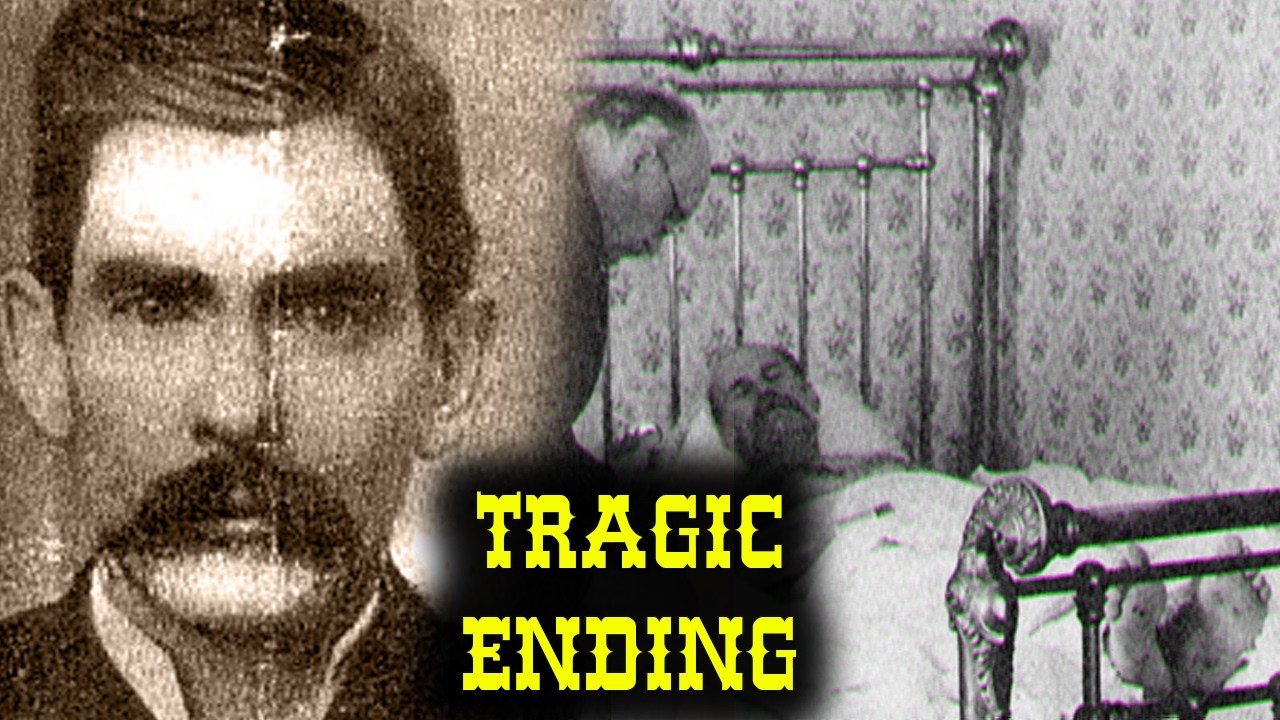 The story of how a brilliant young dental surgeon became the deadliest gambler in the Wild West begins not with a gunfight, but with a death sentence. Born on August 14, 1851, in Griffin, Georgia, Holliday was raised in a respectable antebellum family, educated to be a gentleman, and destined for a professional life far removed from the violence that would later define him. He graduated near the top of his class from the Pennsylvania College of Dental Surgery at just 20 years old, and by every measure, he was supposed to live a quiet, respectable life, fixing teeth, marrying well, and dying old in the South.
Tuberculosis had other plans. The disease ran through the Holliday bloodline like a poison passed from one generation to the next. His sister had died of it before he was even born, and when he was 15, he watched his mother succumb to the same agonizing fate, the persistent cough, the blood-flecked handkerchiefs, the slow wasting away of a woman who had been the center of his world.
The bacterium was already inside him, dormant, waiting for its moment. That moment came just one year into his dental practice. In 1873, at 21 years old, Holliday was diagnosed with advanced tuberculosis.
The prognosis was blunt: months to live. The only advice his doctors could offer was to seek drier, warmer climates to slow, not stop, the progression. Imagine being told at 21 that you will not see 30, that every breath you take is borrowed, that the disease which killed your mother and your sister has now come for you, and no one on earth can stop it.
This diagnosis is the hinge of the entire story. Everything that follows, every gunfight, every gamble, every drunken night, flows from this single moment. A young man with nothing left to lose.
By 1874, Holliday had abandoned his dental practice entirely. The cough drove patients away, and the blood-spattered handkerchief tucked into his pocket told any prospective patient everything they needed to know. So he turned to gambling, then to drinking.
The alcohol dulled the pain, the cough, the terror of what was coming, and the frontier beckoned. Dallas, Texas first, then further west, chasing the dry air that his doctors had promised might buy him time. Holliday wasn’t running from death.
He was running towards something, anything that might fill the years he had left with something other than waiting. The dentist from Georgia was becoming someone else, someone the frontier would learn to fear.
The enemy that was consuming him had a name, though no one in Holliday’s time knew it yet: Mycobacterium tuberculosis. A bacterial lung infection spread through airborne droplets, invisible and merciless. In the 19th century, they called it consumption because it seemed to consume the body from within.
The bacterium attacks the lungs, creating cavities, literal holes in the tissue. The body’s immune response produces chronic inflammation, a war inside the chest that the body cannot win. The inflammation leads to a persistent, worsening cough that never fully relents.
As the cavities grow and multiply, blood vessels in the lungs rupture, causing the hemoptysis, the bloody sputum that marked consumption’s victims as clearly as a brand. But the cough and the blood were only the beginning. Fever came and went without pattern, night sweats soaked the sheets until they had to be changed before dawn, and then came the cachexia, the extreme skeletal weight loss as the body, unable to absorb enough nutrition, begins cannibalizing itself for energy.
In the 1800s, tuberculosis killed approximately 80% of those infected. There was no cure. Robert Koch identified the bacterium in 1882 while Holliday was still alive, still coughing, still gambling, but the discovery led to nothing.
No treatment followed, no vaccine. The first effective antibiotic, streptomycin, wouldn’t arrive until the 1940s, more than half a century after Holliday’s death. Decades before medicine could fight back, tuberculosis was simply a death sentence written in blood on a handkerchief.
Every single day Holliday spent on the frontier, every card game, every shootout, every whiskey-soaked night, he was doing it while his lungs were literally being eaten alive. He wasn’t just a gunslinger. He was a gunslinger who was drowning in his own blood.
The move west brought him first to Dallas, then to Denver, then to the mining towns that dotted the frontier like campfires. As he earned the nickname “the deadly dentist,” a moniker that implied a body count far higher than reality, his verified kills remained at just two. But reputation on the frontier wasn’t built on verified statistics.
It was built on whispers, on the look in a man’s eye, on the willingness to draw without hesitation. And Doc Holliday had something no other gunfighter possessed: he genuinely did not care if he lived or died. A man who’s already been sentenced to death by his own body is the most dangerous person at any card table, in any saloon, on any street.
The fearlessness that made him legendary wasn’t bravery in the traditional sense. It was the recklessness of a man who had already been told he was dead.
It was this recklessness that forged his bond with Wyatt Earp, a friendship that would be tested in the most famous 30 seconds in frontier history. Holliday arrived in Tombstone, Arizona Territory, with the Earps in 1880, and immediately became the most controversial figure in town, a consumptive gambler with a temper and a reputation that preceded him like a shadow. The Earps had been feuding with the Clanton-McLaury faction for months, cattle rustlers and outlaws who saw the lawmen as existential threats to their livelihood.
Tensions ratcheted upward through the summer and fall of 1881 until the whole thing reached a breaking point on October 26, 1881. The gunfight at the O. K.
Corral. Thirty shots, thirty seconds. That’s all it took to forge the myth of Doc Holliday in gunpowder and blood.
Holliday carried a shotgun under his long coat that day, a detail that matters. A man whose hands trembled from disease chose a weapon that didn’t require precision, a weapon that compensated for what his body could no longer guarantee. The exchange of fire was brief, chaotic, and devastating.
Frank McLaury’s bullet grazed Holliday, creasing his hip and drawing blood, but not slowing him. Holliday’s return fire struck McLaury in the stomach and near the ear. McLaury died in the dirt.
Three men on the Clanton-McLaury side were killed that day. The Earps and Holliday survived, barely bleeding, deafened by the concussion of close-range gunfire, standing in a haze of smoke while the echoes faded. A man with advanced tuberculosis, a man whose lungs were riddled with cavities, who coughed blood every morning, who weighed barely 130 pounds, had just walked into a gunfight and walked out alive.
The violence didn’t end there. In March 1882, Morgan Earp was assassinated, shot through a window while playing billiards. The Clanton faction was suspected, and Wyatt Earp snapped.
He formed a posse, and Holliday rode with him without hesitation. The Earp Vendetta Ride was a bloody sweep through Arizona Territory, hunting the men responsible for Morgan’s murder. Holliday’s role was simple: he was the enforcer, the man who didn’t flinch when others wavered.
But by now his body was failing in ways that could no longer be concealed. The cough was constant, a companion more faithful than any friend. The weight loss was alarming to anyone who looked closely enough.
He rode anyway. He was dying in the saddle, and he didn’t care. Because for Doc Holliday, dying while doing something, anything, was better than dying in a bed.
The vendetta ended in 1882, and with it something else ended, too. Holliday and Earp parted ways, not from a falling out, but because Holliday’s body was breaking down too fast to keep riding. The frontier demanded a physical toll that his lungs could no longer pay.
Holliday landed in Leadville, Colorado, a mining town sitting at 10,000 feet above sea level. For a man with damaged lungs, the choice was catastrophic. The high altitude starved his already ravaged lungs of oxygen.
Every breath was a labor, every flight of stairs an expedition. He relied increasingly on alcohol and laudanum, opium dissolved in alcohol, to manage the pain, the cough, and the growing terror of suffocation that came in waves. His gambling skills deteriorated as his hands shook and his concentration fractured.
 His temper, never gentle, shortened to a razor’s edge.
In 1884, ex-policeman Billy Allen confronted Holliday in a Leadville saloon. Allen outweighed Holliday by 50 pounds, and a confrontation erupted, the kind that happened a hundred times a week in frontier saloons. Except this time, a revolver came out.
Holliday shot Allen in the arm, severing an artery. Allen survived after surgery, but his arm was permanently weakened. Holliday was tried for assault and claimed self-defense.
He was acquitted in March 1885. This was the last time Doc Holliday ever shot a man. Not because he found peace, not because he reformed, but because after Leadville, he could barely hold a gun.
By late 1885 and into 1886, the disease had seized full control. The gunslinger was becoming a ghost.
The last time Wyatt Earp saw Doc Holliday alive was in 1886, and the encounter would haunt him for the rest of his days. Earp arrived to visit his old friend, the man who had ridden beside him through the vendetta, the man who had stood with him in that narrow lot near Fremont Street when the hammers clicked and the world exploded. The man he found was almost unrecognizable.
Holliday was skeletal, gaunt, and prematurely gray. His skin stretched over bones that seemed too prominent, too close to the surface. His legs were unsteady, and he used furniture to support himself when he stood, gripping the back of a chair like a man on a ship’s deck in rough water.
The cough was constant now, not the occasional clearing of the throat from the early years, but a deep, wet, tearing sound that shook his entire frame and left him gasping. The rattling breath was audible across the room, a sound like paper being crumpled inside his chest. When he pressed the handkerchief to his mouth, it came away spotted with rust-colored blood.
Both men knew what this was. This was a goodbye, the kind that doesn’t need to be spoken because every detail of the scene, the trembling hands, the labored breathing, the body that seemed to be collapsing inward like a structure losing its supports, says it louder than words ever could. What happened next defied all logic.
Instead of seeking comfort, instead of staying near Kate Harony, the woman who had followed him across the frontier, instead of finding warmth and companionship in his final months, Holliday went alone. His pride, the same iron stubbornness that had carried him through gunfights and card games and courtrooms, now dictated the terms of his dying. He would not let her or anyone watch him disappear by inches.
The man who had never backed down from a fight chose to face his last one in solitude.
The move to Glenwood Springs, Colorado, was Doc Holliday’s last gamble. Not at a card table, but against death itself. The town’s hot sulfur springs had a reputation as a curative destination, the kind of place where doctors of the era routinely sent their consumptive patients.
Seek mineral waters, they told them. Seek dry air and warmth. It was the closest thing the 19th century had to treatment.
And Holliday, who had defied every prognosis for over a decade, was desperate enough to believe in one more longshot. The Hotel Glenwood became Holliday’s final address. It was a modest establishment, not a grand sanitarium, just a place where a man could rent a room and try not to die.
The hot springs steamed nearby, their sulfurous smell hanging over the town like a permanent fog seeping through windows and settling into clothes and hair and lungs.
Holliday arrived alone. He had separated from Kate Harony, “Big Nose Kate,” his longtime companion, the woman who had followed him from Dallas to Dodge City to Tombstone, who had loved him in the turbulent, combustible way that the frontier seemed to demand. Whether she left or he pushed her away, the result was the same.
He was alone. He had separated from Earp. He had separated from Kate.
The connections that had defined his frontier life were severed, not by quarrel, but by the disease that made him a burden he refused to impose. The routine was simple and bleak: mineral baths, sulfur water treatments, rest. It was the opposite of everything Holliday had been.
The gambler, the gunfighter, the man who had moved through the West like a storm. Now he was still, waiting, hoping.
But then came the cruel reversal. The sulfurous fumes from the springs, far from healing his lungs, likely caused additional irritation and damage to tissue that was already more wound than organ. The cure was the poison.
The very thing he had traveled hundreds of miles to find was accelerating the destruction it was supposed to halt. Doc Holliday had survived bullets, blades, and the law, but he couldn’t survive hope. The months that followed were a slow eraser.
This is where the story takes its darkest turn. Because what tuberculosis does in its final stages isn’t simply death. It is the systematic dismantling of everything that makes a person recognizable.
Holliday was now too weak to gamble effectively. The hands that once held dental instruments with surgical precision, the hands that had dealt cards from the bottom of a deck with a conjurer’s deftness, trembled constantly. The laudanum and whiskey, numbing agents for years, now barely touched the pain.
His clothes hung off him like sails without wind. His collar, once snug, gaped around a neck that seemed too thin to hold his head upright. His hair had gone gray, not the dignified silver of age, but the brittle, premature gray of a body that had stopped investing in anything but bare survival.
The cough dominated everything. It was the first sound of his morning and the last sound of his night. Other guests at the Hotel Glenwood could hear it through the walls, a hacking, tearing sound that went on and on, sometimes for minutes, ending in the wet splatter of bloody sputum into a basin beside his bed.
They exchanged glances in the hallways. They knew who he was, or who he had been. The revolver on his nightstand, the hard eyes that hadn’t softened even as the body withered, these details filtered through the hotel’s quiet gossip.
The end-stage siege was underway. His lungs, now more cavity than tissue, could barely exchange oxygen. Every breath was shallow, insufficient, a gasp disguised as respiration.
The fever became constant, a low burn that never fully broke. Night sweats drenched the sheets until the linen had to be changed before dawn. The cachexia accelerated with terrifying speed, the body consuming its own muscle in a desperate attempt to keep the furnace burning just a little longer.
Secondary infections began to take hold in the damaged lung tissue, compounding the primary disease with new assaults that his immune system could no longer repel. Kate Harony reportedly returned during these final weeks, or at least visited. The historical record is unclear, but if she did, she found a man who bore almost no resemblance to the one she had known.
 The fastest gun in the West couldn’t lift a water glass without help.
In his last weeks, Holliday was bedridden. The Hotel Glenwood had become his final battlefield, and the outcome was no longer in question. He was 36 years old.
His hair was gray. His body was skeletal. The revolver on the nightstand hadn’t been touched in weeks, maybe months.
It sat there as a relic of another life, a talisman from a world that no longer included him. The mineral water treatments continued, futile rituals of a pre-scientific age. Staff brought him sulfur water.
He drank it. Nothing changed. The springs hissed outside his window, and their smell drifted through the glass, the same sulfurous fog that had been slowly poisoning the tissue it was supposed to heal.
One detail stands out above all others. Small enough to miss, but carrying the weight of everything that has come before. Holliday, who had always worn his boots, a frontier habit born of readiness for trouble, for flight, for a fight, was now barefoot in bed.
His boots sat on the floor beside the nightstand, unworn and unnecessary. For a man of the frontier, removing your boots meant something specific. It meant you weren’t going anywhere.
It meant you had stopped running.
After 14 years of running from a death sentence that never quite caught him, Doc Holliday had finally taken off his boots. He had outrun posse. He had outdrawn gunfighters.
He had outbluffed card sharks from Dallas to Tombstone. But you cannot outrun your own lungs. He had survived 14 years with a disease that killed most of its victims within months.
Fourteen borrowed years that changed the mythology of America forever. Every card game, every friendship, every bullet fired and dodged played on stolen time. And now the debt was coming due.
On the night of November 7, 1887, Holliday lay in his bed in the Hotel Glenwood. The cough continued, quieter now. Not because it was better, but because he lacked the strength to cough with any force.
The sound had changed from a roar to a whisper, and that whisper was the most frightening sound of all. The end was hours away.
Morning, November 8, 1887. Dim light filtered through the hotel window. The smell of sulfur drifted in from the springs.
Somewhere beyond the walls, the Colorado River murmured past, indifferent to the 𝒹𝓇𝒶𝓂𝒶 unfolding in one small room. Holliday was conscious. He had been conscious through the night, sleep coming only in fragments broken by coughing fits that produced more blood than air.
But this morning, something shifted. The coughing eased, not because he was better, but because his body was giving up the fight. The lungs that had been at war for 14 years were laying down their arms.
The struggle, the inflammation, the hemorrhaging, all of it quieted into something that almost resembled peace. He looked down at his feet, bare against the white sheets. No boots.
And he spoke his last words: “This is funny.”
Why funny? Every source, every historian, every biographer has debated those three words. The most widely accepted interpretation is the simplest and the most devastating.
Holliday had always assumed, always expected, to die with his boots on. In a gunfight, in a saloon, on a dusty street with a revolver in his hand. That was the death that fit the legend, that matched the man he had spent 14 years becoming.
Instead, here he was, barefoot in bed in a hotel. No bullet wound, no blade, no enemy standing over him, just tuberculosis. The disease his mother had carried, the inheritance she had passed to him along with his name.
The deadly dentist, the gunslinger who walked into the 30 seconds that forged his legend and walked out alive, the man who rode the vendetta trail beside Wyatt Earp, died barefoot in bed sipping sulfur water, and the last thing he did was laugh at the cosmic joke of it all.
At 10:00 a. m. on November 8, 1887, Doc Holliday was dead.
The room fell quiet, and it was the first true silence the room had known in weeks, maybe months. No coughing, no rattling breath, no wet tearing sound through the walls. Just the distant hiss of the hot springs and the murmur of the Colorado River carrying on as if nothing had changed.
Because for the river, nothing had. The Hotel Glenwood staff had been expecting it. They had seen this before.
Consumptives came to Glenwood Springs to get better. Many of them came to Glenwood Springs to die. This one had simply taken longer to do it than most.
The body lying in that bed belonged to a man of 36 years, skeletal, prematurely gray. The hands that had dealt cards and drawn revolvers lay still at his sides. The lungs, the enemy that had pursued him for 14 years, had finally won.
The cause of death was respiratory failure secondary to advanced pulmonary tuberculosis, complicated by the secondary infections that had colonized what remained of his lung tissue. The disease that claimed four out of five of its victims had simply taken longer with Holliday than with most. The cure that never came, streptomycin, remained more than half a century in the future.
No gunfight, no posse, no dramatic last stand. Just a man, a bed, and a disease that had been patient enough to wait. Wyatt Earp did not learn of Holliday’s death until two months after it happened.
 Two months in the vastness of the American West, news traveled by letter, by telegram, by word of mouth passed through saloons and cattle towns and railway stations. By the time Earp received word, the man he remembered, the skeleton he had last seen a year before, had already been in the ground for weeks.
Holliday was buried in Glenwood Springs. The exact location of his grave remains uncertain. A fitting final mystery for a man whose entire life was built on half-truths and legend.
The markers that exist today are approximations, best guesses, the kind of uncertainty that would have amused a gambler who made his living on odds and bluffs. The frontier’s reaction to Holliday’s death was muted. He was noted, but not mourned publicly the way a statesman or a general would have been mourned.
He was a gambler, a gunfighter, a consumptive. The respectable world had never claimed him, and the frontier world that had made him famous was already changing. The railroads were pushing through.
Towns were incorporating, electing mayors, building churches. The Wild West was becoming something quieter, something that had less and less room for men like Doc Holliday.
Kate Harony, who had followed him across the frontier, loved him, and possibly returned to him at the end, survived him by 53 years. She died on November 2, 1940, at the age of 89, just six days before the 53rd anniversary of Holliday’s death. She had lived quietly in her later years, eventually entering the Arizona Pioneers Home.
She lived long enough to see the dawn of the antibiotic age, the development of the very medicines that might have saved the man she had loved. The irony would not have been lost on anyone who knew their story. Holliday’s 14-year survival with advanced tuberculosis was by any medical standard extraordinary.
Most patients diagnosed with advanced consumption in the 1870s measured their remaining time in months, not years. The dry western climate slowed bacterial replication, buying him time. But the alcohol, the laudanum, the smoking, the unrelenting stress of a violent lifestyle, and ultimately the altitude that had been killing him in Leadville, and the sulfurous fumes of Glenwood Springs, all worked against whatever advantage the climate provided.
A man whose legend outpaced his actual body count by an order of magnitude. Two verified kills against a mythology of dozens. The frontier’s whisper network had done the work that a modern publicity firm would do today, inflating every confrontation, embellishing every encounter until the real man disappeared beneath the legend.
The real killer’s toll dwarfed anything Holliday ever did with a revolver. Tuberculosis in the 19th century killed approximately one in four Europeans and Americans. It was the leading cause of death in the United States for most of the 1800s.
Holliday was one of millions claimed by the disease, but he is the one we remember. Wyatt Earp carried the memory of Doc Holliday for the rest of his life. In later interviews, Earp spoke of his friend with a loyalty that bordered on reverence, defending Holliday’s character against journalists who wanted only the gunfighter, never the man beneath the legend.
“He was the most skillful gambler and the nerviest, fastest, deadliest man with a six-shooter I ever saw,” Earp reportedly said. The image of the man he had found in 1886, barely able to stand, haunted Earp until his own death decades later.
Kate outlived everyone. She outlived Holliday. She outlived the frontier itself.
And she very nearly outlived the disease that had taken him. By the time she died in 1940, streptomycin was under development. The cure arrived too late for Doc, but Kate lived long enough to inhabit the world that might have saved him, a world that had moved on from gunfights and consumption and sulfur springs into something that would have been unrecognizable to the man she had loved.
The Hotel Glenwood continued to receive consumptive guests after Holliday’s death. The hot springs continued to promise cures that science had not yet delivered. The room where Holliday died became in time a point of quiet fascination, not a shrine, but a story, something the staff mentioned to guests who asked about the famous consumptive who had died there.
The deadly dentist had given the hotel something it could never have purchased, a legend that would outlast the building itself.
But the battle’s end was just the beginning. Because the Doc Holliday who had lived and died in relative obscurity in a Colorado hotel room was about to become something he never was in life: a myth. Hollywood discovered Doc Holliday in the 20th century and never let go.
From My Darling Clementine in 1946 to Tombstone in 1993 to Wyatt Earp in 1994, the deadly dentist became a cinematic icon, always dying with a quip and a revolver, always going down in a blaze of glory that bore no resemblance to the quiet hotel room in Colorado where the real man drew his last breath. The myth versus the man. Hollywood gives us a Holliday who dies gun in hand, defiant, dramatic, immortal in his final moment.
The reality, those final bewildered words spoken barefoot in bed, is stranger, more human, and ultimately more powerful than any screenplay ever written.
The frontier’s whisper network built the legend. Hollywood amplified it beyond anything the real Holliday could have imagined or recognized. But the true story of Doc Holliday isn’t a gunfighter story.
It’s a story about borrowed time. About what a man does when he knows the clock is running out and no one can wind it back. The death sentence handed down 14 years earlier didn’t just end his dental career.
It created the gunfighter. The fearlessness that made him legendary wasn’t bravery in the traditional sense. It was the recklessness of a man who had already been told he was dead.
You can’t threaten a man with death when death is already living inside his chest, when every cough reminds him that the threat has been there longer than any rival with a grudge. His 14 years on the frontier, every card game, every friendship with Earp, every bullet fired and dodged, were played out on time he had stolen from tuberculosis. And when the disease finally collected, it did so quietly, not with a bang, but with a cough.
The age of the frontier gunfighter ended not with a bang, but with a cough. That quiet hotel room in Colorado tells you more about the real Wild West than any shootout ever could. The frontier wasn’t just gunfights and gold.
It was disease, isolation, desperate remedies, and borrowed time. History remembers the gunfighter. It forgets the patient.
He survived 32 gunfights. Bullets grazed him. The law couldn’t hold him.
But tuberculosis, the inheritance his mother left him along with his name, was more patient than any enemy he ever faced. Doc Holliday was born a dentist, became a killer, and died a patient. And the last thing he ever did was look down at his bare feet, realize he wasn’t wearing his boots, and laugh.
Because after everything, the O. K. Corral, the vendetta, the legend, death came for him the way it comes for everyone.
Quietly in bed, without permission, and without 𝒹𝓇𝒶𝓂𝒶.