The 2007 film American Gangster opens with Denzel Washington’s Frank Lucas cradling his dying mentor, Bumpy Johnson, in a Harlem appliance store. The scene establishes Lucas as Johnson’s chosen successor, the man who inherited Harlem’s heroin empire. Audiences left theaters believing Lucas was Johnson’s longtime driver and protégé, groomed for 15 years to take over the drug trade. But Johnson died of a heart attack on July 7, 1968, at Wells Restaurant in Harlem.
Lucas was not there. Johnson’s widow, Mayme, was blunt when reporters asked about the film: “Bumpy never had nobody drive him for 15 years. Frank was nowhere around. All of his talk is lies.
”
The real Lucas was born in North Carolina and became a trafficker who moved heroin through Harlem in the early 1970s. He ran a family operation with his brothers, employed brutal enforcement tactics, and made millions before federal agents raided his Teaneck, New Jersey home on January 28, 1975. Contemporary law enforcement files show Lucas as one player in a crowded narcotics business, not the singular kingpin Hollywood needed. Ridley Scott and screenwriter Steven Zaillian wanted to explore capitalism within crime.
They needed a character audiences could invest in, a criminal with codes and complexity. So they softened his violence, invented his legitimacy, and paired him with a single incorruptible lawman to create a prestige morality play. What they changed reveals how commercial cinema rewrites inconvenient truths to serve narrative clarity and star power. The real Frank Lucas grew up in Greensboro, North Carolina.
He told journalist Mark Jacobson in 2000 that he witnessed Ku Klux Klan members murder his cousin Oadia when Lucas was 6 years old, an event he claimed drove him north and into crime. Biographer Ron Chepesiuk found no evidence to verify this story. What is documented is that Lucas arrived in Harlem in the 1960s and worked various hustles before connecting with heroin suppliers in Southeast Asia. He was ambitious, violent when necessary, and sharp enough to recognize that cutting out middlemen meant higher profits.
Richie Roberts, the prosecutor who helped bring Lucas down, described him as ruthless and effective, but not the criminal genius the film portrays. Roberts told reporters that Frank was smart about business, but reckless about everything else. In American Gangster, Lucas runs a tightly controlled operation. He collects money from his brothers, enforces strict professional standards, and lectures them about discretion.
Washington plays him as a businessman who happens to deal heroin, a man who values discipline over flash. Zaillian wrote Lucas this way deliberately, saying he was fascinated by the paradox of a drug dealer who prided himself on business principles and codes of conduct. Hollywood needed Lucas to be disciplined and controlled because audiences needed someone to root for, even if that someone was destroying communities with heroin. The truth was messier and uglier.
Lucas employed 10 to 12 naked women wearing only surgical masks to cut his heroin with mannitol and quinine in a Bronx processing facility. He used their nudity as theft prevention, reducing places they could hide product. This detail appears nowhere in the film because it complicates the image of Lucas as a professional operator. Lucas also told Mark Jacobson in 2000 that he shot a rival dealer nicknamed Tango four times on a crowded Harlem sidewalk in broad daylight, calling it his real initiation.
Lucas later recanted the story and was never charged with the murder, but he bragged about it for years. The film includes a version of the Tango killing, but frames the act as strategic necessity rather than the kind of brutality that marked his real operation. Roberts said years later that the movie’s depiction of Frank as a family man with moral boundaries was “ludicrous and sickening. ”
American Gangster builds its most iconic myth around coffins.
In a montage that became the film’s signature image, heroin is hidden inside the coffins of dead American soldiers killed in Vietnam, flown back to the United States through military cargo flights. The sequence shows Lucas traveling to Southeast Asia, meeting suppliers in the Golden Triangle, and orchestrating an ingenious smuggling operation that bypassed the Italian mafia’s control of the heroin trade. The coffin story came from Lucas himself. He told Jacobson in the 2000 New York magazine article that became the film’s source material: “We did it.
All right. I had the coffins special made and put a false bottom in them. Who the hell is going to look in a dead soldier’s coffin? ” Lucas claimed he flew a carpenter to Bangkok to build 28 fake coffins with hidden compartments.
On Hot 97 radio in 2007, he changed the number to 500 coffins. Leslie “Ike” Atkinson was Lucas’s actual connection in Southeast Asia. Atkinson was a former US Army sergeant who stayed in Bangkok after his service and connected with heroin suppliers. When reporters tracked down Atkinson years later, he was direct: “It is a total lie.
I never had anything to do with transporting heroin in coffins or cadavers. ” Atkinson said he used teak furniture and false-bottom suitcases, methods that were less sensational but more practical. No law enforcement documentation from Lucas’s arrest and prosecution mentions coffins. The Drug Enforcement Administration found no evidence of the coffin operation.
Even Roberts, who worked the Lucas case for years, said he never confirmed the story. But Hollywood chose Lucas’s most dramatic claim and built the film’s visual identity around it, because the image of heroin arriving in soldiers’ coffins was cinematically irresistible. Scott wanted a striking metaphor for American corruption and the Vietnam War’s moral rot. The contested legend became verified fact.
The film’s most emotionally manipulative invention is Frank Lucas the family man. In a Thanksgiving scene that Roberts called sickening, Lucas bows his head and leads grace at a table surrounded by his wife, mother, brothers, and their families. Later scenes show Lucas conflicted about the heroin trade, troubled by his wife Eva’s pleas to leave the business, and genuinely caring about his relatives’ well-being. Roberts did not hold back when asked about these scenes.
He told reporters in 2007 that the parts of the movie portraying Frank as a family man are ludicrous and that the Thanksgiving scene was sickening. The real Lucas was focused on money and power, not domestic tranquility. He was married and had children, but there is no evidence of the principled family devotion the film invents. Zaillian added the Thanksgiving prayer and Eva’s moral influence because he needed emotional stakes beyond drug deals and police raids.
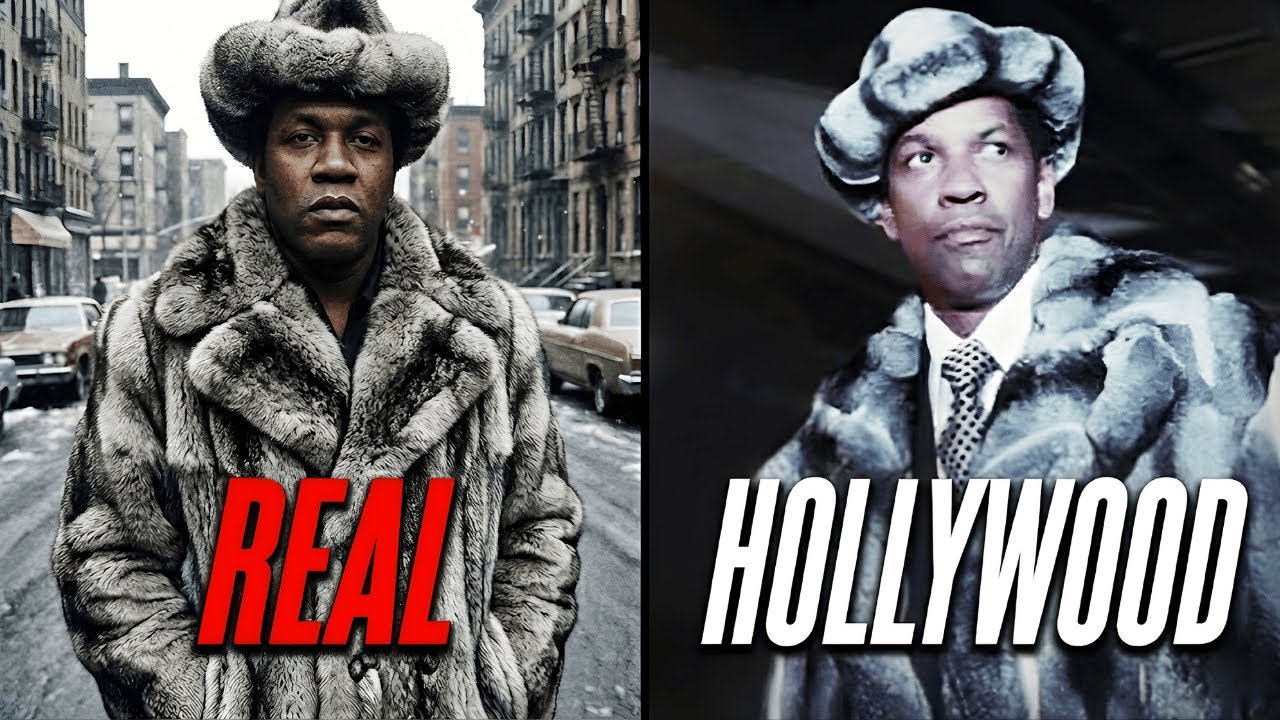
The family scenes also serve Washington’s star image. Washington built his career playing complex men with moral centers, and the script gave him moments of decency to balance Lucas’s criminality. The chinchilla coat became shorthand for the film’s morality lesson. In American Gangster, Lucas wears an extravagant fur coat and matching hat to the Ali versus Frazier fight at Madison Square Garden on March 8, 1971.
The camera lingers on him in the crowd while Roberts watches from across the venue, realizing the dealer he has been hunting is sitting ringside. The film presents the coat as Lucas’s fatal error, the moment his discipline cracked and hubris took over. This is partially accurate. Lucas’s wife, Julie, really did buy him the chinchilla coat, and Lucas admitted he wore it to the fight.
He said he initially thought it was her coat and only wore it to make her happy. The coat did draw law enforcement attention, but Roberts confirmed that police already knew about Lucas before the fight. The coat did not reveal him; it enraged investigators who had been watching him operate with relative impunity. The film also simplifies the investigation itself.
American Gangster compresses multiple detectives, agencies, and years of work into Roberts, played by Russell Crowe, as a lone crusader battling systemic corruption. We watch Roberts turn in nearly a million dollars in drug money he discovers during a search, an act of honesty that makes him a pariah among fellow officers. This part is true. Roberts really did find and surrender nearly a million dollars in cash.
He told interviewers he faced some criticism, but nothing like the film’s dramatic isolation. More importantly, Roberts was not working alone. He said in a Charlie Rose interview that he was more like a composite and that they had a squad of guys that worked on him. Detectives Ed Jones, Al Spearman, and Ben Battoo led much of the investigation alongside Roberts.
All three were upset when American Gangster credited Roberts as the singular hero. Zaillian openly admitted he combined several detectives into Richie Roberts for narrative clarity. He also invented Roberts’s custody battle and promiscuity. The film shows Roberts fighting his ex-wife for custody of their young son while sleeping with multiple women.
In one scene, Roberts confesses to a colleague that he is a terrible father. These subplots never happened. Roberts did not have children with his first wife. The film’s climax shows Roberts arresting Lucas outside a church.
They stand on the steps and have a respectful, almost collegial conversation. Then the film jumps forward to show Lucas cooperating with authorities, but with a crucial distinction: Lucas only testifies against corrupt police officers, refusing to inform on other drug dealers or mobsters. The closing text claims Lucas’s testimony led to the conviction of three-quarters of New York’s DEA agents. Lucas was actually arrested in a raid on his Teaneck home on January 28, 1975.
Federal and state agents seized $584,000 in cash along with property deeds, cars, and safe deposit keys. There was no church arrest, no respectful dialogue on the steps. He was sentenced to 70 years in prison. Facing that sentence, Lucas cooperated extensively.
He did not limit his testimony to corrupt cops. He informed on drug dealers, organized crime figures, mobsters, and anyone else prosecutors wanted. His cooperation was broad and calculating, aimed at reducing his prison time. It worked.
Lucas served about 5 years before his release. He was arrested again in 1984 for drug trafficking and served additional time. The statistic about DEA convictions proved so inflammatory that retired DEA agents sued Universal Pictures for defamation in January 2008. The agents claimed the film falsely portrayed them as corrupt and implied most of New York’s DEA had been convicted, when in reality only a small number faced charges.
Agent Joseph Sullivan told reporters, “His name is Frank Lucas and he was a drug dealer. That’s where the truth in this movie ends. ”
When pressed about accuracy, Universal’s legal team responded that the film was “a fictional work. ” This defense contradicted the studio’s marketing campaign, which promoted the film as based on a true story.
Scott told interviewers when the controversy erupted that he had no obligation to follow the exact historical record because film is not documentary. The friendship between Lucas and Roberts after Lucas’s release is real. Roberts helped Lucas’s son attend a private Catholic school and served as the boy’s godfather. They maintained contact for years, an unlikely bond between former adversaries.
Lucas also admitted he put out a contract on Roberts during the investigation. Roberts confirmed that a hitman was arrested before anything happened. These details did not fit the film’s redemption narrative, so they were omitted. What audiences believe now is a legend carefully constructed to meet Hollywood’s needs.
They believe Lucas was Johnson’s anointed successor, that he built his empire through discipline and family loyalty, that he smuggled heroin in soldiers’ coffins. They believe one honest cop brought him down while the rest of law enforcement was corrupt, and that Lucas redeemed himself by exposing dirty agents rather than informing on fellow criminals. Lucas probably exaggerated much of his life, including his wealth, his methods, and his importance in Harlem’s drug trade. By the time Hollywood adapted his story, the exaggerations had calcified into an accepted narrative.
Scott and Zaillian amplified those exaggerations because they needed a prestige crime drama with symmetrical protagonists and a redemptive arc. They built a myth about a criminal capitalist undone by his own hubris and saved by an incorruptible lawman. Audiences accepted the myth because it offered clean answers and moral satisfaction. Washington’s charisma sealed the deal, making Lucas a folk hero rather than what Roberts said he really was: a man who probably destroyed more black lives than the KKK could ever dream of.
That quote did not make it into the film either.