Historians and psychologists are reigniting one of the most persistent and contentious debates surrounding the private life of one of Adolf Hitler’s most powerful lieutenants, Hermann Göring, after new analysis surfaced challenging long-held assumptions about the Reichsmarschall’s sexuality and personal habits. The question of whether Göring was gay has circulated for decades, fueled by contemporary witness accounts of his flamboyant dress, his use of makeup, and his ostentatious jewelry, but a growing body of expert opinion now suggests that the truth is far more complicated than any simple label could capture.
The rumors are not new. During Göring’s own lifetime, his behavior raised eyebrows among the senior Nazi leadership and foreign diplomats alike. He was the only top Nazi figure who regularly wore makeup, sometimes appearing in public with cosmetics applied to his face.
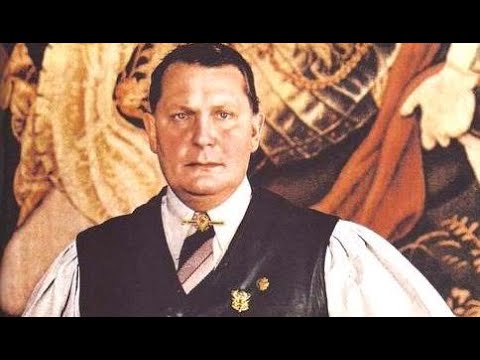 His taste for extravagant jewelry, his often effeminate clothing, and his theatrical uniforms set tongues wagging that the twice-married Reichsmarschall was a secret homosexual or at least bisexual. Such gossip has since entered popular culture, with Göring frequently portrayed as effeminate or as a transvestite, notably in the 1988 television movie The Man Who Lived at the Ritz, where he was played by the acclaimed actor Joss Ackland.
Contemporary witnesses commented repeatedly on Göring’s flamboyant dress sense. Among senior Nazis, he was sometimes referred to as the “perfumed Nero,” a mocking reference to the dissolute Roman Emperor. Swiss diplomat Carl Burckhardt witnessed Göring relaxing at home at Carinhall, his enormous country estate north of Berlin, named after his deceased Swedish first wife, whom he continued to revere and worship after her death, much to the consternation of his second wife, the German actress Emmy Sonnemann.
Burckhardt recalled Göring reclining on an ottoman sofa with his trouser leg rolled up to the knee, exposing red silk stockings, “like a cardinal,” with a petulant look on his bloated face and his mouth sunken and puckered “like an old woman’s.”
Another house guest, the German diplomat Ulrich von Hassell, recalled that Göring would change his outfit several times a day, often appearing for dinner in front of guests wearing a kimono or a Roman-style toga fastened with a heavy gold clasp, and wearing fur-lined bedroom slippers with his fingers dripping with huge ostentatious rings. Judging from witness testimony, he appears to have possessed a vast array of peculiar outfits, gaudy, ostentatious, sensational, and somewhat removed from his image as a military leader. Makeup was often worn with such outfits.
On one occasion, it was noted that Göring attended the annual Heroes Memorial Day parade in Berlin in 1943 dressed in his unique powder-blue Reichsmarschall’s uniform and greatcoat, wearing bright red leather jackboots and makeup, his jewel-encrusted fingers gripping his jewel-encrusted Reichsmarschall’s baton. Eyebrows were certainly raised.
Benito Mussolini’s son-in-law, the Italian foreign minister Count Galeazzo Ciano, recalled meeting Göring in 1941 and commented on his appearance, saying that Göring was wearing a fur coat “like a high-grade prostitute wears to the opera.” Such testimony has fed decades of speculation, yet no concrete evidence has ever emerged to confirm that Göring engaged in homosexual relationships. No rumors exist that he enjoyed male company in a sexual way, nor have any disgruntled former boyfriends emerged in the eight decades since his death alleging that he was homosexual or bisexual.
This absence of evidence is significant, according to researchers who have spent years examining the private lives of Nazi leaders.
Some clues to Göring’s personality may be deduced from his pre-Nazi life. Born into an upper-class German family on his father’s side, but with a working-class mother, he grew up in castles owned by his Jewish godfather, who was also his mother’s lover. He was raised amid considerable luxury and a small army of servants, and was plainly addicted to high-class living.
In later life, he became so rich and powerful that he was able to live, and indeed dress, like a Roman emperor, in a collection of beautiful homes surrounded by vast quantities of both purchased and looted art. He was physically brave as a younger man, and his Pour le Mérite, Imperial Germany’s highest award for gallantry, attests to that fact, having served as a World War I fighter pilot who downed over twenty Allied planes in combat over the Western Front.
 However, following his being shot in the thigh during the 1923 Beer Hall Putsch in Munich, when Hitler and the Nazis attempted to seize power by force, his life took a darker turn. He later suffered a nervous breakdown in exile in Sweden and ended up in a mental hospital, and some said he was addicted to morphine for most of the rest of his life. During his time in a Swedish mental institution in 1925, his medical report noted that Göring was highly emotional and a self-centered hysteric suffering from a persecution complex.
He was also said to possess an exaggerated self-confidence. One of his doctors said that Göring, by then a 𝒹𝓇𝓊𝑔 addict who had bullied his first wife, lacked fundamental moral courage. These aspects of his personality were to be considerably magnified by the addition of huge power, fame, and money.
During World War II, Göring was noted by those who had to work with him as being lazy, corrupt, and brusque with his Luftwaffe pilots and ministerial staff, but also able to laugh at himself, which was unique among Nazi leaders, and hugely flamboyant in dress. His obsession with having himself awarded medals and decorations was another peculiar aspect of his personality. He was never satisfied, and though a holder of Imperial Germany’s highest award and later awarded Nazi Germany’s highest equivalents, the Knight’s Cross and later the Grand Cross of the Iron Cross, the latter a unique award to him alone, he always wanted more.
On one occasion, when he discovered that his attempts to garner for himself some high Italian award had failed, Göring’s response was to burst into tears. He often wore excessive amounts of medals or special improved versions of such medals. For example, his Grand Cross was made of platinum, and he also wore a diamond-encrusted pilot observer badge, fueling rumors that he was rather like a woman with a jewelry box rather than a heroic soldier.
He bloated up, losing his good looks and looking increasingly unhealthy and debauched, while ordinary Germans suffered wartime rationing.
But does any of this mean that he was gay? According to the analysis now gaining attention, the answer is no. Some authors have noted that Göring exhibited, mostly in private, through his clothes, makeup, and jewelry, a tendency toward transvestism, that is, a man who derives sexual pleasure from dressing in female clothing.
This interpretation, however, is disputed by researchers who argue that a close reading of witness accounts does not support it. If one looks closely at what witnesses said of Göring’s sartorial tastes in private, the kimonos, togas, and similar garments, he was not dressing as a woman at all, despite the effeminate use of makeup and jewelry. He was in fact dressing as a very glamorous and slightly effeminate man.
His uniforms and clothing were male, but completely over the top to the point of becoming caricature, a peacock dressed almost in stage costumes.
 Instead, a different term has been proposed to explain Göring’s behavior. According to some experts, Hermann Göring was a “homoestite.” The concept of homoestism describes a particular sexual preference for same-𝒔𝒆𝒙 clothing, as opposed to cross-dressing.
One who identifies as a homoestite would derive sexual pleasure from clothing and behavior that is considered normative to their own gender. Importantly, this involves the wearing of the clothes of one’s own gender, either obsessively, such as a man who only wears a tie and suit all the time every day, or, as in the case of Göring, with exaggeration, the comic-opera uniforms, the strange hunting outfits, the Roman dress and kimonos and makeup, the excessive metal accoutrements and jewelry. Homoestism was first coined by the Greek psychoanalyst George Zevitzanos, and the term remains little known even among specialists.
The implications of this analysis are significant for how historians understand the inner life of one of the Third Reich’s most notorious figures. Göring was, by any measure, a man of contradictions. He was a decorated war hero who became a 𝒹𝓇𝓊𝑔 addict.
He was a married man who revered his dead first wife to the point of naming his estate after her, yet he surrounded himself with luxury and art looted from across occupied Europe. He was a senior military leader who wore makeup and jewelry and changed outfits multiple times a day. He was a man who could laugh at himself, a trait almost entirely absent among his peers in the Nazi hierarchy, yet he was also corrupt, lazy, and brutal.
The question of his sexuality has long been a subject of fascination precisely because it seems to offer a key to understanding these contradictions, but the emerging consensus suggests that the answer may be less about sexuality and more about performance, excess, and the peculiar psychology of a man who constructed his identity as elaborately as he constructed his uniforms.
The broader context of Nazi leaders’ private lives is one of stark contrast between public image and private behavior. Adolf Hitler’s girlfriends and his strange attitudes toward 𝒔𝒆𝒙 are well documented. Dr.
Joseph Goebbels’s behavior has been described as more in common with a rutting goat, a man who happily abused his powerful position to bed a series of starlets and actresses despite playing the happily married family man. Heinrich Himmler’s unlikely 𝒶𝒻𝒻𝒶𝒾𝓇 and secret love children have also been examined. The public image Nazi leaders projected to an adoring German public was often severely at variance with their private behavior and predilections.
Such accusations, of course, are by no means limited to Nazis, but apply to any group of powerful men throughout history, then and now. Yet Göring has seemingly confounded attempts to find his truth more than any other.
 The question of whether Göring was gay has never been definitively answered, and it may never be. What is clear is that the rumors and gossip that surrounded him during his lifetime and have persisted since his death reflect something real about the man, something that was being hidden or perhaps repressed. He was not, by all available evidence, homosexual or bisexual.
He was not, strictly speaking, a transvestite. He was something else, something for which the language of psychology has only recently developed a term. Whether that term, homoestism, will gain widespread acceptance among historians and psychologists remains to be seen.
What is certain is that Hermann Göring remains one of the most enigmatic and unsettling figures of the twentieth century, a man whose private life continues to provoke questions that resist easy answers.
The debate over Göring’s sexuality is part of a larger conversation about how historians should approach the private lives of public figures, particularly those who committed or enabled atrocities. There is a risk of sensationalism, of reducing complex and dangerous individuals to their sexual habits or their fashion choices. There is also a risk of prudery, of ignoring evidence that does not fit comfortable narratives.
The most responsible approach, according to researchers who have spent decades on the subject, is to examine the evidence carefully, to distinguish between rumor and testimony, and to resist the temptation to draw conclusions that the evidence does not support. In Göring’s case, the evidence points not to homosexuality but to a profound and theatrical narcissism, a man who dressed himself as a Roman emperor because he wished to be one, and who surrounded himself with the trappings of power because he could never feel powerful enough.
The psychological profile that emerges from the historical record is that of a man driven by a need for admiration and display. His makeup, his jewelry, his ever-changing outfits, his obsession with medals, his tears when he failed to obtain an Italian decoration, all point to a personality organized around the performance of status rather than around sexual desire. This does not mean that his sexuality was irrelevant, but it does suggest that the question of whether he was gay may be the wrong question.
The more interesting question, perhaps, is what his behavior reveals about the relationship between power, performance, and identity in the Nazi elite. Göring was not alone in constructing a public persona that differed from his private self, but he was perhaps the most extreme example, a man who turned his life into a spectacle and who, in the process, left historians with a puzzle that continues to resist solution.
As the eightieth anniversary of the end of World War II approaches, interest in the private lives of Nazi leaders shows no sign of diminishing. The public appetite for understanding the human beings behind the historical monsters remains strong, perhaps because the alternative, that they were simply monsters, is too easy and too comforting. The question of whether Hermann Göring was gay is, in the end, a question about how we understand the relationship between private desire and public action, between the man and the uniform, between the individual and the regime.
The answer, according to the latest analysis, is that Göring was not gay, but he was something stranger and perhaps more disturbing, a man who loved the clothes of his own gender so much that he turned them into a costume, and who turned his life into a performance that he never stopped giving, even as the regime he served collapsed around him and the world he had helped to build went up in flames.