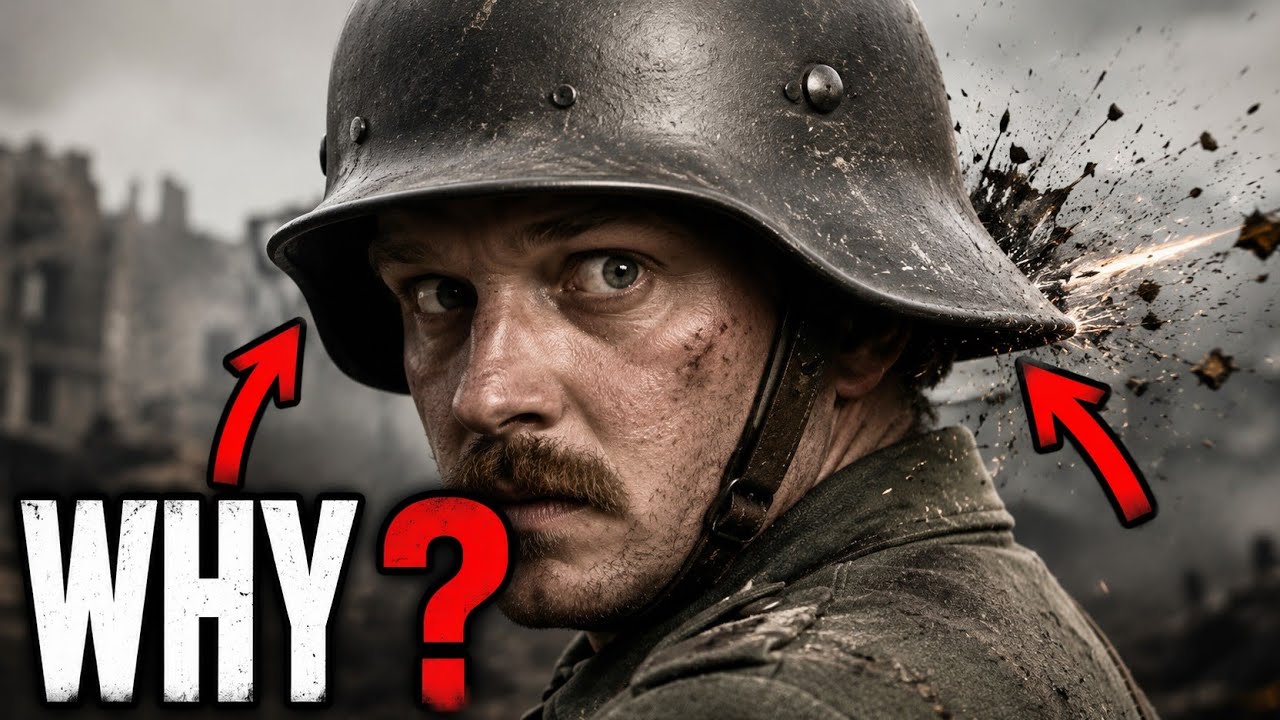
The distinctive rear flare on German steel helmets — the feature that makes them instantly recognizable in any photograph or film — was not designed to intimidate, but to protect the single most vulnerable part of a soldier’s anatomy from artillery fragments that killed tens of thousands during the First World War.
Historians and collectors call it the skirt, the neck guard, or simply the tail. It is the one feature that makes the German-style helmet impossible to confuse with anything else a soldier has ever worn into battle. And according to a detailed analysis of the weapon’s origins, its existence comes down to geometry, medical statistics, and one German engineer who found the answer in a suit of medieval armor.
 The story begins in the summer of 1914, when the largest and most industrialized armies in human history marched to war with essentially no head protection whatsoever. British soldiers wore soft peaked caps. French infantry wore cloth kepis offering roughly the same defensive value as a garden party hat.
German troops wore the Pickelhaube, the famous spiked helmet that looked armored but was mostly made of boiled leather.
That helmet was built for the parade ground and the cavalry charge, for a kind of war where being seen and looking imposing was part of the point. Against machine guns, high explosive, and shell fragments traveling at the speed of a rifle bullet, boiled leather did nothing at all. It was not even a speed bump.
Then the war stopped moving. By the end of 1914, the Western Front had become two enormous scars in the earth facing each other across a strip of ground that nothing could cross. When men dig into the ground, something very specific happens to the pattern of their injuries, and it happens fast enough that army medical officers started noticing within weeks.
A trench puts a man’s body below ground level. His legs, hips, and torso are protected by several feet of packed earth, which is a genuinely excellent form of armor. What remains 𝓮𝔁𝓹𝓸𝓼𝓮𝓭 is the head and shoulders, and only when he needs to look, shoot, or move.
A soldier in a trench had effectively reduced his target area by around 80 percent.
Every single round, fragment, and splinter still going to hit him was now going to hit him in the one place where a wound is most likely to 𝓀𝒾𝓁𝓁 him outright. Medical statistics from those first winters were brutal in a way that made them impossible to ignore. Head wounds went from being a small fraction of battlefield injuries to being one of the dominant causes of death.
The image everybody has is of a rifle bullet, a sniper, a single aimed shot. That was real and it was terrifying, and it killed enormous numbers of men. But it was not the main killer.
The main killer was artillery. And artillery does not really shoot at you. It shoots near you and then disassembles itself into several thousand pieces of hot, jagged metal traveling in every direction at once.
When a shell detonates above or beside a trench, it does not send a neat cone of fragments forward. The casing shatters into pieces ranging from the size of a fist down to the size of a grain of rice, and those pieces are flung outward in a sphere. The blast also picks up everything else in the vicinity and turns it into a projectile as well.
Stones, frozen clouds of earth, splinters of duckboard and revetting timber, fragments of concrete, pieces of previous shells, and pieces of the men who were standing there a second ago. All of that comes down on a trench from above and from the sides at angles that no soldier can predict or dodge or shelter from.
A man could be crouched at the bottom of a well-built trench with his head below the parapet, doing everything right, and still be killed by a fragment that arrived on a downward curve from somewhere behind him. By early 1915, the requirement was clear to everybody. The armies needed to put steel on men’s heads, and they needed to do it immediately.
What is fascinating is that the three main players all agreed on the problem and then went in three completely different directions. The French moved first and fastest, which in engineering terms usually means they compromised the most. Their first attempt was not even a helmet.
It was a small steel skull cap issued to be worn underneath the existing kepi.
Then came the Adrian helmet, issued from the middle of 1915, with a crest running front to back along the top and a small brim all the way around. It was made of mild steel, quite thin, and assembled from several separate pressed pieces riveted together. Ballistically, it was the weakest of the three main helmets of the war by a comfortable margin.
The British went a different way, and their reasoning is the key to understanding why the German helmet ended up looking so different. The Brodie helmet, patented by John Leopold Brodie in 1915 and issued from that autumn, is the flat one, the soup plate, the one that British and later American troops wore and that people tend to sneer at because it looks so unsophisticated next to the German design.
That sneering is unfair. Brodie’s helmet was made from a single piece of manganese steel, sometimes called Hadfield steel, pressed in one operation. Every joint, every rivet, every seam in a helmet is a weak point where a fragment can punch through or where the structure can tear.
Being able to draw the whole thing from a single blank meant the British helmet was significantly tougher than the French one.
But look at the shape and ask what it is optimized for. That wide flat brim runs all the way around the head at roughly the level of the eyebrows. It is an umbrella.
And it is an umbrella because the British had made a specific tactical judgment about where the danger was coming from. Their assumption was that the man wearing it would be in a trench, standing in it, crouching in it, firing from it, living in it.
A man in a trench is protected on all sides by earth. The only open direction is straight up. So the threat that matters, the one you should spend your weight budget on, is shrapnel and fragments falling from overhead.
For that specific situation, the Brodie was extremely good. It was cheap, it was tough, and it was in production within months.
The trouble is that assumptions become invisible once you have built them into a piece of hardware. The Brodie assumed a static soldier in a hole. When the war changed and men had to climb out of the hole and cross open ground and fight standing up in villages and wood lines, that flat brim was suddenly protecting a lot of empty air above a man’s shoulders while leaving the entire back and sides of his head bare.
Turn a Brodie helmet over and look at the back of it. There is nothing there. The neck, the base of the skull, the top of the spine, all of it uncovered.
And the Germans, working slower, were about to build a helmet around precisely that gap. The German program was not a rushed emergency measure in the way the French and British ones were. It was late.
Germany was the last of the major powers to field a steel helmet.
And the reason it was late is the reason it turned out so well. They studied the problem first. Two men are central to this, and they came at it from opposite ends.
One was a surgeon. The other was an engineer. The surgeon was Professor August Bier, one of the most respected medical men in Germany, a pioneer of spinal anesthesia whose name still appears in medical textbooks today.
Bier was serving as a consulting surgeon at the front, which meant he was seeing the casualties arrive by the thousand. Unlike almost anyone else in the chain, he was looking at them as data as well as patients. The engineer was Dr.
Friedrich Schwerd of the Technical Institute at Hanover, an expert in metal forming and in how sheet steel behaves when you push it into complicated shapes.
Bier’s contribution was to ask the question properly. Not how do we protect a soldier’s head, which is too vague to build anything from, but something much more useful. Where exactly are they being hit?
 At what angles? Which wounds are killing them? Which wounds are crippling them?
And which wounds are they surviving anyway?
That distinction is everything. If you do not make it, you end up armoring the places where the visible wounds are rather than the places where the fatal ones are. And those are not the same map.
There is no point adding a kilogram of steel over an area where a hit is survivable if you leave uncovered an area where a hit is over in 40 seconds.
So they went through the casualty records and the wound reports and the shapes of the injuries, and they built a picture of where the metal was actually going into men. Two things came out of it that shaped everything that followed. The first was that the fragments were mostly not arriving horizontally.
They were arriving on descending, oblique, wandering trajectories.
This meant a helmet that only covered the crown was covering the wrong surface. Metal was skidding in under the rim. The second finding was the one that produced the skirt, and it is grimly logical once you see it.
A very high proportion of the deaths were not from wounds to the top of the skull. They were wounds to the region at the back and base of the head.
The occipital area, the nape, the upper neck, the top of the spine. Think for a moment about what is packed into that small area of a human being. The brain stem is there, sitting at the base of the skull.
And the brain stem is the part that runs your breathing and your heartbeat without asking you. Damage there is not an injury you are carried away from. It is instant.
Directly below it is the cervical spine, the top of the spinal cord, and a fragment through that produces paralysis from the neck down in the cases where it does not simply 𝓀𝒾𝓁𝓁. Running up either side of the neck are the carotid arteries and the jugular veins, carrying an enormous volume of blood under pressure, sitting close to the surface with no muscle mass and no bone in front of them.
Now compare that with a wound almost anywhere else. A fragment through the thigh is horrifying, but the femoral artery aside, a man can often survive it. A fragment through the forearm, through the shoulder, through the buttock, through the calf.
All of these produce stretcher cases, and a lot of those stretcher cases lived.
A fragment into the back of the neck produces a corpse, and it produces one long before a stretcher bearer can crawl to him. Nobody is tourniqueting a carotid in a shell hole under fire. Nobody is treating a severed spinal cord in a dugout.
That area of the body is for practical purposes untreatable in field conditions, which means the only intervention that has any value at all is preventing the hit in the first place.
That is the entire justification for the skirt in one sentence. It covers the part of a soldier that cannot be repaired. And there is a second layer to it that has to do with how men behave under artillery fire, which is a genuinely human detail in a story full of steel and statistics.
When shells start landing, a soldier’s instinct is not to face them. He drops. He turns away.
He curls forward and gets his head down and pulls his shoulders up around his ears. Every part of that entirely involuntary reaction rotates his body so that the back of his head and neck are presented upward toward the sky, toward exactly where the fragments are coming from. Men in bombardments made themselves into a target shaped precisely like the area they had no protection over.
You could not have designed a worse alignment on purpose. Bier and Schwerd were looking at the results of that on the operating tables, and Schwerd went away to work out what shape of steel would fix it. What he came back with was not a new idea.
It was a very old one. Schwerd looked backwards to the armorers of the 15th century and specifically to a helmet called the sallet.
The sallet is a smooth, curved, close-fitting helmet that comes down low over the brow and the sides of the head. At the back it extends into a long tapering tail that sweeps out over the nape of the neck, sometimes in a single graceful sheet and sometimes in overlapping lames like the plates of a lobster’s tail. It is more or less exactly the shape that Schwerd ended up drawing in 1915.
This can sound like a charming historical footnote, an engineer with a taste for the medieval indulging himself. It is nothing of the kind. Medieval armor was not decorative and it was not guesswork.
It was the end product of several hundred years of the most ruthless iterative testing imaginable, in which every design failure was recorded by the death of the man wearing it.
Armorers in Nuremberg and Augsburg and Milan were competing against arrows, crossbow bolts, lance points, polearms, and swords, all delivered by human beings actively trying to find the gaps. Anything that did not work got a man killed and got the armorer a reputation he could not afford. The shapes that survived that process survived it for reasons.
The reason the sallet has a tail is that men on medieval battlefields were also being killed by blows to the back of the neck. Different weapon, different century, identical anatomy. The vulnerability had never changed.
It had just been forgotten for 400 years. Between the decline of plate armor and the arrival of the machine gun, there was a long stretch of history where nobody wore metal on their head at all.
Schwerd’s insight was that the human being had not been redesigned in the interim. The threat was now traveling at 800 meters a second instead of being swung on the end of a shaft, but it was arriving at the same piece of anatomy. And the solution to a downward blow to the nape of the neck was still a piece of curved metal projecting over the nape of the neck.
But he did not simply copy it. The single most important idea in the whole design is that the helmet was never meant to stop things. It was meant to make them go away.
Those are completely different problems. If you want to stop a projectile dead, you need thickness and mass. Both of those cost weight, and weight is the one thing a soldier absolutely cannot be given more of.
A man carrying a rifle, ammunition, water, entrenching tool, gas mask, and rations across broken ground for 11 hours does not have a spare two kilograms to donate to his head. And if you give it to him anyway, he will simply take the helmet off and carry it on his belt, which is what soldiers have always done with equipment that costs more than it pays.
 But if you accept that you cannot stop the fragment, you can do something almost as good. You can make sure it never gets a square hit. When a piece of metal strikes a curved surface at a shallow angle, it does not transfer all its energy into that surface.
It skids. It bites, scrapes, and slides off along the curve, and it takes most of its energy with it when it goes.
The steel underneath has to survive a graze rather than a punch. And a graze is something thin metal can absorb. So Schwerd designed a helmet with almost no flat surfaces anywhere on it.
Every part of that shell is curved or angled in a way that makes a perpendicular hit unlikely from most realistic directions. The crown is domed rather than flat. The sides sweep down and outward.
And that rear skirt, crucially, is not a shelf sticking out horizontally the way people sometimes describe it. It is a continuous curve flowing down and out from the crown so that a fragment falling from above meets a surface already turning away from it and gets flicked outward and downward past the neck entirely. It is not a shield held over the neck.
It is a ramp built to throw things past it.
There is a related point about how it sits on the head which sounds small and is not. The Stahlhelm was designed to wrap the skull rather than perch on it. Deep sides, a low sweep over the ears and the temples, a brow that comes down close to the eyebrows.
Compare that to the Brodie, which genuinely does just sit on top like a lid, held in place with a chin strap and not much else.
The wrapping matters for coverage, obviously, but it also matters for stability. A helmet that engulfs the head moves with the head. One that balances on top of it gets knocked askew every time a man runs, dives, or takes a knock.
And there is nothing more useless than protection that has slid round to cover your ear while you are trying to see.
The construction was single-piece deep drawn from a nickel and silicon steel alloy, which was a serious manufacturing challenge for the time. Pressing that much depth and that complicated a curve into one sheet without tearing it or thinning it out at the corners takes multiple stages and very good tooling. It is the reason the Germans were last to the party.
You cannot rush that.
They tested it at the Kummersdorf proving ground in late 1915 and then did something sensible. Rather than immediately re-equipping the entire army with an unproven design, they issued it in small numbers to a unit that would give it the hardest possible workout. The assault detachment under Captain Willy Rohr, the stormtroop pioneers who were developing the infiltration tactics that Germany would use for the rest of the war.
Those troops took the new helmets to Verdun in early 1916, which is how the Model 1916 got its trial by fire in the worst place on Earth to be a human head. The M16 is a beautiful object if you can put the history to one side for a moment, and it has one feature that puzzles people constantly. On each side there is a stubby horn, a projecting steel lug.
Almost everybody assumes they are decorative or some kind of Germanic flourish or a mounting point for the chin strap. They are neither. They are hollow and they are the ventilation ports letting air move under the shell.
They were also designed as the mounting lugs for a Stirnpanzer, an additional brow plate of thick armor that clipped across the front of the helmet, meant for sentries and snipers who spent long periods with their heads 𝓮𝔁𝓹𝓸𝓼𝓮𝓭 above a parapet.
The brow plate weighed roughly five kilograms, and it was predictably hated. Men who tried to wear it found their heads dragged forward, their necks aching within minutes, and their ability to look up almost gone. Most were left in the bottom of trenches.
It is a good reminder that the whole discipline of body armor is a series of arguments with weight, and that the winner of those arguments is usually weight.
Inside the liner was a leather band carrying three padded pockets stuffed with horsehair or similar material, holding the shell off the skull by a couple of centimeters. That gap is doing real work. It is a crumple zone.
When something strikes the outside of the helmet, the shell deforms inward. If your head is pressed directly against it, that deformation arrives in your skull.
What happened next is one of the most misunderstood statistics of the entire war. After the Stahlhelm was issued in quantity, German head-wound figures went up. You will occasionally see that quoted as evidence that helmets did not work.
It is one of those facts that sounds devastating until you think about it for 10 seconds. Head injuries increased because head fatalities collapsed.
The men who previously appeared in the records as killed in action with no further detail were now appearing in the records as wounded because they were alive to be written down. A fragment that would have gone through the back of a man’s neck now skated off the rear flare and left him with a ringing skull, a bruise the shape of a saucer, and the rest of his life.
Every one of those entries in the wounded column was a soldier who 12 months earlier would have been a name in a letter home. The design worked so well that German soldiers formed an attachment to it that is difficult to overstate. It stopped being equipment.
Frontline troops in the last two years of the war identified themselves by it and photographed themselves in it.
And that attachment is where the second half of this story begins, because the shape was about to acquire a meaning that had nothing at all to do with fragment trajectories. Germany lost the war, and in the chaos that followed, veterans came home to a country arguing violently with itself about what had happened and whose fault it was. The helmet came home with them.
Freikorps units and paramilitary formations fighting in the streets of German cities wore it. A veterans organization calling itself Der Stahlhelm, the Steel Helmet, took the object as its actual name and grew into one of the largest political movements in the country. Poster artists and sculptors reduced the shape to a black silhouette because it needed no caption.
When the German army rearmed in the 1930s and redesigned the helmet for mass production, the skirt stayed. By then it was carrying two arguments at once. One about ballistics and one about identity.
And both pointed the same way. The M35, introduced in 1935, is the version most people picture when they think of the Second World War. It is a refinement rather than a reinvention.
The shell was slightly smaller and lighter. The horns were gone and replaced by neat separate ventilation grommets riveted into the sides. The edge was rolled over into a smooth hem for strength and to stop it cutting into things.
 The interior got a much better liner with a sprung aluminum band and individually adjustable leather tongues. It was made from a molybdenum steel alloy.
Then the war came and the war did what war always does to well-made objects. The M40 arrived in 1940 with the ventilation holes punched directly through the shell instead of being separate riveted fittings, saving a component and a manufacturing step, and with a change of alloy to a manganese and silicon steel because molybdenum was needed elsewhere.
The M42 from 1942 dropped the rolled edge entirely, leaving the rim raw and flared where it came off the press. That is why late-war helmets have that slightly sharp, unfinished lip, and it is one of the fastest ways to date one. Each change made the helmet a little cheaper and a little quicker to produce, and each one is a small marker of an economy running out of everything.
The skirt survived all of it, every version. Through every cost cut, every material substitution, every attempt to shave seconds off a production line, that rear flare was never the thing they removed, except once. And the exception proves the whole argument.
German paratroopers, the Fallschirmjäger, got their own helmet, the M38. Put one next to a standard Stahlhelm and the difference is immediate.
The skirt is gone. So are the flared sides. What is left is a smooth-cut, almost egg-like shell that ends close to the head all the way round with only the faintest suggestion of a lip at the back.
The reason is that German airborne doctrine used a static line jump from very low altitude with a harness that gave the man almost no control.
The landing was not the elegant flexed-knee touchdown of later parachute forces. It was a forward roll onto the hands and knees at speed. Imagine doing that with a wide steel flange sticking out over your neck.
The moment your shoulder hits the ground, that flange catches. The helmet levers backwards and the chin strap either strangles you or the helmet comes off.
In the air, the problem is worse. A projecting rim is exactly the kind of shape that catches a rigging line during the opening shock. And a rigging line snagged on a helmet at that moment can break a man’s neck as effectively as any fragment.
So they cut it off and they added a proper four-point chin strap system to hold the thing rigid.
They accepted a measurable reduction in protection because in that specific job the skirt was more likely to 𝓀𝒾𝓁𝓁 the wearer than save him. That tells you the flare was never sentimental. It was a calculation, and when the inputs to the calculation changed, the answer changed with it.
Those helmets were produced in far smaller numbers than the standard pattern and are now among the most sought after and most faked items in the entire militaria world.
Out in the field, the helmet accumulated the usual layers of soldier improvisation. Wire mesh and chicken wire wrapped around the shell to hold foliage. Cloth covers in splinter and marsh patterns.
Whitewash or lime slapped on for winter camouflage and scrubbed off in spring. Strips of inner tube or leather belting stretched around the circumference as a universal attachment point for grass, twigs, and bits of scrim.
There was also a long-running argument about the decals. Early-war helmets carried a national shield on one side and a service emblem on the other, and both had a habit of catching light. A glossy shield on the side of a man’s head on a hillside in the sun is a small mirror pointed at whoever is looking for him.
The tricolor was ordered off in 1940 and the remaining decal went in 1943.
Somebody somewhere worked out that the national colors on the side of a helmet were getting men shot and had them scraped off. The steel had a life outside combat, too. It was a wash basin, a cooking pot, a bucket for hauling water up a slope, a stool, a seat on wet ground, a scoop for digging when the entrenching tool was somewhere else.
And in the winters on the Eastern Front, it had one property nobody wanted, which is that steel conducts heat away from a human body with terrible efficiency. Men at Stalingrad and in the winter fighting around Moscow padded them with rags, wore knitted toques and balaclavas underneath, and still came away with metal frozen against skin.
The one genuine cold-weather bonus was the drainage. Rain, sleet, and melting snow ran off that rear flare and dripped clear of the collar instead of finding its way down the spine, which sounds trivial until you have spent a week in wet clothing you cannot change. So was it actually better than what the Allies wore?
The honest answer is that it was better at most things and worse at one.
Against fragments arriving from directly overhead, a wide-brimmed helmet like the Brodie covers more of the shoulder area than the Stahlhelm does. And for men in static positions being shelled, that is a real advantage. That was the situation the British designed for, and within it, their helmet is not the joke it is usually treated as.
But across everything else, the German shape simply covered more of what mattered.
More of the sides, more of the ears, more of the back of the skull, and all of the neck. And you can measure how convincing that argument was by watching what everybody else did next. The American M1, introduced in 1941, abandoned the flat brim entirely and adopted a deep shell that came down over the sides and swept out at the rear.
It is not a copy, but the principle underneath it is Schwerd’s principle.
Wrap the head. Cover the back. And then in the 1980s, the United States replaced the M1 with a helmet made of Kevlar rather than steel, designed with computers rather than drawing boards, and shaped by ballistic modeling that Friedrich Schwerd could not have imagined.
It came out with deep sides, a low profile over the ears, and a pronounced flare over the back of the neck.
American soldiers took one look at it and nicknamed it the Fritz. They were not wrong. Seventy years, an entire revolution in material science, and the answer came back the same, because the question had never changed.
The head is a sphere on a stalk, and the stalk is where a man dies. That is why the skirt is there. Not to intimidate anyone, though it did.
Not to look the way it looks in every film you have ever seen, though it does. It is there because a surgeon counted the dead, worked out where the metal was going in, and handed the problem to an engineer who understood that men had solved it once before and then forgotten. Every one of those soldiers in the old footage, running forward with their heads down and their shoulders hunched, is wearing a piece of 15th-century thinking pressed out of 20th-century steel.
And a great many of them came home because of it. The helmet that defined the silhouette of two world wars was never about fear. It was about the four inches of anatomy that no field surgeon could ever repair.