Seven years ago, Yvonne sat down across from me with her suitcases already packed behind her and said the words I’ve never been able to erase. “You’re not enough, Luke. You haven’t taken us anywhere. ” She said it with the calm of someone who had already made up her mind long ago.
She took our daughter that same night and left me with the house, the unpaid bills, and a humiliation that hollowed me out. For weeks, I didn’t know who I was without her. I only knew I would never let anyone make me feel that small again. My name is Luke.
I’m fifty-two years old, and I live in Erie, Pennsylvania, on the shores of the lake. Today I run a company in the marine industry. But this story began much earlier, in front of an overdue bill held to the refrigerator by a starfish-shaped magnet. In the months before that night, I worked double shifts at a factory assembling industrial components.
The factory was losing contracts one after another, and the overtime started disappearing just when I needed it most. I came home with rough hands and the smell of metal still on me, and I’d find Vicky already in bed because it was too late to say goodnight to her awake. Some nights I’d stand at her door just to listen to her breathe, as if that sound alone could remind me why it was worth pushing forward. We’d been married ten years.
Vicky was ten. And I was trying to protect my family with hours of work that were slowly consuming me. Yvonne began to change gradually, the way the light changes when autumn arrives. Her answers got shorter.
She’d watch me walk through the kitchen, and there was something in her eyes I couldn’t name, until one day I understood it was contempt, not exhaustion. One night I caught her on the phone with a friend from high school, and I heard her say, “They just bought a house, and we’re still here renting while Luke works the night shift. ” There was shame in her voice, the same shame I felt every time I opened an envelope with a late bill. I tried to talk to her one evening in the garage while she loaded the washing machine and I came home from work.
I told her things would get better, that I had an interview for a different shift, better paid. She stopped for a moment, looked at me the way you look at something that has been broken too many times to be fixed, and said, “You always say that, Luke. In the meantime, promises don’t pay the rent. ” There was something worse than anger in her voice: a cold, almost final resignation.
Yvonne had grown up in a house where creditors’ phone calls interrupted dinner and her mother hid the bank’s letters at the bottom of a drawer. I understood that during those months, from the way she counted coins in her wallet, from the way she avoided opening the mail in front of Vicky. She was terrified of becoming her mother, and somehow she had decided I would be the one dragging her there. I kept believing the problem was only money, that if I worked even harder, if I found a way to earn a little more, I could bring her back.
I loved my wife, and that love made me blind to the fact that she had already stopped waiting for me. And so we arrived at the evening I told you about at the beginning. I asked her where she would take Vicky. She said they would stay temporarily at her mother’s and that a lawyer would send me the divorce papers.
I didn’t raise my voice. Vicky was there on the doorstep with her backpack on and her eyes searching for mine, and I understood that any argument right then would only hurt her. I walked her to the car. Before getting in, Vicky turned one last time to look at me.
I smiled, even though everything inside me was collapsing, and told her I’d see her soon, that everything was fine. She nodded. She kept gripping the strap of her backpack until her knuckles turned white. I followed the red taillights until they disappeared at the end of the road.
I thought that was the worst thing that could happen to me. Three weeks later, the factory decided they didn’t need me anymore. Three weeks after losing my wife and daughter, the shift supervisor waited for me by my locker with a brown envelope in his hand. He said my department was closing at the end of the shift, that there was nothing personal, just lost contracts and numbers that didn’t add up anymore.
I signed the papers without really reading them. In less than a month, I had lost everything I thought I was meant to protect. I came home for the last time still wearing my uniform, as if taking it off would mean admitting something. The house felt bigger than usual, and every sound that had once gone unnoticed now filled the rooms.
The radiator clicking on by itself. A hallway door that didn’t close properly. My own footsteps on the wooden floor. These were sounds that used to get lost among Yvonne’s and Vicky’s voices.
Now they were all that remained. I tried to keep a routine. I woke at the same hour, even with no shift to go to. I put on my work clothes out of habit, as if my body refused to believe they were useless now.
I went out with printed résumés, from factory to factory, workshop to workshop, warehouse to warehouse, gripping my folder as if it were the last solid thing I had left. The answers were almost always the same: “We’ll let you know. ” Nobody called back. I came home with worn-out shoes and the feeling of having knocked on doors that closed before I even finished speaking.
I started leaving meals half-eaten. I walked past Vicky’s bedroom door and couldn’t bring myself to open it, as if something fragile still lived inside. When my sister Sue called to ask how I was doing, I said everything was fine, because admitting otherwise felt like another defeat to stack on the others. Sue didn’t settle for my vague answers.
One afternoon she showed up unannounced, a grocery bag in one hand and the copy of my keys she’d been given years before in the other. She opened the living room curtains without asking permission. She said light did as much good as food. She made me shower and change, then dragged me out along the lake, where we walked for an hour without saying almost anything.
The cold wind cleared my head in a way the walls of the house never could, and for the first time in days, I felt my body belonged to me again. It was there, in front of the water, that she said something I’ve never forgotten: “Yvonne has decided who she thinks you are. Now it’s up to you to decide whether you want to prove her right. ”
Those words sounded like a challenge, and in that moment I understood she was right to be hard on me.
The divorce papers arrived, as promised. They proposed Vicky stay primarily with Yvonne, temporarily at her mother’s house, while I was unemployed. I refused to disappear from my daughter’s life. I asked for regular visits, phone calls, fixed weekends.
A lawyer told me losing a job doesn’t erase a father’s rights, and I clung to that sentence like a rope. But Yvonne used my instability as an argument. During one exchange in front of her house, with Vicky between us, she said those words with a firm calm, without softening their weight: “Vicky needs stability, Luke. Right now, you can’t even guarantee that for yourself.
”
The words tightened my throat. I hugged Vicky and told her we’d see each other soon, that I loved her, that none of this changed how important she was to me. She held me tight, confused, pulled between two worlds she didn’t yet fully understand. Before getting back in the car, she asked me, in her small ten-year-old voice, if I would come to her next school play.
I promised her I would. And I kept that promise, even when it was hard. Weeks passed like that: failed interviews, résumés piling up on the hallway chest, bills arriving on time even without a paycheck. One evening, Sue found me sitting in the hallway, still dressed in the clothes from the day before, surrounded by papers and opened envelopes.
She didn’t tell me everything would be fine. She looked me straight in the eye and asked what I was going to do now. I realized I had spent weeks trying to prove Yvonne wrong while inside I was repeating, word for word, everything she had said about me. Sue picked up the keys and headed for the door.
“His name is Fabian. Tomorrow morning I’m taking you to see him. ”
I couldn’t have known then that that man would give me back much more than a job. The next morning, Sue dropped me off in front of a shed that looked like it was about to collapse.
Above the door hung a faded sign, and in the yard, two boats split open seemed to be waiting for someone desperate enough to try and save them. That someone, as it turned out, was me. Fabian was bent inside one of the boats, hands covered in grease, a flashlight clenched between his teeth. I barely recognized him, even though we had attended the same school over twenty-five years before.
We hardly knew each other back then, just two faces passing in the hallways. He climbed out of the hull, looked me up and down, and said, “Sue tells me you know how to work with your hands. Let’s see if that’s true. ”
He didn’t waste time on pleasantries.
He led me to a second boat resting on two trestles, pointed to a bilge pump that had stopped working days ago, and told me the owner wanted it ready by Friday. He explained nothing more. He wanted to see how I handled a problem, not hear me talk about it. I knelt beside the pump and started checking the connections one by one, the way I had learned over the years in front of factory machines.
I found a corroded wire near the connector, hidden under a layer of greenish oxidation caused by moisture. I cleaned it, insulated it, tested the circuit again. The pump started on the first attempt. Fabian came over, watched the water drain, and nodded once without comment.
“I can pay you little, at least until these two jobs come through. If you’re looking for security, you’re in the wrong place. ”
I asked nothing more. I didn’t tell him about the factory, about Yvonne, about the divorce papers still open on the entryway table.
I just told him I could start the next day at dawn. The first days were hard and quiet. I got up before the sky lightened, arrived at the shed with coffee still burning my throat, and spent hours cleaning rusty parts, hauling fuel cans, holding hulls steady while Fabian worked on engines. I learned by watching more than by listening, memorizing every gesture of his hands as if it were a new language to decode.
One afternoon I assembled a metal bracket wrong and it broke again as soon as I put it under pressure. I didn’t try to hide it. I called him over, showed him the mistake, and he taught me how to do it properly without scolding me. I came home every night with my body wrecked and my mind, for the first time in months, quiet.
The money was little, the bills kept coming, and the divorce expenses didn’t wait for me to get back on my feet. But someone, for the first time in weeks, was judging me by what I knew how to do, not by what I had lost. Fabian spoke little about himself. One afternoon, as we were closing the shed, he said that the previous winter the workshop had nearly closed for good.
He had invested all his savings, was behind with his suppliers, and without two jobs coming in he would have had to shut down. Listening to him, I understood he too was fighting to keep from losing everything, and that resemblance brought us closer than any speech could have. One Friday, he handed me the key to the shed without explanation, saying only that he had to be away for a day. When he came back and found the work done, he paid me right away, even though I knew he needed that money.
Vicky came to see me one Sunday, brought by Sue. She saw me dirty with oil, my hands marked, and asked if this was my new job. I said yes, without shame, and showed her the hull I was working on, explaining calmly what I had repaired that morning. She ran a finger along the painted edge and smiled, as if that simple gesture was enough to tell me this was okay.
Things changed one afternoon when the marina owner showed up at the shed. A storm had damaged several boats, and the season was about to open. He wanted everything ready in two weeks, a job Fabian could never handle alone. Fabian hesitated, knowing that failure would sink us forever.
I looked at the boats lined up at the dock, calculated the time in my head, and said we could do it if we reorganized everything from scratch. “Are you sure? ” he asked. The certainty was missing.
But fear had already decided enough for me. We accepted the job that afternoon. Two weeks later, we were out of money, behind schedule, and one step from losing everything. It was then that we found the solution that would change our lives.
The marina owner came into the shed and laid in front of Fabian the list of boats still waiting. Four days remained until the season opened. We had almost run out of money, and the parts supplier had told us he wouldn’t deliver anything without an advance payment we couldn’t afford. Fabian looked at the list, then at me, as if searching for a solution he often couldn’t see.
I told him we were working wrong, not for lack of effort, but because we were tackling each boat alone, looking for parts only when the problem surfaced. I proposed doing things differently: inspecting all the boats together, dividing the damage into categories, salvaging the components still in good shape, and dealing directly with the supplier for a simpler arrangement. Fabian resisted. He had worked alone for years, and the idea of reorganizing everything according to a method that wasn’t his put him on the defensive.
He said he knew those boats better than anyone, that he didn’t need a system to do what he had always done by eye. I told him the old way would cost us the contract, and that if he wanted to keep working alone, he could, but I would organize my hours that way regardless. Fabian stared at the scattered tools in the shed for a few seconds. In the end, he rolled up his sleeves, and we began reorganizing everything.
The supplier accepted a two-part payment: a reduced advance that day and the balance as soon as the marina paid us. I negotiated the deal face to face in his warehouse. It wasn’t an easy victory. I had to repeat the same figures three times before he trusted two strangers with an almost empty shed.
I walked out of that warehouse with sweaty hands but with the signed agreement on a page torn from a notebook, and I understood I had just learned something no factory had ever taught me: how to ask. The last obstacle came the night before the deadline, when we discovered one of the boats had structural damage no one had noticed before. We worked until dawn, hands cut by the tools, clothes still damp from the rain that had leaked through a crack in the roof. The coffee went cold on the counter while we kept tightening bolts, and I watched the sun rise over the lake just as we closed the last hull.
We delivered on time. The marina owner inspected every boat personally. Then he said a sentence I have never forgotten: “You delivered when everyone else had already said no. Next season, I’ll call you first.
”
The profit was small. Most of it went straight to the suppliers, and Fabian was still in debt. But that job gave us a reputation no advertisement could have bought. Over the next two years, life became a sequence of dawns at the dock and evenings spent cleaning tools.
I learned boat mechanics by watching Fabian, repeating every gesture until it became natural. And he learned to trust my organization, even when it changed his old habits. We reinvested almost everything we earned into tools and space. We hired a first helper and moved into a slightly larger shed near the main dock.
I began handling clients and planning while Fabian focused on the most complex mechanical work. I learned to turn down customers who treated our time badly. I admitted mistakes without humiliating myself over them. I started asking for fair payment instead of settling out of fear of losing a job.
I stopped apologizing for existing in every conversation. And I began putting aside a small amount every month, even when it seemed pointless. I kept every commitment to Vicky, even in the hardest weeks. During one handover, Yvonne looked at my work clothes with an expression I knew well.
“I thought you would have found a real job by now,” she said. I answered calmly: “It is a real job, and I’m building something that depends on me. ” She dismissed my response with a shrug, still convinced I was floundering. Vicky, though, began to notice something different in me.
More presence, more steadiness, less need to prove something to anyone. One afternoon, a regional network of marinas offered us a major contract. We were still small, without the structure needed to handle it without risk. Fabian asked me if it was worth it.
Years before, I would have chosen safety out of fear of losing everything. Now I knew what it meant to fall and get back up. That contract could turn the workshop into something much bigger. But accepting it meant risking the only thing I had finally managed to rebuild: my relationship with my daughter.
“Dad says that since this place exists, work always comes before me. Is that true? ” Vicky looked me straight in the eye, standing next to Sue at the entrance to the shed. She was fifteen by then, with a firmness in her voice I didn’t recognize, as if she had rehearsed that sentence for a long time before finding the courage to say it.
The words stopped me for a few seconds. The question hurt because it touched something I had avoided looking at for three years. When we accepted the contract with the regional marina network, I had set a condition for Fabian: the days reserved for Vicky remained untouchable, and the workshop had to learn to function without me during those hours. Fabian agreed, and for a while it worked.
But growth brought travel, meetings, emergencies at the marinas that required my presence. The visits got shorter. I started believing that showing up on time was enough, that punctuality equaled presence. Yvonne, meanwhile, had begun a relationship with Brendan, a man who managed two small marinas, always in a jacket, with a life seemingly ordered in every detail.
Yvonne fed the distance without resorting to open attacks. It was enough for her to comment that I was always busy, that the workshop came before everything, that I had arrived late to a school play or shortened a weekend. She scheduled Vicky’s activities during the hours I was supposed to see her, then simply observed that once again I hadn’t managed to be there. Every delay became proof.
Every sacrifice I made to be present remained invisible. Vicky began comparing Brendan’s orderly world with my work clothes and my quiet life. I took Vicky along the dock, away from the noise of the equipment, to a boat still open for repair. We sat on the edge of the hull, feet nearly touching the water.
I told her the truth without searching for excuses. “I showed up almost every time, and I convinced myself that was enough. A father can respect a calendar and still stay too far away. ” I explained that work had been my way of getting back on my feet after the divorce.
I should have talked to her more, asked her what she felt, and stopped believing that a few weekends together were sufficient. Forgiveness didn’t come right away. Vicky kept her eyes fixed on the water, arms wrapped around her knees, and said that for years she had felt reduced to a commitment to respect when she wanted to be a daughter truly known. Her words hit me harder than any shouted reproach.
In the months that followed, Vicky began spending some afternoons at the workshop. I taught her small, safe tasks: sanding a piece of wood, choosing the color for a hull, holding a bracket still while Fabian tightened a bolt. We had lunch together at the dock, away from the noise, and she started asking me questions about my youth she had never asked before. At one of her school plays, I sat in the back of the hall.
Vicky searched for me in the audience before even stepping on stage. When our eyes met, her shoulders relaxed. One afternoon, looking for a tool on an old shelf, Vicky found a tin box. Inside were the program from a school play, a crumpled photo of the two of us by the lake, and a drawing she had made at age eight with the words “Dad and me” in crooked letters.
Looking at those objects, Vicky realized I had followed her life much more than she had imagined. She asked why I had never told her how hard I had fought to stay close. I answered calmly: “Because I didn’t want you to become the judge of our divorce. You were my daughter.
You had the right to love us both. ”
Vicky also began to notice how much the workshop had grown. There were more workers than before. Boats arrived from other states.
Clients treated me with a respect she didn’t remember from childhood. Fabian consulted me before every important decision. Yet I still lived in a modest house. I drove the same car as always and avoided talking about money.
Yvonne remained convinced the workshop barely kept me alive. One afternoon, as I walked her toward the exit, Vicky stopped in front of the glass of the new office, from which you could see the newly expanded shed, full of men working under our name. “Dad, how big has this company really become? ”
I followed her gaze toward the building.
For years, I had allowed the people from my old life to imagine me still struggling to survive. Vicky was the first to sense how different reality was. Instead of answering, I took her hand and led her through the new building. We walked past the mechanical department, where three teams worked simultaneously on different engines, then past the electrical area where technicians tested systems on commercial boats that had come from other states.
At the end of the corridor, a sign indicated the hull department, where workers in overalls polished fiberglass under large industrial lights. Beyond the yard, the newly expanded shed housed the delivery area, while offices occupied the upper floor of the main building. Some workers stopped me for a signature, a clarification on an estimate, a decision to be made before evening. Vicky watched everything without saying a word, as if recalculating every memory she had of me.
The company is called North Shore Marine Systems. It doesn’t bear my name or Fabian’s. And that’s exactly why no one from my old life ever connected that name to me. We had started with maintenance contracts with marina networks.
Then came small commercial fleets to salvage, the modernization of electrical systems, procedures that reduced repair times. We hired experienced mechanics and electricians, reinvested the profits. We opened a second location, and the business slowly spread toward neighboring states, contract after contract, without ever forcing the pace. No miracle, no mysterious investor.
Just organization. Fabian’s technical knowledge. And a reputation built year after year. I brought Vicky into my office and showed her some documents on the desk: the annual balance sheet, the deed to the new property, and the corporate document showing the division of shares.
I didn’t explain every figure. I let her see the whole picture. “Are you rich? ” she asked, pinching the edge of the folder between her fingers.
“Half the company is mine. Between my share, the real estate, and what I’ve set aside, I’ve been a millionaire for a few years. ” I told her most of that value was tied to the company itself, not a bank account full of cash, and that might explain why my life still looked so ordinary. She asked why I kept living in a modest house, driving the same car, dressed almost always in work clothes.
I explained that for years, I had wanted to show her mother how wrong she had been. But when I finally could have shown her, her judgment no longer had any value. The humiliation had left a mark. My choices now belonged only to me.
I asked her just one thing. “You don’t have to lie to anyone. I only want money to stay out of the relationship between you and your mother. ” Vicky nodded.
She understood it was a boundary to respect without lies and without complicity. Over the next two years, Vicky went from fifteen to seventeen, and North Shore opened a second location. Fabian became the public face of the company. He represented us at industry trade shows, received important clients, and appeared in photos in specialized magazines.
He liked that part of the work: shaking hands and telling the story of the workshop that almost closed. I preferred running operations, personally following contracts, and staying close to the teams. Many believed Fabian was the sole owner and that I was just the operations director, an old mechanic who had grown up inside the company. My ownership wasn’t hidden.
It was simply that no one from my old life had ever had any interest in knowing it. At one of Vicky’s events, I ran into Brendan, who managed two small marinas and knew North Shore well. He looked at me with the usual condescension. “Fabian still keeping you busy?
” he asked. “Enough,” I replied. He mentioned, with a hint of professional irritation, the contracts our company was taking away from his competitors, never imagining that half the company winning those contracts was mine. At trade shows and industry meetings, he had always seen Fabian at center stage.
When I was present, he found me next to the operational teams. Yvonne, standing nearby, watched me with the old contempt, still convinced that my uniform was a sign of my lack of alternatives. For me, it had become a daily choice. Weeks later, at the inauguration of the second location, a former classmate recognized me in the crowd.
“Still working for Fabian? ” he asked, surprised to see me there. I answered calmly, without correcting him, without telling him anything about the company. For him, I was still the man who had lost his factory job.
I didn’t feel the need to prove otherwise. A few weeks later, Sue showed up at my house with a white envelope in her hand. On it was the emblem of the old school. Inside was the invitation to the reunion.
I read the date printed on the invitation twice. Seven years later, I was going to see Yvonne again in the same place where we had met. She still believed she knew exactly who I was. I had signed contracts worth more than everything I owned seven years ago.
Yet it took an envelope with the old school emblem to make me feel like the man Yvonne had left on the doorstep. I kept the invitation in the office drawer for two days, then moved it to the pickup seat, as if changing its location could change my decision. I found it in my hands again several times on my way home in the evening, almost decided to refuse. I wasn’t only afraid of Yvonne.
I was afraid of the old classmates who had witnessed my fall, the polite questions about the divorce, the looks that know how to judge without saying anything out loud. And a part of me that, despite everything, still wanted to prove something to someone. Sue noticed immediately. She found me with the envelope open on the kitchen counter and understood I was about to give up.
“If you stay home because you’re afraid of what they’ll think, then you’re still letting them decide who you are,” she said without raising her voice, looking at me the way only she could. Vicky, for her part, wanted me to walk into that hall without shame for the man I had become. I no longer needed to silence anyone. Her words weighed more than my own hesitations.
I decided to go, to finally face that past. I went to the old school to confirm my attendance in person. In the administration hallway, I ran into Tessa Reid, former class president, now in charge of organizing the reunion. She was visibly tense.
The planned sponsor had pulled out at the last moment, and only a few days remained to pay for the hall, the dinner, the service staff, the music, and the sound system. Without that money, the evening risked being reduced to the bare minimum, or canceled entirely. I offered to cover the entire cost of the evening. I would reimburse the advances already paid by the committee and pay for the hall, dinner, music, service staff, decorations, and sound equipment.
I asked only one thing in return: that my name remain confidential until the end of the evening. I didn’t want anyone to change their attitude toward me based on my financial situation. Tessa looked at me for a few seconds, as if weighing whether I was serious. Then she accepted, but explained that the emcee would have to officially thank the sponsor during the closing of the event.
I authorized the reveal only at that moment, not before. I wasn’t doing this to prepare revenge. That school had mattered to me. It was there I learned to use tools in a school workshop where an old teacher let me stay after classes because he understood that working with my hands helped put my head in order.
Those skills, years later, had served me on my first day with Fabian. Paying for that evening felt like a way of giving back to the place where it all began. I have to admit, though, that knowing Yvonne would be present made the decision more complicated. A small part of me imagined her face before the truth.
But I would never have built that evening as a trap. When I told Fabian everything, he shook his head, more amused than surprised. I explained that the amount was manageable and that I had no intention of making a theatrical entrance. “Then show up in your old pickup, so nobody suspects anything,” he said with the irony I had come to know well.
It was the vehicle I drove every day, so there was no image to construct. As for the suit, I chose something simple and elegant: a dark, well-cut suit, a discreet watch, no flashy signs of wealth. I didn’t want to show up dressed as a mechanic; that would have felt staged, a kind of reverse disguise. If Yvonne was going to judge me, it would be out of prejudice and outdated information, not because of any performance on my part.
From the list of attendees Tessa showed me, I learned that Yvonne and Brendan would be coming together. I only knew he still managed his two marinas and seemed to enjoy a certain stability. The night of the reunion, I arrived in the pickup, the same one as always, and walked into the brightly lit hall. I recognized old classmates among the class photos on the walls, background music, groups that still seemed divided along the old high school hierarchies.
Someone greeted me with an absent nod, not quite recognizing me. I felt the weight of those years, but I kept moving forward without stopping. I saw Yvonne on the other side of the room, next to Brendan, a glass in her hand and a smile directed at someone from the old group. Yvonne stopped in front of me with her usual ease, her arm still linked through Brendan’s.
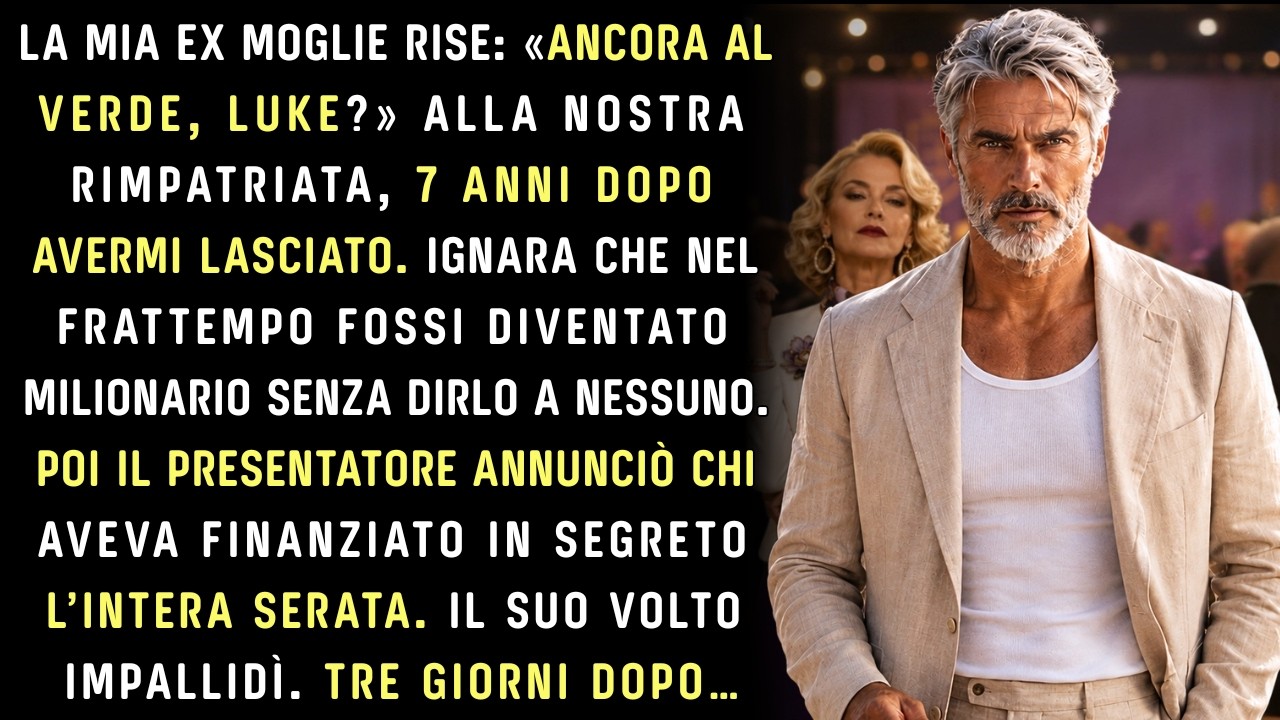
A few old classmates nearby instinctively turned toward us, as if sensing something was about to happen. “Still broke, Luke? ” she said with a calm smile, as if commenting on the weather. She let her gaze drift over my simple suit, then over the pickup keys in my hand, lingering a second too long on the worn logo of the keychain.
“At least Fabian lets you out once in a while. I thought you still spent your evenings cleaning engines for him. ”
I felt the keys grow colder in my palm. For a moment, the feeling from seven years ago returned: the weight of being looked at as a man already defeated.
I gripped the keychain, breathed, and let it pass. “I’m getting by,” I replied, without looking for anything more to add, letting the silence after those two words make more noise than any speech. Brendan stepped in with the same professional condescension I had heard from him months before at one of Vicky’s events, adjusting his shirt collar with an almost theatrical gesture. “Fabian has built something impressive.
You must be lucky to still have a place there. ”
I didn’t correct him. I even found a bitter irony in hearing him praise a company that was half mine, speaking to me as if I were an ordinary employee, and noticing how his confidence seemed designed to reassure himself more than to hurt me. Yvonne looked at Brendan with pride, as if his proximity to a man who managed two marinas was enough to prove how well she had chosen this time.
Among the nearby guests, I noticed a woman look away uncomfortably and a man sketch an amused smile before changing the subject with a joke about the buffet. No one intervened. They were people still loyal to the old hierarchies, as if high school remained their only way of measuring others. And for a moment, I wondered how many of them were still stuck on that same version of themselves.
I saw Tessa, a few steps away, standing by the drinks counter. She caught the scene, and for a moment I read in her face the temptation to say something, perhaps to correct Yvonne on the spot. I gave her a barely perceptible nod. She lowered her eyes and moved toward the stage, respecting the agreement we had made days before.
I moved through the room greeting faces I barely recognized. A former classmate asked if at least the job at North Shore had been stable, as if he were afraid of openly naming another failure of mine. Another recalled, laughing, the day I lost my job at the factory, as if it were a funny anecdote to dig up between appetizers. But an old technology teacher told me she remembered me in the school workshop, always the last to leave, hands always cut up, head always somewhere else — and added that she had always known I would find a way to use those hands.
It was the only moment of the evening when I felt truly seen. I looked around the room: the warm lights above the class photos, the carefully chosen music, the impeccable service, the fresh flowers arranged on every corner of the hall. Every detail of that night had been paid for by me, and no one knew it yet. Yvonne laughed beside Brendan, toasting as if enjoying a gift she felt she deserved, while I remained the man she believed still lived day to day.
Toward the end of dinner, Tessa approached discreetly, her face tense with the responsibility of the evening. “Are you still sure? ” she asked, keeping her eyes on the stage. “Yes.
That was the agreement,” I answered calmly. The emcee climbed onto the stage a few minutes later, asking for silence with a wave of his hand. The room gradually quieted: glasses stopped clinking, conversations faded into a murmur that died out, until only the rustle of chairs turning toward the stage remained. Yvonne and Brendan stayed next to me, relaxed, while the emcee opened the envelope.
“This evening exists thanks to one of our former classmates who chose to secretly cover every single expense. ” The emcee opened the envelope with the benefactor’s name while the room fell into almost total silence. Beside me, Yvonne’s smile remained intact for one more second. Only a name was missing.
The emcee opened the envelope and read the name without hesitation. “The person who made this evening possible is Luke, co-owner of North Shore Marine Systems alongside Fabian. ” He explained that I had personally covered the hall, dinner, music, service, and organization, and that I had asked to remain anonymous until that moment so as not to change the way people behaved that evening. I looked at Yvonne.
The smile she had worn all evening went out in an instant. Her fingers tightened around her glass until the rim trembled, and for a moment I thought she would drop it. The color drained from her face gradually, from her neck to her cheeks, while her eyes moved from me to Brendan, searching for an explanation he himself didn’t have. The confident posture she had arrived with crumbled in a few seconds, and for the first time in years, I saw her search for words and find none.
Around us, some old classmates exchanged glances. A little further away, someone repeated to the person next to them the joke about the pickup that had been made only minutes before. The discomfort spread through the room without turning into collective scorn. Brendan loosened his grip on Yvonne’s arm and straightened the lapel of his jacket, as if that gesture could restore order to the situation.
He knew well the weight of North Shore in the industry. Many marinas in the region entrusted us with maintenance, renovations, and urgent work. And Brendan knew how much a partnership with our company could affect his business. He understood in an instant that he had just humiliated the man who owned half of it.
A former classmate nearby asked him, “Didn’t you know Luke was the owner? ” Brendan replied that Fabian usually represented the company, that they had never openly discussed the corporate structure. This time, the tone had nothing condescending left in it. Tessa approached the microphone and confirmed that I had paid for the entire evening, asked for anonymity, and chosen to give back to the school where I had learned to work with my hands.
My old technology teacher took the microphone for a moment and remembered that I was always the last to leave the school workshop. Those words showed the room that my success had roots far older than that night. The emcee invited me to come up to the stage. I accepted, but said only a few words: “This school gave me a place when I needed one.
It seemed right to give something back. ” I didn’t speak about the divorce. I didn’t name Yvonne. In the minutes that followed, some classmates who had treated me with distance earlier approached with firmer handshakes, questions about the company, and sudden assurances that they had always believed in me.
One of them, the one who had laughed recalling the factory, avoided my eyes for the rest of the evening. I felt no satisfaction in that change. I simply understood that they respected the wealth they imagined, not necessarily the man I had always been. Near the exit, Yvonne stopped me with a step less sure than the one she had arrived with.
“Why didn’t you ever tell me? ” she asked. The confidence with which she had confronted me earlier was gone. “You never asked.
You had already decided who I was,” I answered. Brendan, completely changing his attitude, proposed that we sit down and talk business, maybe some possible future collaboration between North Shore and his marinas. I closed the conversation with a single sentence: “Tonight we will not talk business. ” It was the first thing Brendan couldn’t control that night.
The next day, Vicky came to see me by the dock, visibly agitated. She had heard Yvonne and Brendan arguing after the party, through the wall of her room. At dawn, she kept replaying the words she had overheard. She told me she had heard Brendan repeat during the argument that the bank had refused the refinancing, that some installments were overdue, and that a supplier had blocked new deliveries.
He was at risk of losing at least one of his two marinas. She added that her mother, after the announcement, had started wondering how much power I really had inside North Shore. Listening to her, I understood that Yvonne’s contempt for years had also hidden a fear of becoming poor again, the same fear that had pushed her to judge me long before I had anything to prove. That discovery explained her coldness back then, but it didn’t erase the cruelty with which she had treated me.
Three days after the reunion, Yvonne knocked on my door. This time she wasn’t smiling. I opened the door and found her alone, without Brendan, with deep circles under her eyes and her hair hastily tied back. “Did you come about what happened at the reunion?
” I asked. “I came because Brendan is about to lose everything,” she answered. I let her in. We stopped in the entryway, both standing, while she opened a folder full of bank notices, installments marked in red, and a letter from a supplier who had suspended deliveries.
Her hands trembled slightly as she flipped through the documents, as if still searching for a way to arrange the right words. I didn’t need to read every page to understand how serious the situation was. Yvonne asked me for a temporary personal loan. She wanted to cover the most urgent installments, pay off the arrears, win back credit with the supplier, and prevent the bank from seizing one of the two marinas.
She said Brendan would repay everything as soon as the new season arrived, that it was just a few months of breathing room. She avoided giving a precise figure. The amount would have been high, even for me. I knew why she had come to me and not to someone else.
She had only discovered three days before that I had the resources to save them. She told me, without too many detours, that Brendan had gone into debt to buy the second marina, counting on future earnings as if they were already guaranteed. He had put off necessary maintenance, convinced he could deal with it later, and some clients had left when the facilities began to deteriorate. He had hidden the real size of the debts from her, convinced the next season would fix everything.
Yvonne had only discovered the truth when the bank refused the refinancing, a few days before the reunion. Then she tried to make the request heavier. She pulled from the folder a letter with the university’s letterhead, the one Vicky dreamed of attending. The institution was inviting her to complete her application within a few weeks.
Yvonne said Brendan’s collapse would also overwhelm the house where our daughter lived, her stability, and her university plans, as if those words could shake my decision. I stopped her immediately. “I’ll protect Vicky directly. Brendan’s debts remain the responsibility of whoever created them.
”
Yvonne accused me of enjoying the situation, of using this moment to take revenge for years of humiliation suffered in silence. I answered calmly that revenge would be lending her the money and then controlling her, humiliating her, demanding submission in return. Refusing meant only drawing a boundary. “You can afford it,” she said, almost challenging me.
“Being able to afford it doesn’t mean I have to do it,” I replied. She brought up the difficult years of our marriage. She said she had suffered too, that no one really understood her during that time. I acknowledged that we had both suffered.
But she had chosen to turn fear into contempt, to treat me as if my worth depended on a bank balance. “Your fear explained many things,” I told her. “It didn’t justify the way you destroyed me to feel safer. ” It was then that she admitted, for the first time in seven years, that she had grown up terrified of becoming poor again like her parents, among the same creditor phone calls that had interrupted the dinners of her childhood, among the same letters hidden in a drawer.
Brendan had seemed like a guarantee of security, while I, at the time, represented exactly what she feared. “Your fear explains your choices,” I told her. “The consequences remain yours. ”
I refused the loan with a final answer.
I ruled out any involvement of Fabian and North Shore. I rejected the idea of a personal loan. And I kept Vicky safe from that pressure. Yvonne pressed the folder against her chest and stared at the door handle.
She waited a few more seconds, then lowered her eyes. For the first time, one of my boundaries stood without her being able to move it. She turned and reached the door without adding anything. Across the street, I caught a glimpse of Brendan sitting in his car, both hands gripping the steering wheel.
When Yvonne reached the vehicle with the folder still pressed to her chest, Brendan clenched his jaw and started the engine. Neither of them looked back toward my house. I closed the door and noticed some papers that had slipped out of the folder. Among them, I recognized the letter Yvonne had shown me when speaking of Vicky’s university plans.
The institution was inviting her to complete her application within a few weeks. At the bottom of the page, in my daughter’s handwriting, was a single sentence: “Maybe it’s better to give up. ”
I read that sentence again the next morning, with the university letter still in my hand, sitting in my car in front of North Shore. I understood that my daughter was about to let go of a dream, so as not to become a financial burden for the adults around her.
I found her on a bench by the lake in the early afternoon. I showed her the letter and asked why she had written that sentence. Vicky pressed her hands between her knees and explained that she wanted to study out of state, that she feared the cost of tuition, housing, and books. She had heard the argument between her mother and Brendan through the wall.
She knew they risked losing a marina and changing homes, and she didn’t want to make her mother’s situation worse. She was ashamed to ask me for help right now, right after everyone had discovered how much I owned. She feared that accepting from me would seem like choosing her father against her mother, as if her future had to depend on that impossible choice. I told her that supporting her studies was part of my responsibilities as a father.
Her affection and my old competition with Yvonne had nothing to do with that decision. “My money won’t buy your affection. But it can keep your future from starting with a fear that belongs to adults. ” I explained that she would complete the application, and if she was accepted, I would pay the tuition and housing costs directly to the university.
Books and essential expenses would be covered through a budget agreed with her. She would begin adult life without dragging debts behind her. That help didn’t ask her to choose between us, and Yvonne’s role as her mother remained intact. I showed her that this help would have clear rules, because protecting her also meant teaching her to manage what she received.
“I can take the weight of the debt off you. The work, the choices, and the result will still be yours. ”
Vicky didn’t accept right away. She asked if I was doing this out of guilt, to prove I was better than Brendan, to take revenge on her mother, or out of fear of losing her again.
I answered honestly. For years, I had tried to prove my worth through work, convinced that success would answer those who had judged me. Now I knew that being enough didn’t depend on impressing those who had despised me. I wanted to be there for her now that we had rebuilt something real.
We walked along the shore, the cool wind rippling the water beside us. Vicky folded the letter carefully, then pulled the rest of the application documents out of her backpack, already ready for weeks. I realized she had prepared to give up before even trying. The next day, I spoke briefly with Yvonne in front of her house.
I told her I would directly support Vicky’s application and future studies, and that every important decision would be communicated to both of us. Yvonne accused me of using money to look like the perfect father. “Your place as her mother remains yours,” I told her. “I will stop our daughter from giving up her future to protect the adults.
” Yvonne looked at me for a long time. Her gaze moved from the documents in my hand to our daughter’s face, and for once she didn’t look for another accusation. In the following weeks, Brendan put the second marina up for sale under the bank’s supervision, concentrating what few resources remained on the first marina, now the only viable business left. He and Yvonne began looking for a smaller house, and their standard of living visibly shrank after years of living as if every future season were already guaranteed.
I had no role in that process. Sue stopped by North Shore that week and, seeing me with the university documents on my desk, said only: “You stopped saving the people who hurt you. Now you’re protecting the people you love. ”
I drove Vicky to her school’s counseling office to complete the application.
She handed the final folder to the counselor, signed the necessary documents, and confirmed the submission through the school system. Before the final confirmation, Vicky placed a hand on the folder and turned toward me. “This time I’m not giving up. ” The counselor confirmed the submission.
I watched Vicky put the printed copy of the application in her backpack, and I understood I had just protected something far more important than any marina. The application was sent that morning. The answer would come months later. Only then would I understand what my real victory had been.
A few months after the submission, Vicky met me at the lakeshore with a still-sealed envelope in her hand that the school counseling office had given her that morning. Her hands trembled so much she handed it to me almost pleading for me to open it in her place. I gave it back to her. “This answer belongs to you,” I said, closing her fingers around the envelope.
Vicky opened it, read the first line twice, and held her breath. She brought one hand to her mouth, eyes already full of tears, while the rest of the page trembled between her fingers. She had been accepted to the university she had dreamed of for years. I thought for a moment of the sentence written months before: “Maybe it’s better to give up.
” The university had also granted her a small merit scholarship. I would cover the rest, as we had agreed. She hugged me without saying anything, holding me tightly, and for a moment we stayed like that, by the lake, with no need to add anything else. That afternoon, Sue and Fabian joined us to celebrate, with a blanket spread on the grass and a few boxes of simple food Sue had brought, while the sun slowly sank behind the moored boats.
Fabian hugged Vicky and promised that North Shore would hold up perfectly during the days needed to accompany her and help with her move. Sue took her hands and told her only that she was proud of her, without adding anything else. In the weeks before, the sale of Brendan’s second marina had been completed under the bank’s supervision. He was left with only the first business, scaled down and reorganized with half the staff as before.
He and Yvonne had moved into a smaller house, and their standard of living had visibly declined. I had played no role in that process, and I felt no satisfaction from it. Vicky had also invited Yvonne to the celebration, because she still loved both parents. Yvonne arrived alone, without Brendan, who had stayed to deal with the problems at the first marina.
She hugged Vicky with a genuine pride, visible in the way she held her daughter’s face between her hands for a few seconds. With me, she kept a cautious distance. The reunion and the request for money still lay between us, with no easy solution. “You did well to protect her directly,” she said.
For the first time, she held my gaze without a trace of the old contempt. “It was exactly what she needed,” I answered. Before leaving, Vicky asked for a photograph with both of us. I stood on one side, Yvonne on the other, Vicky in the center, smiling between the two parents who would never be together again.
No embrace between us, no fake reconciliation. That moment belonged only to our daughter. Later, alone by the water while the others gathered the empty boxes, Vicky asked me: “Do you feel like you finally proved to her that you were enough? ” I understood that this question contained the true heart of this entire story, the same question I had asked myself for seven years without ever saying it out loud.
“For years, I believed I would become enough the day your mother regretted leaving me. In the end, I understood that my worth already existed. I was the one who kept giving others the right to define it. ”
Wealth hadn’t created that worth.
The revelation at the reunion had brought justice, but it hadn’t healed everything. Yvonne’s judgment had stopped governing my life long before that night on stage. Having Vicky back was the true victory, the one no contract or company could ever give me. Protecting her future mattered more than any marina saved.
Dignity begins when we stop asking the people who hurt us for permission to be worthy. Loving someone requires loyalty. Letting them destroy us means abandoning ourselves. Responsibility protects those who depend on us.
The consequences of those who chose poorly remain in the hands of those who created them. I learned that you can stand without anger and that setting a boundary doesn’t mean losing your humanity. I watched Vicky walk along the shore, talking with Sue and Fabian about her plans, her hair moved by the lake wind. Yvonne watched her from a distance, no more contempt in her eyes.
I understood that the sentence that had destroyed me seven years ago had finally lost all power over me.