Most accounts of the Old West revolve around legendary lawmen like Wyatt Earp and Doc Holliday, but one of the most effective figures in bringing order to the Arizona Territory has remained largely overlooked. John Horton Slaughter, better known as Texas John Slaughter, rose from a Civil War soldier and cattle driver to become a sheriff whose reputation for decisive justice helped transform one of the most lawless regions in American history into a governed territory. Born on October 2, 1841, in Sabine Parish, Louisiana, Slaughter was the son of Benjamin and Manurva Mabberry Slaughter. When he was only a few months old, his family relocated to a land grant near Lockhart, Texas, where they began raising cattle.
Although his formal schooling was limited, he proved an eager learner, mastering the Spanish language and adopting the cowboy techniques taught to him by Mexican vaqueros. As a young man, Slaughter worked alongside his father and brothers on the family ranch. When the Civil War broke out, he enlisted as a Texas Ranger in Captain John Files Tom’s company, where he fought against the Comanche. Standing just 5 feet 6 inches tall with striking black eyes and a voice that occasionally stammered, Slaughter was determined to make a name for himself.
On March 9, 1862, he joined the Confederate Army, but illness forced him to return home by 1864. After recovering, he rejoined the conflict with the Third Frontier Division of the Texas State Troops in Burnet County, where he gained a reputation as a resolute and skilled marksman. Following the war, Slaughter and his brothers founded the San Antonio Ranch Company in Atascosa County, Texas. They raised their own cattle and expanded their business by driving herds to destinations including Mexico, California, Kansas, and New Mexico.
They were among the pioneers who helped establish cattle drives along the famous Chisum Trail. During a cattle drive to California, Slaughter developed a strong passion for poker, a hobby that would become a lifelong interest. On August 4, 1871, he married Eliza Adeline Harris. Together they had four children, though only two would survive to adulthood.
In 1876, while in San Antonio, Slaughter became involved in a confrontation with another poker player, Barney Gallagher, who was caught cheating. After losing money in a hand, Slaughter confronted Gallagher and reclaimed his losses. Infuriated, Gallagher followed Slaughter back to his ranch and challenged him to a confrontation. When Slaughter appeared, Gallagher fired at him but missed.
Slaughter returned fire, and Gallagher was fatally shot. By the late 1870s, Slaughter grew increasingly frustrated with the overcrowded conditions in Texas and decided to seek a new place to settle. He left his wife and children in Texas and ventured to New Mexico, where he purchased cattle but did not acquire land. Instead, he began scouting for property in southern Arizona.
As his search continued, he sent for his family, who joined him in Tucson. Shortly after their reunion, Eliza succumbed to smallpox in 1877. After retrieving his cattle from New Mexico, Slaughter left his children in Arizona and headed east. While camping by the Pecos River during his travels, he encountered a family named Howell, which included a 16-year-old daughter, Viola.
On April 16, 1878, John married Viola and persuaded her entire family to relocate to Arizona. Initially, they settled south of Tombstone, but in 1884, Slaughter purchased the expansive 65,000-acre San Bernardino Ranch near Douglas, Arizona, stretching into Mexico. He built a large and well-organized operation that employed 20 cowboys and 30 farming families. Although John and Viola did not have biological children together, they opened their hearts to several adopted children.
In 1886, Slaughter’s efforts were recognized when he was elected Cochise County Sheriff, a role that saw him working to eliminate the lawlessness that plagued Tombstone and Galeyville. He formed a strong partnership with Jeff Milton, a former U. S. deputy marshal and Wells Fargo Express agent, and together they became highly effective in apprehending criminals.
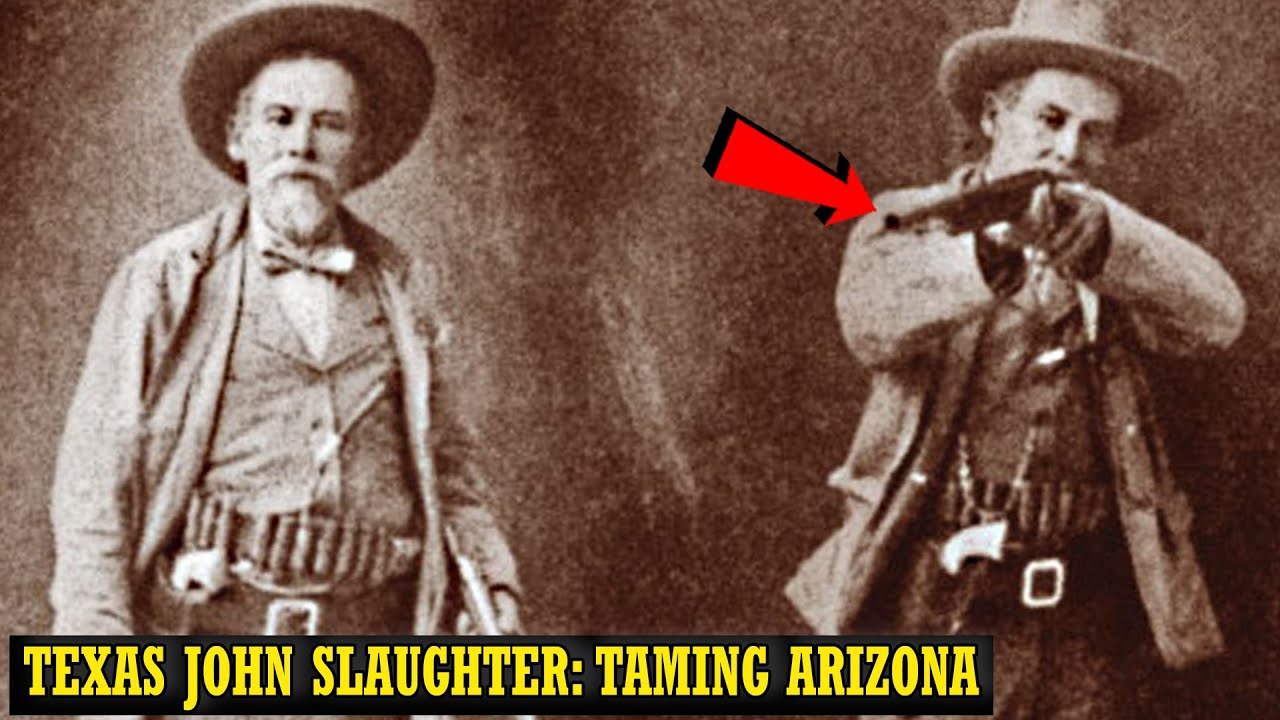
During his time as sheriff, Slaughter became known for carrying a pearl-handled . 44 revolver and a 10-gauge double-barreled sawed-off shotgun, which he referred to as his “equalizer. ”
However, one decision he later faced criticism for was hiring Burton Alvord as a deputy sheriff. Alvord, a skilled tracker, quickly gained a reputation for capturing cattle rustlers and other criminals.
Unfortunately, his heavy drinking eventually led him into a life of crime, and he turned against the law he had once upheld. One of Slaughter’s early challenges as sheriff was pursuing the Jack Taylor gang, who had recently robbed a train near Nogales and fired on the train crew. Slaughter and his posse learned the gang was hiding at the home of Flora Cardinas. By the time they arrived, the gang had already fled.
They then followed leads to Willcox and later to Contention, where they found gang members Manuel Robles and Nieves Deron asleep at the camp of Manuel’s brother, Guadalupe Robles. When Slaughter ordered the two men to get up, a gunfight erupted. To Slaughter’s surprise, Guadalupe Robles, who had been a respected member of the community, joined in. He was shot and killed almost immediately.
Manuel Robles and Nieves Deron attempted to flee, continuing to fire their revolvers as they ran. One of their bullets grazed Slaughter’s ear, but he quickly returned fire, fatally wounding Deron. Despite being severely injured by a shot from Deputy Burton Alvord, Manuel Robles managed to escape. Soon after, gang leader Jack Taylor was captured in Sonora, while Manuel Robles and another accomplice, Geronimo Miranda, were killed by Mexican authorities in the Sierra Madre Mountains.
During his first term as sheriff, Slaughter also supported the U. S. Cavalry in their efforts against Geronimo’s Apache warriors. His success in maintaining law and order was so notable that he was reelected in 1888.
However, during this time, Burton Alvord’s performance as a lawman began to decline. His drinking problem worsened, and he began spending more time in the saloons of Tombstone, mingling with criminal elements. This behavior led to frequent altercations, and Slaughter grew increasingly frustrated with his deputy. As tensions rose, Alvord became disillusioned with both Slaughter and the law.
Eventually, Alvord left his position, and by the turn of the century, he had descended into a life of crime, leaving Slaughter to face lasting criticism for having hired him. By 1890, Cochise County, once notorious for its lawlessness, had largely been brought under control, allowing Slaughter to retire from law enforcement and focus on managing his ranch. In 1906, he briefly served in the territorial assembly, but his primary focus remained on his business ventures and ranching. Over time, he expanded his interests, acquiring a meat market in Charleston and two butcher shops in Bisbee.
His keen business acumen proved valuable, and he also began offering financial assistance to his neighbors, lending money for mortgages and further solidifying his reputation as a trusted figure in the community. In his later years, Slaughter’s health began to decline due to various ailments, including eczema on his hands and feet and high blood pressure. After experiencing a headache the night before, he passed away peacefully in his sleep at his home in Douglas, Arizona, on February 16, 1922. He was laid to rest at Calvary Cemetery in Douglas.
Throughout his life, Slaughter made a significant impact on the Arizona Territory, using both his skill with a six-shooter and his sawed-off shotgun to bring order to the region. His efforts earned him respect and admiration from other notable figures of the Old West, including Wild Bill Hickok, Ben Thompson, Wyatt Earp, Bigfoot Wallace, King Fisher, Sam Bass, Billy the Kid, and Pat Garrett. One lawman who worked alongside Slaughter described him as a figure who was like a spider spinning its web for the unwary fly, emphasizing his strategic approach to law enforcement. Today, the Slaughter Ranch stands as a fully restored museum, preserving the legacy of a man whose influence helped shape the American West.
From his daring days as a Texas Ranger to his pivotal role in bringing law and order to the chaotic lands of Arizona, Slaughter’s life embodies the rugged determination that defined the frontier. He not only tamed lawless territories but also became a symbol of justice in a time when the rule of law was often in question.