
The six-shooter that won the West may never have existed outside a soundstage, and a growing body of firearms scholarship suggests the revolvers Americans actually trusted with their lives have been systematically erased from popular culture.
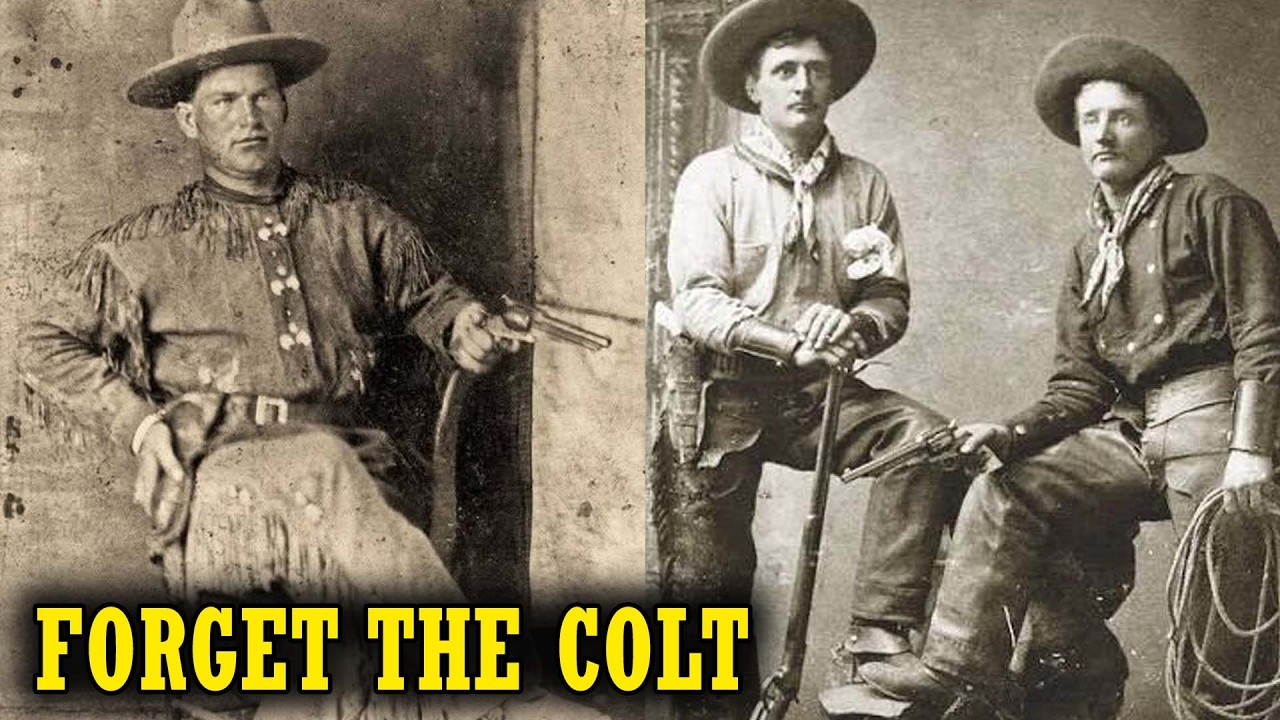
From the precision-machined Merwin Hulbert to the ten-shot Walch pocket pistol, historians and collectors say the frontier was armed with a far stranger and more inventive arsenal than Hollywood has ever been willing to show, and the reasons have as much to do with blank cartridges and prop budgets as they do with historical truth.
The myth is deeply embedded. Generations of moviegoers grew up believing the Colt Single Action Army was the gun that tamed the frontier, its distinctive silhouette and mechanical clicking as familiar as the dusty main street itself. But stepping off a train into a rough town like Deadwood or Tombstone in the late 1870s would have revealed a bewildering variety of handguns carried by lawmen, gamblers, and cowhands alike.
Among those who cared most about engineering and dependability, one name came up again and again: Merwin Hulbert. Produced by Hopkins and Allen in Norwich, Connecticut, under patents held by Joseph Merwin and William Hulbert, the Army revolver was machined to tolerances so tight that working the action created a genuine suction effect inside the frame.
Its selective ejection system let a shooter rotate the barrel a quarter turn and pull the front assembly forward, opening the gun like a mechanism unfolding. Only the longer, expanded fired cases dropped free while shorter unfired cartridges stayed seated, allowing a reload far faster than a Colt user could manage with a rod and loading gate.
Chambered mainly in the proprietary . 44 Merwin and Hulbert round or the respected . 44 Russian, both heavy, slow lead loads driven by substantial black powder charges, it earned a reputation as accurate and formidable.
Period advertisements and shipping records regularly priced Merwin Hulberts above their competitors.
Frontier figures known to have owned or carried them include Pat Garrett, John Wesley Hardin, Bob Dalton, Sam Bass, and Texas Ranger Frank Hamer. It was a discerning owner’s gun, favored by people who valued craftsmanship as much as function.
So why has Hollywood largely forgotten it? The answer has more to do with film production than the gun’s merits. Prop departments need firearms that are simple and reliable when firing blanks.
The same hyper-precise machining that made the Merwin Hulbert exceptional in the 1880s makes it troublesome on a movie set.
Blank cartridges leave heavy, dirty residue, and in a mechanism built with almost no clearance, that fouling can quickly jam the twisting action. Surviving originals are also rare and valuable collector pieces, making them a poor financial risk to expose to the wear of an active film shoot.
The forgotten arsenal does not stop there. For a Union soldier making his way through the smoke and undergrowth of the Wilderness or holding a position at Gettysburg, one silhouette stood out from the rest. It was not the typical sidearm of the Northern cavalry, and it was not built in a New England factory.
It was the LeMat, a large imported piece of ordnance nicknamed the Grapeshot Revolver, arguably the most imposing and unconventional handgun to see American combat. While westerns romanticize the tidy one-on-one showdown, the LeMat was built for overwhelming close-range firepower.
Dr. Jean Alexandre LeMat, a French-born physician who had settled in New Orleans, patented the design in 1856. He partnered with a relative by marriage, his wife’s cousin Pierre Gustave Toutant Beauregard, who would go on to become one of the Confederacy’s most prominent generals.
Once the war began, Beauregard used his influence to help secure production contracts in Paris and London, and the finished revolvers were shipped through the Union naval blockade into Confederate ports like Charleston and Wilmington. Fully loaded, the LeMat weighed over four pounds, a substantial handful compared to typical revolvers of the day.
Its defining feature was a dual-barrel design. Where most contemporary revolvers held five or six rounds, the LeMat cylinder carried nine rounds of . 42 or .
36 caliber ammunition wrapped around a central axis. That axis pin turned out to be the real innovation.
Rather than leave it as a simple mechanical rod, LeMat bored it out into a second smoothbore barrel, roughly 16 to 18 gauge, positioned beneath the main pistol barrel and loaded separately with buckshot. The hammer had a pivoting nose the shooter could flip downward with a flick of the thumb, redirecting the strike to the lower barrel’s percussion cap.
Confederate cavalry commander J. E. B.
Stuart carried one throughout much of the war, including at Yellow Tavern, where he was fatally wounded. General Braxton Bragg was known to favor the weapon as well. Estimates of how many were brought into Confederate service range from roughly 1,500 to nearly 3,000.
After the war, many surviving pistols made their way west in the possession of former soldiers. Hollywood rarely features the sidearm, partly because it does not fit the sleek, symmetrical image of the classic western quick draw. It is front-heavy, somewhat bulky, and includes an old-fashioned ramrod assembly that looks unfamiliar on screen.
There is also a production safety angle. The LeMat was originally a cap-and-ball percussion weapon, and converting an authentic or replica model to safely fire modern blanks, nine pistol-caliber blanks plus one shotgun-size blank from a completely separate barrel, requires specialized gunsmithing that most productions do not bother with.

Then there is the Star double-action Model 1858, a revolver that brought genuinely rapid repeat fire to American hands well before its time. Designed by Ebenezer Townsend Star of New York and patented in the late 1850s, it broke sharply from the design conventions of the day.
At a time when Samuel Colt’s single-action percussion revolvers dominated both civilian and military markets, Star built something meant specifically for fast, close-range use: a sturdy .44 caliber cap-and-ball revolver with an unusually sophisticated internal mechanism.
Instead of a conventional single trigger, the Star used a large forward blade inside an oversized trigger guard that functioned as a cocking lever. Pulling it rotated the cylinder and drew the hammer back. A second, smaller trigger tucked at the rear of the trigger space dropped the hammer and fired the round.
In practice, a shooter did not need to thumb the hammer at all. Simply pulling the trigger repeatedly could cycle through all six chambers in just a few seconds, a genuinely fast rate of fire for the era. A small switch on the back of the trigger blade let a shooter disengage the self-cocking feature for more traditional single-action precision.
The historical record shows the US government took real notice. During the Civil War, government purchasing records show the Army bought around 20,000 to 23,000 Star double-action revolvers, making Star the third-largest supplier of revolvers to Union forces after Colt and Remington.
After the war, large numbers of surplus Stars entered the civilian market and made their way west with settlers, scouts, and early lawmen. Filmmakers, however, rely on pacing and suspense, and the slow, deliberate click of a hammer being thumbed back builds tension in a way that suits the genre.
A gunfight resolved almost instantly by rapid trigger pulling does not create that same dramatic buildup. To modern audiences, its speed can look more like a twentieth-century double-action revolver than a nineteenth-century frontier weapon, breaking the visual tone directors are going for.
There is also a practical mechanical reason. The Star’s cocking and firing linkage was intricate and required careful timing even when new. The Model 1863 that replaced it during the war actually dropped the double-action feature in favor of a simpler, more durable single-action design.
In the tight, crowded quarters of a boomtown saloon, a large combat revolver was awkward to carry. It caught on clothing, could not be hidden, and took too long to bring into action. Gamblers, undercover lawmen, and others who needed protection in close quarters usually favored something smaller.
In the early 1870s, that meant the Colt Cloverleaf House pistol, introduced by Colt’s Patent Firearms Manufacturing Company in 1871. This compact revolver was a significant departure from the large military-style guns that had built the company’s reputation.
It was designed by Charles Brinckerhoff Richards and William Mason, the same engineers who would go on to design the Single Action Army just a couple of years later. What made the Cloverleaf distinctive was its cylinder, a compact four-round design with recessed chamber walls that, viewed from the front, resembled a four-leaf clover.
That slim cylinder profile, combined with a short barrel of 1. 5 or 3 inches depending on the model and a smooth bird’s head grip, allowed the revolver to tuck neatly into a vest pocket, boot, or sleeve. It was chambered in .
41 rimfire, a notably larger and more powerful round than the . 22 or . 32 caliber typical of pocket pistols at the time.
The gun was never adopted by the military, but historical records show it found solid commercial success on the civilian market. It is perhaps best known today for its connection to a notorious real incident: financier James “Jubilee Jim” Fisk was shot and killed with one in 1872 by Edward Stokes during a personal dispute.
Westerns lean heavily on a rugged, larger-than-life aesthetic, and a long-barreled Colt worn low on the hip instantly signals authority and toughness on screen. A four-shot pocket gun, by comparison, does not carry that same visual weight, even though its cartridge was genuinely potent for its size.
Original Colt Cloverleafs are also relatively scarce today. Only a few thousand were produced during their five-year run from 1871 to 1876, making surviving examples valuable to collectors and difficult for prop houses to source or safely modify to fire blanks.
Step into a frontier gunsmith shop in a city like St. Louis or Kansas City in the early 1860s, and past the familiar shapes of Colt and Remington percussion revolvers, you would eventually spot something stranger: a gun that looked more like a piece of industrial machinery than a typical sidearm.
That was the Savage Navy Model 1861. Built by the Savage Revolving Firearms Company in Middletown, Connecticut, under patents held by Henry S. North and Edward Savage, it took a genuinely different approach to how a shooter’s hand worked the gun.

Its most recognizable feature was a large heart-shaped trigger guard housing two separate triggers stacked vertically. The lower one was a ring-shaped lever meant for the middle finger. The upper trigger handled the actual firing and was operated with the index finger.
This two-trigger setup gave the shooter a real practical advantage. Rather than using the thumb to cock a hammer, a motion that could disrupt a steady grip on horseback, the shooter pulled the lower ring lever with the middle finger. That single motion cocked the hammer and rotated the cylinder to the next chamber.
The Savage Navy’s other notable feature was how it handled gas pressure. Ordinary cap-and-ball revolvers lost some power through the gap between the cylinder and barrel, and that same gap was often blamed for chain fires. The Savage Navy addressed this with a cylinder that moved forward as the ring lever was pulled, seating tightly against the rear of the barrel.
US Ordnance records show the federal government contracted for roughly 12,000 of these revolvers beginning in late 1861, with total production reaching about 20,000 units once civilian and other sales are included. They saw service with several Union cavalry units, including regiments from Wisconsin and Kansas.
Audiences expect a familiar silhouette, a sleek single-trigger Colt sliding smoothly from a leather holster. The Savage Navy’s dual-trigger design and bulky frame looks unfamiliar by comparison, more like something out of a steampunk film than a period western.
By the mid-1870s, people who depended on their sidearm for survival were not loading bullets one by one if they could help it. Many carried the Smith and Wesson Model 3 Schofield instead, a large revolver that represented a real advance in handgun ergonomics.
It was a set of modifications by Major George W. Schofield of the 10th US Cavalry, patented in the mid-1870s, that turned it into a frontier favorite. Schofield, who served with the Buffalo Soldiers on the Southwestern Plains, recognized that managing a standard revolver on horseback was awkward at best.
What set the Schofield apart mechanically was its top-break automatic ejecting design. Pulling back the latch just ahead of the hammer let the shooter swing the barrel and cylinder assembly downward. As the action opened, a spring-loaded star extractor in the center of the cylinder lifted and ejected all six spent casings at once.
Instead of loading cartridges individually, a shooter could drop six fresh rounds in together, snap the revolver closed, and be ready to fire again in well under thirty seconds, roughly half the time it typically took to fully reload a Colt Peacemaker.
The Army purchased around 8,000 to 8,300 Schofields by 1879, and it was issued to cavalry regiments including the 4th, 9th, and 10th, the latter two comprising the Buffalo Soldiers. Jesse and Frank James, Wyatt and Virgil Earp, John Wesley Hardin, Pat Garrett, and lawman Bill Tilghman are all reported to have carried one at some point, along with Theodore Roosevelt.
In a movie, speed works against 𝒹𝓇𝒶𝓂𝒶. If a character can reload in a few seconds, the tension of whether they will finish in time disappears. The Colt’s slower, more visible reload process gives directors room to build that suspense.
Real history tells a more varied story than the movies. Pioneers, lawmen, and outlaws navigating the harsh conditions of the Southwest and the Northern Territories often wanted something built primarily for durability, a revolver that could survive a horse fall, bad weather, or rough handling. For many, that gun was the Remington Model 1875.
Introduced by E. Remington and Sons of Ilion, New York, the Model 1875, also known as the Improved Army or Frontier Army, was built to compete directly with Colt for both civilian and government buyers. Running along the underside of the barrel was a distinctive solid steel web that reinforced the whole front end of the revolver.
On a Colt, the ejector rod housing was a separate, thinner piece attached with a single screw, which could loosen or bend with hard use. Remington instead built the housing directly into the frame. The Model 1875 was offered in several serious calibers, including .
44 Remington, . 44-40 Winchester, and later . 45 Colt.
The . 44-40 chambering in particular gave frontier users a practical advantage. It used the same ammunition as the widely carried Winchester Model 1873 rifle, letting someone carry a single type of cartridge for both weapons.
The US Department of the Interior purchased 639 nickel-plated units in 1883 for use by Indian police forces on western reservations.
Perhaps its best-known association is with outlaw Frank James, who carried a Model 1875 and upon surrendering to Missouri’s governor in 1882 reportedly called it the hardest and best shooting pistol made.

During the studio era of the 1930s and 1940s, prop houses often bought up large, inexpensive lots of surplus Colt revolvers since they were far more plentiful than surviving Remingtons. Because the two guns look broadly similar from a distance, it was simpler and cheaper for productions to standardize on the Colt.
In the late 1850s and early 1860s, a small number of people carried a pocket pistol built specifically to defy the expectation that a revolver holds six shots. From the outside, it looked and handled like an ordinary pocket revolver, but it carried a hidden reserve of firepower. This was the Walch ten-shot pocket revolver.
Patented in 1859 by John Walch of New York, the design addressed a common frustration with early personal defense weapons: limited capacity. What made this possible without making the gun bulky was an unusual approach called superimposed loading.
Where a standard revolver holds one charge per chamber, the Walch’s cylinder chambers were bored deep enough to hold two complete powder and ball charges stacked one behind the other. Firing this safely required two hammers and two triggers arranged side by side.
Cycling through all five, or in some versions six chambers, this way let a small pocket-size revolver deliver up to ten or twelve shots total. Roughly 200 of the larger . 36 caliber Navy twelve-shot models were produced, and around 3,000 of the smaller .
31 caliber ten-shot pocket models were manufactured by the New Haven Arms Company.
The concept of superimposed loading is not something a general audience would immediately grasp, and explaining it on screen would interrupt the pacing of an action sequence. Modern blank cartridges also rely on carefully controlled gas pressure, and designing a safe double-loaded blank system is a real engineering challenge most productions would simply avoid.
Texas Rangers patrolling the borderlands in the 1850s and 1860s and other frontier figures who prized raw stopping power sometimes looked overseas for their sidearms. Among the imported options, one heavy British revolver earned a real reputation on the American frontier: the Tranter, designed by William Tranter of Birmingham, England.
Tranter had already built and licensed thousands of Adams-pattern revolvers before developing his own refinements, aiming to combine speed of fire with genuinely large calibers. The early Tranter stood out for its dual-trigger design, and later models simplified this into a single-trigger double-action mechanism while retaining solid frame construction notably sturdier than the open-top frames common on Colt revolvers.
Tranter offered his revolvers in genuinely large calibers by American standards, including . 442, . 50, and even .
577 bore variants, well beyond the . 36 or . 44 caliber typical of US military sidearms of the time.
With almost no domestic arms manufacturing capacity, the Confederacy relied heavily on imported weapons.
Thousands were shipped from Birmingham to the South, and the gun earned a following among Confederate officers including cavalry commander J. E. B.
Stuart. It was not, however, a Confederate government-issued standard arm. It arrived through private and commercial import channels rather than official contracts.
By the 1870s and 1880s, western boom towns like San Francisco, Denver, and Tombstone had grown into dense, crowded urban spaces, saloons, alleyways, and gambling halls packed close together. In those tight quarters, a long combat revolver was often impractical, slow to draw, and impossible to conceal.
For everyday self-defense in that kind of environment, many people turned to something smaller: the British Bulldog revolver, widely produced in America by makers like Forehand and Wadsworth. Originally designed by Philip Webley and Son of Birmingham, England, in 1872, the British Bulldog quickly became an international sensation.
Despite its small size, the Bulldog was solidly built. It featured a solid frame design, a short 2. 5-inch barrel, and a distinctive curved bird’s head grip that sat securely in the hand.
It was most commonly chambered in the . 44 Bulldog cartridge, a wide, slow-moving lead round backed by a solid black powder charge.
Period hardware catalogs, including Montgomery Ward listings from the 1880s, show these compact revolvers sold in large numbers, often outselling the pricier Colt Peacemaker among ordinary shopkeepers, miners, and travelers. The design is also tied to a sobering moment in American history: in 1881, Charles Guiteau used a . 442 caliber Bulldog-style revolver to shoot President James A.
Garfield, who died several months later.
Westerns tend to favor tall, striking figures in long coats carrying long-barreled revolvers, an image that has become the genre’s visual shorthand. A stubby pocket revolver does not fit that picture. To a modern audience, it can look more like something from a later crime 𝒹𝓇𝒶𝓂𝒶 than a frontier film.
The Colt Peacemaker may own the myth, but the real Old West was armed with a far stranger, more inventive arsenal: guns that fired ten shots from a five-round cylinder, revolvers with a shotgun hidden in the barrel pin, and pocket pistols powerful enough to end a presidential term.
Hollywood picked one silhouette and ran with it for a century. But the frontier itself was an arms race of clever, sometimes bizarre engineering that never made it to the screen, and the gap between what audiences believe and what actually hung on a lawman’s hip grows wider with every passing generation of westerns.