
Last time we talked about Brushy Bill Roberts, the Texas man who claimed Billy the Kid didn’t die in 1881. But today’s twist doesn’t happen in Texas. It happens in an Arizona cemetery.
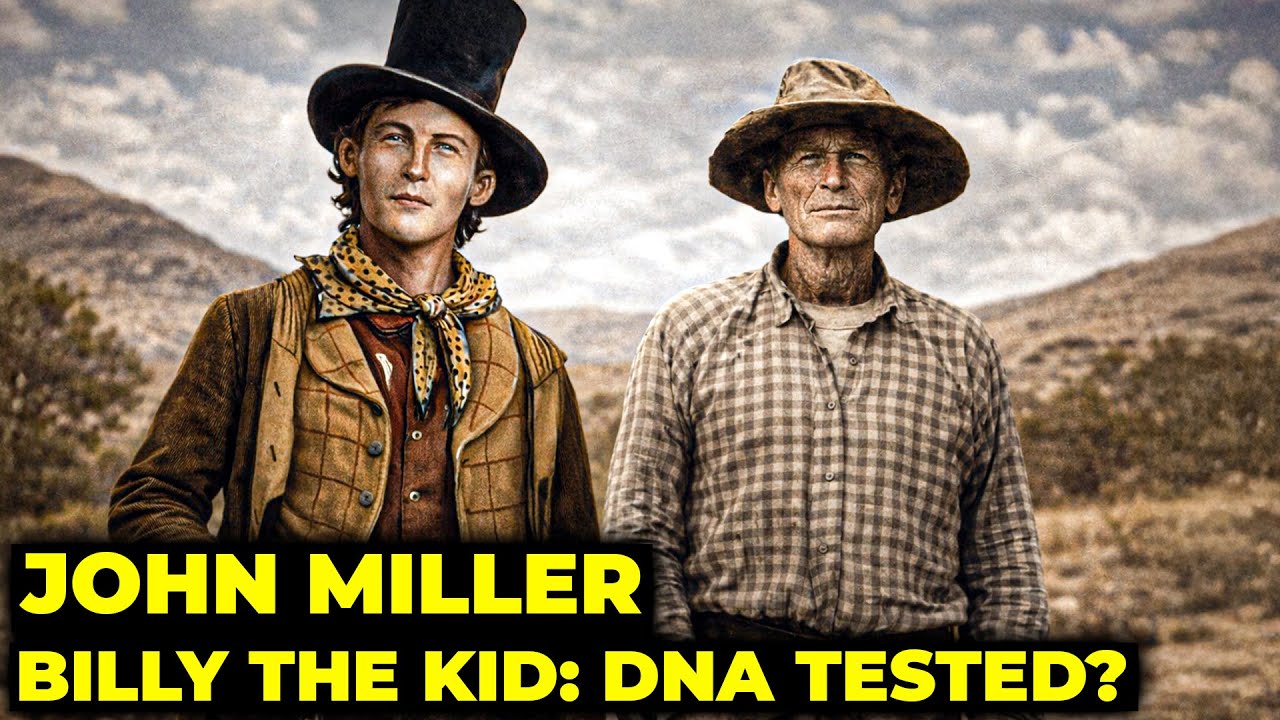
Because in May 2005, two investigators went to the Arizona Pioneers Home Cemetery in Prescott and did something most Billy Survived stories never dare to do. They opened a grave.
Not Billy’s grave.
The grave of a man named John Miller, who died in the late 1930s and who some people believed was Billy the Kid living under a new name.
And it didn’t stop at rumors. They took DNA from the remains and tried to compare it to blood traces linked to the night Billy was supposedly killed.
Sounds like it should end the debate, right? The reality is way messier, and that’s exactly what makes the John Miller case so wild.
Number one, a grave in Prescott.
In May 2005, in a quiet cemetery in Prescott, Arizona, two men showed up with a mission that sounds like a movie plot, but played out in real dirt, real paperwork, and real consequences.
They weren’t digging for gold, and they weren’t looking for some anonymous bones from the 1800s. They were looking for a specific man buried in the Arizona Pioneers Home Cemetery, John Miller, who died on November 7th, 1937.
And the reason they wanted John Miller wasn’t because he was famous under that name. It was because some people believed John Miller had lived most of his life under a different name entirely. William H.
Bonney, better known as Billy the Kid.
That’s the weird little hinge point of this whole case. This wasn’t the usual my grandpa told me a story situation.
This wasn’t somebody waving around a blurry photo and swearing they can see Billy’s jawline if you squint hard enough.
This was a survival legend that went all the way to the most serious, most irreversible step you can take in a historical mystery. Opening a grave.
The two investigators tied to the exhumation were Tom Sullivan, a former sheriff in Lincoln County, New Mexico, and Steve Sederwall, a former mayor in Capitan, New Mexico. They weren’t casual fans. They had been chasing Billy the Kid proof for years.
And like a lot of people who get pulled into Old West questions, they learned fast that the story isn’t just outlaws and lawmen. It’s counties, courts, tourism money, politics, and people who don’t want their town’s most famous legend turned into a lab project.
Their original holy grail target was the most iconic grave of all, the spot in Fort Sumner, New Mexico, where history says Billy the Kid was buried after Pat Garrett shot him on July 14th, 1881.
But that famous grave is also a mess. The cemetery flooded in the early 1900s. Markers disappeared, stories piled up.
The grave became a symbol, a tourist stop, and an argument.
And when a grave becomes a landmark, it stops being just a body in the ground. It becomes a community’s identity, which means getting permission to dig is like trying to borrow the town’s crown jewels.
Sullivan and Sederwall spent a long time trying to get traction for an exhumation in New Mexico. And then instead of pushing straight through the hardest door, they switched strategy. They went after the claimants.
That’s the logic that took them to Arizona. Because if you can’t easily test the famous grave, you test the men who pop up decades later saying, actually, I’m the real Billy.
John Miller was one of those names.
Not as loud in public as the Texas claimant Brushy Bill Roberts, but persistent in the legend world because of one nasty little detail. John Miller’s early life is foggy.
Researchers point out that John Miller shows up clearly in records in 1881, right after Billy the Kid is supposed to have died, then lives for decades, works, moves around, and stays relatively quiet.
That kind of gap is like candy to a survival theory. If the paper trail is thin, the imagination fills it in.
So in Prescott in 2005, they decided to stop imagining and start sampling.
They opened the ground, recovered material, and sent it to be tested.
The plan wasn’t to compare Miller’s DNA to Billy the Kid’s DNA because nobody has a confirmed biological sample from Billy himself sitting in a vault somewhere.
The plan was to compare Miller’s DNA to stains taken from objects tied to the Billy story, especially a carpenter’s bench that was claimed to be the one Billy’s body was laid on after the shooting in Fort Sumner.
That right there is the core gamble of the John Miller case. Not just is this man Billy, but can we build a DNA chain strong enough when the reference evidence is basically historical rumor with a label on it?
And that’s why this case never stops being talked about.
It’s not only a Wild West story. It’s a modern story about proof, about how fragile evidence becomes when you’re more than a century late, and about how quickly a DNA test can turn into a new kind of legend instead of an answer.
Number two, the man named John Miller.
To understand why anyone would connect John Miller to Billy the Kid, you have to see how the John Miller story feels when you hear it the first time. It doesn’t feel like a guy trying to cash in. It feels like a man who wanted to disappear.
John Miller’s last chapter is fairly clear. He ended up at the Arizona Pioneers Home in Prescott, a state-run place with its own cemetery, and he died there in 1937. That part isn’t a rumor.
That’s a real date in a real record.
The part that gets slippery is everything around it. Where he came from, what he did, why he kept certain things quiet, and why people around him later started whispering that he had a secret.
In the John Miller legend, the earliest hard paper people point to is a marriage record dated August 8th, 1881 in Las Vegas, New Mexico, showing a man named John Miller marrying a woman named Isidora.
That date matters because it lands just weeks after Billy the Kid is supposed to have been killed. Survival story fans love that timing because it feels like a clean handoff.
One identity dies in Fort Sumner. Another identity gets married in Las Vegas.
It’s neat.
It’s cinematic. Real life is usually not that neat, but you can see why the timing became the hook.
From there, the John Miller story branches into two tracks.
Track one is the normal life track. John and Isidora living in the Southwest, moving around, working ranch jobs, doing what a lot of people did on the edge of the Old West as it was turning into the modern West.
Not everyone was a shootist.
Most people were trying to eat, keep animals alive, find water, fix fences, and avoid trouble.
Track two is the legend track. Stories of John Miller knowing way too much about Billy the Kid’s life.
Stories of him being unusually skilled with a gun. Stories of him avoiding photographs, avoiding deep conversations about his past.
And then this is the part that always shows up.
Stories that he would deny being Billy in daylight, but get sloppy when he’d been drinking and let something slip.
It’s not hard to see how a community can build that kind of tale around a quiet man, especially in the Southwest where stories travel faster than paperwork.
And there’s another detail that keeps getting repeated because it fits the Old West vibe.
John Miller and Isidora are often described as living in a way that made them hard to pin down. Moving often, staying outside town, keeping to themselves.
In a world of outlaws and lawmen, that kind of lifestyle gets read like a code.
People think he’s hiding. Sometimes a person is hiding. Sometimes a person just doesn’t like people.
The problem is the legend doesn’t care which one is true. It takes the behavior and turns it into a storyline.
And then there’s the family angle, which is where the John Miller case becomes emotionally sticky.
John and Isidora are sometimes said to have adopted a Native American boy, usually named as Max in retellings.
That matters because once you have a family line, you have living descendants or extended family who can carry the story forward as something personal, not just a campfire myth. A legend becomes harder to 𝓀𝒾𝓁𝓁 when it lives inside a family identity.
You’re no longer arguing about a random outlaw. You’re arguing about someone’s great-great-grandfather.
Add in one more ingredient.
A rumor that John Miller left behind a trunk with secrets, papers, maybe a gun, maybe letters, maybe something that proves it. And now you’ve got the perfect Old West recipe. A quiet man, a mysterious past, a missing object, and a famous name.

It’s basically designed to last forever because it’s built around absence. If the trunk can’t be found, it’s always out there. If the paper trail is thin, it’s always covered up.
If John Miller never sat down and did a public confession tour, it’s always because he was smart. That’s the kind of logic that feeds itself.
But here’s what makes John Miller different from a lot of other Billy survival claims.
The ending isn’t just a story. The ending is a grave, and people actually went into it.
That act pulled John Miller out of the category of interesting rumor and dropped him into the category of forensic problem.
Because once a body is part of a DNA hunt, the question stops being poetic. It becomes brutally practical.
What exactly did you recover?
How clean is it? What can you compare it to? And can you prove your comparison isn’t garbage?
Number three, why Billy’s identity is a magnet. The Billy the Kid legend attracts survival claims the way a bright light attracts bugs at night. And it’s not just because Billy was famous.
It’s because the historical situation around him is the perfect storm for confusion.
Start with the basics. Billy the Kid lived fast, used multiple names, and moved through a chaotic part of the American Old West where records were inconsistent, spelling shifted, and people lied casually because it was useful.
Even his birth details are argued over.
That doesn’t mean anything is possible. It just means the foundation is already shaky, which makes it easier for later stories to wedge themselves in.
Then there’s the death scene, which is the centerpiece of everything. The official version is that Pat Garrett shot Billy in the dark at Pete Maxwell’s house in Fort Sumner on July 14th, 1881. The lighting was poor.
Identification was based heavily on voice and context.
Afterward, the body was handled quickly, buried quickly, and turned into a legend almost immediately. In modern true crime terms, the chain of custody is basically a nightmare.
You don’t have a clean set of photographs of the body. You don’t have a full forensic report the way you’d expect now. You have stories and an inquest summary from an era where forensics meant people look at the body and agree it’s him.
That was normal. Then it’s not a 𝒔𝒄𝒂𝓃𝒹𝒶𝓁. It’s just the reality of the time.
But modern audiences hear that and think, so you’re telling me it was dark? Everyone was stressed and then they buried him fast. And you want me to treat that as perfect proof?
That gap between old methods and modern expectations is the oxygen survival claims breathe.
The next problem is physical evidence. Billy the Kid is one of the most famous outlaws in American history.
But the confirmed physical evidence is shockingly thin.
As of now, the only widely accepted authenticated photo of Billy as a young man, the famous tintype, sold at auction in 2011 for about $2. 3 million.
That number matters because it shows you the market value of Billy proof.
When a single small image is worth millions, everything connected to the story becomes a kind of treasure hunt. People start searching attics and junk shops and old family boxes.
Some of that searching is honest. Some of it is wishful thinking. Some of it is straight up fraud.
But the effect is the same. The story gets noisier. Every new artifact becomes a fresh argument.
And because Billy is culturally huge, the arguments don’t stay in academic circles. They spill into documentaries, podcasts, local newspapers, museums, tourism boards, and even state politics.
Another reason Billy is a magnet is how the Old West has been packaged.
The Old West was complicated. Ranch economics, land disputes, ethnic tension, corruption, territorial politics, real violence, and communities trying to survive.
But pop culture turns it into a cleaner 𝒹𝓇𝒶𝓂𝒶.
Outlaw versus lawman, bad versus good, freedom versus order. Billy the Kid sits right in the middle of that 𝒹𝓇𝒶𝓂𝒶.
He’s been portrayed as a cold killer, a folk hero, a kid who got trapped in a dirty war between powerful factions.
When a figure becomes that flexible, he becomes reusable. People can fit him into whatever story they want to tell about rebellion, about injustice, about the birth of modern policing, about mythmaking in America.
And if Billy can be reshaped in stories, it’s not a big jump for some people to believe he could be reshaped in life, too.
𝒻𝒶𝓀𝑒 death, new name, quiet old age.
Finally, there’s the geography and what happened to the graves. Fort Sumner cemetery had floods in the early 1900s, and the Billy grave marker story is its own saga of thefts, replacements, and protective cages.
That doesn’t prove Billy survived, but it does keep alive the idea that the burial site is uncertain, disturbed, or symbolic rather than strictly scientific. If you can’t point to a grave and say this is definitely him and we can test it, then every alternative claim gets a little more room to breathe.
That’s why John Miller matters.
He isn’t the loudest claimant, but he’s one of the few where investigators tried to force the legend to collide with biology. The trouble is, biology doesn’t solve mysteries by vibes. It solves them with clean samples and clean comparisons.
And in the Billy story, clean is exactly what you don’t have.
Number four, the hunt and the exhumation. When people picture a DNA investigation, they usually imagine lab coats and sleek machines and a clean match no match answer.
The John Miller case was the opposite. Dusty paperwork, local officials, and a whole lot of gray area.
Sullivan and Sederwall weren’t operating in a vacuum.
In New Mexico, the effort to do DNA testing around Billy had already turned into a public battle.
Part of the plan in those years was to exhume not only the body believed to be Billy at Fort Sumner, but also Billy’s mother, Catherine Antrim. Because if you can locate her remains, mitochondrial DNA could potentially help confirm or eliminate a match.
Mitochondrial DNA is passed down through the maternal line. It doesn’t give you a this is definitely Billy slam dunk, but it can tell you whether two people could share a maternal line. It’s a tool.
But even getting to the tool requires you to locate the right grave, get legal permission, and deal with communities that don’t want their cemeteries turned into dig sites.
So, the hunt shifted to Prescott, where John Miller was buried in a state-run cemetery connected to a care facility. On paper, that sounds simpler.
In real life, it still blew up.
The exhumation happened in May 2005. A key detail that kept coming up afterward is that the grave was unmarked.
That alone can cause problems. If you don’t have a clear marker and clear records, you risk disturbing the wrong remains.
And in this case, that risk became part of the controversy because remains from an adjacent unmarked grave, often identified in reports as belonging to a man named William Hudspeth, were also disturbed.
Whether you frame it as an accident, a mistake, or reckless behavior depends on who you ask. But the fact is, once you touch two graves, you’ve doubled the ethical and legal heat instantly.
After the exhumation, there was real talk from authorities about charging the investigators because taking human remains without proper permits is not a slap on the wrist issue.
It’s serious.
The investigators argued they believed they had permission from an official connected to the facility. Critics said that wasn’t enough and that permission to dig is not the same as permission to remove remains and ship them for testing.
Eventually, authorities decided not to prosecute. But the fact that it got that far tells you how tense this was. This wasn’t some fun hobby project.
It was a clash between people who saw themselves as truth seekers and a system that treats graves as protected for good reason.
Now add the practical reality. The moment you exhume remains, you’ve introduced risks that can ruin the science.
Bones and teeth can hold DNA, but after decades in the ground, the DNA is degraded.
The sample can be contaminated by handling. It can be mixed if remains were disturbed historically.
And because the grave was unmarked, even the basic question, is this definitely John Miller, becomes harder than people think.
That’s why some accounts from the dig focus on physical clues, injuries, dental features, things that fit the story of John Miller’s life, like a hip injury that might match the way he ended up at the pioneers home. But again, that kind of matching is suggestive, not definitive.

Lots of people had injuries. Lots of people had similar dental traits. If you’re already emotionally invested, those details feel like confirmation.
If you’re a cautious investigator, they feel like noise.
Still, Sullivan and Sederwall went forward, recovered material, and shipped DNA samples to a lab in Dallas connected to the broader Billy DNA effort.
The big hope was simple.
Get a usable profile from John Miller. Get a usable profile from the bench blood or other claimed Billy-linked evidence. And see if there’s a match.
On the surface, it sounds like a straightforward plan. Under the surface, it’s more like building a bridge over a canyon using rope you found in a shed. It might hold.
It might snap. And if it snaps, you don’t just lose the case. You create a new argument that lasts another 50 years.
Number five, the DNA dream and the bench problem. Here’s the part people don’t like hearing. DNA isn’t magic.
DNA is incredibly powerful when you have the right conditions. But when you don’t, it can become a very expensive way to learn that your evidence is basically a mess.
The John Miller case was built around a DNA comparison that depended on historical objects being exactly what people claimed they were.
The famous one is the carpenter’s bench, supposedly used to lay out Billy’s body after he was shot in Fort Sumner.
Investigators said they had access to that bench and that blood traces were present. They also talked about other sources like old courthouse floorboards connected to Lincoln County history.
The logic was understandable. If you can’t dig up Billy’s confirmed grave, maybe you can extract his DNA from something he bled on. The problem is obvious once you say it out loud.
How do you prove the blood is Billy’s?
You can’t just point at an old stain and declare it. You need chain of custody.
You need documentation showing where the object was, how it was stored, who handled it, and why you should trust that the stain wasn’t contaminated by someone else’s blood, or that the bench wasn’t used for other bodies, or that the stain even dates to the right era.
Old West towns weren’t sterile places. Benches got used.
Wood got moved. Buildings got renovated. Museums swapped items.
Private collectors bought and sold things. Every one of those steps is a chance for confusion or contamination.
Also, even if you do have blood, old blood often contains very little usable DNA, especially after a century of exposure.
Heat, humidity, cleaning, and plain time break DNA down into fragments.
Modern labs can sometimes pull partial profiles from tiny degraded samples. But partial profiles create partial certainty.
And partial certainty is rocket fuel for arguments.
Another issue is mixture. A stain isn’t always from one person.
It can be layered. It can include DNA from multiple handlers. If someone touched it with bare hands, you can end up reading the DNA of the last person who handled the bench more clearly than the person who bled on it in 1881.
That’s not a Hollywood twist. That’s normal forensic reality. People hear DNA test and imagine a crisp name label.
Real forensic work often looks like this sample is too degraded. This sample is a mixture. This sample is consistent with many people or this sample cannot be interpreted with confidence.
And here’s the deeper issue. Even a match might not settle anything if the reference sample is disputed. Imagine in a perfect world that John Miller’s DNA profile matched DNA extracted from the bench.
What would that prove?
It would prove that John Miller’s DNA matches whatever DNA is on that bench. It would not prove beyond argument that the bench DNA belongs to Billy the Kid.
You’d still have to convince people that the bench is authentic, that the stain is Billy’s, and that the profile isn’t contaminated.
In other words, you’d still be stuck debating history, except now you’d be debating it with lab language added on top. That’s why DNA in historical cases needs something solid to anchor it.
A confirmed reference sample.
The cleanest anchor would be a confirmed maternal relative, like Billy’s mother, if her remains could be confidently located and sampled with proper permission. Another possible anchor would be a confirmed personal item directly tied to Billy with solid documentation, something like hair in a sealed envelope with a proven chain of custody.
But those kinds of anchors rarely exist for 19th century outlaws who weren’t thinking about future forensic science. And when people don’t have anchors, they grab whatever seems close enough. A bench, a floorboard, a rumor about a blood soaked object kept safe for generations.
The John Miller case is basically the story of what happens when you try to do modern science on evidence that was never preserved to modern standards. It doesn’t mean the effort was pointless. It means the effort was always going to be controversial and the results, whatever they were, were unlikely to end the argument cleanly.
Which brings us to the most frustrating part of the story. The results didn’t land like a final verdict. They landed like smoke.
Number six, the quiet results and the paper war. After the exhumation and the lab work, you’d expect one of two things. Either a public announcement with documentation or a public announcement that the test failed.
What happened instead was the worst possible outcome for anyone who wants the story to end. The DNA work became private, disputed, and legally tangled.
Reports and summaries have circulated, saying the testing did not provide a clear, conclusive answer.
Some accounts describe the results as essentially unusable for proving identity. Others hint at claims that something meaningful was found, but never backed up in a way that convinced the wider historical community.
And when results aren’t clearly presented, the vacuum gets filled instantly.
People start narrating the silence. One side says they didn’t release it because it disproved the claim. The other side says they didn’t release it because it proved too much and officials don’t want the fallout.
Silence is like that. It can be turned into whatever shape someone needs.
On top of that, the Billy DNA effort wasn’t only about John Miller.
It also involved claims about other remains and other pieces of evidence, and it got pulled into legal fights over public records.
At one point, a lawsuit under New Mexico’s public records laws forced the release of documents connected to the investigation. The released material confirmed that reports and lab work existed, but it didn’t hand the public a simple yes or no to the Billy survival question.
In other words, people got papers, but not closure.
And that’s important because for a lot of true crime style audiences, paperwork feels like proof. If there are documents, people assume there must be a hidden answer inside them.
Sometimes there is, sometimes there isn’t. Sometimes the documents just confirm that the case is messy.
Another problem is that even when a lab produces an internal conclusion, releasing it publicly is complicated.
Labs have confidentiality rules. Investigators have legal limits, and if the profile is partial or mixed, professionals might be cautious about letting raw results out into a world where non-experts will treat them like a scoreboard.
That caution can be responsible.
It can also look like a coverup to people who already distrust institutions. That distrust is especially common in Old West legend circles because the West itself was full of corruption and power games. People project that old world cynicism onto modern agencies.
Of course, they’re hiding it.
Then there’s the human side. Even if you’re convinced you’re chasing the truth, digging up someone’s grave is an emotional act.
It isn’t neutral. There are ethical questions about disturbing remains for a claim that might never be provable.
There’s also the question of consent.
John Miller is not a museum artifact. He was a person. His grave exists because his life ended and people laid him to rest.
When investigators move into that space, the story stops being just history and becomes a moral argument.
Some people see exhumation as a legitimate tool of investigation. Others see it as crossing a line, especially when the target is a claimant whose identity claim was never formally documented in a way historians accept.
And because the John Miller dig also disturbed another grave, the criticism got louder. Even though no charges were filed, the damage to credibility was real. In cases like this, credibility is everything.
If people don’t trust your process, they won’t trust your result, even if it’s correct.

And the John Miller case didn’t happen in a calm environment. It happened in the middle of a Billy the Kid culture war where towns, museums, descendants, historians, and buffs all have their own stake in what the truth should look like.
The result is that John Miller’s DNA became part of the legend instead of the end of it. It turned into another object people talk about without being able to hold it up and say, here, this settles it.
And once that happens, the story shifts from who was John Miller to why can’t anyone settle this, which is basically the Billy the Kid mystery in a nutshell.
Number seven, the pardon shadow. One reason the Billy DNA hunt got so much attention is that it wasn’t only about science. It was tied to something that sounds almost unreal.
The idea of a government-issued pardon for Billy the Kid based on a promise made in the 1870s.
Back in 1879, New Mexico Territory Governor Lew Wallace, yes, the same Lew Wallace who wrote Ben-Hur, was trying to calm the chaos of the Lincoln County War era.
Billy the Kid, or William H.
Bonney, offered to testify about a killing in exchange for protection and clemency. Letters between Wallace and Bonney exist, and they show that some kind of deal was discussed.
The details of what was promised, what was meant, and what was politically possible are still debated.
But the important part is this. Billy believed he’d been promised a pardon. And he later complained that the promise wasn’t kept.
That disagreement, whether Wallace offered real clemency or whether the situation fell apart, became one of the biggest what-ifs. If Billy was promised a pardon and didn’t get it, people start framing him not just as an outlaw, but as someone played by the system. That framing is powerful, especially in a culture that loves the idea of the underdog versus corrupt power.
Fast forward more than a century, and the pardon idea comes roaring back in modern politics. New Mexico Governor Bill Richardson publicly explored the possibility of a posthumous pardon for Billy, specifically tied to the killing of Sheriff William Brady.
This wasn’t a small local rumor.
It was a real public discussion. People argued about it fiercely. Descendants weighed in.
Law enforcement groups had opinions. Historians were split. And the state government had to treat it like an actual decision, not a joke.
Richardson ultimately announced on December 31st, 2010, his last day in office, that he would not pardon Billy the Kid. His reasoning focused on the lack of conclusiveness and the historical ambiguity around the original promise.
That phrase matters because it basically captures the whole Billy problem in plain language.
You don’t have a clean foundation to make a clean modern decision.
And when a governor says, we can’t be sure, it doesn’t calm the story down. It does the opposite.
It tells the public officially that uncertainty is part of the record.
Now connect that back to the DNA chase. The pardon conversation made the Billy story feel present tense, not this happened in 1881, but this is still alive enough that a governor has to address it.
That energy spills into everything else, including the John Miller exhumation.
If the state is even talking about pardons, then in the minds of some investigators and fans, the case feels open, like the book hasn’t been closed. And if the book isn’t closed, then digging up John Miller can be framed as part of finishing the job.
But here’s the catch. Government decisions don’t run on legend logic. They run on evidence that can be defended publicly.
A pardon, even posthumous, is still an official act. It’s a statement. It becomes part of the historical record.
And no governor wants to sign a statement that collapses under the first serious challenge.
So the pardon debate highlighted the same brick wall the DNA debate hits, the proof standard. What counts as good enough when you’re dealing with the Old West?
Is a letter good enough? Is witness memory good enough? Is a rumored bench stain good enough?
Is a DNA profile that depends on disputed objects good enough?
People answer those questions differently depending on whether they’re thinking like a historian, a politician, a forensic scientist, a tourist town business owner, or a descendant who grew up hearing one version of the story at the dinner table.
The John Miller case sits right at that crossroads.
It’s not only was he Billy, it’s what would you accept as proof in a world where proof was never preserved for you.
Number eight, the legend that refuses to sit still. When you zoom out, the John Miller case is less like a single mystery and more like a demonstration of how American legends work.
The Old West had real outlaws, real cowboys, real lawmen, and real violence. But it also had storytelling built into it from the start. Newspapers exaggerated.
Dime novels polished rough people into characters. Later, movies and TV turned those characters into symbols.
Billy the Kid became one of the biggest symbols of all.
Youth, danger, charm, recklessness, rebellion, tragedy. Once a person becomes a symbol, the facts become negotiable for a lot of people because they’re not only arguing about what happened, they’re arguing about what the story means.
That’s why the identity question is so addictive.
If Billy died in 1881, the story is a short, brutal arc that ends in a dark room. If Billy survived, the story becomes something else entirely. A long life lived under pressure.
A man watching his own legend grow while staying silent. An outlaw outlasting the law.
That version feels emotionally satisfying to some people, even if it’s unlikely.
It’s the same reason people keep searching for lost Billy photos and artifacts.
In 2011, when the authenticated tintype sold for about $2. 3 million, it didn’t just set a price.
It lit a flare over the whole market. Suddenly, the hunt for Billy evidence wasn’t only about curiosity. It was also about money and status.
That kind of pressure changes behavior. It encourages people to see what they want to see. It encourages people to connect dots that shouldn’t be connected.
It also encourages honest researchers to get more careful because once money enters the room, trust gets harder.
In that environment, the John Miller exhumation looks like both a serious attempt and a cautionary tale. On one hand, it’s admirable in a blunt way.
Instead of arguing forever, someone tried to test something.
On the other hand, the way it played out shows how easy it is for a test to become another argument when the evidence chain is weak or disputed.
And then there’s the ethical side that never goes away.
Exhumation isn’t just a method. It’s a choice that affects real human remains. A lot of people are uncomfortable with the idea of disturbing graves to satisfy a legend, especially when the legend doesn’t have a high chance of being resolved cleanly.
In a perfect modern investigation, you’d start with the most reliable plan possible, locate a confirmed maternal reference, confirm the grave location with proper records, use careful archaeological methods, document everything, and run tests in a way that can be reviewed by independent experts.
You’d also be transparent about limitations, whether the DNA is partial, whether it’s mixed, whether it can exclude but not confirm, and what assumptions you’re making about historical objects.
But the Billy case is almost designed to block that perfect plan.
The graves are contested. The sites are politically sensitive. The artifacts are disputed.
The records are incomplete.
And the moment you say DNA, people assume the answer is sitting there waiting when the reality might be that biology can only tell you this is consistent with or this can’t be excluded or this can be excluded. And even those statements depend on the quality of the samples.
That’s where the John Miller case ends up living in that space between what people want DNA to do and what DNA can actually do when the past didn’t leave you clean evidence.
And the strangest part is that even if you stripped away every myth, there’s still something very human left. John Miller was a real man who lived, aged, and died under the Arizona sun.
And long after his death, his name got pulled into the biggest outlaw legend in America.
Whether that happened because he really was Billy, because he resembled Billy, because he enjoyed the rumor, or because other people needed him to be Billy, the end result is the same. A grave in Prescott became part of the Wild West.
And once that happens, the story doesn’t really end. It just keeps shifting shape, moving from campfire talk to courthouse filings, to lab reports to headlines, and then back again like a dust devil that never fully settles.